HCPCS Code Q4185: Cellesta flowable amnion billing guide
HCPCS Code Q4185: definition and official descriptor HCPCS Code Q4185 is the Lev...

Last Updated: Nov 20, 2026
CPT code 99058 covers service(s) provided on an emergency basis in the office, which disrupts other scheduled office services, in addition to basic service. It sits in the CPT Special Services, Procedures and Reports range. It is reported alongside a basic evaluation and management (E&M) service on the same claim.
The code needs two things at once: A condition that cannot wait, and a disruption to patients already on the schedule. A routine same-day walk-in meets neither test. Medicare bundles 99058 into the E&M payment, and commercial payers set their own policies.
Let Pabau's smart automation suggest the right codes, reduce claim denials, and keep your practice compliant—effortlessly.
Automate repetitive tasks and focus on what matters most—your patients.
Reduce coding errors and ensure compliance with the latest regulations.
Clean claims, fewer denials, and faster reimbursements.
Powerful insights and reporting to help your practice thrive.
HIPAA compliant SOC 2 certified GDPR-compliant Trusted by 4,000+ clinics worldwide

CPT code 99058 is reported in addition to a basic E&M service on the same date, never as a standalone service.
The qualifying trigger is an emergency that disrupts other scheduled office services, not a routine unscheduled or same-day visit.
Time of day does not decide 99058, so an after-hours emergency qualifies only if it disrupted services already on the schedule.
Medicare does not separately reimburse 99058 under the Physician Fee Schedule. Commercial payer coverage varies, so verify it with each carrier.
Documentation must state the nature of the emergency and how it disrupted scheduled services to support the claim.
CPT code 99058 covers service(s) provided on an emergency basis in the office, which disrupts other scheduled office services, in addition to basic service. Moda Health’s reimbursement policy RPM004 lists that descriptor word for word. The wording comes from the CPT code set published by the American Medical Association (AMA). It contains two criteria, and both must be met for valid reporting.
CPT places 99058 in its Special Services, Procedures and Reports range (99000-99091), without the “+” symbol that marks add-on codes. It is reported in addition to a basic E&M service and has no value on its own. The base E&M code (for example, 99213 or 99214) captures the clinical work. CPT code 99058 captures the disruption of providing that service on an emergency basis. Both appear on the same claim and date of service, with 99058 on a separate line below the primary code.
Knowing where 99058 stops prevents both under-reporting and improper use. The code covers the operational cost of treating an emergency patient in the office. Additional clinical work beyond the E&M is outside its scope.
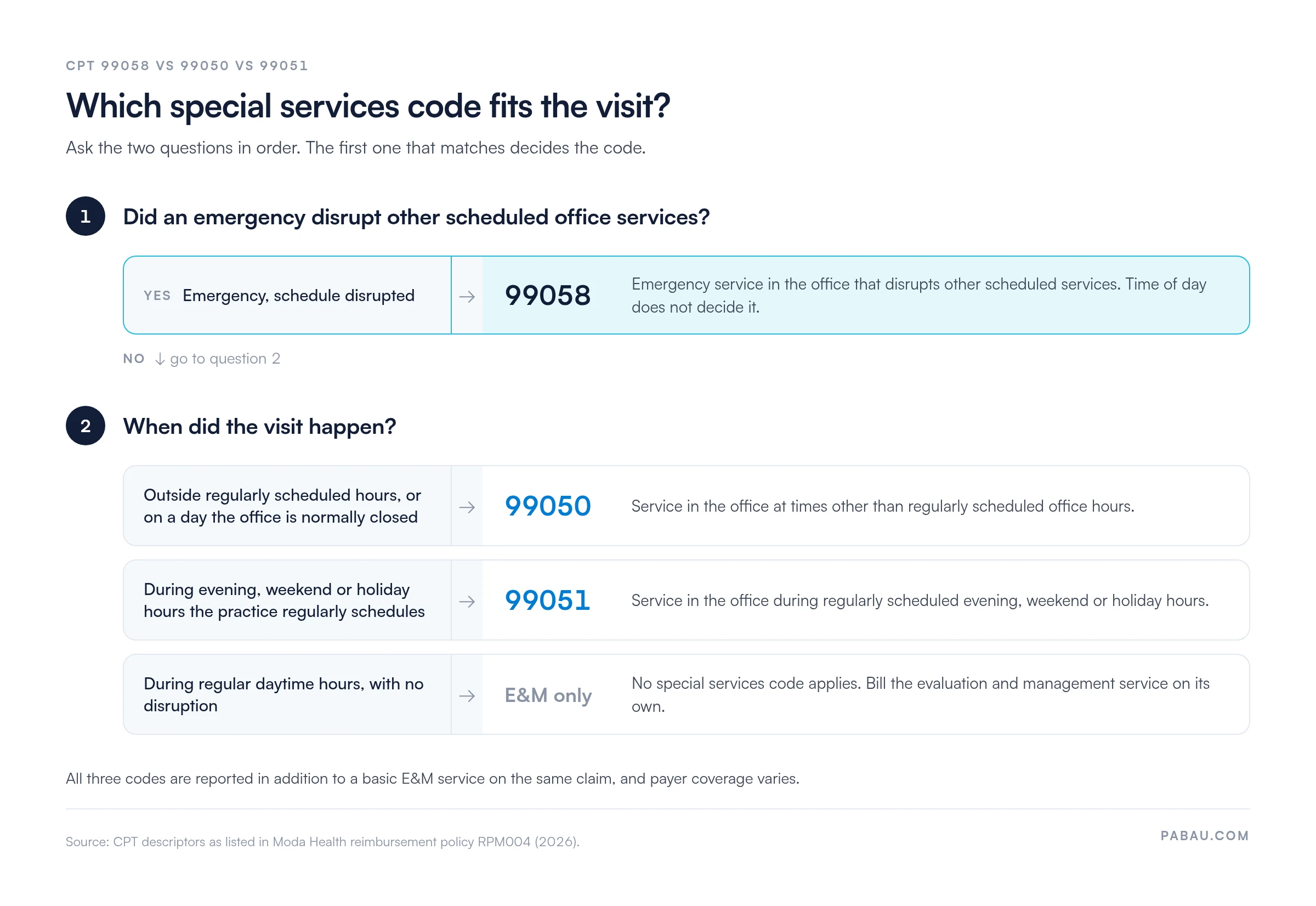
CPT does not limit 99058 to regular office hours. Time of day is what 99050 and 99051 describe, and 99058 turns on disruption instead. An emergency seen after hours qualifies for 99058 only if it disrupted services that were already scheduled.
Accurate reporting of 99058 follows a specific claim structure. These six steps reduce the risk of automated edits and manual review requests.
A complete superbill documentation entry for a 99058 visit lists both the primary E&M and 99058. The ICD-10 diagnosis code attaches to the E&M line.
Run a payer-specific eligibility check before the patient leaves. Knowing upfront whether the carrier covers 99058 lets front-desk staff set accurate financial expectations and avoids surprises at the remittance stage.
Three codes from the same Special Services group describe atypical office circumstances, and coders frequently conflate them. The choice turns on when the service happened and what made it atypical. The severity of the clinical encounter plays no part.
Take a patient who needs urgent attention at 7 p.m. If the practice does not regularly schedule evening hours, that visit is 99050. If the practice posts evening or weekend hours, the visit is 99051 instead. If a patient calls at 10 a.m. in acute distress and the physician drops a scheduled patient to see them, that is CPT code 99058. The two questions below settle the choice in order.
Documentation for CPT code 99058 must do two things. It establishes the emergency nature of the presentation, and it shows that other scheduled services were disrupted. A chart note that simply says “urgent visit” does not meet the standard most payers expect.
These elements should appear in the clinical record for every 99058 claim. Following medical billing compliance standards means capturing them at the point of care, not reconstructing them after a denial.
Practices with digital intake workflows can add a brief emergency-encounter checkbox to their clean claim submission process. The disruption statement is then recorded as it happens, instead of being rebuilt from memory at billing time.
Medicare does not separately reimburse CPT code 99058 under the Physician Fee Schedule. The CMS Physician Fee Schedule lookup tool lists 99058 with a status indicator that bundles its value into the primary E&M payment. A 99058 line sent to Medicare is denied as bundled. That denial reflects Medicare payment policy, so it is no sign of a coding error.
Commercial payer coverage follows a similar pattern for most carriers, though a minority of plans do reimburse 99058 at a nominal rate. Because payer policy changes annually, verify coverage through the individual carrier’s provider portal before assuming the code will pay.
Medicare treats 99058 as bundled, so its value is folded into the E&M payment. Payer or CMS claim edits then decide what happens to the 99058 line itself. Status indicators can change with each annual rule, so recheck the CMS fee schedule before submitting.
Denials for CPT code 99058 follow predictable patterns. Most can be corrected before the claim leaves the practice, using denial management workflows that catch missing documentation during charge entry.
Our reference on common billing denial codes covers the other codes that can appear on a 99058 remittance.
When a commercial payer that should cover 99058 sends a CO-97 denial, appeal within the payer’s timely filing window. Appeals succeed most often when the submission includes three things:
Submit through the payer’s designated appeal channel and keep a timestamped copy of the submission.
Audit your 99058 claims quarterly. Pull all remittances where this code was submitted and calculate the acceptance rate by payer. Carriers with consistent CO-97 denials should come off your 99058 billing list, so the team stops spending submissions on a code that never pays.
Several common scenarios lead coders to reach for 99058 when a different code, or no extra code at all, is appropriate. Misuse exposes the practice to audit risk even when claims are paid.
The documentation failures behind 99058 denials share one cause: The disruption statement never reaches the chart note. By the time billing staff enter charges the next morning, nobody remembers which booked patients were delayed.
Pabau, a practice management platform, ties charge entry to clinical documentation through its claims software for billers. Billers can see whether the chart note contains the emergency and disruption language before the claim goes out.
Claims that clear internal scrubbing go out through the Claim.MD clearinghouse, which connects to thousands of US payers and runs payer-specific edits first. CO-16 issues then surface at the scrubbing stage, not weeks later at remittance.
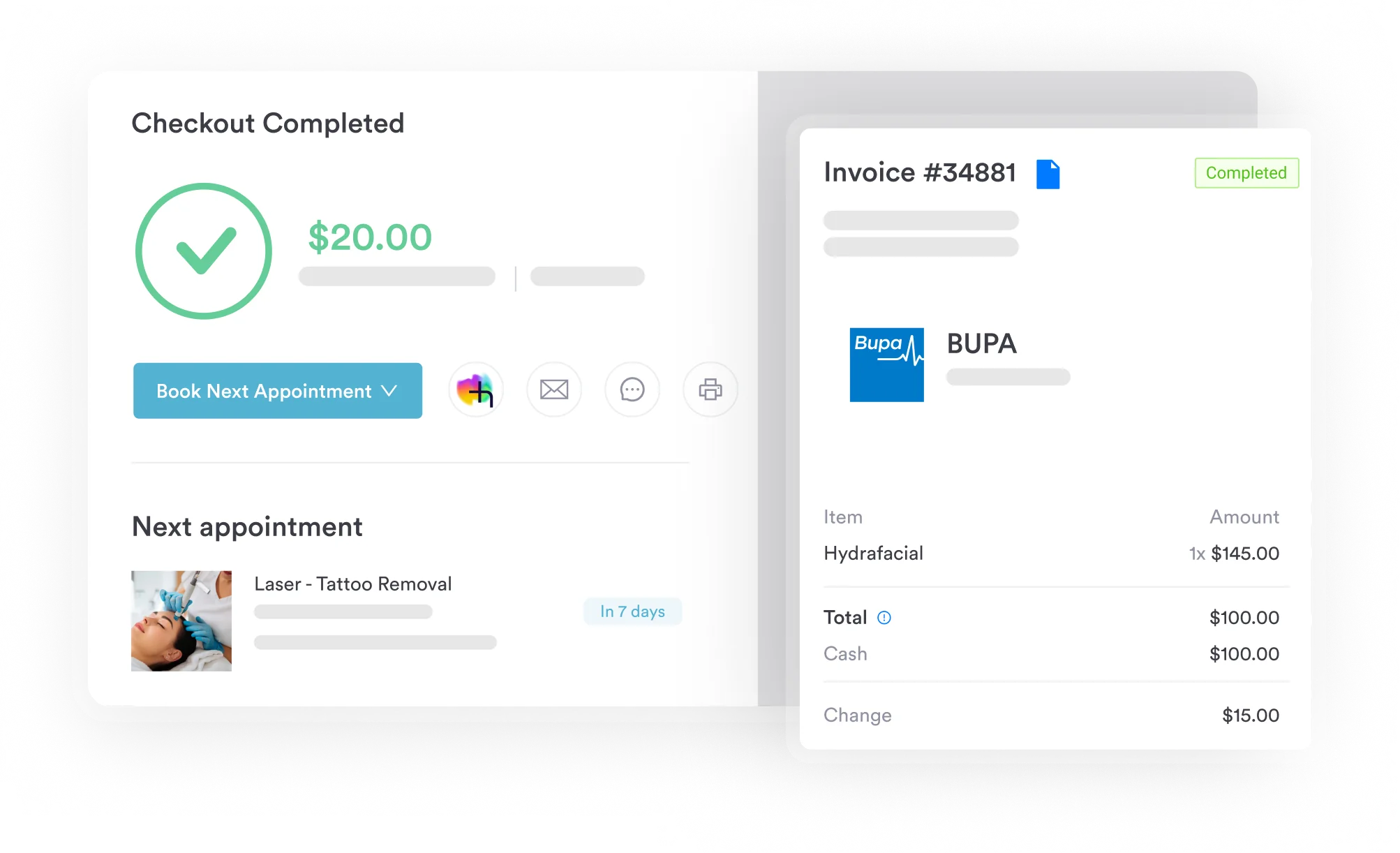

Pabau’s claims management software puts the chart note beside the charge line. Billers confirm the emergency and disruption statements before a 99058 claim reaches the payer.

CPT code 99058 pays only when three facts are on record. The visit was an emergency, it disrupted scheduled services, and a basic E&M service sits on the same claim. Medicare pays nothing extra for it, so the decision that matters is which commercial payers to send it to.
Move that decision out of the billing desk and into the visit. Capture the disruption statement while the clinician still remembers the delay. Keep a payer list based on your own remittances, and drop the code for carriers that deny it every time.
Book a demo to see how Pabau links the chart note to the 99058 claim line before it reaches the payer.

Billing a late-night visit at a 24-hour facility? CPT code 99053 covers services provided between 10:00 PM and 8:00 AM at a 24-hour facility.
Want to understand how the clearinghouse ecosystem works? Medical claims clearinghouse guide explains how clearinghouses route, scrub, and transmit claims between providers and payers.
Looking for the full list of denial codes that affect your billing? Electronic remittance advice (ERA) guide covers how to read ERA files and act on CARC/RARC denial reason codes efficiently.
CPT code 99058 covers service(s) provided on an emergency basis in the office that disrupt other scheduled office services. It is reported in addition to a basic evaluation and management (E&M) service and is not billed as a standalone service.
Bill CPT 99058 when a patient’s condition needs immediate attention and seeing them disrupts other scheduled office services. A typical case makes the clinician defer booked patients. It does not apply to routine same-day slots or unscheduled convenience visits.
No. Medicare does not separately reimburse CPT 99058 under the Physician Fee Schedule, and its value is bundled into the primary E&M payment. Most commercial payers also do not cover it, though a minority of plans pay a nominal rate. Verify individual payer policy before submitting.
CPT 99050 covers services in the office at times other than regularly scheduled office hours, or on days the office is normally closed. CPT 99058 covers an emergency in the office that disrupts other scheduled services, whatever the time of day. An after-hours visit qualifies for 99058 only if it disrupted services that were already scheduled.
The chart note must state the nature of the emergency and explain how it disrupted other scheduled services. It should record when the patient presented and include the treating clinician’s attestation. A note that says only “urgent visit” is insufficient for most payer audits.
CO-97 is the most common denial, because the service is bundled into the primary payment. CO-4 flags a modifier that is inconsistent with the procedure code, or a required modifier that is missing. CO-16 means the claim lacks information. Verifying payer coverage and recording the disruption at the point of care prevents most of them.
Yes. CPT code 99058 is always billed in addition to a basic E&M code on the same date of service. The E&M code (such as 99213 or 99214) goes on claim line 1. 99058 goes on a separate line below it, with the same date and place of service (POS 11).