

HCPCS code E0198: Water pressure pad billing guide
HCPCS code E0198 is a water pad for a standard mattress HCPCS code E0198 is the ...

Last Updated: Oct 13, 2026
99051 is the CPT code for service(s) provided in the office during regularly scheduled evening, weekend, or holiday office hours, in addition to basic service.
It is a supplemental code, so it rides on the primary E/M code and is never reported alone. Commercial payers that cover it allow roughly $15 to $35 per qualifying visit. The phrase "regularly scheduled" is the whole qualifier. An ad hoc Saturday appointment fails it, while a Saturday slot on the practice's published schedule every week passes.
Let Pabau's smart automation suggest the right codes, reduce claim denials, and keep your practice compliant—effortlessly.
Automate repetitive tasks and focus on what matters most—your patients.
Reduce coding errors and ensure compliance with the latest regulations.
Clean claims, fewer denials, and faster reimbursements.
Powerful insights and reporting to help your practice thrive.
HIPAA compliant SOC 2 certified GDPR-compliant Trusted by 4,000+ clinics worldwide

CPT Code 99051 is a supplemental code, billed alongside a primary E/M code and never on its own.
It applies only to regularly scheduled evening, weekend, or holiday hours, so an ad hoc after-hours visit fails the qualifier.
Medicare bundles 99051 into practice overhead. Commercial payers such as UnitedHealthcare and Horizon Blue Cross may allow $15 to $35.
Practice management software like Pabau can append 99051 automatically when a visit falls inside a defined time window.
CPT Code 99051 is classified by the American Medical Association under Miscellaneous Medicine Services.
Its official descriptor reads: “Service(s) provided in the office during regularly scheduled evening, weekend, or holiday office hours, in addition to basic service.” The phrase “in addition to basic service” is what makes it supplemental. 99051 is never reported alone, and it appends to whichever primary procedure or E/M code covered the clinical encounter.
The code exists because evening and weekend hours cost more to run than daytime hours. Extended staffing, utilities, and administrative time all sit outside what standard daytime rates cover. The AMA created 99051 so practices offering those hours consistently could recover that overhead through the billing system.
The hours that qualify depend on what the practice publicly schedules, not on a fixed federal clock. Most payers and coding references still apply a consistent working definition.
These hours must be part of the practice’s regular, published schedule. A practice that opens one Saturday for a patient’s convenience cannot bill 99051 for that visit. A practice with Saturday morning hours on its website, its front-door posting, and its scheduling system every week can.
Payer definitions of “evening” vary. UnitedHealthcare’s policy documents typically use 5:00 PM as the threshold, and some regional Medicaid programs use 7:00 PM. Verify the exact cutoff in your payer contracts before applying the code.
Three CPT codes cover after-hours or off-schedule service scenarios. Applying the wrong one either leaves money on the table or triggers a denial. Two questions separate them, and the diagram below runs through both in order.
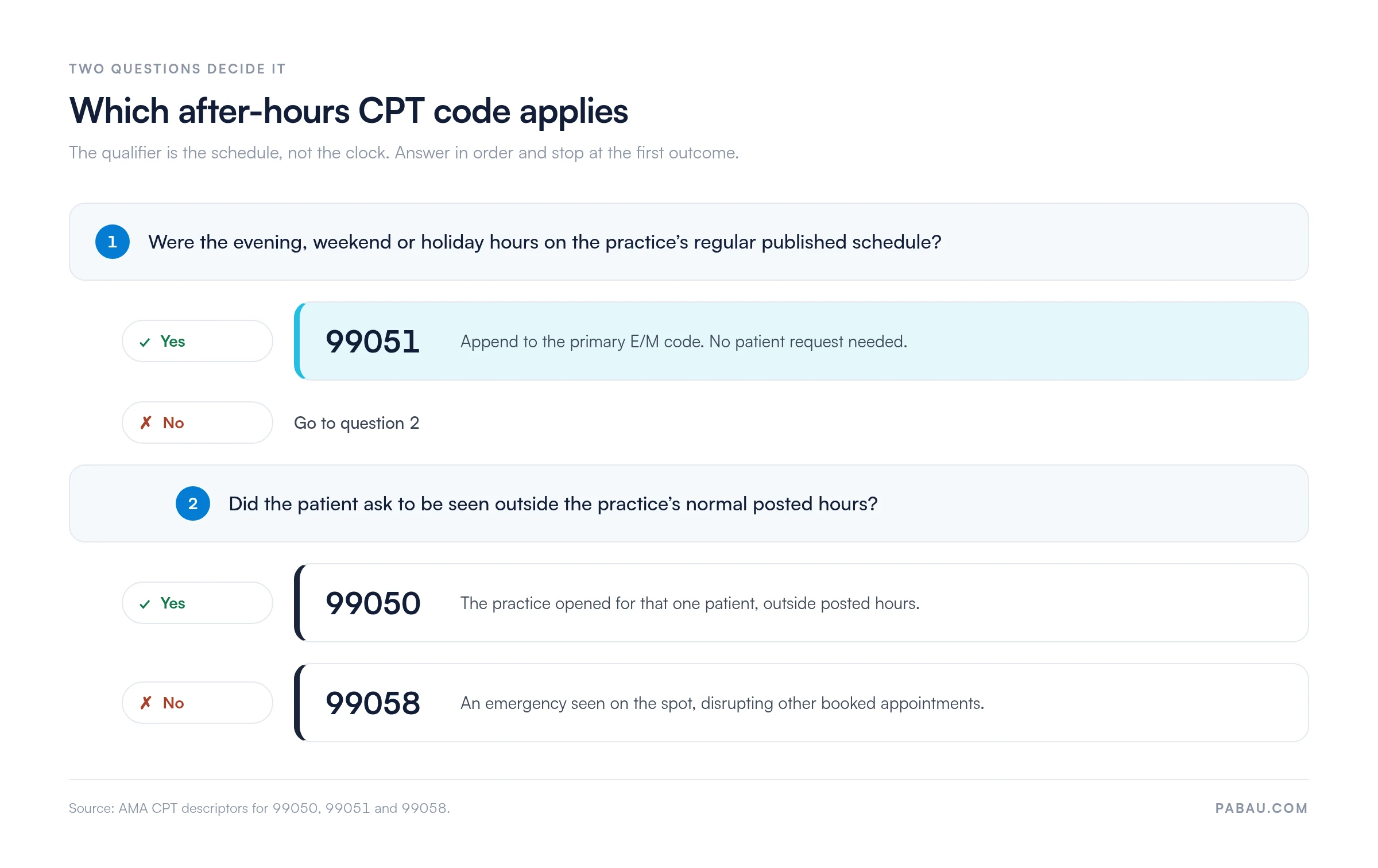
The table below sets the same three codes side by side, with the two conditions a payer checks on each one.
99050 in practice: a patient calls at 6:30 PM asking to be seen for an urgent issue. Your practice does not normally hold evening hours, and you accommodate the visit. That is 99050 territory, because the practice opened specifically for this patient outside its posted hours.
99058 in practice: a patient presents as an emergency mid-afternoon and you disrupt a full appointment schedule to accommodate them. That schedule disruption is what 99058 covers. Time of day plays no part in it.
Billing 99051 correctly requires four verifiable conditions, each of which a payer auditor or denial reviewer will check. Work through them in order on every qualifying visit.
Run a monthly audit of all evening and weekend appointments in your scheduling system. Filter claims from those visits and check whether 99051 appears on each one. Practices new to this code often find that 15% to 25% of qualifying visits went out without it. That is missed revenue on claims that met every condition.
The claim and the medical record must each carry specific elements to support 99051. Missing any one of them gives the payer grounds to deny on insufficient documentation. What a clean claim for 99051 requires is spelled out in the AAPC’s CPT reference.
Some payers explicitly require that qualifying hours be publicly posted, so a schedule visible only in the internal system does not satisfy them. Add a notation to the claim that ties the appointment timestamp to the publicly posted schedule.
Medicare does not pay separately for CPT Code 99051, Medicaid coverage varies by state, and several commercial payers do reimburse it. Checking the payer before submission prevents unnecessary denials on a code that carries no clinical documentation standard of its own.
Medicare’s non-payment position is confirmed by the CMS Physician Fee Schedule lookup tool. Searching for 99051 returns a bundled status, meaning the code carries no separately payable RVU value. Submitting 99051 on a Medicare claim adds no payment and may trigger a flag for billing review, depending on the MAC.
Where commercial payers do reimburse CPT Code 99051 separately, typical allowed amounts run from roughly $15 to $35 as an add-on to the primary service. Treat those figures as estimates. Actual allowed amounts depend on geographic locality, specialty, and individual payer contract terms, so verify current rates before you forecast revenue.
Take $20 as the average allowed amount per qualifying visit. A primary care practice seeing 30 evening or weekend patients a week captures roughly $31,200 a year from 99051 alone. That assumes commercial payer coverage applies and the code is appended consistently. Where a practice captures far less, the usual reason is that nothing in the billing workflow adds the code. Use a fee schedule verification tool such as the FastRVU 2026 RVU lookup to check current values and geographic modifiers for your locality.
Most 99051 denials fall into a small number of categories, and each one has a specific corrective action. The denial codes returned on the remittance advice tell you which category applies before you start drafting an appeal.
Mental health, primary care, OB/GYN and allied health practices bill 99051 most often. Each of them publishes evening or weekend hours as a competitive differentiator. The code is worth least to a practice that keeps standard daytime hours all year.
Appending 99051 is a manual step at the point of billing, and that is where the revenue goes. When a biller processes 40 claims in one session, a supplemental code on a qualifying visit is easy to pass over. Practice management software removes the manual step by encoding the rule at the scheduling level instead.
Pabau’s claims management software can be configured around your defined evening, weekend, and holiday slots. Any appointment booked into one of them generates a claim with 99051 already appended to the primary code. The time-window rule is set once in the system configuration, and every qualifying appointment after that carries the code without anyone keying it in.
That also leaves an audit-ready record. The appointment timestamp, the published time-window configuration, and the appended code are all logged in one system. That is exactly what a payer asks for when it questions whether the hours were regularly scheduled.
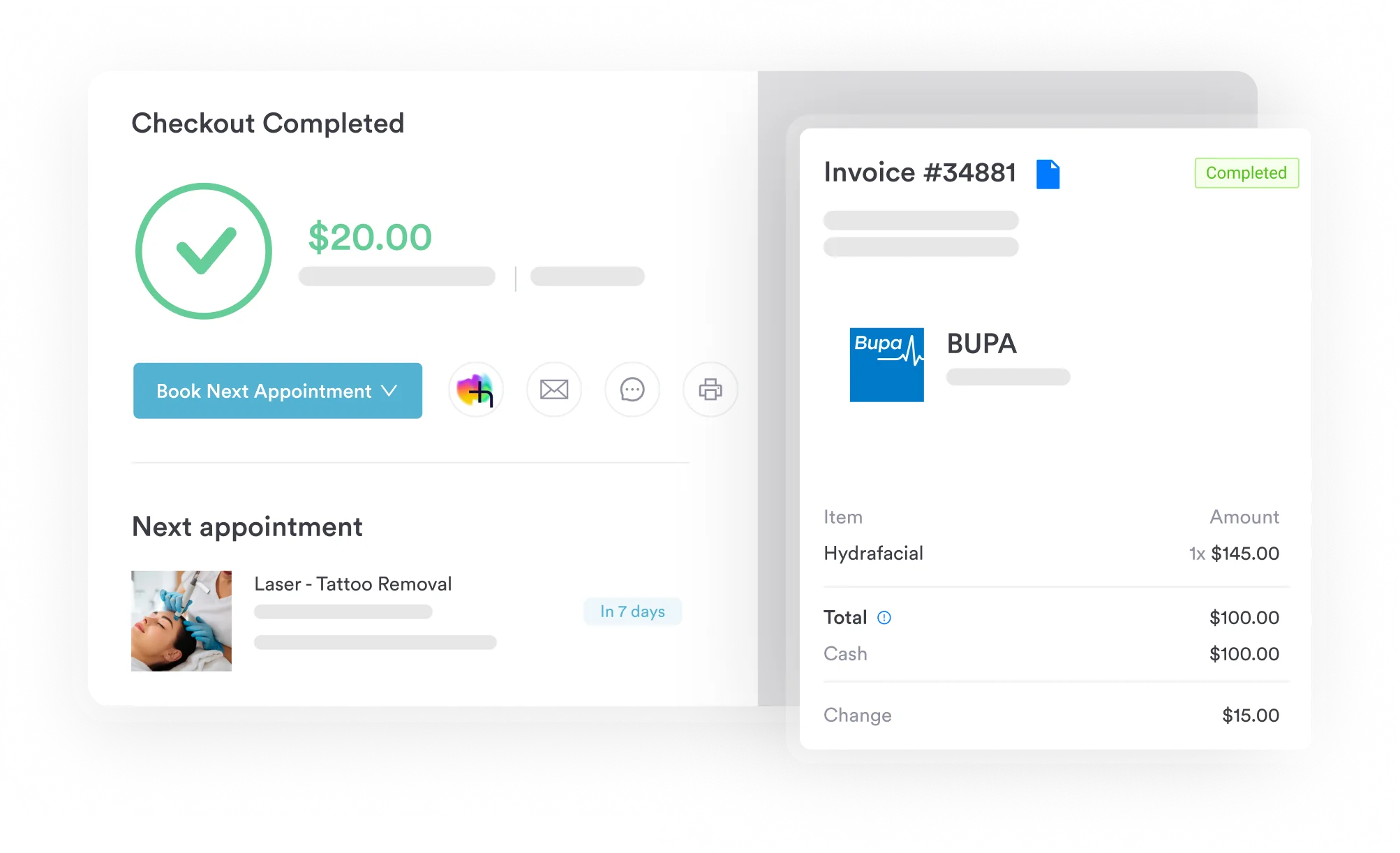
Claims submitted through Pabau are validated against payer-specific rules before transmission, which covers both the primary and the supplemental code. A payer that does not cover 99051 is caught before the claim leaves the practice, so the denial never ages into a write-off.

Pabau’s claims management software lets you configure time-window rules for your evening, weekend, and holiday hours. Supplemental codes like 99051 are appended automatically, with no manual entry and no missed revenue.

Build a payer matrix before you enable automated 99051 appending. List every payer in your mix and confirm which ones cover the code, and at what rate. Then configure the system to suppress 99051 on Medicare and non-covering Medicaid claims. Automating the append without the payer filter generates preventable denials.
CPT Code 99051 is straightforward in concept and consistently underbilled in practice. The qualifying logic is simple: regularly scheduled hours, appended to a primary code, with documentation tying the appointment timestamp to the published schedule. The revenue loss from skipping it compounds across every qualifying visit in the week.
The decision worth making now is whether the code lives in your workflow or in someone’s memory. A practice that offers evening or weekend hours and appends 99051 by hand will keep losing some of it, however diligent the billing team is. Automating the append at the scheduling level is what makes the capture rate stop depending on attention. Book a demo to see how Pabau configures time-window billing rules for after-hours claims.

List Item #1
List Item #2
CPT Code 99051 is a supplemental code that covers services provided in the office during regularly scheduled evening, weekend, or holiday hours. It is billed in addition to the primary service code, and it compensates practices for the overhead of maintaining those extended hours.
CPT 99051 applies when a practice regularly schedules evening, weekend, or holiday hours. CPT 99050 applies when a practice sees a patient outside its normal posted hours at the patient’s request. The distinction is whether those hours are part of the routine schedule or an ad hoc accommodation for one patient.
No. Medicare does not separately reimburse CPT Code 99051 under the Physician Fee Schedule. CMS treats the after-hours overhead as bundled into the practice expense component of the primary service code. Submitting 99051 on a Medicare claim results in a bundled denial, so do not bill this code to Medicare.
Most payers define qualifying hours as Monday through Friday after 5:00 PM, plus all hours on Saturday, Sunday, and federal holidays. Those hours must be part of the practice’s regularly published schedule. Some payers use a later evening cutoff of 7:00 PM, so verify the threshold in your payer contracts.
Four reasons account for most 99051 denials. The first is Medicare or non-covering Medicaid status. The second is hours the payer did not accept as regularly scheduled. The third is 99051 submitted without a primary E/M code, and the fourth is a payer contract that excludes it. Each type has its own corrective action, from removing the code on Medicare claims to appealing with published schedule evidence.
Coverage is payer-specific and contract-dependent. UnitedHealthcare and Horizon Blue Cross Blue Shield have published after-hours reimbursement policies that may allow payment, and other commercial payers vary. Medicare does not pay separately. Verify 99051 coverage directly with each payer before you bill the code routinely.



