



CCSD code G5100: Bypass of duodenum billing guide
CCSD code G5100 bills a bypass that leaves the duodenum in place CCSD code G5100...

Last Updated: Oct 16, 2026

CPT code 99053 applies only to services provided between 10:00 PM and 8:00 AM at a 24-hour facility.
Medicare assigns 99053 status indicator B nationwide, so it is always bundled and never paid separately in any jurisdiction.
Services on days the office is normally closed, such as a Saturday, Sunday, or holiday, belong to 99050.
As an add-on code, 99053 always accompanies a base E/M or procedure code and never stands alone on a claim.
Pabau’s claims management software pre-fills the claim form from the patient record and checks required fields before submission.
CPT code 99053 is the after-hours add-on code for services delivered between 10:00 PM and 8:00 AM at a 24-hour facility. Both conditions have to hold at once. An office that closes for the night does not qualify, however late the visit ran.
One fact then shapes the billing. Medicare bundles 99053 into the base service nationwide and never pays it separately, so the code only earns money inside a commercial contract. Appending it to every overnight claim burns staff hours and collects no extra payment.
So the work splits in two. First prove the encounter qualifies, then find out which of your payers list the code.
The current American Medical Association (AMA) descriptor reads: “Service(s) provided between 10:00 PM and 8:00 AM at 24-hour facility, in addition to basic service.” That is the whole scope. There is no second scenario.
Two conditions have to hold at the same time. The encounter falls inside the 10:00 PM to 8:00 AM window, and it happens at a facility that operates 24 hours. Miss either one and the code does not apply.
CPT groups 99053 with the special services, procedures, and reports codes in the medicine section. Three features decide how it behaves on a claim:
The defensible reading is a site staffed and open to patients around the clock. CPT does not define the term inside the descriptor, and that silence drives a share of 99053 denials. Payers read it in different ways.
A hospital emergency department, a freestanding 24-hour urgent care center, and a 24-hour ambulatory facility all fit. An office with published closing hours does not.
Picture a pediatric practice that keeps a physician on site until 1:00 AM during flu season. The hours are brutal, but the site still closes, so 99053 is off the table.
Before you bill 99053 to a commercial payer, ask for the payer’s definition in writing and file it with your billing policies. If your site closes at any point in the day, look at 99050 or 99051 instead.
Two questions settle the choice, and the order matters. Ask about the site first, because it rules out 99053 faster than the clock time does.
Only one of the three codes can apply to any single encounter.
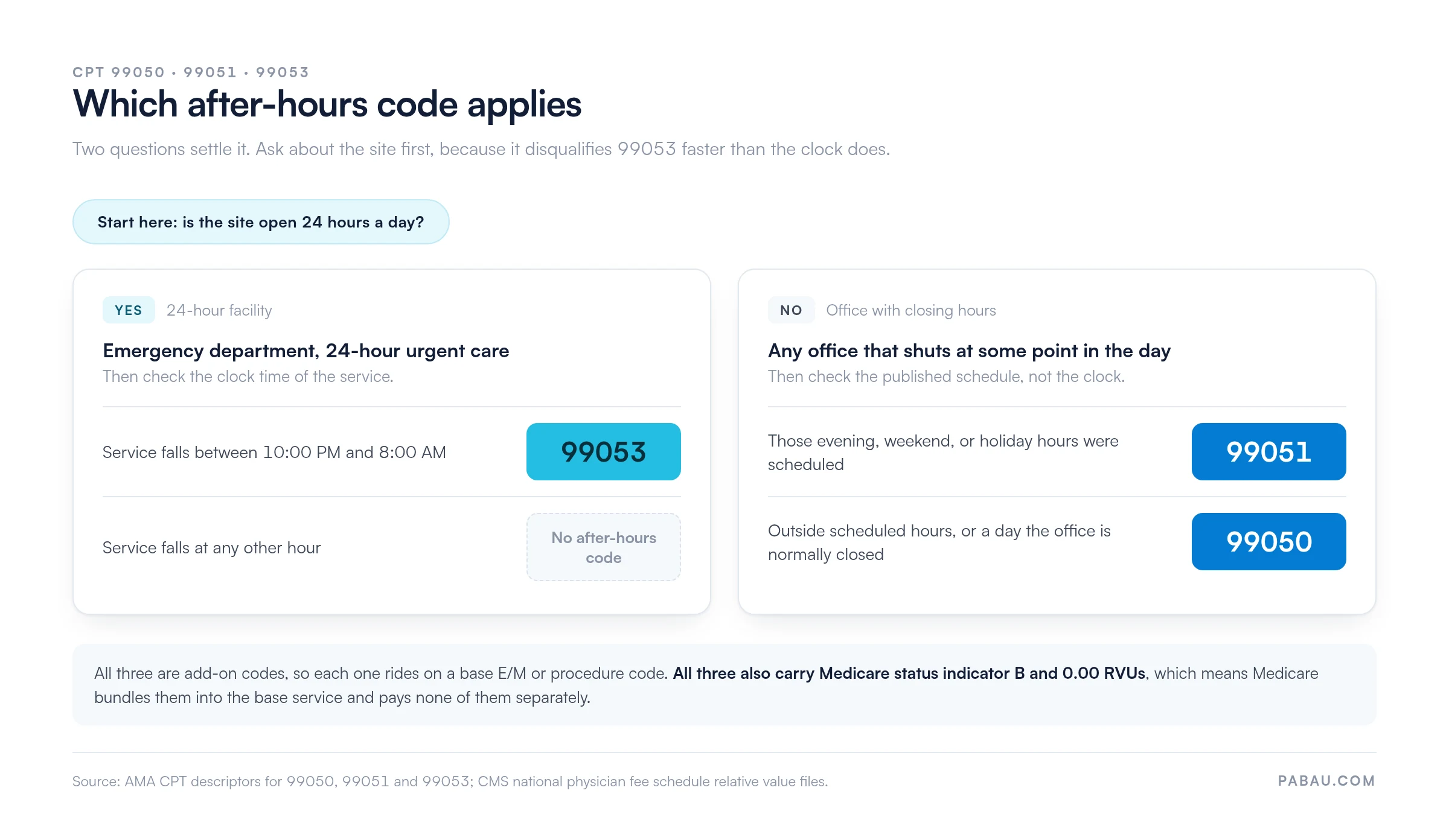
The table below carries the full descriptors, so you can match your own setting against the wording a payer will read.
Each descriptor above is quoted from CPT with its closing phrase removed. All three end with “in addition to basic service”, which is what makes them add-on codes.
Take a worked case. An urgent care center that closes at 10:00 PM sees a patient at 11:00 PM. The clock looks right for 99053, but the site is not a 24-hour facility, so the correct code is 99050.
Note what the 99051 row does not say. The “5:00 PM to 10:00 PM weekdays” and “9:00 AM to 1:00 PM Saturdays” figures circulate widely in billing guidance. They are a consultant convention, not AMA text. CPT attaches no clock hours to 99051.
Plenty of billing guidance still describes 99053 as the code for Sundays, holidays, and any late-night visit. That guidance is two decades out of date.
CPT once carried two separate codes for exactly that ground. Code 99052 covered services between 10:00 PM and 8:00 AM with no facility requirement at all. Sundays and holidays had their own code in 99054.
AMA deleted both in the 2006 CPT code set, and 99050 absorbed the ground they used to cover. So anything that assigns Sunday, holiday, or non-facility overnight services to 99053 predates that change, or copied a source that did.
Three more codes in the same CPT family describe disrupted or off-site work. They sit close enough to the after-hours set to get mixed up with it:
All three carry the same Medicare status as 99053. They are bundled nationally, so they only matter in commercial and self-pay contexts.
No jurisdiction pays it, and this is the most misreported fact about the code. CMS assigns 99053 status indicator B on the National Physician Fee Schedule. Status B means the code is bundled, so payment for it is subsumed by payment for the service it accompanies.
The status indicator is a single national field, which no Medicare Administrative Contractor can change locally. Relative value units say the same thing.
Work, practice expense, and malpractice RVUs for 99053 are all 0.00 in the CMS relative value files, and have been for years. There is no geographic adjustment to apply to zero.
Reporting 99053 on a Medicare claim is not a compliance problem. Some practices include the line so overnight volume stays visible in their own reporting. It will not add a dollar to the remittance, and appealing the bundling is wasted effort.
You can confirm any of this yourself in the CMS Physician Fee Schedule lookup. Search 99053, and the status indicator and zeroed RVUs come back the same for every locality.
With Medicare settled, the question becomes which of your remaining payers recognize the code. Medicaid follows the state fee schedule, and commercial plans follow whatever the contract happens to say.
The order of work is straightforward. Pull your top commercial contracts, search each fee schedule for 99053, and mark the ones where it does not appear. That list becomes your negotiation queue.
Then check what the payers on the other list allow. The remittance advice on paid claims carries the allowed amount, which is more reliable than a contract summary.
Run a 90-day look-back on encounters between 10:00 PM and 8:00 AM at your 24-hour site, then split the list by payer. The Medicare and Medicare Advantage share is revenue you will never collect on 99053, whatever you do. The commercial share is the number your negotiation case rests on, and it is usually far smaller than practices expect. Sizing it first stops you building a workflow around a code that cannot pay for most of your volume.
The record has to support the add-on independently of the base E/M note. Reviewers are not looking for clinical detail here. They want proof of the hour and proof of the site. That bar is much easier to clear when the system captures both by default.
The record should carry all of the following:
Practices on electronic health records should set the scheduling and billing templates to capture service time automatically. Manual entry of encounter times is where most of these records go wrong.
Audit your scheduling configuration before you audit your claims. Many systems can stamp the service time onto the encounter record without anyone typing it. If yours cannot, make clock time a required field at check-in. That single change satisfies the hardest 99053 documentation requirement for every overnight encounter, permanently.
The sequence below is ordered to fail fast. Both screens that can disqualify the code come first, so nobody spends time on a line that was never billable.
A clean claim on an add-on code means both screens pass before the line ever leaves the practice.
Most rejections on this code are caught in under a minute. Work down the list before you hit send:
Five noes are five different fixes. A missing service time is a documentation problem you can fix tonight. But a payer that never listed the code has a contract problem, and no rework changes that.
CPT assigns no required modifier to 99053, and no national Medicare policy attaches one either. Most modifier trouble on these claims comes from putting a modifier in the wrong place.
Three questions come up again and again:
A few commercial payers do publish their own modifier requirement for after-hours codes, written into the contract or the billing policy.
If a payer denies 99053 for a missing modifier, ask for the written policy that names it. A verbal instruction from a phone representative will not survive a later audit.
These denials follow predictable patterns, which makes them cheap to prevent. The denial codes that show up on a 99053 remittance fall into a short list, and each one has a standard fix.
Only commercial denials are worth the paperwork. The American College of Emergency Physicians (ACEP) publishes a short FAQ on 99053. It confirms the code’s emergency department use and the Medicare bundling, so it is worth citing in your own letter.
Where a commercial payer has left 99053 off the fee schedule, contract negotiation is the only route to payment. That case matters most to 24-hour urgent care centers and ambulatory facilities carrying steady overnight volume.
Practical steps for the negotiation:
Checking eligibility ahead of each encounter also tells you which plan a patient is on before the visit closes. That is the difference between billing the add-on where it pays and billing it everywhere.
Manual add-on coding is where overnight capture breaks down. A biller working through 30 encounters from the previous night checks each service time and confirms the payer. They also have to remember which contracts list 99053 at all.
Pabau’s claims management software takes the retyping out of that loop. The claim form pre-fills from the patient record, so the CPT code already attached to the service lands on the charge line. ICD-10 slots come seeded from the recorded problem list.
Required-field checks then run before the claim can go out. Membership numbers, authorization codes, and other payer-required fields have to be complete before the send button unlocks. That stops a class of avoidable rejections at the door.
US practices submit through Claim.MD, Pabau’s clearinghouse partner. It also returns live eligibility responses, claim statuses, and remittance advice into the same dashboard. So the after-hours line and its base code travel together on one claim, and you see what the payer did with both.

Pabau’s claims management software pre-fills the claim form from the patient record and checks that every payer-required field is complete. In the US it submits through Claim.MD, so a base code and its after-hours add-on leave the practice on one claim.

CPT code 99053 is narrower than most billing guidance suggests, and knowing that saves more money than billing it does. Appending the code to every late-night encounter costs staff hours. Appealing Medicare bundling denials costs more, and neither one can pay.
Where the code does earn, it earns through the contract. So confirm the site operates 24 hours, capture the service time on the record, and find out which commercial payers list 99053. Then take your overnight volume to the ones that do not.
The record is the part you control every night. If service times and payer fields land on the claim without anyone retyping them, book a demo to see how Pabau handles that step.

Want the wider Medicare picture behind the bundling rule? Medicare billing guide explains status indicators, fee schedules, and what actually reaches the remittance.
Need to understand how clearinghouse submissions work? 837 file submission guide explains the electronic claim format that transmits 99053 and every other CPT code to payers.
Not sure how to read the response on a bundled line? Electronic remittance advice explained shows where allowed amounts and bundling messages appear.
Working a queue of after-hours denials? Denial management in healthcare covers the workflow for triaging, appealing, and preventing repeat denials.
Want to reduce claim rejections before submission? Best medical billing software options for US practices compares platforms by claim accuracy and clearinghouse integration.
Yes. AMA deleted 99052 and 99054 in 2006, but 99053 remains in the current CPT code set. Check the descriptor in each year’s CPT book before you bill it.
Once. The code attaches to one base service per qualifying encounter, and it is not reported per hour or per unit. A second overnight visit on the same date needs its own base code.
Use the place of service on the base service line. An emergency room visit is POS 23, and a 24-hour urgent care center is POS 20. CPT ties no place of service to the add-on itself.
Yes, where the payer credentials that clinician for the base service. The add-on follows the billing provider on the base line. State scope rules and payer enrollment still decide who may report it.
CPT does not address telehealth in the 99053 descriptor, and CMS does not list the code as a payable telehealth service. Check each commercial payer’s telehealth policy before appending it to a virtual encounter.



