



CCSD code G5100: Bypass of duodenum billing guide
CCSD code G5100 bills a bypass that leaves the duodenum in place CCSD code G5100...

Last Updated: Oct 16, 2026

CPT code 98960 covers 30 minutes of individual patient self-management education, taught by a qualified nonphysician professional from a standardized curriculum.
Medicare never pays 98960 separately, because CMS assigns the code status indicator B and treats the service as bundled.
Medicare diabetes training bills as HCPCS G0108 or G0109, and the 10-hour initial benefit belongs to those codes rather than 98960.
Commercial plans do pay 98960, usually $30 to $55 per 30-minute unit, and they audit the curriculum name first.
Head count picks the code, so 98961 covers 2 to 4 patients per session and 98962 covers 5 to 8.
CPT code 98960 covers 30 minutes of individual patient self-management education, taught from a standardized curriculum by a qualified nonphysician professional.
Commercial plans do pay 98960, usually $30 to $55 per 30-minute unit. Send it to the wrong payer and you write off the session. From there, payment turns on an eligible provider, a named curriculum, and a diagnosis that supports the visit. Let’s start with what the descriptor says.
The American Medical Association descriptor reads, “Education and training for patient self-management by a qualified, nonphysician health care professional using a standardized curriculum.” It then adds, “face-to-face with the patient (could include caregiver/family) each 30 minutes; individual patient.”
Each of those clauses decides something on the claim.
Four elements have to be true before a 98960 claim survives an audit. The provider must be a qualified nonphysician health care professional.
The session must follow a recognized, standardized curriculum rather than an improvised talk. It must run face-to-face with one patient, which is what separates 98960 from its group siblings.
The time must be documented, because “each 30 minutes” makes this a timed code.
That time unit is where practices quietly lose money. A 30-minute session is one unit, and a 60-minute session is two. Record start and stop times rather than a rounded total. Then check the payer’s rule on a partial final unit before you bill it.
A physician cannot bill CPT code 98960 under any circumstance, whatever the session covered. The code belongs to allied health professionals and specialized educators. State licensure has to authorize the service as well, so eligibility shifts by jurisdiction.
Scope of practice laws differ by state. A pharmacist billing 98960 in one state may lack the licensure to do it in another. Check that the provider’s state license covers patient self-management education before the claim goes out.
Eligibility here is a commercial-payer question. Because Medicare bundles 98960, nobody on that list can bill the code to Medicare and expect payment.
For Medicare diabetes training, the educator works under an accredited diabetes self-management training program and the claim carries G0108 or G0109.
Diabetes self-management education and support, known as DSMES, is the primary use for CPT code 98960.
Payers and the AMA also recognize the code for other standardized programs. The program has to target a diagnosable condition and meet accreditation standards.
The standardized curriculum requirement is not flexible. Informal one-on-one counseling, ad hoc education conversations, and unaccredited programs all fall short of 98960. Teaching a patient to use remote therapeutic monitoring equipment also falls outside 98960, and is reported once per episode under CPT code 98975.
Payers audit the line between structured education and incidental counseling harder than any other element.
The 98960 family covers one service across three group sizes. 98960 is one patient, 98961 is 2 to 4 patients, and 98962 is 5 to 8. Picking the wrong code for the head count is the most common error in the family.
All three share the same curriculum and provider rules, so only the number of patients present changes. A session that starts with one patient and gains a second becomes 98961, so document the head count every time.
Nothing in the family covers a group larger than eight. A nine-person class gets split, or it runs under a different program code.
Payer type and head count together settle the code, and the routing below is the whole decision.
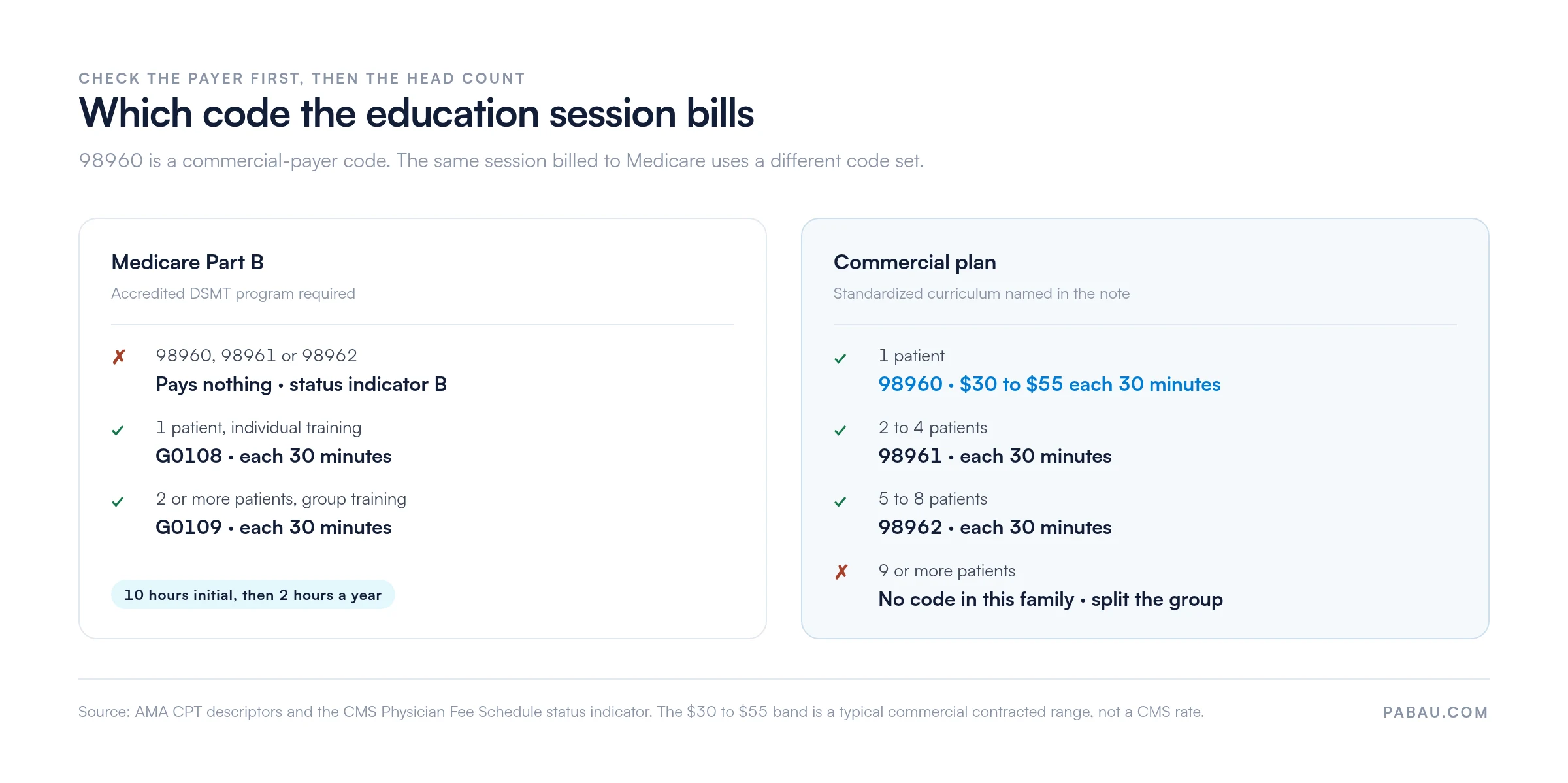
None of the three pays on a Medicare claim. Group diabetes training goes out on G0109 and individual training on G0108, both timed in 30-minute units.
Every 98960 claim needs a supporting ICD-10 code that establishes medical necessity. Missing or mismatched diagnosis codes are a leading denial trigger. The pairings below come up most often.
Use the most specific code available. E11.9 is acceptable, but E11.65 for type 2 diabetes with hyperglycemia carries more clinical detail and draws fewer medical necessity reviews. When one session addresses several chronic conditions, list every relevant diagnosis on the claim.
Medicare does not pay CPT code 98960 separately, in any place of service. CMS lists the code on the National Physician Fee Schedule with status indicator B, which means bundled.
A bundled code carries no separately payable RVUs. So there is no fee schedule amount to look up, and no locality adjustment to run. Codes 98961 and 98962 carry the same status.
You can confirm it yourself in a minute. Search 98960 in the CMS Physician Fee Schedule lookup and the tool returns the status indicator instead of a dollar figure. Repeat that check each year, before anyone builds a fee schedule around the code.
Medicare covers diabetes self-management training through two HCPCS codes instead. G0108 reports individual training, per 30 minutes. G0109 reports a group session of two or more people, also per 30 minutes.
Both are HCPCS codes rather than CPT codes, so they sit with the rest of the HCPCS code library.
Both G-codes also require an accredited program. That means current recognition from the American Diabetes Association, or accreditation from ADCES.
Both draw on the same benefit too. Medicare allows up to 10 hours of initial training in a continuous 12-month period, then 2 hours of follow-up training each year after that. The cap belongs to G0108 and G0109, not to 98960, whatever other billing guides attach it to.
Commercial plans are where 98960 gets paid. UnitedHealthcare, Blue Cross Blue Shield, Cigna, and Aetna plans are the ones that typically reimburse it.
Contracted rates generally land between $30 and $55 per 30-minute unit. That band comes from commercial contracts rather than from CMS, so your own agreement sets the number.
Check benefits before the session and confirm which code the plan wants.
Before you bill any diabetes training to Medicare, confirm your program’s recognition or accreditation is current. G0108 and G0109 both depend on it, and Medicare denies the claim once the status lapses, even when the educator is fully credentialed. Put the renewal date on the compliance calendar and check it every year.
Incomplete documentation denies more 98960 claims than any coding error does. Capture every billable element at the time of service, rather than reconstructing it after the denial notice lands.
The elements below belong in the record for each session:
Post-payment auditors go looking for two of those elements first. They want the curriculum name and the patient response. A note reading “diabetic education provided, 60 minutes” fails both. Specificity in the record is what separates a clean claim from a repayment demand.
No modifier makes Medicare pay a bundled code, so read the list below as commercial-payer housekeeping. Modifier choice depends on the payer, the place of service, and the provider type.
Append the wrong one, or leave out a required one, and the clearinghouse rejects the claim before a human sees it.
Telehealth for 98960 is a commercial question, not a Medicare one. Because Medicare bundles the code, no update to the CMS telehealth list makes it payable. Some commercial plans do reimburse live video education, and a Medicare Advantage plan may add benefits original Medicare does not carry.
Ask the plan for its policy in writing before you deliver a session by video. Confirm the place of service code it expects at the same time.
Same-day billing of 98960 with an evaluation and management (E/M) code is allowed. The two services have to be distinct, and the note has to show it.
The National Correct Coding Initiative, known as NCCI, governs which pairs may appear on one date. Its edits for this family update quarterly. Check the current tables on the CMS website before you assume a combination is fine.
Knowing the rules is one job. Seeing where a claim stalls is what brings a denial rate down. Below is the path a 98960 claim takes, and what can stop it at each step.
Take a worked example. A registered dietitian runs a 75-minute individual DSMES session for a patient on a commercial plan, diagnosis E11.65.
The coder bills two units of 98960 for the first 60 minutes. The last 15 minutes only bill as a third unit where that plan pays partial units. So the note records 9:05 to 10:20, not “about 75 minutes.”
Most 98960 denials come from a short list, and each one has a fix that sits upstream of the claim. Good denial management in healthcare starts with the cause rather than the resubmission.
Run a monthly denial rate report filtered to CPT 98960 claims. If one payer denies more than 5 percent of them, pull that plan’s published medical policy for self-management education. Some plans cover diabetes education under the code but not asthma or hypertension education, and the policy says so in writing.
One pass through the list below catches most of what the previous section describes. Print it, or build it into the claim scrub.
Running that list by hand on every claim is where it breaks down, especially when one coder owns all of it.
Manual code lookup, disconnected notes, and spreadsheet denial tracking bring back the same errors the rules above are meant to prevent. Practice management software like Pabau runs the repetitive checks, so one coder is not the last line of defense.
Pabau’s claims management software carries CPT and ICD-10 lookup libraries, plus required-field validation before a claim is submitted. Coders search the libraries directly, and validation catches a missing field before the claim leaves.
Practices that bill 98960 regularly can also build a documentation template for the session. That template can make the curriculum name, the clock times, and the patient response required fields.
Submission runs through the Claim.MD clearinghouse for CMS-1500 and 837P claims, across thousands of US payers. Electronic remittance advice posts back automatically, and denied claims are flagged for rework instead of sitting in an inbox.
None of that removes the payer-by-payer judgment this code demands. It does keep the note, the claim, and the remittance in one system. A billing team is then not reconciling three tools to work out what happened.

Pabau’s claims management tools include CPT and ICD-10 lookup libraries, documentation templates, and Claim.MD submission. See how practices billing patient self-management education keep the note, the claim, and the remittance in one place.

Decide the payer question before the session, not after it. Medicare patients belong on G0108 or G0109, and commercial patients on 98960 through 98962 by head count. Get that call right and the remaining checks are routine paperwork.
The curriculum name and the clock times are what an auditor asks for, so make them required fields rather than habits. Pabau can enforce that in the note and track the claim after it leaves.
Book a demo to see how a billing team keeps 98960 claims moving without chasing paperwork after the denial.

Need to know how a claim reaches the payer? Medical claims clearinghouse guide explains the routing between practice, clearinghouse, and payer.
Tracking denials across several payers? Electronic remittance advice guide covers how ERA files return denial codes and payment detail.
Want fewer claims coming back at all? Clean claim guide sets out what a payer needs on first submission.
Building the documentation side from scratch? Superbill guide covers the components that support a clean CPT claim in any specialty.
Worried about an audit rather than a denial? Medical billing compliance guide covers the standards payers and regulators expect a record to meet.
The session is timed with the patient, not the caregiver. The descriptor lets family or a caregiver join, so their presence does not change the code or the units. Bill only the minutes the patient was there.
Yes, on different dates. A patient can take an individual session one week and join a small group the next. What you cannot do is report two codes from the family for the same patient on the same date.
It depends on the plan. Some commercial payers treat structured education as a covered benefit with no review, and others want authorization or a referral first. Check benefits before the first session, not after the third.
The eligible nonphysician professional reports 98960 under their own NPI. A physician cannot bill the code, and supervision does not change that. Confirm the payer has credentialed the educator before the first session.
A no-show is not billable, because the code requires face-to-face time. A short session may still bill one unit where the payer allows a partial final unit. Get that rule in writing, plan by plan.



