



CCSD code G5100: Bypass of duodenum billing guide
CCSD code G5100 bills a bypass that leaves the duodenum in place CCSD code G5100...

Last Updated: Oct 16, 2026

CPT code 97150 covers therapeutic procedures delivered to a group of two or more patients, and it is billed once per session.
Each patient in the group gets their own claim line for 97150, carrying one unit on that date of service.
Medicare claims need GP, GO or GN for the discipline, plus CQ or CO when an assistant furnished the session.
Missing supervision notation and thin group composition records are the two leading denial triggers for 97150 claims.
Practice management software like Pabau prompts the fields a group note needs, then builds the claim from what the note captured.
CPT code 97150 is the billable code for therapeutic procedures delivered to two or more patients at once by a single qualified provider. It sits in the Physical Medicine and Rehabilitation section, and it is reported per session rather than in 15-minute units.
This guide covers the official descriptor, who may bill the code, and the group size and supervision rules. It then works through documentation, Medicare modifiers, reimbursement, related codes, and the denials that follow a thin group note.
According to the American Medical Association (AMA), CPT codes in the 97000 series describe Physical Medicine and Rehabilitation services. Group and individual distinctions in that category carry significant reimbursement and compliance weight.
CPT code 97150 carries the official AMA descriptor: Therapeutic procedure(s), group (2 or more individuals). The code describes skilled therapeutic interventions delivered simultaneously to two or more patients by a single qualified provider. It is not a mental health group therapy code. It sits in the Physical Medicine and Rehabilitation section alongside 97110 (therapeutic exercise) and 97530 (therapeutic activities).
The billing distinction that matters most is that 97150 is not time-based. Individual therapeutic exercise codes are reported in 15-minute units. 97150 is reported once per session, however long the group runs. Each patient gets one claim line carrying one unit for that date of service.
Each patient in the group receives their own claim submission for 97150 on the same date of service. A group of four patients means four separate claim lines. Each is billed once, and each needs its own documentation in that patient’s medical record.
Under Medicare Part B, CMS recognizes a defined set of practitioners who may bill 97150. Scope of practice rules vary by state, so confirm eligibility against your state licensing laws before billing. That matters most for providers who are neither physical therapists nor occupational therapists.
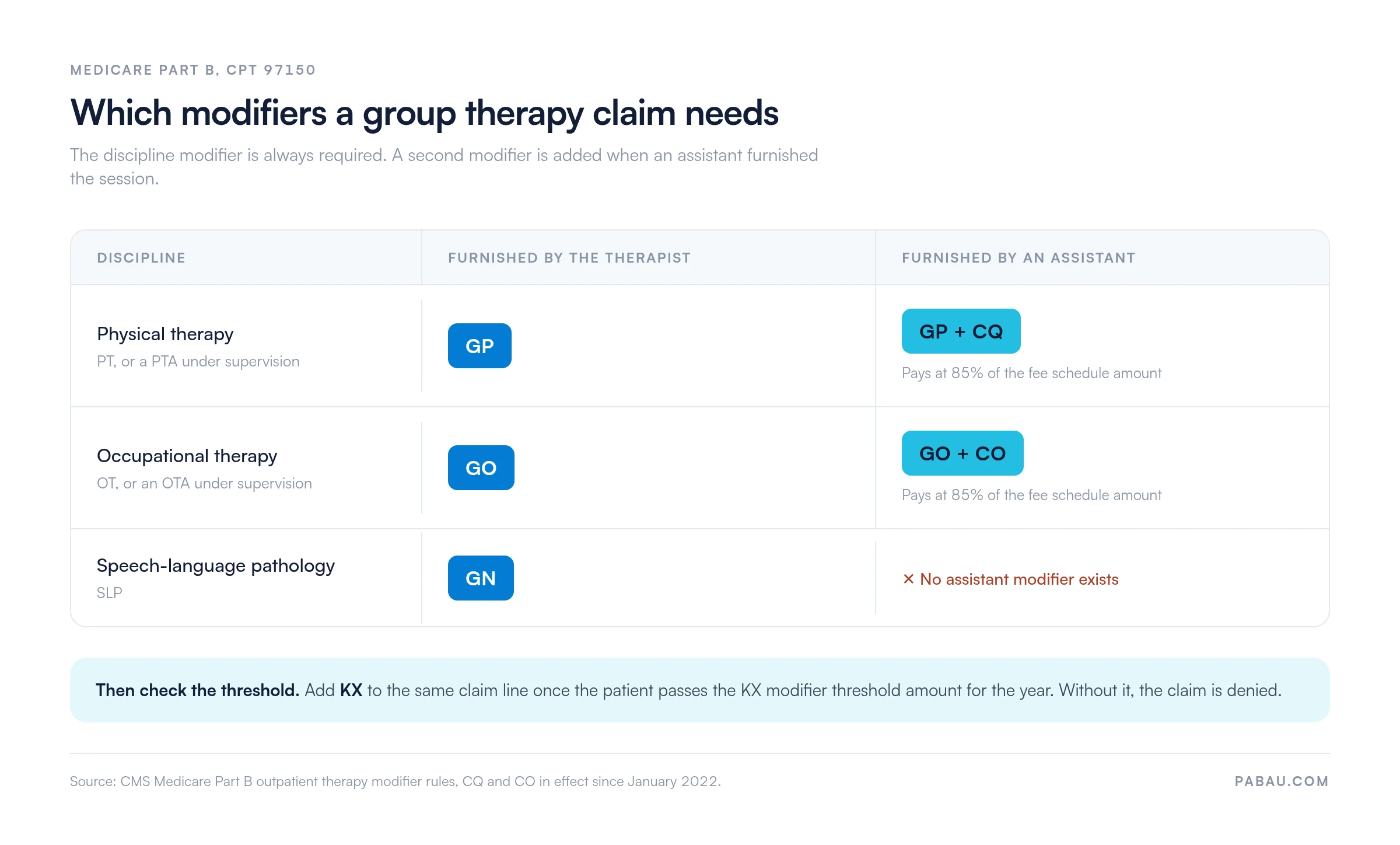
For Medicare billing, only practitioners recognized under the CMS Physician Fee Schedule may bill Part B for outpatient therapy. The discipline modifier identifies the service type. Use GP for physical therapy, GO for occupational therapy, and GN for speech-language pathology.
A second modifier applies when an assistant furnished the session. Add CQ when a PTA delivers the service and CO when an OTA does. Both have been required since 2022, and the services they flag pay at 85% of the fee schedule amount. The grid below maps each discipline to the modifiers its claims carry.
The two-patient floor is a hard rule. A single patient with one therapist is individual therapy, even if another clinician is in the room. The group must consist of two or more patients receiving simultaneous therapeutic intervention from a single qualified provider.
CMS guidance on supervision for outpatient therapy generally permits general supervision for group sessions with established patients. That means the therapist need not be in the same room but must be immediately available. Direct supervision can apply in certain settings or for assistant-led sessions, so confirm the requirement for your setting and payer.
Thin documentation is the single most common reason 97150 claims are denied or clawed back on audit. Each patient’s medical record must support the medical necessity of the group session, even though the intervention reached several people at once. A single group note that never references individual goals or responses is not compliant.
The OIG and RAC auditors consistently flag group therapy claims with documentation identical across every group member. An absent individual response to treatment draws the same attention. A note reading “patient participated in group exercise program” is an audit liability. It never links the activity to that patient’s goals or functional progress.
On HCPCS code H0045, a Medicaid respite claim carrying HN for bachelor’s level staff or HO for master’s level needs the worker’s qualifications on file. Missing that proof is a common audit finding.
Medicare Part B covers 97150 under the Medicare Physician Fee Schedule (MPFS), administered by CMS. Several Medicare-specific rules apply that commercial payers handle differently.
Per session, not per unit: 97150 is billed as one unit per session. Reporting multiple units inflates the claim and triggers an automatic edit.
KX modifier above the threshold: Medicare no longer caps therapy benefits, because the 2018 Bipartisan Budget Act repealed the hard caps. It does set a KX modifier threshold amount each year. One threshold covers physical therapy and speech-language pathology combined, and a separate one covers occupational therapy. Once a patient’s cumulative services pass it, append KX to signal that continued care is medically necessary. Claims above the threshold without KX are denied, and the rule applies to 97150 exactly as it does to individual therapy codes.
Discipline and assistant modifiers: Medicare requires GP on physical therapy claims, GO on occupational therapy claims, and GN on speech-language pathology claims. Add CQ or CO on top when a PTA or an OTA furnished the session. A missing modifier on a 97150 claim causes a denial before any clinical reviewer sees the note.
Submitting 97150 claims electronically through a clearinghouse flags modifier errors before the claim reaches the payer. Practice management software like Pabau connects to Claim.MD, a US clearinghouse that validates CPT codes and modifiers against CMS edits. The most common 97150 formatting errors surface before submission rather than on the remittance.
Medicare rates for 97150 are set annually through the MPFS and vary by locality, using Geographic Practice Cost Indices (GPCIs). Publishing a single dollar figure here would go stale quickly. The CMS Physician Fee Schedule lookup tool returns the current facility and non-facility rates for any locality. Search 97150 in the HCPCS/CPT field for the current figure.
As a reference point, 97150 reimburses at a lower rate than individual therapeutic exercise codes such as 97110 per unit. The per-session group rate reflects provider time split across several patients. Practices building a group program should model the revenue against practitioner capacity. One therapist treating six patients generates six claim lines at the group rate.
Commercial and Medicare Advantage rates are negotiated by contract and can differ substantially from the Medicare fee schedule. Verify your 97150 contract rate with each payer before building group therapy into the service mix.
The most common coding confusion involves 97150 and the individual therapeutic procedure codes beside it. The core distinction is that 97150 is group-only and per-session, while the codes below are individual and time-based in 15-minute units. Our reference on 97110 works through the per-unit timing rules those individual codes follow.
One compliance point decides most of these calls. 97110, 97112, 97530, and 97140 all require direct one-on-one contact between therapist and patient. Delivering those services to several patients at once and billing the individual codes is unbundling, which carries significant audit risk. If the session is genuinely group-based, 97150 is the correct code.
Billing 97150 on the same date as individual therapy codes is generally permissible under Correct Coding Initiative (CCI) edits. The services have to be distinct, separately documented, and not delivered at the same time. Take a patient who receives 30 minutes of individual therapeutic exercise in the morning. If they also join a group session that afternoon, both codes can be billed that day.
Verify current CCI edits before billing any code combination, since bundling rules are updated quarterly. The AAPC Codify CPT lookup includes CCI edit data and modifier indicators. Those indicators tell you which code pairs need a modifier to bypass a bundle edit.
Run a CCI edit check on every 97150 claim that also carries an individual therapy code on the same date. Many billing platforms flag potential bundling conflicts before submission. If the edit shows a modifier-1 indicator, appending the -59 modifier or a more specific X modifier with separate documentation can resolve the denial.
The denial patterns for group therapy billing are consistent across payers. Most stem from thin documentation rather than incorrect code selection. Matching a remittance remark to its underlying cause is quicker with a reference for common denial codes beside the worklist.
Group therapy is an active OIG focus area for outpatient rehabilitation billing. The Office of Inspector General has repeatedly named group therapy documentation as a high-risk area in its annual Work Plan. Recovery Audit Contractors also run post-payment reviews on 97150 claims, because per-session billing with thin documentation is easy to exploit.
Proactive compliance for 97150 means treating each group session note with the same rigor as an individual therapy note. Every patient’s record should stand on its own as evidence of medical necessity.
The AMA’s CPT coding resources cover the Physical Medicine and Rehabilitation codes, which makes them useful for provider education and internal compliance training.
Knowing the documentation requirements for 97150 and capturing them on every session note are two different problems. Most denial exposure comes from workflows that make it easy to skip a required field under time pressure.
Pabau’s claims management software lets PT and OT practices build group session templates. The template prompts the therapist for group composition, each patient’s goals, and the skilled intervention rationale before the note can be finalized.
Pabau then populates the claim from those documented session details. Your billing staff confirm the code, the modifiers, and the unit count before the claim goes out, so nobody retypes the same information twice.
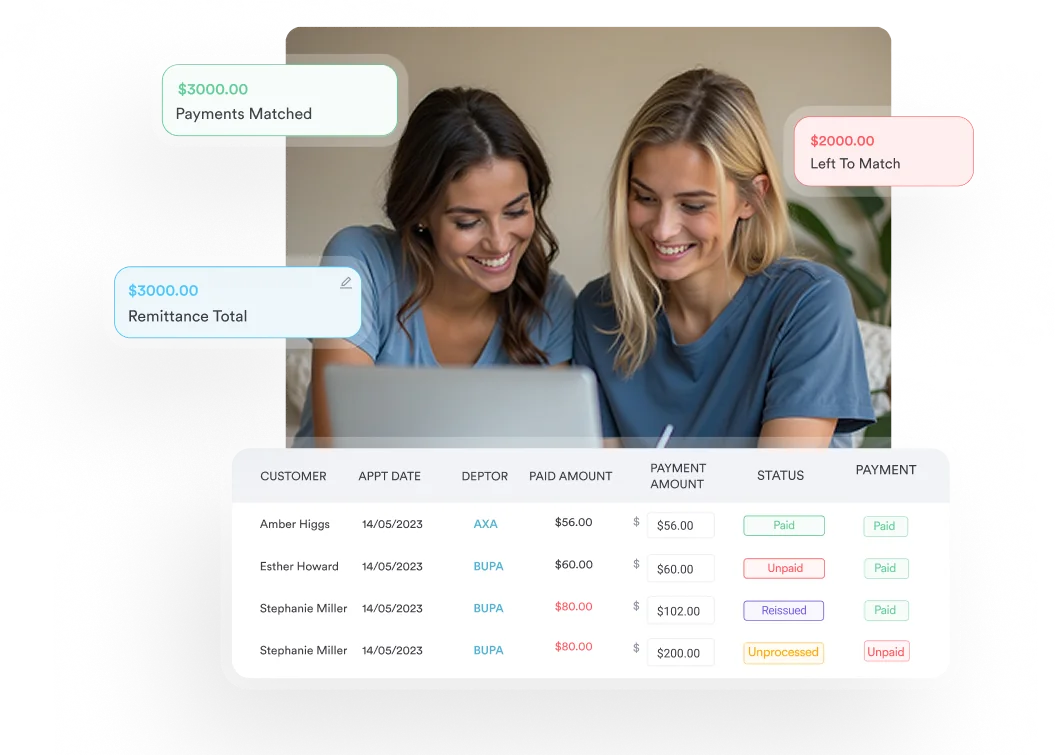
For practices running regular group sessions alongside individual therapy, Pabau tracks each patient’s cumulative therapy spend against the KX modifier threshold amount. It flags when the next claim will need KX, which heads off the most avoidable denial in 97150 billing.
Reporting across group sessions also surfaces patterns that manual review misses. If one therapist’s 97150 claims deny at twice the practice average, the data points at a documentation or modifier problem. Targeted training fixes that faster than a broad audit.

Pabau’s claims management software prompts the fields a 97150 note needs and checks each claim against CCI edits before submission. See how PT and OT practices cut denial rework on group sessions.

97150 is an easy code to bill and an easy one to lose on audit. The coding decision takes seconds: two or more patients, one therapist, one unit per session. What decides whether the payment sticks is the note sitting behind each claim line.
So put the effort where the risk is. Build the group note so every patient’s record carries their own goals, their own response, and the modifier set their discipline requires. Do that and the quarterly audit becomes a spot check rather than a scramble.
Pabau prompts those fields at the point of care and tracks each patient against the KX modifier threshold amount. Book a demo to see how it handles 97150 documentation and claim submission for a PT or OT practice.

Need to understand OIG compliance requirements for outpatient therapy? Medical billing compliance covers the OIG guidance and audit patterns that affect group therapy billing.
Exploring revenue cycle management for your PT or OT practice? Revenue cycle management explained walks through how claim submission, denial management, and payment posting connect in one workflow.
Want to know how clearinghouses reduce claim rejection rates? Medical claims clearinghouse guide explains how electronic claim validation works before submission to Medicare and commercial payers.
Billing therapeutic activities one patient at a time? 97530 sets out the per-unit timing and documentation rules for the individual code.
Coding hands-on treatment in the same episode of care? 97140 explains why manual therapy cannot be delivered to a group.
CPT code 97150 is used to bill for therapeutic procedures delivered simultaneously to a group of two or more patients by a single qualified provider. It covers group-based physical therapy, occupational therapy, and related rehabilitation services, and is reported once per session regardless of session duration.
A minimum of two patients must be present and receiving simultaneous therapeutic intervention to bill CPT 97150. A single patient with one therapist is individual therapy, regardless of the treatment approach used.
CMS generally permits general supervision for outpatient group therapy sessions with established patients. The therapist need not be in the same room, but must stay immediately available. Specific supervision requirements vary by setting, provider type, and payer, so confirm requirements with your payer and state licensing board before billing.
Yes. Both physical therapists and occupational therapists may bill CPT 97150 under Medicare Part B. Physical therapists append GP and occupational therapists append GO. When a PTA or an OTA furnishes the session, add CQ or CO alongside the discipline modifier.



