



CCSD code G5100: Bypass of duodenum billing guide
CCSD code G5100 bills a bypass that leaves the duodenum in place CCSD code G5100...

Last Updated: Oct 16, 2026

CPT code 97116 covers gait training therapy, billed in 15-minute units with direct one-on-one patient contact required.
The CMS 8-minute rule sets the unit count, and 8 minutes of direct therapy time buys the first unit.
Medicare pays separate facility and non-facility rates for 97116, published annually in the CMS Physician Fee Schedule.
Start and stop times belong in the note for every timed code, or the units billed cannot be defended.
Practice management software like Pabau pairs CPT and ICD-10 codes during charting, so the link is set at the point of care.
CPT code 97116 bills gait training therapy, the direct one-on-one training that helps a patient walk, ambulate, or negotiate obstacles. It is a timed code, billed in 15-minute units. It applies when injury, surgery, or neurological disease has impaired the patient’s gait.
The American Medical Association (AMA) maintains 97116 in the Physical Medicine and Rehabilitation section of the CPT code set.
Two variables decide whether a 97116 claim pays on first submission. The first is documented one-on-one time, which sets the unit count. The second is the ICD-10 diagnosis that supports medical necessity.
Physical therapists and occupational therapists are the primary billers of 97116. CMS coverage policy defines the eligible provider types, and for Medicare the service setting narrows them further.
Speech-language pathologists may bill 97116 where gait training falls inside their licensed scope. Payer acceptance varies by state, so check with the specific payer first. Physicians and other qualified practitioners may bill the code when they deliver the training themselves.
Scope of practice rules matter here. Licensing laws differ by state, so a provider type that qualifies in one jurisdiction may not qualify in another. Practices running locations in more than one state should confirm eligibility per location before billing.
The AMA descriptor names stair climbing outright, which signals how broad the covered range of ambulation activities is. Each activity has to be therapeutic and has to address the documented gait impairment. Knowing what qualifies is what separates 97116 from its neighbors, 97530 and 97112.
CPT code 97116 is a timed code, meaning the number of billable units depends on the minutes of direct, one-on-one therapy time documented. The Centers for Medicare and Medicaid Services (CMS) sets the 8-minute rule that governs unit counting on Medicare claims. Most commercial payers follow the same standard.
When several timed codes are billed on the same date, the 8-minute rule applies to the total timed minutes. It does not apply to each code alone. CMS totals the units using the aggregate method, then assigns them to each timed code proportionally. Undercounting session time therefore drags down every code billed that day, not just 97116.
Start and stop times must be documented for every timed code. Without them, the claim has no basis for the unit count billed. A payer audit then recoups the payment, whether or not the therapy took place.
Medication training under H0034 counts the same 15-minute units, but its eight-minute floor is payer-specific rather than a CMS standard. Confirm the threshold in your state Medicaid manual before billing a short session.
Medicare pays CPT code 97116 at two rates, set by the service setting. The facility rate covers outpatient hospitals and skilled nursing facilities. The non-facility rate covers private practices, and it is higher because the practice absorbs overhead that no facility fee reimburses.
Rates change annually with the CMS Physician Fee Schedule update. Confirm the current figure through the CMS Physician Fee Schedule lookup tool before each plan year.
Geographic locality moves the payment a long way. A practice in San Francisco receives a higher locality-adjusted rate than one in rural Mississippi for the same code. Use the FastRVU lookup tool to work out the adjusted rate for your Medicare Administrative Contractor jurisdiction.
Commercial and Medicaid payers set their own rates, often as a percentage of the Medicare fee schedule. Contracted rates commonly run between 80% and 130% of Medicare. Those figures are not published publicly, so reconcile payments against your own payer contracts rather than the fee schedule.
Every claim for CPT code 97116 requires at least one ICD-10 diagnosis code that supports medical necessity. Payers review these pairings to confirm the billed gait training service is clinically appropriate for the documented condition. The following codes represent the highest-frequency pairings; this list is not exhaustive, and payer-specific Local Coverage Determinations (LCDs) govern which diagnoses are accepted.
Use the most specific ICD-10 code available. Laterality and encounter characters matter here, since S72.001A and S72.001D describe different points in the same hip fracture episode. The ICD-10-CM code directory sets out those character rules code by code.
Vague codes like R26.89 are accepted when no definitive diagnosis has been established, but they carry higher denial risk than condition-specific codes. Document the functional limitation that makes gait training necessary in the clinical note, not just the diagnosis code.
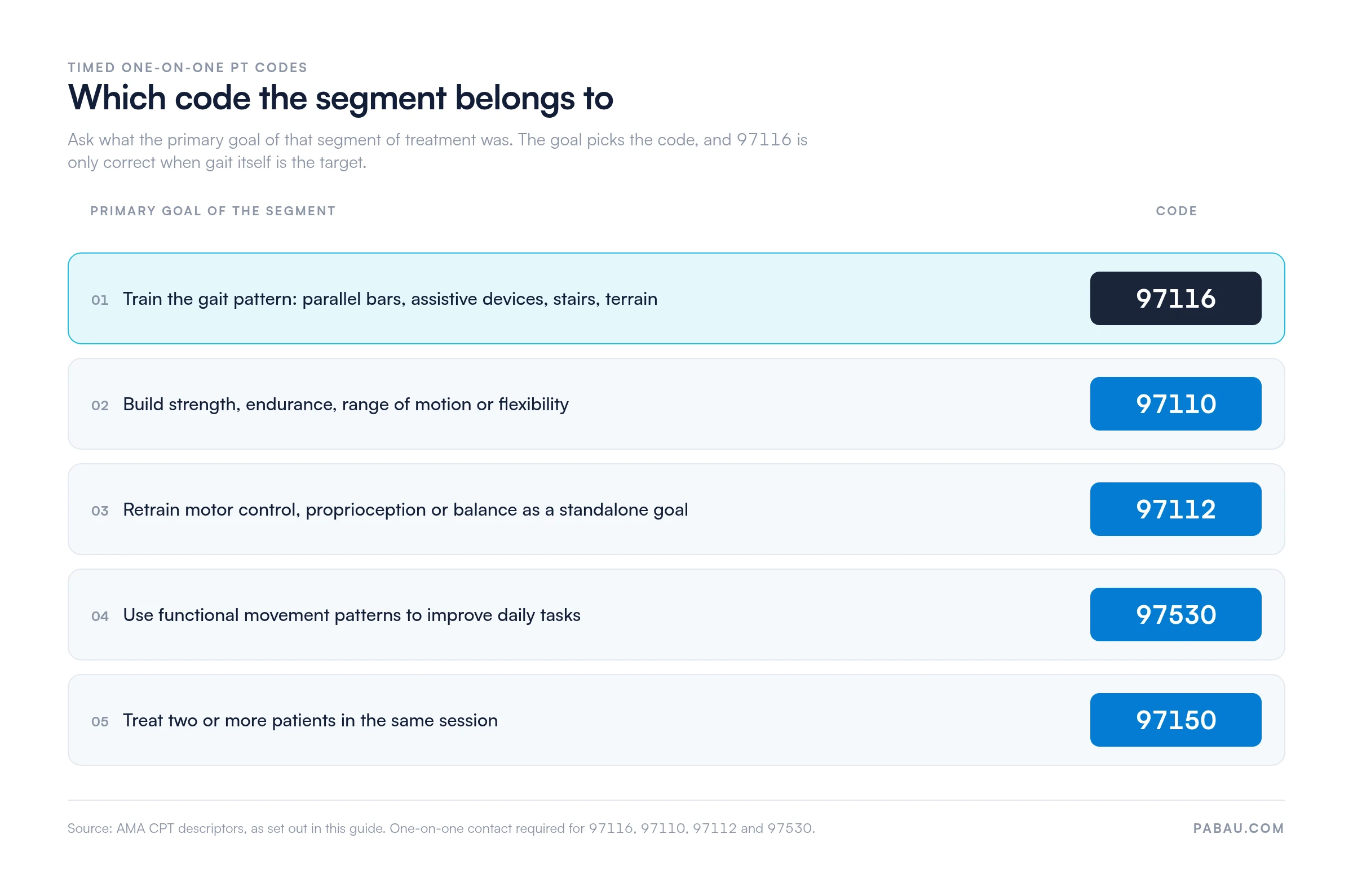
CPT 97110 is the code most often confused with 97116. Both are timed, both need direct one-on-one contact, and both turn up in the same PT session.
The clinical distinction is the goal of the segment. 97110 builds strength, endurance, range of motion, or flexibility. 97116 trains the gait pattern and ambulatory function. Billing one when the other was delivered is upcoding, which carries audit and recoupment risk.
CPT 97112 (neuromuscular reeducation) is another close neighbor. Use 97112 when the session works on motor control, proprioception, or balance retraining as standalone goals. Use 97116 when those elements appear but the overarching objective is functional gait improvement.
CPT 97530 (therapeutic activities) applies when treatment uses functional movement patterns to improve daily tasks rather than gait. When in doubt, ask which goal that segment of treatment served. The table below runs the same question across all five timed codes competing for a PT session.
Modifiers tell payers which type of provider delivered the service and under what conditions. A missing discipline modifier on a Medicare claim denies automatically, which makes modifier errors one of the cheapest denial categories to eliminate.
Modifier rules differ by payer, and commercial insurers may not require GP, GO, or GN at all. Check each payer’s provider manual before submitting. Secondary payers deserve the closest look, because modifier stacking is where the edits appear.
Documentation for 97116 has to establish three points. It must show medical necessity for gait training, the nature and duration of the session, and the patient’s response to treatment. Payers audit those three most often, and a missing one can trigger denial or recoupment.
Record the number of units billed alongside the start and stop times in every session note. A claim showing 3 units of 97116 needs documentation showing at least 38 minutes of direct gait training. Auditors cross-reference those two figures, and a mismatch creates automatic recoupment risk.
97116 denials trace back to a short list of recurring errors. Billing teams at physical therapy practices see the same three patterns. They are unit miscounts, wrong modifiers, and ICD-10 codes that do not support the level of service billed. All three are catchable at charge entry.
Submitting a clean claim is always faster than working a denial afterward. For practices carrying high therapy visit volumes, dedicated claims management software with built-in CPT and ICD-10 validation catches these errors before claims leave the building.
High-volume physical therapy practices hit a compounding billing problem. Every extra timed code billed per session multiplies the documentation and the arithmetic behind it.
A therapist seeing 12 patients a day and billing three timed codes per session is tracking 36 separate unit counts. Each one needs its own start and stop times and its own modifier. Manual tracking at that volume produces a steady rate of errors.
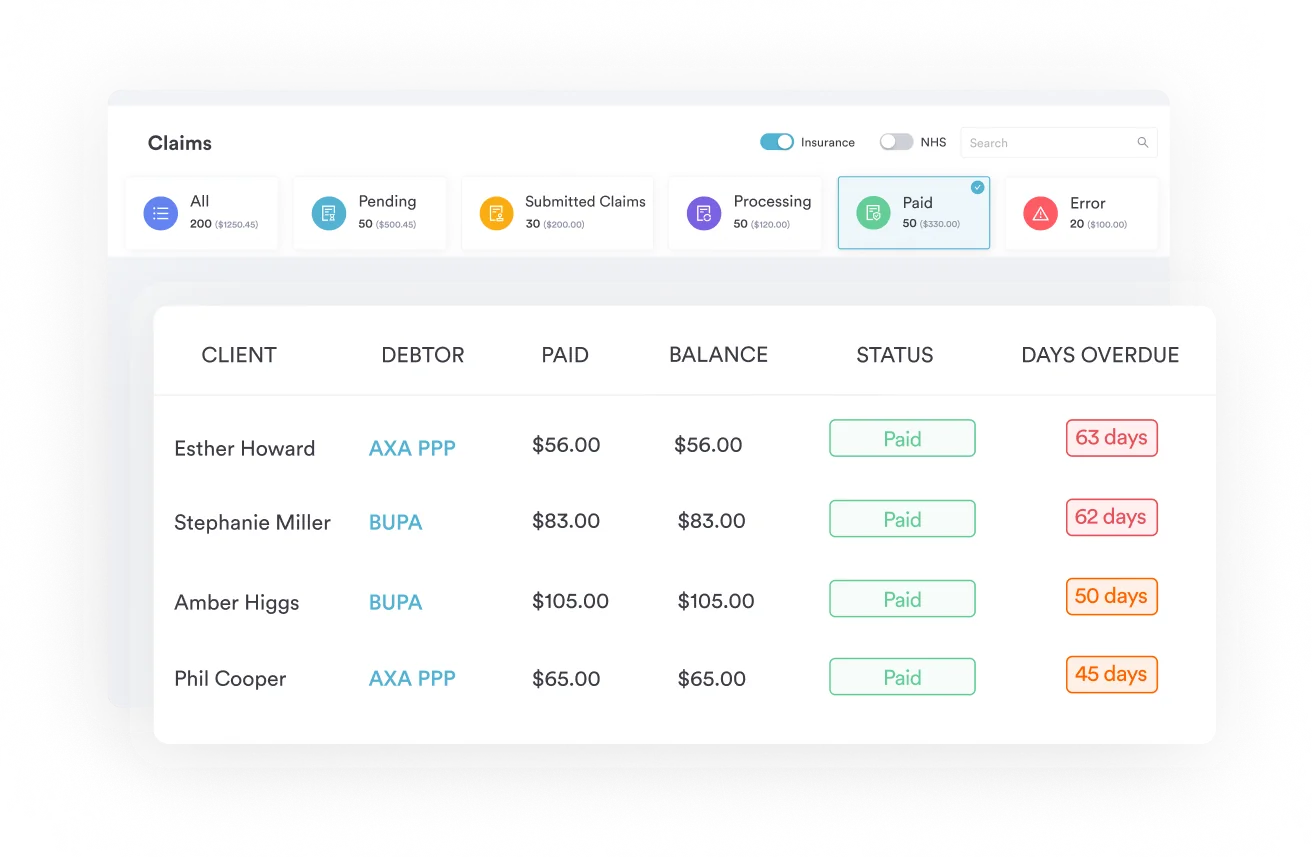
Practice management software like Pabau puts the billing logic inside the clinical workflow instead. Therapists record time as the session runs, and the system counts billable units against the 8-minute rule. ICD-10 codes attach to the treatment record during charting, so the pairing is set at the point of care rather than rebuilt at billing time.
Claims then submit electronically through the Claim.MD clearinghouse, which reaches thousands of US payers for eligibility checks and electronic remittance advice. Remittances post back against the original claim line, so a billing manager can see which 97116 unit was cut and why.
Run a monthly audit of your 97116 claims against the 8-minute rule table. Pull every claim where the units billed do not match the documented time range. Then check whether modifier KX was applied to claims near or over the Medicare therapy cap. Catching these before a payer does saves recoupment and appeal time.

Pabau connects to thousands of US payers through Claim.MD, supporting CPT and ICD-10 pairing, modifier selection, and clean claim submission for physical therapy practices.

The hard part of 97116 is not choosing the code. It is proving, months after the visit, that the minutes billed were the minutes delivered.
That makes the session note the place to fix denials, not the billing queue. A therapist who writes start and stop times while the patient is still in the parallel bars has already answered the auditor. One who reconstructs them on Friday afternoon has not.
Set that habit first, then hand the arithmetic to software. Book a demo to see how Pabau counts 97116 units against the 8-minute rule while your therapists chart.

Working a backlog of denied therapy claims? Denial management in healthcare sets out how to triage, appeal, and stop repeat denials.
Want the claim to pay on first submission? Clean claim explains what a payer checks before it accepts a claim.
Building superbills for therapy visits? Superbill covers the fields payers expect and how practices assemble one.
Choosing how to submit claims electronically? Medical claims clearinghouse explains how electronic submission cuts denial rates and speeds reimbursement.
Preparing for a payer audit? Medical billing compliance covers documentation standards, audit readiness, and payer policy management.
CPT code 97116 bills gait training therapy, a Physical Medicine and Rehabilitation service. A qualified healthcare professional delivers direct one-on-one training to improve a patient’s ability to walk and ambulate. It covers parallel bar walking, assistive device training, stair climbing, and terrain adaptation, and is billed in 15-minute units.
The billable units depend on the total documented therapy time under the CMS 8-minute rule. 8-22 minutes equals 1 unit, 23-37 minutes equals 2 units, 38-52 minutes equals 3 units, and 53-67 minutes equals 4 units. When several timed codes are billed on the same date, the rule applies to the aggregate total rather than each code.
Yes. CPT code 97116 is a timed code, so the CMS 8-minute rule governs unit calculation for all Medicare claims. A minimum of 8 minutes of direct, one-on-one gait training must be documented to bill even one unit. Most commercial payers follow the same standard, but verify individual payer policies.
CPT 97116 is for gait training, aimed at a patient’s ability to walk and ambulate. CPT 97110 is for therapeutic exercise, aimed at strength, endurance, range of motion, or flexibility. Both can be billed on the same date when the services are clinically distinct and separately documented. The National Correct Coding Initiative does not bundle them.
For Medicare claims the discipline modifier is mandatory. It is GP for physical therapists, GO for occupational therapists, and GN for speech-language pathologists. Modifier 59 may be needed when a payer questions whether 97116 and another timed code are distinct services. Modifier KX applies once therapy passes the annual Medicare therapy cap and continued medical necessity is attested.
Yes. Occupational therapists can bill CPT code 97116 when gait training falls inside their licensed scope of practice and the service is medically appropriate. Medicare claims from OTs must carry the GO modifier. Scope of practice rules vary by state, so check with the applicable licensing board first.
Common ICD-10 codes paired with 97116 include I69.351 (hemiplegia following cerebral infarction), G20 (Parkinson’s disease), and G35 (multiple sclerosis). Post-surgical pairings include Z96.641 (right artificial knee joint), S72.001A (hip fracture), and Z89.511 (below-knee amputation). R26.89 covers other abnormalities of gait. Use the most specific code available, and verify acceptance under the payer’s Local Coverage Determination.



