

HCPCS code E0198: Water pressure pad billing guide
HCPCS code E0198 is a water pad for a standard mattress HCPCS code E0198 is the ...

Last Updated: Oct 13, 2026
97033 is the CPT code for application of a modality to 1 or more areas; iontophoresis, each 15 minutes. It is a timed, constant-attendance modality, so the provider must stay in direct contact and the units follow the treatment minutes.
Physical therapists and outpatient practices bill it often, for conditions from plantar fasciitis to hyperhidrosis. It still draws a disproportionate share of denials. Coders confuse it with CPT 97014 (electrical stimulation, unattended), undercount units under the 8-minute rule, or leave out the constant-attendance note payers require.
Let Pabau's smart automation suggest the right codes, reduce claim denials, and keep your practice compliant—effortlessly.
Automate repetitive tasks and focus on what matters most—your patients.
Reduce coding errors and ensure compliance with the latest regulations.
Clean claims, fewer denials, and faster reimbursements.
Powerful insights and reporting to help your practice thrive.
HIPAA compliant SOC 2 certified GDPR-compliant Trusted by 4,000+ clinics worldwide

CPT Code 97033 covers iontophoresis as a timed, constant-attendance modality. The clinician must be in direct contact throughout the session.
Units follow the 8-minute rule: one unit for 8-22 minutes, two units for 23-37 minutes, three units for 38-52 minutes, and so on.
97033 is not interchangeable with CPT 97014 (electrical stimulation, unattended). Supervision requirements, coding, and reimbursement rates all differ.
Practice management software like Pabau validates required claim details before submission and tracks every 97033 claim through to payment.
CPT Code 97033 is the physical therapy billing code for iontophoresis. The American Medical Association defines it as: Application of a modality to 1 or more areas; iontophoresis, each 15 minutes. The “each 15 minutes” language makes it a timed code, so unit count drives reimbursement rather than a flat per-session rate.
Clinically, iontophoresis delivers ionized medication through intact skin using a small direct electrical current. The active electrode carries a charged drug solution, and the current repels the ions into the underlying tissue without breaking the skin.
Common medications include dexamethasone for tendinopathies and bursitis, acetic acid for calcific tendinitis, and lidocaine for localized pain management.
The code sits within the Physical Medicine and Rehabilitation section of the CPT codebook, the 97000 series. It is classified as a supervised modality requiring constant attendance. The qualified provider must be present and in direct contact or immediate attendance for the whole treatment.
That single requirement separates 97033 from unattended electrical stimulation and drives most of the documentation failures behind denials.
97033 applies across a range of musculoskeletal and dermatological presentations where transdermal drug delivery is clinically appropriate. Common diagnoses billed alongside it include:
The code does not cover dry-needle iontophoresis or phonophoresis, which uses ultrasound rather than electrical current and is billed under CPT 97035. It also does not cover any application where a clinician is absent during the session.
Because 97033 is a timed code, billing units depend on treatment time and the CMS 8-minute rule set out in Medicare Physician Fee Schedule guidance. At least eight minutes of a timed service must be delivered to bill one unit. Each further unit threshold then follows the rounding table below.
In practice, most iontophoresis sessions run 20 to 40 minutes, making one or two units the typical claim. Once the biller has counted the units, claims management software checks the claim for missing membership numbers and authorization codes before it goes out. The claim then submits electronically to the clearinghouse, and its status stays visible on one dashboard until the payment posts.

When multiple timed codes are billed on the same day, the leftover minutes from each service are pooled before units are rounded. Consider a session with 20 minutes of iontophoresis (97033) and 25 minutes of manual therapy (97140). Total timed minutes are 45.
The therapist bills 97033 for 1 unit and 97140 for 2 units. Leftover minutes from each code only combine into another unit once the pooled remainder reaches the next 8-minute threshold. Getting this calculation wrong, in either direction, is a leading trigger for post-payment audits on 97033 claims.
CPT 97014 is the code most often confused with 97033, and the distinction matters clinically and financially. 97014 is an unattended modality: the clinician sets up the equipment and leaves the patient. 97033 requires the therapist to stay present throughout. Swapping one for the other is a coding error and a potential compliance breach.
Attendance decides which code you bill, and only then do the minutes decide how many units. The chart below walks that order.
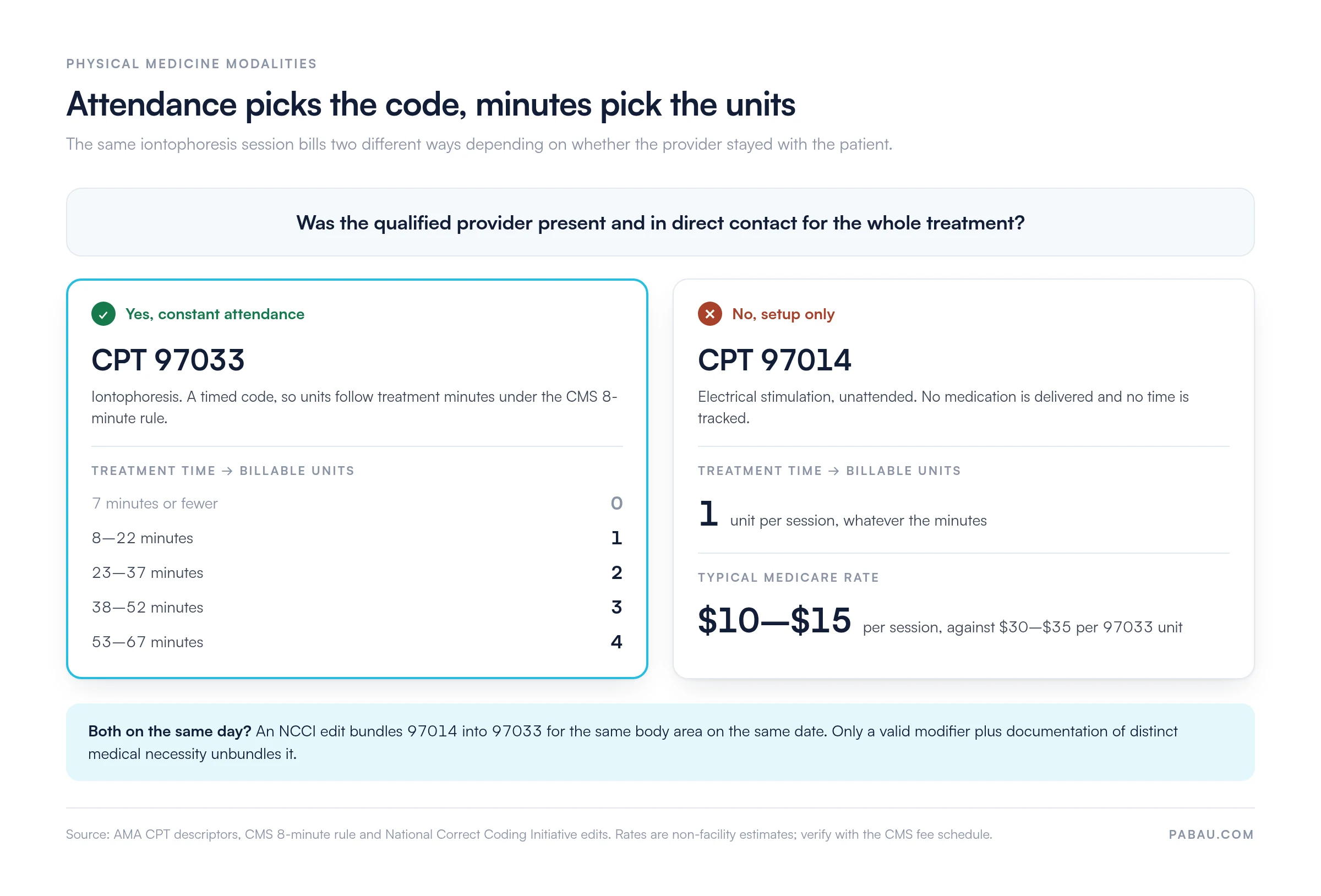
NCCI (National Correct Coding Initiative) edits pair 97033 and 97014 as a column 1/column 2 edit. 97014 counts as bundled into 97033. Billing it separately for the same area on the same date needs a valid modifier plus documentation of distinct medical necessity.
Iontophoresis rarely stands alone in a PT session. The companion codes below are regularly co-billed, each with its own attendance classification and bundling considerations.
When billing multiple timed codes, keep documentation for each service chronologically separated. A note that reads “20 min iontophoresis, then 25 min manual therapy” is far stronger than “45 min combined treatment.”
Track start and stop times for every timed modality separately in the daily note. Even if the overall session time is correct, auditors look for per-code time documentation. A note that says ‘iontophoresis x20 min, manual therapy x25 min’ passes; ‘modalities x45 min total’ fails.
Every 97033 claim needs a treatment note that establishes medical necessity and demonstrates constant attendance. Missing any of these elements is one of the fastest routes to a denial or a post-payment audit recovery. Physical therapists billing under Part B should also read their MAC’s local coverage determination, since some MACs ask for extra specificity.
A compliant treatment note for CPT 97033 must include:
The constant attendance statement is the element most often missing. During post-payment audits, payers pull every 97033 claim and look for explicit language confirming attendance. A note that says only “modality applied”, without the attendance qualifier, will not survive that review.
Medicare covers CPT Code 97033 iontophoresis when it is medically necessary. That means the treating therapist has documented a diagnosis that responds to transdermal drug delivery, and the treatment plan supports functional improvement.
Coverage for the hyperhidrosis indication varies by MAC and by commercial payer, and some payers have issued blanket non-coverage policies for that diagnosis.
Commercial payers take differing positions. Aetna’s Clinical Policy Bulletin (CG-MED-28) covers iontophoresis for musculoskeletal conditions once conservative care has been tried and documented. Some plan types exclude it for hyperhidrosis. BCBS follows a similar framework. Always verify with the individual plan before assuming coverage.
Medicare does not require prior authorization for CPT 97033, but many commercial payers do. It comes up most often when iontophoresis is prescribed for a chronic condition, or when the plan’s physical therapy benefit has a visit limit. The authorization request typically requires:
Failing to obtain required prior authorization before treating is the third most common denial reason for 97033 claims. Check authorization requirements at the point of scheduling, not at the time of claim submission.
The 2026 Medicare Physician Fee Schedule rate for CPT 97033 is roughly $30-$35 per unit in non-facility settings. Facility settings run closer to $20-$25 per unit. These figures are estimates based on RVU data. Confirm them against the CMS Physician Fee Schedule lookup tool for the exact locality-adjusted rate.
Rates vary by geographic practice cost index (GPCI), so a practice in San Francisco sees a different rate than one in rural Mississippi. Use FastRVU’s 2026 RVU lookup to calculate locality-adjusted rates before you set your fee schedule.
Iontophoresis claims get denied more often than many other PT modalities, because the constant-attendance requirement asks for documentation that generic note templates leave out. Build prevention into the billing workflow instead of discovering the problem at remittance. That is what separates a clean claim rate above 95% from a queue full of resubmissions.
Once a denial lands, the remittance advice carries a CARC or RARC reason code that names the fix. Practices working through these patterns can map each one to its remediation step using our reference on medical billing denial codes. Routing rejected 97033 claims to a named biller for same-day resubmission recovers revenue that would otherwise age out.
Iontophoresis is a recognized treatment for palmar and plantar hyperhidrosis (L74.510, L74.511, L74.512, L74.519). It delivers tap water or medication to reduce sweating over repeated sessions. The clinical evidence is strong enough that some payer policies list it as a covered indication.
Medicare coverage for the hyperhidrosis indication is inconsistent across MACs, though. Many commercial payers, including some Aetna and BCBS plan types, exclude hyperhidrosis from CPT 97033 coverage under their medical policy.
Before billing 97033 for hyperhidrosis, verify three things. First, check the MAC’s local coverage determination for physical therapy modalities. Second, confirm the commercial plan’s specific benefit and exclusion language. Third, document that conservative measures such as antiperspirants and lifestyle modification were tried and failed.
Without that prior-treatment documentation, a hyperhidrosis claim for iontophoresis is unlikely to survive a medical necessity review. Treat it as a conditional coverage scenario that needs pre-claim verification, not a routine billable service. Practices can also use CrossCoder’s procedure-to-diagnosis crosswalk tool to check which ICD-10 codes sit under active LCD policies for 97033.
For hyperhidrosis patients, document a conservative treatment failure log in the intake record before scheduling iontophoresis sessions. List every prior treatment, dates tried, and why it was discontinued. This single document becomes the anchor for any medical necessity appeal if the initial claim is denied.
In most physical therapy practices, a 97033 claim passes through three sets of hands and two systems. The therapist writes the note on paper or in an EMR. A biller then rekeys the minutes and the diagnosis into a billing tool. Nobody sees the claim again until the remittance arrives.
A missing authorization code or a stale membership number surfaces weeks later, as a denial.
Practice management software like Pabau keeps the whole sequence in one place. The treatment note, the timed minutes, the diagnosis, and the insurer details all sit on the same patient record.
The biller retypes none of it. Before the claim goes out, Pabau checks it for the details payers reject on sight, such as a missing membership number or authorization code.
Claims then submit to Claim.MD without leaving the system. Every one of them shows on a single dashboard as pending, submitted, processing, paid, or error. Filter by insurer or date to see which 97033 claims have stalled. Your team can fix and resubmit them while the session is still fresh.

Pabau validates required claim details before submission, sends 97033 claims straight to Claim.MD, and tracks each one through to payment on a single dashboard. Your billers see a stalled claim in days, not at month end.

CPT Code 97033 has a clear scope, and the two things that sink its claims are both procedural. Constant attendance has to be stated in the note. The 8-minute rule has to be applied to iontophoresis minutes alone, not to the session total. Practices that fix those two habits see the denial rate on this code fall without touching anything clinical.
The trade-off worth remembering is time at the front end. Checking payer coverage before you treat, and flagging every hyperhidrosis case for verification, costs a few minutes per patient. Chasing the same claim through an appeal costs far more, and you may still lose it. Book a demo to see how Pabau validates and tracks physical therapy claims from the treatment note through to payment.

Working through a stack of rejected PT claims? Denial management in healthcare sets out how to triage denials, appeal the ones worth appealing, and stop the same reason code recurring.
Want to understand the full billing compliance picture for PT practices? Medical billing compliance guidance covers documentation standards, audit preparation, and the compliance obligations that surround timed modality billing.
Looking for guidance on submitting clean 837 claims for modality codes? How 837 electronic claim files work explains the claim transmission format physical therapy practices use when submitting 97033 and companion timed codes to payers.
New to the revenue cycle behind a modality claim? What revenue cycle management involves traces a claim from scheduling and eligibility checks through to posted payment and collections.
CPT code 97033 covers iontophoresis, a physical therapy modality that uses a low-level electrical current to deliver ionized medication through intact skin. It is a timed, constant-attendance code requiring the qualified provider to be present throughout the session. Common indications include plantar fasciitis, lateral epicondylitis, calcific tendinitis, and hyperhidrosis.
Units follow the 8-minute rule: one unit for 8-22 minutes, two units for 23-37 minutes, and three units for 38-52 minutes. Sessions shorter than 8 minutes cannot be billed. Most iontophoresis treatments run 20-40 minutes, making one or two units the typical claim. When 97033 is billed with other timed codes on the same day, each code’s time is tracked and rounded separately.
Yes, Medicare covers CPT 97033 when iontophoresis is medically necessary and the treating therapist documents a diagnosis that responds to transdermal drug delivery. Coverage for hyperhidrosis specifically varies by Medicare Administrative Contractor and may require additional documentation of failed conservative treatment. Always verify with your MAC’s local coverage determination before billing.
The top denial reasons are missing constant-attendance documentation, incorrect unit calculation under the 8-minute rule, and failure to obtain prior authorization. A non-covered diagnosis is the fourth, most often hyperhidrosis L74.5x under payers with explicit exclusions. Billing 97033 and 97014 together for the same area on the same day also triggers an NCCI edit denial.
CPT 97033 (iontophoresis) requires constant attendance by the qualified provider throughout treatment and delivers medication transdermally via electrical current. CPT 97014 (electrical stimulation, unattended) requires only setup, so the provider may leave during treatment and no medication is delivered. They cannot be billed together for the same body area on the same day due to NCCI bundling rules. Reimbursement rates also differ, with 97033 paying significantly more per unit.
Medicare does not require prior authorization for CPT 97033, but many commercial payers do. It comes up most often for chronic conditions, or when a plan’s physical therapy visit limit is close. Check authorization requirements at the point of scheduling. Required documentation typically includes a physician referral, an ICD-10 diagnosis code, evidence that conservative measures were tried, and proposed session count with functional goals.



