CCSD Code H3334: Low anterior resection billing guide
CCSD Code H3334: Definition and clinical scope CCSD Code H3334 covers an open an...

Last Updated: Oct 16, 2026
95957 is the CPT code for digital analysis of an electroencephalogram (EEG), such as epileptic spike analysis. It covers substantial extra computer analysis, like 3D dipole localization or topographic voltage mapping, beyond a standard digital EEG read.
Neurologists report it mainly during presurgical evaluation of intractable epilepsy, usually alongside video-EEG long-term monitoring. It is not billed for automated spike detection or for a digital recording alone, because routine, ambulatory, and video EEG codes already include them.
Let Pabau's smart automation suggest the right codes, reduce claim denials, and keep your practice compliant—effortlessly.
Automate repetitive tasks and focus on what matters most—your patients.
Reduce coding errors and ensure compliance with the latest regulations.
Clean claims, fewer denials, and faster reimbursements.
Powerful insights and reporting to help your practice thrive.
HIPAA compliant SOC 2 certified GDPR-compliant Trusted by 4,000+ clinics worldwide

CPT code 95957 covers additional digital EEG analysis, such as 3D dipole localization or topographic voltage mapping, beyond a standard digital EEG read.
Report it only when that extra analysis was medically necessary and performed, never for automated spike detection or a digital recording alone.
Payers mostly limit coverage to presurgical evaluation of intractable epilepsy, typically alongside video-EEG long-term monitoring (95718-95726).
Cigna does not cover 95957 with a routine EEG or sleep study for any indication, so pairing it with 95816 or 95819 invites a denial.
The 2026 Medicare fee schedule allows the -26 and TC split for 95957, or global billing with no modifier when one entity does both.
CPT code 95957 is defined by the American Medical Association (AMA) as Digital analysis of electroencephalogram (EEG) (eg, for epileptic spike analysis). It describes substantial additional computer analysis of a digitally recorded EEG, beyond the standard read that every digital EEG already receives.
In practice, that additional analysis is a specific technique such as 3D dipole localization, also called dipole source imaging, or topographic voltage mapping. Both help locate where epileptiform spikes start in the brain. That is why the service is mostly performed at specialty centers with epilepsy surgery programs.
Payer policies describe three parts to the work behind 95957:
What it does not include is the EEG recording, or the automated spike and seizure detection that digital EEG machines run by default. Routine, ambulatory, and video EEG codes already include that detection. According to Centene’s clinical policy CP.MP.105, 95957 should never be billed simply because the EEG was recorded on digital equipment.
The code sits in the Neurology and Neuromuscular Procedures subsection of the CPT Medicine section (95700-96020), within the Other EEG Testing Procedures range (95954-95962).
A frequent coding error is treating 95957 as a routine add-on to every digital EEG. It is a separate analysis service that only a narrow group of patients needs, and payers tie it to specific companion codes.
Key rule: report 95957 only when additional digital analysis, such as dipole localization, was medically necessary and was performed. Turning on an automated spike detector during a routine, ambulatory, or video EEG does not qualify. Payers commonly deny 95957 when it is billed with a routine EEG code such as 95816 or 95819.
95957 most often accompanies the long-term monitoring codes (95700-95726). Their professional descriptors already include analysis of spike and seizure detection. So 95957 adds value there only when the epilepsy team needs source localization beyond that standard review.
Before a 95957 line goes on the claim, it has to clear four checks in order, and the last one sets the billing form.
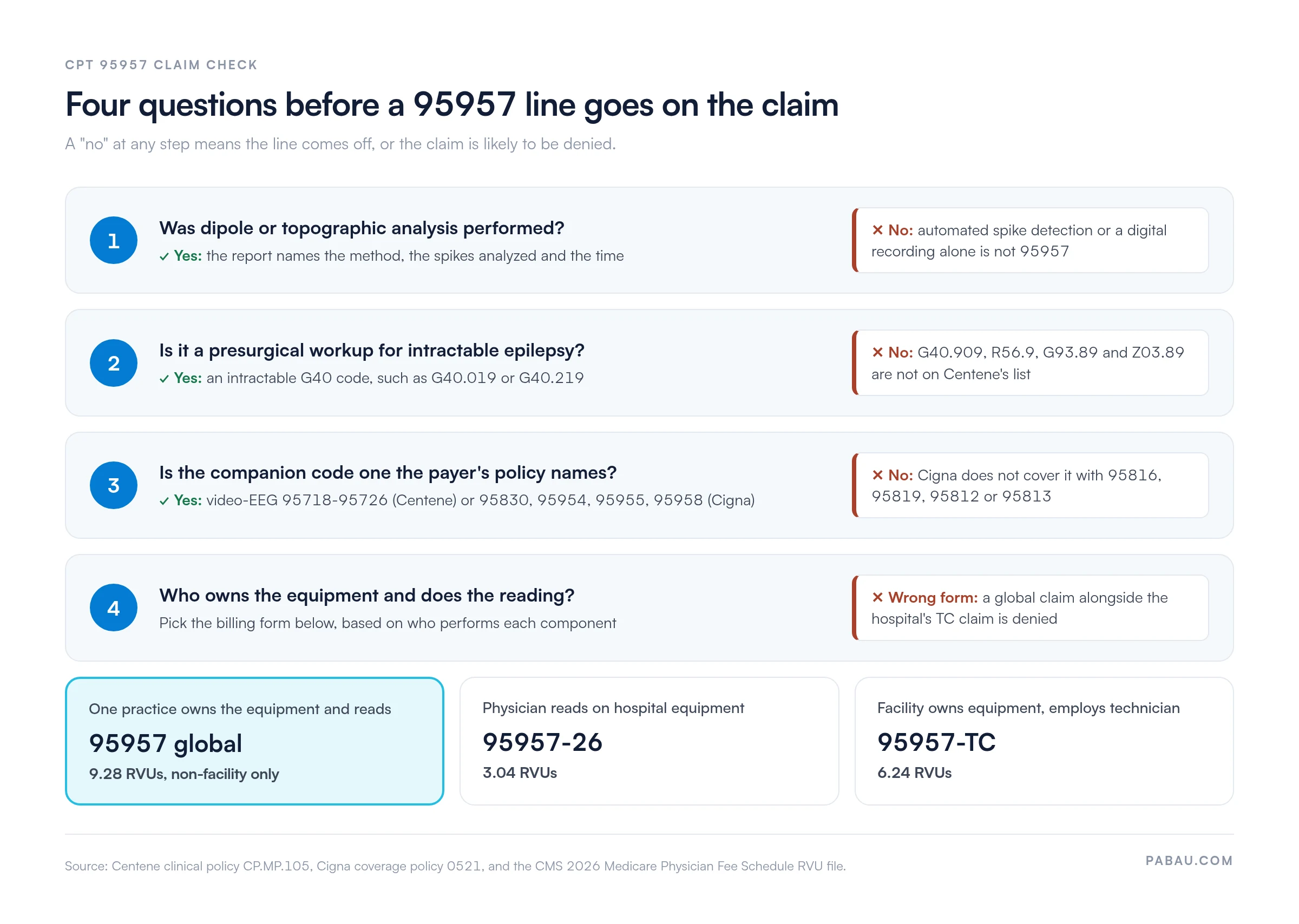
Medical necessity for CPT code 95957 is narrow. Published payer policies limit it to presurgical evaluation of patients with intractable epilepsy, usually alongside video-EEG long-term monitoring. Centene’s policy CP.MP.105 states that 95957 is not medically necessary for any other indication.
The diagnosis codes that support coverage are the intractable epilepsy codes in category G40. Examples from Centene’s covered list include:
Codes outside Centene’s intractable G40 list, such as G40.909, R56.9, G93.89 and Z03.89, are not on the policy’s supporting list. That covers unspecified epilepsy that is not intractable, unspecified convulsions, other specified brain disorders, and observation encounters.
Documentation must show why source localization was needed, not only that the patient has seizures. A note such as “drug-resistant focal epilepsy, presurgical workup, dipole source analysis to localize interictal spikes” supports necessity. A note reading “EEG ordered” does not.
CPT code 95957 is billed with modifier -26, modifier TC, or modifier -59, or with no modifier for global billing. The right choice depends on who owns the equipment and who performs each component.
In the 2026 Medicare Physician Fee Schedule, 95957 carries PC/TC indicator 1. That means Medicare accepts the -26 and TC split, as well as global billing. Re-check the indicator each January, because CMS can change it in the annual update.
When the neurologist reads in a hospital, bill 95957-26 and let the hospital bill the technical component. Billing the global code from the professional side duplicates the hospital’s TC claim and is denied.
Medicare reimbursement for CPT code 95957 is calculated from relative value units (RVUs) published annually in the Medicare Physician Fee Schedule (MPFS). The CMS Physician Fee Schedule lookup tool gives exact locality-adjusted rates for your MAC region. Use the FastRVU 2026 RVU lookup to calculate the dollar conversion using the current CMS conversion factor.
The three RVU components that drive reimbursement for 95957 are:
These national figures come from the CMS 2026 RVU file and are unadjusted for locality. Geographic Practice Cost Index (GPCI) values change the dollar amount by region. A practice in Manhattan will receive a different amount than one in rural Mississippi for the same code.
Medicaid rates for 95957 vary significantly by state. Most states set rates as a percentage of Medicare. That percentage ranges from roughly 60% to over 100%, depending on the state’s Medicaid fee schedule. Pabau, the practice management platform we build, sends electronic claims through Claim.MD and returns remittance data. You can then compare what each payer paid against its fee schedule.
Rate caution: never treat a published rate as a guaranteed payment. CMS updates the MPFS each January 1. Commercial payers negotiate their own fee schedules, and many limit 95957 coverage through medical policy regardless of the rate. Always verify current rates using the CMS lookup tool before setting expectations with billing staff.
Prior authorization requirements for CPT code 95957 vary widely by payer and plan. Meeting billing compliance requirements here means checking each payer’s current clinical policy before the study is performed, not after.
Payer patterns as observed in published clinical policies:
When prior auth is required, payers typically request a physician order, the epilepsy history showing intractability, and the presurgical plan. They also expect the reason source localization is needed. Submitting without authorization when one is required results in a denial that many plans will not approve retroactively.
Incomplete documentation also triggers denials and audits. Submitting a clean claim for this code requires the chart to contain all of the following elements before the claim leaves the practice.
A common defect that triggers post-payment audit is a report that never names the analysis method. Auditors look for explicit evidence of dipole or topographic analysis, not a routine visual read with automated detection. “EEG reviewed, spikes detected” does not support 95957 billing.
The denial patterns below follow from the payer policies covered above, each with its corrective action. Practices billing EEG codes at volume need denial management workflows that trace each one back to its fix.
Review common denial codes in medical billing to understand which CARC (Claim Adjustment Reason Code) typically accompanies each of these scenarios. Matching the CARC to the denial reason tells your team which fix the appeal needs.
Where CPT code 95957 is billed affects both the reimbursement rate and the supervision requirements CMS applies to the technical component.
The place of service (POS) code on the claim tells the payer which setting applies. CMS pays the global code only at the non-facility rate, because the practice expense reflects equipment ownership and technician time.
The 2026 MPFS assigns the technical component of 95957 general supervision. That means a physician must be available but does not need to be physically present during the technician’s processing work. Some commercial payers apply different supervision standards, so verify with the specific payer before delegating technical oversight.
A 95957 denial is easiest to stop at charge capture, before the claim is built. The fix is a front-desk and coding check that the indication, companion code, and analysis method all match payer policy before the charge is posted.
Pabau’s claims management software keeps that charge, the patient record, and the claim in one place. Your coders review the report and the codes together, then submit from the same screen.
Submitting EEG claims through a medical claims clearinghouse checks claim format before the payer sees it. Pabau sends CPT and ICD-10 codes on 837P claims through Claim.MD. It then returns ERA (electronic remittance advice) data that maps denial reason codes back to the specific line item.
For a practice billing 95957 regularly, each denial then arrives as a coded line item your team can sort by payer and reason.
Specific workflow steps for practices looking to reduce 95957 denials:

Pabau sends neurology claims through Claim.MD and returns remittance and denial data by line item. Your team sees which 95957 claims failed and why, so appeals start sooner.

CPT code 95957 belongs on a small share of EEG claims. Bill it when an epilepsy team needed dipole or topographic analysis to plan surgery for intractable epilepsy, and the report proves it. Leave it off routine, ambulatory, and standard video EEG reads, because automated detection is already paid inside those codes.
Getting that call right at charge entry protects revenue and audit standing at once. Book a demo to see how Pabau helps neurology practices submit EEG claims and follow every denial back to its cause.

Need to understand how a clearinghouse handles EEG claims? The Claim.MD clearinghouse guide explains how claims and remittance data move between your practice and payers.
Want to build a denial-prevention workflow for neurology? Understanding electronic remittance advice walks through how ERA data maps CARC codes back to specific claim line items. Denials then become structured data rather than manual investigations.
Want charge capture that supports medical necessity? Superbill documentation guidance covers how to structure charge capture documentation to support medical necessity across specialty billing scenarios.
CPT code 95957 is the code for digital analysis of an electroencephalogram (EEG), such as epileptic spike analysis. It covers substantial extra analysis, like 3D dipole localization, beyond a standard digital EEG read. It is not billed for automated spike detection or because an EEG was recorded digitally.
CPT 95816 is a routine EEG recorded awake and drowsy, and its read already includes any automated spike detection. CPT 95957 is a separate dipole or topographic analysis used mainly in presurgical epilepsy evaluation. Cigna does not cover 95957 with a routine EEG for any indication.
Traditional Medicare does not typically require prior authorization for 95957. Medicare Advantage, commercial, and Medicaid managed care plans often review it against their clinical policies. Most limit coverage to presurgical evaluation of intractable epilepsy, so verify before the study.
CPT 95957 is usually billed with video-EEG long-term monitoring codes 95718, 95720, 95722, 95724, or 95726 during presurgical epilepsy evaluation. Centene plans cover it only with those codes. Cigna covers it with specialized EEG procedures such as the Wada test, but never with a routine EEG.