HCPCS Code G0163: Skilled nursing observation and assessment
What is HCPCS Code G0163? HCPCS Code G0163 is a deleted Level II code for skille...

Last Updated: Oct 15, 2026
95912 is the CPT code for nerve conduction studies; 11-12 studies. It is billed when a single testing session includes 11 or 12 individual nerve conduction studies, counted across motor, sensory, and mixed nerves.
Code selection inside the 95907-95913 family turns on that count alone. A session documenting 9 or 10 studies belongs to 95911, and fewer than nine falls to an earlier code in the 95907-95910 range. A session documenting 13 or more belongs to 95913. Getting the count right depends on how bilateral testing, H-reflex, and F-wave studies are tallied in the interpretation report.
Let Pabau's smart automation suggest the right codes, reduce claim denials, and keep your practice compliant—effortlessly.
Automate repetitive tasks and focus on what matters most—your patients.
Reduce coding errors and ensure compliance with the latest regulations.
Clean claims, fewer denials, and faster reimbursements.
Powerful insights and reporting to help your practice thrive.
HIPAA compliant SOC 2 certified GDPR-compliant Trusted by 4,000+ clinics worldwide

CPT Code 95912 covers nerve conduction studies when 11 or 12 individual studies are performed. It sits between 95911 (9-10 studies) and 95913 (13 or more studies).
Study count is the only thing that separates the codes in the 95907-95913 family. Motor, sensory, and mixed studies each count once per nerve, per side.
Medicare’s 2026 national non-facility payment for 95912 is $253.33, built from 7.58 total RVUs and a conversion factor of $33.42.
EMG codes 95885 and 95886 may be billed on the same date of service as 95912, subject to NCCI edits. Verify current bundling status before submitting.
Pabau’s claims management software supports NCS code selection, documentation capture, and electronic claim submission through the Claim.MD clearinghouse integration.
CPT Code 95912 describes nerve conduction studies involving 11-12 studies, as defined by the American Medical Association’s CPT code set. The official long descriptor is: Nerve conduction studies; 11-12 studies. The code sits within the Neurology and Neuromuscular Procedures section of the CPT manual.
Nerve conduction studies measure the speed and strength of electrical signals in peripheral nerves. They are used to evaluate conditions including peripheral neuropathy, carpal tunnel syndrome, and radiculopathy. The study count that decides which code in the 95907-95913 range applies is established at the time of service, not retrospectively.
Sudomotor testing falls outside that range, under the autonomic function series. CPT code 95923 covers the sweat-output pathway there, and it reports the session rather than each individual test.
Medicare paid a national non-facility average of $253.33 for CPT Code 95912 in 2026. That figure comes from 7.58 total non-facility RVUs multiplied by the 2026 conversion factor of $33.42. Both values are published in the AANEM 2025-2026 RVU comparison for NCS and EMG codes.
Locality-specific amounts differ, so check the CMS Physician Fee Schedule lookup tool for your MAC jurisdiction before you bill.
The non-facility rate applies when the study is performed in an office and the practice carries the equipment, supplies, and staffing cost. In a facility setting the hospital or ASC bills separately for that overhead, so the practice expense RVU falls and the payment is materially lower.
Confirm the facility amount for your locality in the CMS lookup rather than assuming a fixed discount.
Relative Value Units are the building blocks of every Medicare payment. Three components make up the total for 95912:
The three components total 7.58 RVUs. Multiply that by the conversion factor and your locality’s geographic practice cost index to arrive at the payment.
Work RVU eased slightly, from 3.00 to 2.93, while non-facility practice expense rose from 4.11 to 4.51. The conversion factor climbed from $32.35 to $33.42 after CMS applied the statutory updates in the 2026 Medicare Physician Fee Schedule, including the One Big Beautiful Bill Act adjustment. Together those changes lifted the national payment by 7.88%, or $18.49 per study session.
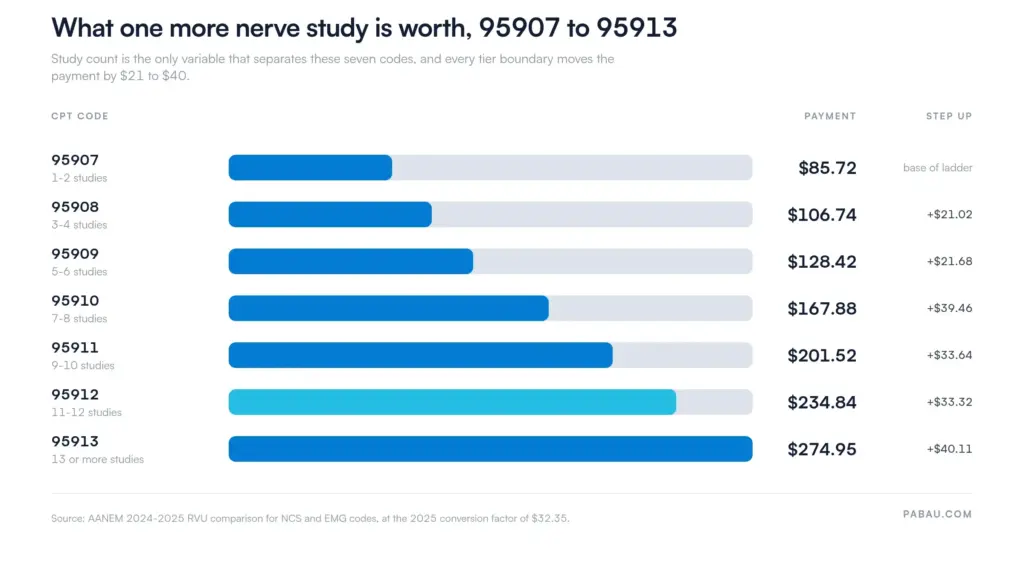
Codes 95907 through 95913 are differentiated solely by the number of individual studies performed during a single session, as confirmed by AAPC’s CPT code reference. The ladder has been stable since CPT 2013, with each code covering two study counts until 95913 opens at 13. CPT Code 95912 occupies the 11-12 study tier.
The size of each step up the ladder is what makes the count worth checking. Moving from 95911 to 95912 adds $34.42 per session, and moving from 95912 to 95913 adds another $46.79. No boundary on the ladder is worth less than $23.
CMS billing and coding articles A54095 and A56619 carry the study-count rules your MAC applies. Cross-check them before billing a session that lands near a boundary.
Correct code selection for CPT Code 95912 depends entirely on an accurate study count. Each distinct nerve tested counts as one study, whether it is a motor, sensory, or mixed nerve conduction study. Bilateral testing of the same nerve counts as two studies.
Take a combined upper and lower limb evaluation for suspected polyneuropathy with a carpal tunnel question. The session records:
That totals 12 studies, which sits at the top of the 95912 tier. Drop the radial sensory comparison and the count falls to 10, which belongs to 95911. Run the radial comparison on one side only and the count is 11, the first study that qualifies for 95912. Add an F-wave study on each median nerve to the original twelve and the total reaches 14, which requires 95913.
Document each study performed with the nerve name, side tested, and result in the interpretation report before coding. CMS auditors use the written report to verify the study count matches the billed code. A report listing twelve nerve-response waveforms supports 95912. A report listing nine waveforms supports 95911, and billing 95912 against it is an overpayment waiting to be recovered.
CPT Code 95912 must be linked to a diagnosis code that establishes medical necessity. CMS billing and coding articles A54095 and A56619 define which ICD-10-CM codes support coverage for nerve conduction studies. The diagnoses below are commonly accepted by Medicare and most commercial payers.
Covered lists are revised, so verify against the current active LCD before billing. Because 95912 requires a count of 11 or 12, the diagnoses that justify it tend to be the multi-limb ones. Our reference library of ICD-10-CM codes carries the official descriptor behind each entry in the table.
Always link the specific ICD-10-CM code to the documented clinical finding, not just the presenting complaint. A diagnosis code that reflects the referring note without matching clinical documentation in the NCS report is a common denial trigger.
Electromyography codes 95885 and 95886 may be billed on the same date of service as CPT Code 95912 when both procedures are performed and documented. The combination is common in neurology practices, where NCS and needle EMG together characterize a peripheral nerve condition.
Same-day billing is subject to National Correct Coding Initiative edits, so verify current bundling status in the CCI edit table before submitting. Strengthening your clean claim submission practices reduces the risk of automatic denial.
Scope separates the two EMG codes. Code 95885 covers a limited study of one extremity, while 95886 covers a complete study.
A complete bilateral EMG alongside a 12-study NCS session requires documentation showing medical necessity for each component. Write separate interpretation paragraphs for the NCS findings and the EMG findings, so a reviewer can follow the rationale for each.
Complete documentation is the primary defense against audit findings and claim denials for CPT Code 95912. CMS and commercial payers require a written interpretation report that can stand on its own as evidence of medical necessity. Capturing that detail at the point of service is far easier than reconstructing it weeks later from a waveform printout.
The interpretation paragraph is where most audit failures originate. A report that lists waveform data without clinical correlation carries significant audit exposure. So does a report signed by someone other than the billing provider without a proper supervision agreement.
NCS billing errors fall into a predictable set of categories. Addressing them systematically is more effective than reviewing individual claims after denial. The checks that catch them belong at the coding and documentation stage, before the claim is ever built.
Payer policies for NCS billing differ meaningfully from Medicare to commercial plans. Verify eligibility before each NCS session, and check whether the payer sets frequency limits or prior authorization requirements for this code. Tracking those requirements by payer type is what keeps clean claim rates steady across a mixed panel.
Commercial payer policies change more frequently than Medicare coverage articles. The safest practice is to check payer-specific policies quarterly rather than relying on knowledge that is more than six months old.
Billing CPT Code 95912 accurately depends on three steps happening consistently. The study count has to be captured in the documentation. The correct ICD-10 diagnosis has to be linked to the claim. Then a clean 837P has to reach the right clearinghouse.
Pabau, practice management software for medical and allied health practices, connects all three steps through its claims management software.
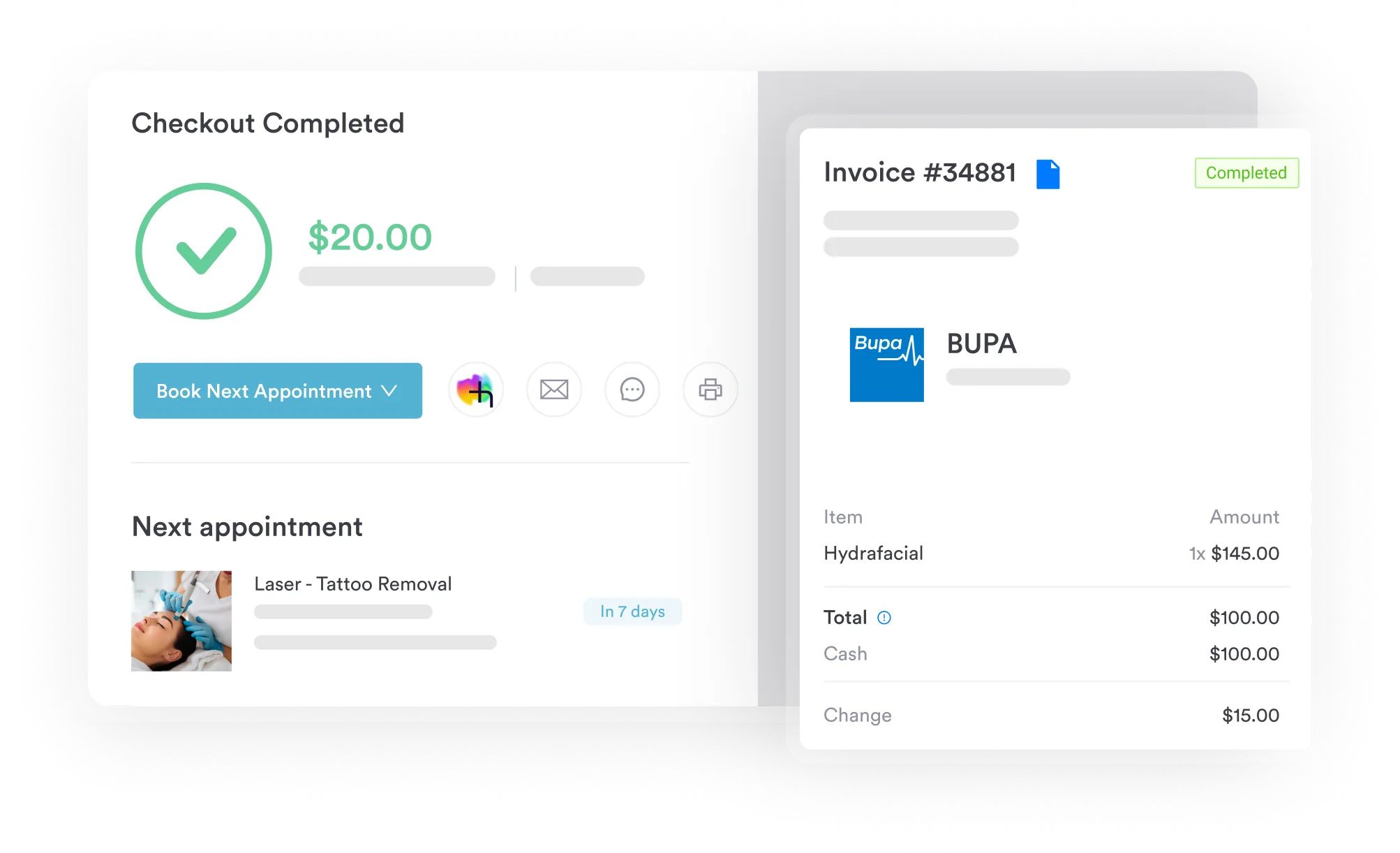
Pabau integrates with Claim.MD, our US clearinghouse partner, routing NCS claims to over 4,000 US payers. The integration handles CMS-1500 and 837P electronic claims, real-time eligibility checks, and electronic remittance advice on 835 remittances.
When a 95912 claim returns with a CARC denial code, the reason appears in the platform beside the original claim data. Billers can investigate and resubmit without leaving the system.
Built-in CPT and ICD-10 catalogs reduce the risk of invalid code combinations reaching the payer. Pabau’s reporting tools surface claim acceptance rates by code. For a practice managing a mixed panel across Medicare, Anthem, and commercial plans, that report shows which codes are losing money.
Run a monthly audit of your 95912 claims using Pabau’s reporting filters: sort by denial reason code, then group by ICD-10 diagnosis. If one diagnosis code generates repeated denials, check whether it still appears on the current active coverage article for your MAC. Those lists gain and lose diagnosis codes mid-year without direct notice to providers.

Pabau helps neurology and allied health practices capture study documentation, select the right NCS code, and submit clean claims electronically. See how the billing workflow holds up under payer scrutiny.

Accurate billing for nerve conduction studies rests on one discipline. Count the studies from the documentation rather than from the order sheet. CPT Code 95912 is the correct code when 11 or 12 individual studies are performed and documented. The claim also needs a covered ICD-10-CM diagnosis and a physician-signed interpretation report.
The trade-off worth remembering is that the boundaries on either side of 95912 each move the payment by more than $30. That is small enough to ignore on one claim and large enough to matter across a year of neurology volume. Build the count check into the point where the report is signed, and the code takes care of itself.
Pabau’s claims management software and Claim.MD integration give neurology and allied health practices the infrastructure to submit clean NCS claims and resolve denials quickly. Book a demo to see how the billing workflow handles NCS coding, documentation, and denial follow-up in one place.

Need to understand how claim denials are tracked and resolved? Denial management in healthcare explains the systematic approach to reducing NCS and other neurology claim rejections.
Submitting NCS claims electronically for the first time? How the Claim.MD clearinghouse works walks through the 837P submission pathway, real-time eligibility, and ERA processing.
Want to verify eligibility before each NCS session? Medical claims clearinghouse guide covers how clearinghouses validate claims before they reach the payer, reducing same-day denials.
CPT Code 95912 is the billing code for nerve conduction studies when 11 or 12 individual studies are performed in one session. It is used to evaluate peripheral nerve function in conditions such as peripheral neuropathy, carpal tunnel syndrome, and radiculopathy. The code covers the physician interpretation and the technical component of the testing session in a non-facility setting.
CPT 95911 covers 9-10 nerve conduction studies, 95912 covers 11-12 studies, and 95913 covers 13 or more studies. Code selection is determined by the total number of individual nerve studies performed and documented during the session. Each nerve tested on each side counts separately, so a bilateral study of one nerve counts as two.
The 2026 national non-facility average is $253.33, calculated from 7.58 total RVUs and a conversion factor of $33.42. That is $34.42 more than 95911 and $46.79 less than 95913. Locality adjustments and facility place-of-service both change the amount, so confirm the figure in the CMS Physician Fee Schedule lookup for your jurisdiction.
Yes, CPT 95912 may be billed on the same date of service as EMG codes 95885 and 95886. Both procedures must be performed and separately documented. Same-day billing is subject to NCCI bundling edits. Verify the current CCI edit table and apply any required modifiers before submitting the combined claim.
Commonly accepted ICD-10-CM codes include G56.00 (carpal tunnel syndrome), G60.9 (idiopathic neuropathy), and G62.9 (polyneuropathy). The list also covers M54.12 (cervical radiculopathy), M54.16 (lumbar radiculopathy), and E11.40 (type 2 diabetes with neuropathy). Covered diagnoses must align with the current active coverage article for your Medicare Administrative Contractor. Commercial payer lists may differ.
Required documentation includes the referring diagnosis, the ordering physician’s name and NPI, and individual results for each nerve tested covering latency, amplitude, and conduction velocity. A signed physician interpretation must correlate the findings with the clinical indication. Some MACs also ask for technologist credentials and equipment information.
The most common error is miscounting studies and billing the wrong code in the 95907-95913 range. Two others follow closely: billing 95885 or 95886 alongside 95912 without separate EMG documentation, and failing to link the claim to a covered diagnosis code. Each has a different fix, namely a pre-submission count check, a documentation review, and coverage verification before the session.