CCSD Code G6080: Laparoscopic small bowel resection billing guide
CCSD Code G6080: Definition and clinical scope CCSD Code G6080 is the procedure ...

Last Updated: Oct 15, 2026
95851 is the CPT code for range of motion measurements and report (separate procedure); each extremity (excluding hand) or each trunk section (spine). Physical therapists, occupational therapists and physicians report one unit for each extremity or spine section they formally measure and write up.
The hand is carved out into its own code, CPT 95852. The "separate procedure" label means payers often bundle 95851 into a same-day evaluation or E/M visit. It's paid separately only when the record shows a distinct service with its own written report.
Let Pabau's smart automation suggest the right codes, reduce claim denials, and keep your practice compliant—effortlessly.
Automate repetitive tasks and focus on what matters most—your patients.
Reduce coding errors and ensure compliance with the latest regulations.
Clean claims, fewer denials, and faster reimbursements.
Powerful insights and reporting to help your practice thrive.
HIPAA compliant SOC 2 certified GDPR-compliant Trusted by 4,000+ clinics worldwide

CPT code 95851 covers ROM measurement and a written report for each extremity (excluding the hand) or each trunk section. The hand and wrist use 95852.
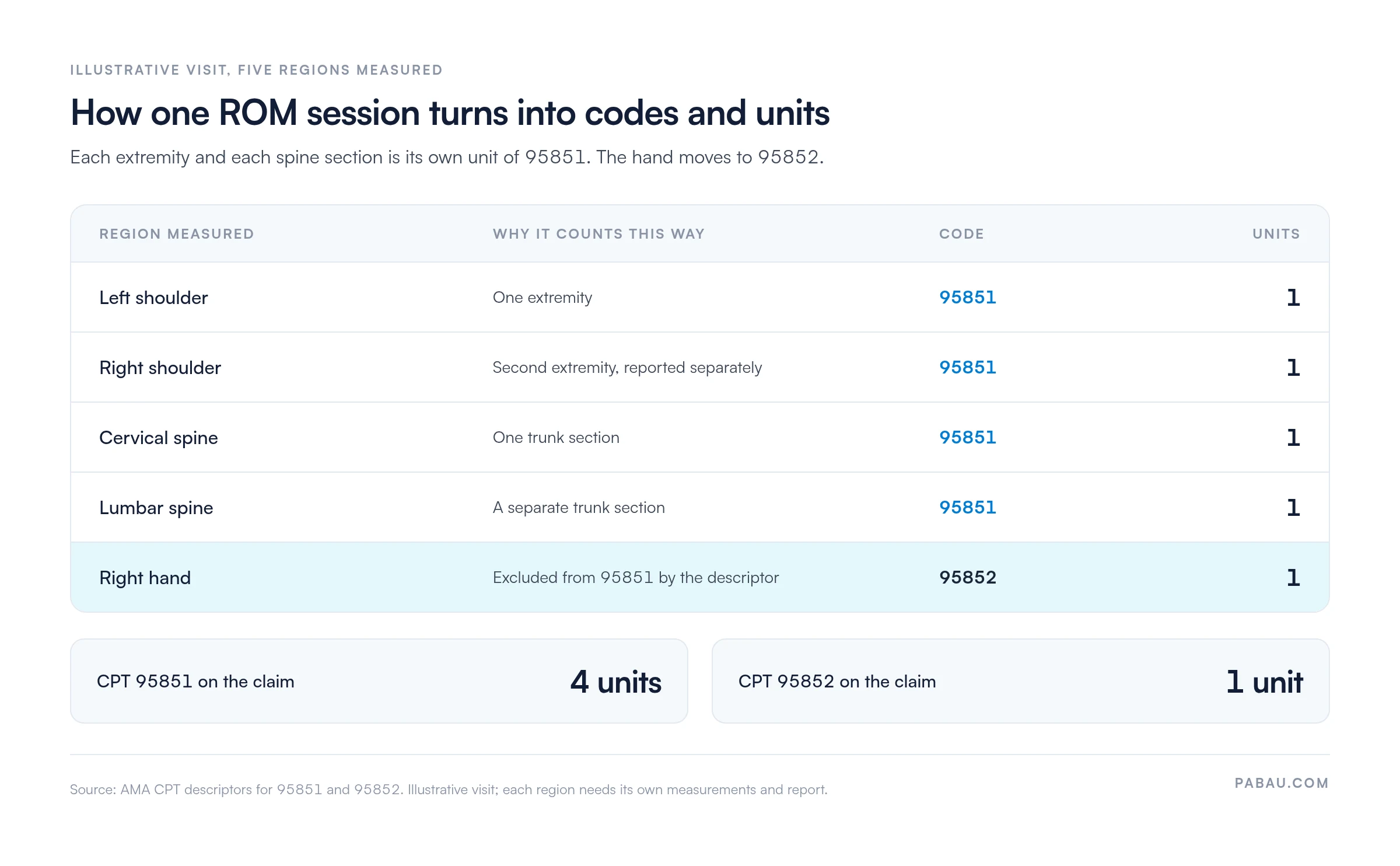
The code is reported per extremity or trunk section measured, so bilateral shoulder ROM is two units of 95851.
The descriptor requires a written report. A goniometer reading alone in the treatment note doesn’t satisfy it and is a common denial and audit-recoupment reason.
Pabau, the practice software we build, stores ROM measurements and the written report in the patient record through its digital forms. Claim.MD then submits the claim and returns remittance data.
The American Medical Association (AMA) publishes the official descriptor for CPT code 95851. It reads: “Range of motion measurements and report (separate procedure); each extremity (excluding hand) or each trunk section (spine).”
The parenthetical “(separate procedure)” signals a specific AMA coding convention. Payers may bundle the service into a more comprehensive procedure, such as a PT evaluation. The exception is a ROM assessment performed and documented as a distinct service. The code can still be billed separately, but the claim has to justify the separation.
The code is not a timed code. Time spent does not affect the unit count or the reimbursable amount. Units are driven entirely by how many extremities or trunk sections are formally measured and reported.
CPT 95851 covers extremity and spine ROM except the hand. The hand is carved out of 95851 into its own code, CPT 95852.
A frequent coding error starts when a PT measures a patient’s shoulder and wrist in the same session and bills two units of 95851. The wrist unit should be 95852. Both codes can appear on the same claim, but each must describe the correct region.
Coding a multi-region visit comes down to counting regions, as the worked example below shows.
CPT codes 95831 and 95832 are manual muscle testing (MMT) codes, not range of motion codes. They measure strength, not joint mobility. They are frequently confused with 95851 because both assessments often happen in the same session.
Can 95851 and 95831 be billed together? Only when the current NCCI edit table allows it. The National Correct Coding Initiative (NCCI) pairs codes in procedure-to-procedure edits, and each pair carries a modifier indicator. Modifier 59, XS or XP can bypass the edit only where that indicator is 1, and only for a documented, distinct service.
XP is narrow. It signals that a different practitioner performed the second service, so it isn’t a general fix for the bundle. Payers, particularly no-fault and PIP carriers, also dispute whether both tests are separately compensable in one encounter. Check the current-year table before billing both codes on the same claim.
The descriptor requires both measurements and a report. Each element has a specific documentation standard that payers audit during claims review.
CPT 95851 is not a timed code. The documentation must reflect what was measured and reported, not how long the assessment took.
Eligible providers include physical therapists, occupational therapists, physiatrists (physical medicine and rehabilitation physicians), and orthopedic surgeons. Some payers also recognize chiropractors as eligible billers for 95851. Scope of practice varies by state and payer contract, so verify before billing. For guidance on OT-specific coding, the OT Potential CPT guide covers occupational therapy code selection in detail.
Medicare incident-to billing applies when a non-physician practitioner performs the service in a physician’s office under that physician’s supervision. Incident-to services there need direct supervision, meaning the physician is in the office suite and immediately available (CMS Medicare Benefit Policy Manual, Chapter 15). A therapist enrolled in private practice isn’t billing incident-to. They bill under their own NPI.
CMS covers CPT 95851 under outpatient physical and occupational therapy services. Reimbursement is calculated using the Medicare Physician Fee Schedule (MPFS), which assigns relative value units (RVUs) to the code. The fee schedule breaks down into three RVU components: work RVU (clinician effort), practice expense RVU (overhead), and malpractice RVU. The geographic practice cost index (GPCI) applies a locality adjustment to all three.
Because Medicare rates change annually on January 1, no specific dollar amount is published here.
Use the CMS MPFS Look-Up tool to pull the current non-facility and facility payment amounts for 95851 in your specific locality.
The non-facility rate applies to outpatient practices and private offices. The facility rate applies when services are provided in a hospital outpatient department or skilled nursing facility. For a quick RVU lookup, the FastRVU 2026 lookup tool provides searchable work, PE, and MP RVU data by code.
Pabau submits US claims through the Claim.MD clearinghouse. The electronic remittance advice that comes back shows the allowed amount and any contractual adjustments. Reconcile each electronic remittance advice against your fee schedule to catch underpayments.
Medicaid rates for 95851 vary significantly by state. Some states reimburse at Medicare rates; others use their own fee schedules, which may be higher or lower. For state-specific Medicaid rates, start with the individual state Medicaid agency fee schedule or a reference tool such as PayerPrice. Do not rely on a neighboring state’s rate as a proxy.
Private payers follow their own policy guidelines for 95851. Highmark’s general policy guidelines, for example, address ROM measurement codes and may limit when they’re separately reimbursable alongside an evaluation. Requirements vary by contract, not just by code.
Run a payer-specific eligibility check before scheduling a standalone ROM assessment visit. Many payers attach ROM measurement reimbursement to a broader evaluation. They’ll deny 95851 as a duplicate if an evaluation code was billed in the same therapy episode without documentation of a distinct clinical purpose.
CPT 95851 denials cluster around a small number of predictable errors. Each one has a clear correction pathway. Building denial management workflows around these patterns reduces resubmission volume and speeds up payment. The CARC on each denial tells you which pattern you’re facing, and our guide to medical billing denial codes maps each one to a response.
Every correction above points the same way. A clean claim goes out with the right code, the right units, and a written report already in the record.
Understanding which codes can and cannot sit alongside 95851 on the same claim is essential for clean billing. The AAPC Codify CPT lookup provides current NCCI edit data for each of the following code pairs.
Verify NCCI edit status against the current-year edit table before submitting any of the potentially bundled pairs. Edit applicability changes annually. ROM work done inside an initial evaluation belongs to the evaluation code, such as 97161 for a low-complexity PT evaluation.
Most therapists know 95851 needs a written report. Denials and recoupments follow when the documentation template never produces one, so there’s no discrete report to send when a payer requests records.
Pabau’s claims management software starts on the clinical side. A digital form built for ROM testing captures each region, the instrument, and the joint angles. The findings save as a report in the patient record, next to the visit they belong to.
That puts the report where billing staff can see it. Before a claim goes out, they can check the regions measured against the units billed, so a bilateral assessment isn’t sent as one unit.

For US practices, Pabau sends claims through Claim.MD, which submits them and returns remittance data. When a 95851 claim is denied, the remittance shows the CARC. Your team works the fix from the denial table above, with the report already on file.

Pabau’s digital forms keep ROM measurements and the written report in the patient record, ready when a payer asks. Claim.MD submits the claim and returns remittance data to Pabau.

CPT 95851 pays when the record answers a payer’s questions before they’re asked. Which regions were measured, and with what instrument? Where’s the written report? Why was the work separate from any evaluation or E/M billed that day?
Build those answers into the ROM form itself, and billing becomes a matter of counting regions. Leave them to memory, and every multi-region visit is a recoupment request waiting to happen.
Book a demo to see how Pabau keeps ROM measurements and reports in the patient record, ready for every claim you send.

Billing a re-evaluation on the same date? CPT code 97164 covers when a PT re-evaluation is billable and what to document.
Wondering how denial codes map to corrective action? Denial codes in medical billing explains CARC and RARC codes and how to respond to each.
Looking for a clearinghouse comparison for your therapy practice? Medical claims clearinghouse guide covers what to look for when choosing a clearinghouse for PT and OT claims.
Checking coverage before a standalone ROM visit? Insurance eligibility verification walks through what to confirm with the payer before the patient arrives.
CPT code 95851 covers range of motion measurements and a written report for each extremity (excluding the hand) or each trunk section of the spine. It’s reported per extremity or section measured. It requires a calibrated measurement (goniometer or inclinometer) and a discrete written report, not just a notation in the treatment chart.
Sometimes, but payment isn’t automatic. ROM measured as part of the E/M exam isn’t separately reportable. 95851 is payable only when the record shows a distinct, separately identifiable ROM measurement and report. When a physician bills both, modifier 25 goes on the E/M code, not on 95851, and it doesn’t guarantee payment. No-fault and PIP payers are particularly aggressive in disputing this combination.
The AMA descriptor requires both measurements and a report. Record numerical joint angles taken with a calibrated goniometer or inclinometer, and identify each extremity or trunk section measured. Write a report that stands apart from general treatment notes, and link the ROM findings to the plan of care. A goniometer reading in a flow chart without a discrete report is a common denial and audit-recoupment reason for this code.
Six patterns account for the usual denials. The first is a missing written report, since the descriptor requires one. The second is billing 95851 with a PT evaluation code on the same date. NCCI bundles that pair with modifier indicator 0, so a modifier can’t override it (verify the current edit table). The third is a same-day E/M where the ROM work wasn’t a distinct service. The others are billing one unit for bilateral measurements, using 95851 for hand ROM instead of 95852, and supervision deficiencies under Medicare.