HCPCS Code S0115: Deleted bortezomib billing code
HCPCS Code S0115 is a deleted Level II S-code that described bortezomib, 3.5 mg,...

Last Updated: Oct 5, 2026
95940 is the CPT code for continuous intraoperative neurophysiology monitoring in the operating room, one-on-one and in person, for each 15 minutes. It is an add-on code, listed in addition to the code for the primary surgical procedure.
Monitoring teams use it for SSEP, MEP, EMG and EEG monitoring during spine, brain, vascular and ENT surgery. Remote or nearby oversight, or monitoring more than one case at once, moves the claim to CPT 95941, which is billed per hour.
Let Pabau's smart automation suggest the right codes, reduce claim denials, and keep your practice compliant—effortlessly.
Automate repetitive tasks and focus on what matters most—your patients.
Reduce coding errors and ensure compliance with the latest regulations.
Clean claims, fewer denials, and faster reimbursements.
Powerful insights and reporting to help your practice thrive.
HIPAA compliant SOC 2 certified GDPR-compliant Trusted by 4,000+ clinics worldwide

CPT code 95940 is an add-on code for continuous, one-on-one IONM in the operating room, reported for each 15 minutes of monitoring.
Remote or nearby oversight, or monitoring more than one case at once, moves the claim to CPT 95941, which is billed per hour.
A 15-minute unit counts once more than half of it has passed, so 98 documented minutes bill as 7 units.
Modifiers -26 and -TC don’t apply to 95940, because the code has no professional and technical split.
Spine surgery is the most common context, but 95940 also covers brain tumor resection, vascular surgery, and ENT procedures using SSEPs, MEPs, or EMG.
CPT code 95940 describes continuous intraoperative neurophysiology monitoring in the operating room, one-on-one monitoring requiring personal attendance, each 15 minutes. It is an add-on code, listed separately in addition to the code for the primary procedure.
The American Medical Association (AMA) maintains this code within the Medicine section of the CPT code set, under the Neurology and Neuromuscular Procedures subsection (95700-96020).
Three rules govern every 95940 claim. First, the code is time-based, so each unit represents a 15-minute interval of monitoring rather than the whole case. Second, the monitoring professional must be in the operating room, attending one patient. Third, 95940 is never billed on its own, because it rides on the primary surgical procedure code.
Spine surgery accounts for the majority of CPT 95940 claims. Scoliosis correction, spinal fusion, and decompression can injure the spinal cord or nerve roots. Continuous neurophysiological monitoring is therefore a patient safety standard in most major spine centers.
Beyond spine, four other surgical contexts regularly generate 95940 claims:
The monitoring modalities vary by procedure. Somatosensory evoked potentials (SSEPs) and motor evoked potentials (MEPs) are the workhorses for spine cases. EEG monitoring is standard in vascular and craniotomy contexts. Free-run EMG and triggered EMG appear most in ENT and orthopedic spine work.
CPT 95940 applies when the interpreting physician is physically present in the operating room, monitoring one patient. CPT 95941 applies when monitoring happens from outside the room, whether nearby, in another facility, or via telemedicine. It also covers monitoring more than one case at once. Payers treat a 95940 claim for remote monitoring as incorrect billing.
A common error starts when a neurophysiologist begins monitoring in the OR, then steps out to manage a second case. From the moment the physician leaves the room, those intervals belong to 95941. Documentation must reflect this transition precisely, with start and stop times for each code.
CPT code 95940 sits within a broader neuromonitoring code family. Coders managing IONM claims need to recognize all of the adjacent codes to avoid incorrect substitutions and NCCI edit violations. Baseline SSEP testing before or after surgery, for example, bills as 95938 rather than as a monitoring code.
Calculating billable units correctly is where IONM billing most often goes wrong. Each 15-minute period of continuous monitoring equals one unit, so a 90-minute session bills as 6 units. CPT’s midpoint rule covers the remainder: a unit counts once more than half of its 15 minutes has passed.
So a 96-minute session still bills as 6 units, while a 98-minute session bills as 7. The thresholds below show where each extra unit starts.
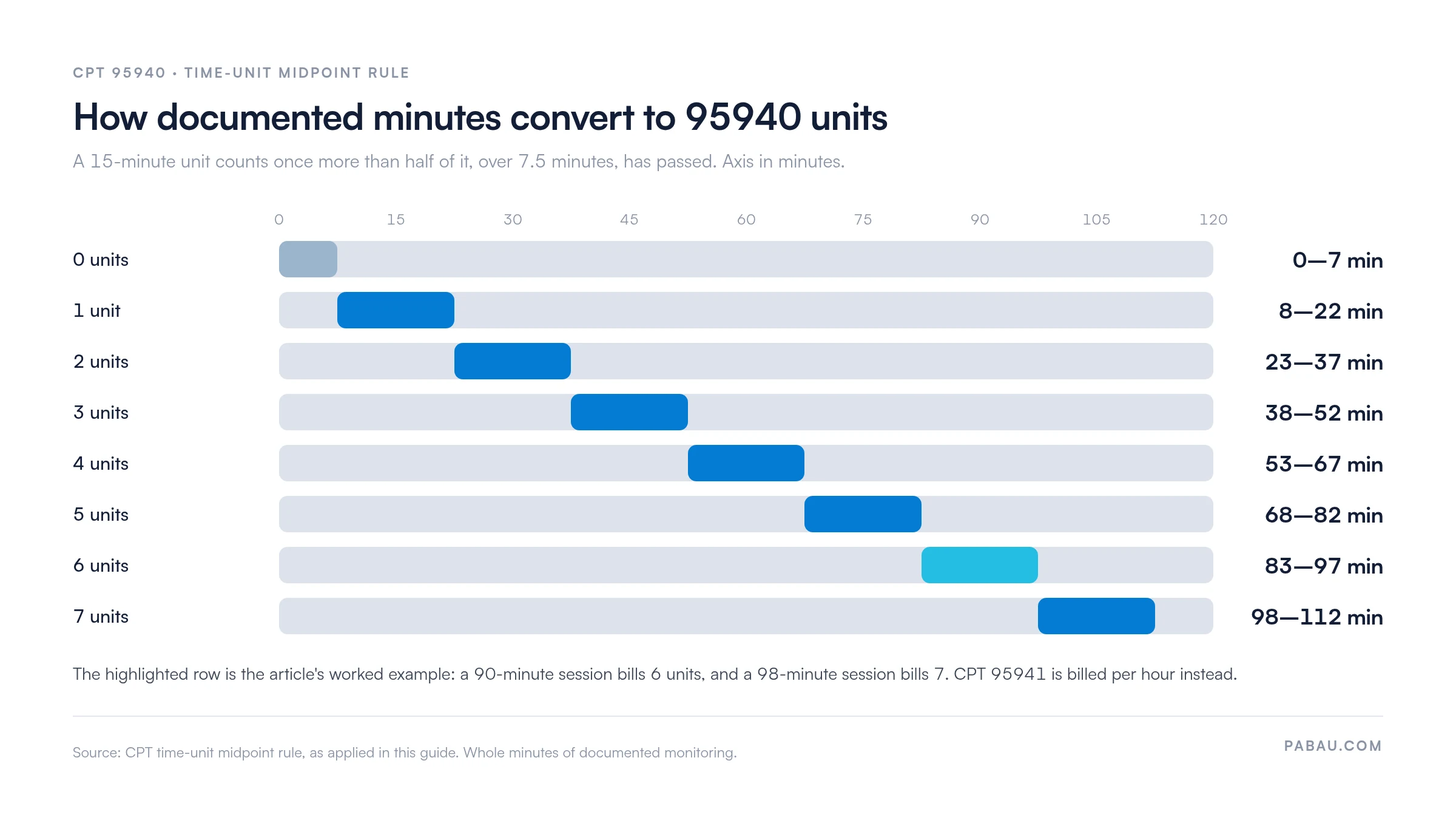
The operative report has to capture start and stop times for monitoring. Here is how to convert those times to billable units:
If the physician steps out mid-case and remote oversight continues, the in-person interval bills as 95940 units. The remote interval bills as 95941, in hourly units. The two cannot overlap, and total billed units across both codes must match the total documented monitoring time.
Document start and stop times for each monitoring interval as separate entries in the operative report, not as a single block. When 95940 and 95941 both apply in the same case, auditors will reconstruct a timeline from the documentation. Overlapping or unaccounted minutes between intervals trigger denial.
Medical necessity for CPT code 95940 depends on an appropriate ICD-10-CM diagnosis code that supports the clinical rationale for intraoperative monitoring. Payer LCDs vary, but the following diagnoses are broadly accepted across commercial and Medicare payers:
Code to the highest specificity the record supports. A scoliosis correction billed with M41.9 gives the payer less to match against LCD criteria than a code naming the curve type and region.
Always verify the specific diagnosis codes against the MAC LCD covering the billing jurisdiction. CMS Medicare Coverage Database Article A56722 defines intraoperative neurophysiological testing coverage criteria and should be consulted for Medicare claims specifically.
CPT 95940 has no professional and technical split, so modifiers -26 and -TC don’t apply to it. The AMA’s CPT Assistant corrected earlier guidance on this in August 2017. On the Medicare fee schedule, 95940 carries PC/TC indicator 0 and 95941 carries indicator 9, and neither allows a component split.
The modifiers that do apply to 95940 come up in specific billing situations. Using the wrong one, or omitting a required one, reliably generates a denial.
Medicare reimburses CPT code 95940 under the CMS Physician Fee Schedule, which updates annually each January. Rates are expressed per 15-minute unit and vary by geographic practice cost indices (GPCI). The 2026 fee schedule should be confirmed via the CMS MPFS lookup tool, as rates are subject to annual adjustment and any legislative updates.
The RVU structure for 95940 breaks down across three components: work RVUs, practice expense RVUs, and malpractice RVUs. Use the FastRVU 2026 RVU lookup tool to retrieve the current work/PE/MP breakdown and calculate the locality-adjusted allowed amount for your MAC jurisdiction.
Commercial payer rates for 95940 vary significantly. Many commercial plans negotiate rates above Medicare, particularly for high-acuity spine programs. Others apply lower multipliers or cap total units per case. Check the AAPC’s CPT code reference for commonly cited benchmark ranges, and always verify with individual payer contracts.
Prior authorization (PA) requirements for intraoperative neurophysiological monitoring vary by payer and plan year. Medicare generally does not require PA for 95940 when the procedure meets Local Coverage Determination criteria. Commercial payers increasingly do require it for IONM, particularly for elective spine cases.
Building a solid insurance eligibility verification step before scheduling any IONM case is the most reliable way to surface PA requirements. For Medicare cases, the LCD published by your jurisdiction’s MAC defines the covered surgical contexts. It also sets the diagnostic criteria the patient must meet.
An IONM PA request typically needs this documentation package:
Incomplete documentation drives many of the 95940 denials that get past the initial coding check. Meeting clean claim requirements for IONM means the monitoring report must contain specific elements that auditors can verify against the operative note.
Required elements in the IONM monitoring report for CPT 95940 claims:
The superbill documentation submitted with an IONM claim should cross-reference the monitoring report. The billed unit count must match the documented monitoring duration. A four-unit claim on a 90-minute session signals an arithmetic error and invites scrutiny, so check the count before the claim goes out.
CPT code 95940 has a predictable denial pattern. Most denials cluster around a handful of root causes, and each one maps to a specific fix in the pre-submission workflow. The CARC on each remittance names the cause, and our guide to reading denial codes explains each one.
Practices with a structured denial management workflow catch most of these issues at pre-submission rather than post-denial. A pre-submission NCCI edit check and an eligibility confirmation that flags PA requirements take less than two minutes per case. Together they prevent the most common denial categories.
Run a batch audit of your last 90 days of 95940 claims. Group denials by denial code. If more than 30% share the same CARC (Claim Adjustment Reason Code), the cause sits in a single workflow step. Fix that step instead of appealing each claim individually.
Many IONM billing teams still copy start and stop times by hand from the monitoring report into a separate billing system. Each copy is a chance to miscount a unit, miss a PA requirement, or send 95940 where 95941 belonged.
Pabau, the practice management platform we build, runs insurance eligibility checks before surgery and submits claims electronically through its Claim.MD clearinghouse integration. Its error-catching claims management tracks each claim to remittance, and ERA files post back against every billed unit.
The result is fewer hand-offs between the monitoring report and the claim. A short-paid 95940 line shows up in the same week, with its CARC attached, so your team can fix the cause.

Pabau integrates with Claim.MD to support time-based claims like CPT 95940. Eligibility verification, ERA reconciliation, and clean claim tracking sit inside your practice management workflow.

Get two facts into the operative record on every case: where the monitoring professional was, and when each interval started and stopped. Those two lines decide the code, the unit count, and whether the claim survives an audit.
If your current reports can’t show both, change the report template before the next spine case. A few extra timestamps per case cost far less than reworking a denied claim. Book a demo to see how Pabau tracks IONM claims from the eligibility check to the remittance.

Need to understand the clearinghouse that handles your IONM claims? Medical claims clearinghouse overview explains how electronic claims flow from practice to payer.
Want to reduce claim errors across your billing team? Medical billing fundamentals covers the end-to-end revenue cycle from charge capture through payment posting.
Dealing with recurring denials on neurophysiology claims? Denial codes in medical billing explains CARC and RARC codes and how to map them to root-cause fixes.
CPT code 95940 covers continuous intraoperative neurophysiological monitoring with the interpreting physician physically present in the operating room. It is an add-on code, billed for each 15 minutes of monitoring. It includes any combination of modalities (SSEP, MEP, EMG, EEG) monitored during surgery to detect and prevent neurological injury.
The difference is physician location. 95940 requires the interpreting physician to be physically present in the OR and bills per 15 minutes. 95941 covers remote oversight and bills per hour. The same physician cannot bill both codes for the same patient on the same date of service. Billing 95940 for remote oversight is incorrect billing.
Modifier -59 is the one you’ll use most, when 95940 is billed alongside a service subject to an NCCI edit. Modifier -GC applies when a teaching physician is present in an academic setting, and -CR only in payer-directed disaster circumstances. Modifiers -26 and -TC don’t apply, because 95940 has no professional and technical split.
Broadly accepted ICD-10 pairings include scoliosis (M41.xx), spondylosis with myelopathy (M47.xx), aortic aneurysm (I71.xx), carotid occlusion (I65.2x), and brain neoplasms (D33.x). Accepted codes vary by jurisdiction, so check your MAC’s LCD for Medicare claims and each payer’s coverage policy for commercial ones.
CPT 95940 may be billed by a physician or other qualified healthcare professional who is physically present in the operating room. That person serves as the interpreting clinician throughout monitoring. A nonphysician IONM professional providing remote oversight must bill 95941 instead, regardless of their credentials.
The leading denial reasons are missing prior authorization and billing 95940 when the physician was remote. Others include a diagnosis that misses the payer’s LCD criteria, unit calculation errors, and a missing attestation of physical presence.