HCPCS code P9058: Red blood cells, leukocytes reduced, CMV-negative, irradiated
HCPCS code P9058: Official descriptor and key attributes HCPCS code P9058 report...

Last Updated: Oct 26, 2026
95180 is the CPT code for a rapid desensitization procedure, reported per hour, with insulin, penicillin and equine serum named as examples.
Allergy practices report it for accelerated allergen immunotherapy on both rush and cluster schedules, at one unit per hour of direct physician or QHP observation. Standard build-up and maintenance injection visits stay on 95115 or 95117. The two accelerated schedules differ by pace and session length, and both use 95180.
Let Pabau's smart automation suggest the right codes, reduce claim denials, and keep your practice compliant—effortlessly.
Automate repetitive tasks and focus on what matters most—your patients.
Reduce coding errors and ensure compliance with the latest regulations.
Clean claims, fewer denials, and faster reimbursements.
Powerful insights and reporting to help your practice thrive.
HIPAA compliant SOC 2 certified GDPR-compliant Trusted by 4,000+ clinics worldwide

CPT Code 95180 reports rapid desensitization per hour of direct physician or QHP observation, not routine allergy injections.
The code requires documentation of physician supervision, start and stop times, each escalating dose given, and the observation period after the final dose.
Rush and cluster immunotherapy differ by schedule and session length, and both are reported with 95180 per hour (AMA CPT Assistant, June 2019).
Payer policy still varies, so check whether the plan covers accelerated inhalant immunotherapy before the first session.
Pabau’s claims management software tracks prior authorization status and surfaces 95180 documentation requirements before a claim is submitted.
CPT Code 95180 reports rapid desensitization in hourly units, for rush and cluster allergen immunotherapy as well as drug desensitization.
Each unit is one hour of direct physician or QHP observation, so the documented session length sets the claim. The table below collects the key facts. Check descriptor wording against the AMA CPT code set for the current code year before submitting claims.
CPT Code 95180 covers rapid desensitization, reported in hourly units. In allergy practices, that means an accelerated build-up in which escalating allergen doses are given on a compressed schedule. The patient stays in the office under direct physician or QHP observation between doses.
According to AMA CPT Assistant (June 2019), 95180 is the appropriate code for both rush- and cluster-accelerated desensitization schedules. It is reported in place of multiple units of 95115 or 95117 for those visits. Outside allergen immunotherapy, the same code covers drug desensitization, such as penicillin or insulin.
To bill 95180, each of the following must be true for the encounter:
Extract preparation is not included in 95180. When a new extract is prepared for the accelerated session, CPT 95165 may be billed on the same date. That holds only where the payer allows both codes together.
CPT 95180 is limited to the hours of accelerated desensitization itself. These services sit outside it and need their own codes:
Cluster immunotherapy is not on this list. A cluster visit is an accelerated schedule, so its hours go on 95180 like a rush day, subject to the payer’s own coverage policy.
Rush and cluster immunotherapy differ by how fast doses escalate and how long each session runs. The code does not change between them. ACAAI’s coding guidance bills both under 95180, one unit per hour of direct observation.
The schedule decides the unit count, so the chart must show which schedule was followed and how long the patient was observed. A cluster visit that lasts under an hour may not support a unit at all, so check the payer’s time rule.
Rush and cluster immunotherapy both compress the allergen build-up phase. The clinical steps map directly to what Medicare and commercial payers want in the record to support a 95180 claim.
A narrative note that says “rush immunotherapy performed” without times or a dose log does not meet payer standards. Without start and stop times, the payer cannot match the units to the session, which is a common reason for reduced payment. Both points are basic medical billing compliance.
Before the session begins, confirm prior authorization in writing and document the approval reference number in the chart. A common way to lose a 95180 claim is an authorization given by phone that never made it into the chart.
Each unit of 95180 represents one hour of direct physician or QHP observation during desensitization. Units follow time in the office, not the number of injections given, as the chart below shows for both schedules.
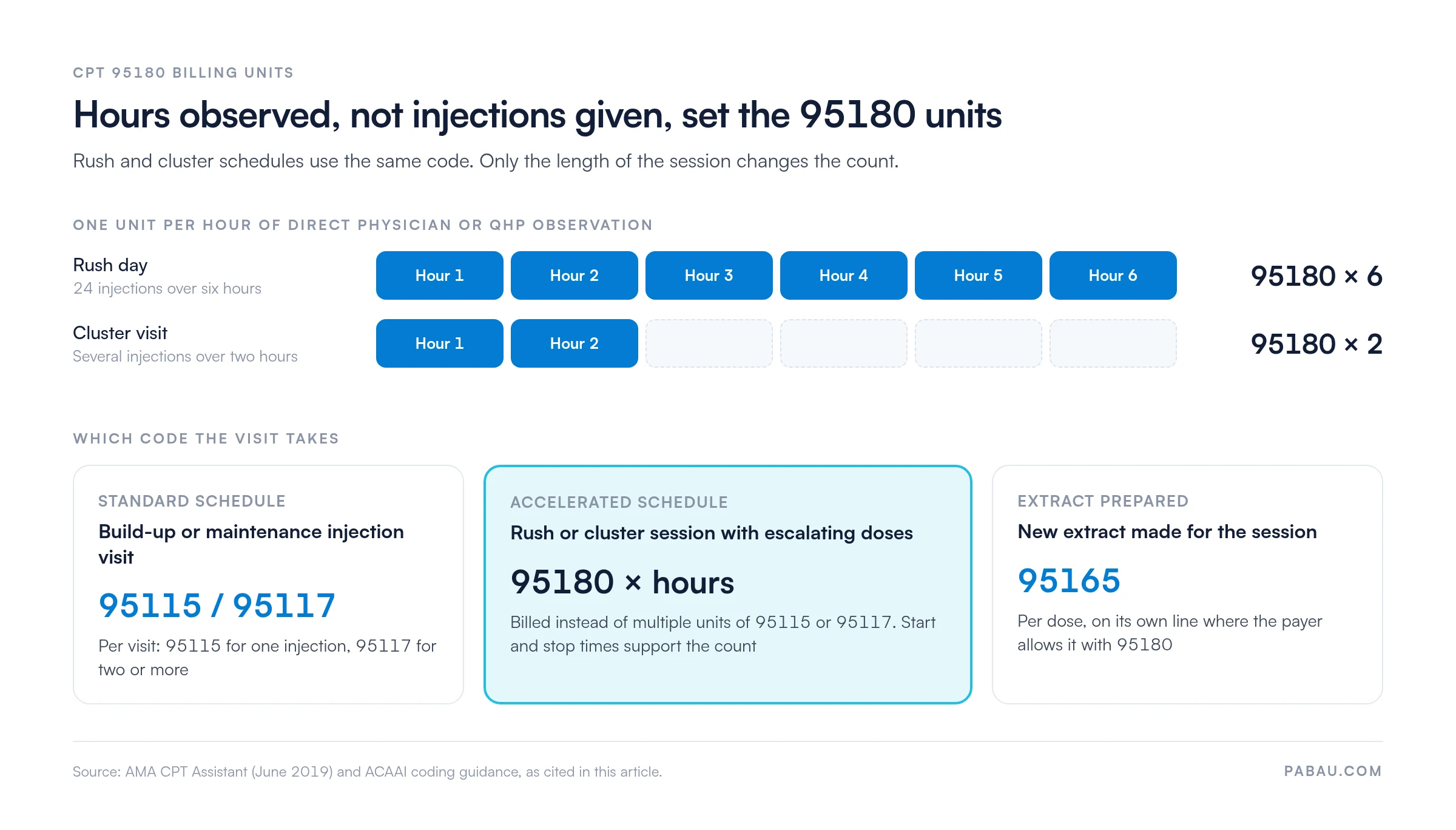
Some Medicare contractors say outright that the hours of desensitization go in the unit field. That makes the documented start and stop times the evidence for the claim.
Coders often confuse the accelerated code with the standard injection codes. The table below sets out how each code in the family is used, drawing on the AAPC CPT code reference.
Modifier usage on 95180 claims is a common audit trigger. Apply each modifier only when the documented circumstances meet its definition.
The 95180 claim must link to a diagnosis that matches the allergens used and the documented test results. These codes are common pairings, though payer lists of covered diagnoses vary.
Medicare has no national coverage determination for 95180. Coverage runs through each Medicare Administrative Contractor’s LCD and billing article on allergy immunotherapy. The claim must link to an ICD-10-CM code for the documented allergic condition being treated.
Contractor wording on 95180 is not uniform. Some MACs frame the code around drug desensitization in their billing guidance. They describe it as the code to use when a drug sensitivity is established and the drug is essential.
Key requirements to check in your MAC’s documents include:
A patient’s preference for a faster build-up does not establish medical necessity on its own. Running insurance eligibility verification before the session also catches Medicare Advantage plan rules that differ from the MAC’s.
Commercial payers vary considerably in how they handle CPT Code 95180 claims. Blue Cross Blue Shield and Ambetter/Centene plans publish medical policies on allergy immunotherapy, and some go further than Medicare.
Confirm payer-specific rules before scheduling an accelerated session. Policy details change, and no published coding reference replaces a direct check with the payer.
The 2026 Medicare Physician Fee Schedule (MPFS) sets the national payment rate for 95180. Because facility and non-facility settings carry different overhead assumptions, the two rates differ.
Use the FastRVU 2026 RVU lookup to calculate the geographic-adjusted rate for your locality. The national unadjusted rate shown below will differ from your payment once the GPCI is applied.
The MPFS rate for 95180 is paid per unit, and each unit is one hour. A six-hour rush day billed at six units pays six times the unit rate. Rates change annually with the MPFS final rule. Confirm exact 2026 payment amounts through the official CMS Physician Fee Schedule lookup tool before financial planning or contract negotiations.
When negotiating commercial contracts for immunotherapy services, pull the Medicare rate for 95180 as your baseline. Then request a percentage of Medicare rather than a fixed dollar amount. Fixed rates lose ground to inflation. A percentage-of-Medicare contract adjusts automatically each time the MPFS updates.
Most 95180 denials trace back to one of the seven causes below, each with its fix. The CARC and RARC on the remittance name the cause, and our denial code explanations decode each one. Tracking which cause recurs is the job of denial management workflows.
Accelerated immunotherapy billing needs a tighter workflow than routine allergy injection visits. Three problems come up most often. Authorization is missing at claim time, the session lacks start and stop times, or 95165 is bundled incorrectly.
Pabau, the practice management platform we build, links its error-checked claims management to clinical documentation. The fields payers check on a 95180 claim come from the session record, so nobody re-enters them. The authorization number entered at scheduling carries forward to the claim.
The dose log and observation times captured during the session stay attached to the encounter. When Pabau sends claims electronically through its Claim.MD integration, eligibility checks run first. That way a claim does not go out against a plan that excludes accelerated immunotherapy.
Denial analytics by CPT code show whether 95180 denials are rising, and whether the cause is documentation, authorization, or payer policy. More on the underlying framework is in medical billing fundamentals.

Pabau tracks prior authorization status and surfaces documentation requirements before each immunotherapy session. Claims go out through integrated clearinghouse workflows, so allergy practices spend less time on appeals.

CPT Code 95180 is a low-volume, high-scrutiny code, and the hourly unit is what makes it different. Rush and cluster schedules both bill under it, so the coding question is how many hours the record supports. Practices that log start and stop times, doses, and authorization before the claim leaves will see fewer 95180 denials.
Pabau connects accelerated session documentation to claim generation, so the record supports every unit from the moment the patient sits down. Book a demo to see how allergy practices use Pabau to reduce immunotherapy claim denials.

Need to understand how clearinghouse submissions work for immunotherapy claims? Medical claims clearinghouse guide explains how claims move from your practice to the payer and where errors are caught.
Want to reduce claim rejections before they reach the payer? Clean claim requirements covers the fields and edits that determine whether a claim passes or fails the first scrub.
CPT Code 95180 covers rapid desensitization, billed per hour of direct physician or QHP observation. In allergy practices it is used for accelerated build-up on rush and cluster schedules. It does not cover standard injection visits, vial preparation (CPT 95165), or skin testing.
Both are billed with CPT 95180, one unit per hour of direct observation, per AMA CPT Assistant (June 2019). Rush usually runs over one or two days with doses about every 30 minutes. Cluster visits last about 1.5 to 2 hours, two or three days a week. Standard, non-accelerated visits stay on 95115 or 95117.
Modifier -25 applies when a separate E/M service with distinct documentation is provided on the same date. Modifier -59 may be needed when CPT 95165 is billed on the same date and the payer bundles the two codes. The place of service (POS 11 or POS 22) should match where the session took place. Verify modifier requirements with each payer before using them routinely.
Medicare can pay for CPT 95180, but coverage depends on your MAC’s LCD and billing article. Some contractors frame the code around drug desensitization, so check whether yours accepts it for accelerated allergen immunotherapy. Medicare Advantage plans may add prior authorization rules, so verify coverage with the patient’s plan before scheduling.
The record needs start and stop times for direct observation, plus a time-stamped log of each dose and any reaction. It also needs the supervising physician’s name, the extract lot number and concentration, and a post-session observation note. Finally, it should state why an accelerated schedule was medically necessary.
The most frequent causes are missing prior authorization, an incomplete dose log, and units not supported by start and stop times. Payer non-coverage of accelerated inhalant immunotherapy, unmet supervision rules, and 95165 bundling errors also cause denials. A pre-session checklist and an authorization check before submission prevent most of them.