



CCSD code G5100: Bypass of duodenum billing guide
CCSD code G5100 bills a bypass that leaves the duodenum in place CCSD code G5100...

Last Updated: Oct 16, 2026

CPT Code 95165 covers professional supervision of preparing and providing antigens for allergen immunotherapy from a multiple-dose vial.
Medicare has defined one dose as a 1 cc aliquot drawn from that multiple-dose vial since January 1, 2001.
A standard 10 cc vial caps at 10 billable doses, however many aliquots the practice draws from it.
Smaller vials cap at their volume in cc, and an NCCI edit limits CPT 95165 to 30 units per date of service.
Preparation in single-dose vials belongs on CPT 95144, which CMS keeps separate from the multiple-dose code.
Practice management software like Pabau carries the logged vial details through to the claim, so billers work from the record.
CPT Code 95165 covers the professional supervision of preparing and providing antigens for allergen immunotherapy, billed per dose. Specifically, Medicare defines one dose as a 1 cc aliquot drawn from a multiple-dose vial, capped at 10 doses per vial. As a result, practices that count vials instead of aliquots understate the claim roughly tenfold.
This guide walks through the official descriptor, the Medicare dose definition, and the 10-dose vial cap. It then works through unit calculation, payer differences, 2026 reimbursement, modifiers, documentation, denials, and the related immunotherapy codes.
The American Medical Association (AMA) descriptor for CPT Code 95165 reads: Professional services for the supervision of preparation and provision of antigens for allergen immunotherapy. It then adds: single or multiple antigens (specify number of doses). That parenthetical carries the whole billing problem. The payer decides what counts as a dose, and Medicare does not count it the way most practices do.
CPT 95165 captures the physician work behind antigen preparation. That means reviewing the allergy test results, prescribing the antigen formulation, and supervising preparation of the multiple-dose vial. Instead, administering the shot is billed separately under CPT 95115 or CPT 95117.
The allergy test results behind that formulation come from a separate testing visit, billed on its own claim. Where intradermal skin testing established the sensitivities, that claim uses CPT 95024, counted per test rather than per session.
CMS reserves CPT 95165 for multiple-dose vials. When the allergist prepares single-dose vials instead, the correct code is CPT 95144, reported per vial. Choosing between the two codes comes first, because the dose rules below apply only to 95165.
Medicare defines one dose of CPT Code 95165 as a 1 cc aliquot drawn from a single multiple-dose vial. In fact, that definition has applied since January 1, 2001. It sits in CMS Billing and Coding Article A57472 and in the matching MAC billing guidance, including L34597 and L30471.
Units therefore follow volume rather than vials or visits. The practice reports the number of 1 cc aliquots the vial supports, up to a maximum of 10 doses per multiple-dose vial. That cap holds even when the allergist draws smaller aliquots and gets more injections out of the vial.
Vials under 10 cc scale down with volume. For example, a 5 cc maintenance vial supports 5 billable doses, and a 3 cc vial supports 3.
Counting vials instead of aliquots is the error that costs allergy practices the most money. A practice that bills 2 units for two 10 cc vials has claimed 2 units where 20 are supported. In short, that is close to a tenfold understatement on every immunotherapy claim it sends.
Likewise, billing once per injection visit is the opposite error. The unit count belongs to the preparation event. The vial is billed when it is prepared, and never again at each subsequent shot.
Two separate limits sit on CPT Code 95165, and a clean claim has to clear both of them.
The first is the per-vial cap. Medicare pays a maximum of 10 doses from any one multiple-dose vial, whatever aliquot size the allergist draws. The cap is a property of the vial, not of the patient or the date of service.
The second is the Medically Unlikely Edit. The NCCI MUE for CPT 95165 is 30 units per provider, per patient, per date of service. Units above 30 are denied automatically. However, genuinely necessary volume can still be appealed with the vial log and the treatment plan.
Unit calculation for CPT Code 95165 follows one rule: count the 1 cc aliquots the vial supports, then apply the caps. Here is the sequence an allergy billing team should run at the time of preparation.
However, commercial payers may count differently. Some follow the Medicare aliquot definition, some pay per vial, and some set their own limit per treatment period. Verify the policy before submitting, because applying Medicare rules to a commercial plan is a frequent denial source.
Medicare and commercial payer rules for CPT Code 95165 diverge more than a shared code number suggests. Therefore, knowing which ruleset applies before the claim goes out is what keeps immunotherapy billing clean. Checking coverage at the start of each preparation cycle confirms the plan type and any prior authorization requirement.
Medicare reimbursement for CPT Code 95165 is set annually through the CMS Physician Fee Schedule (MPFS). The code carries 0.43 total RVUs, which the 2026 conversion factor of about $33.40 turns into roughly $14 per dose. Rates vary by locality and setting, so use the MPFS Look-Up Tool for your own figure.
Read every figure as a rate per 1 cc dose. Because a standard 10 cc vial supports 10 billable doses, a single vial claim carries ten times the per-dose amount. The chart below sets each preparation scenario against its unit count and its approximate payment.
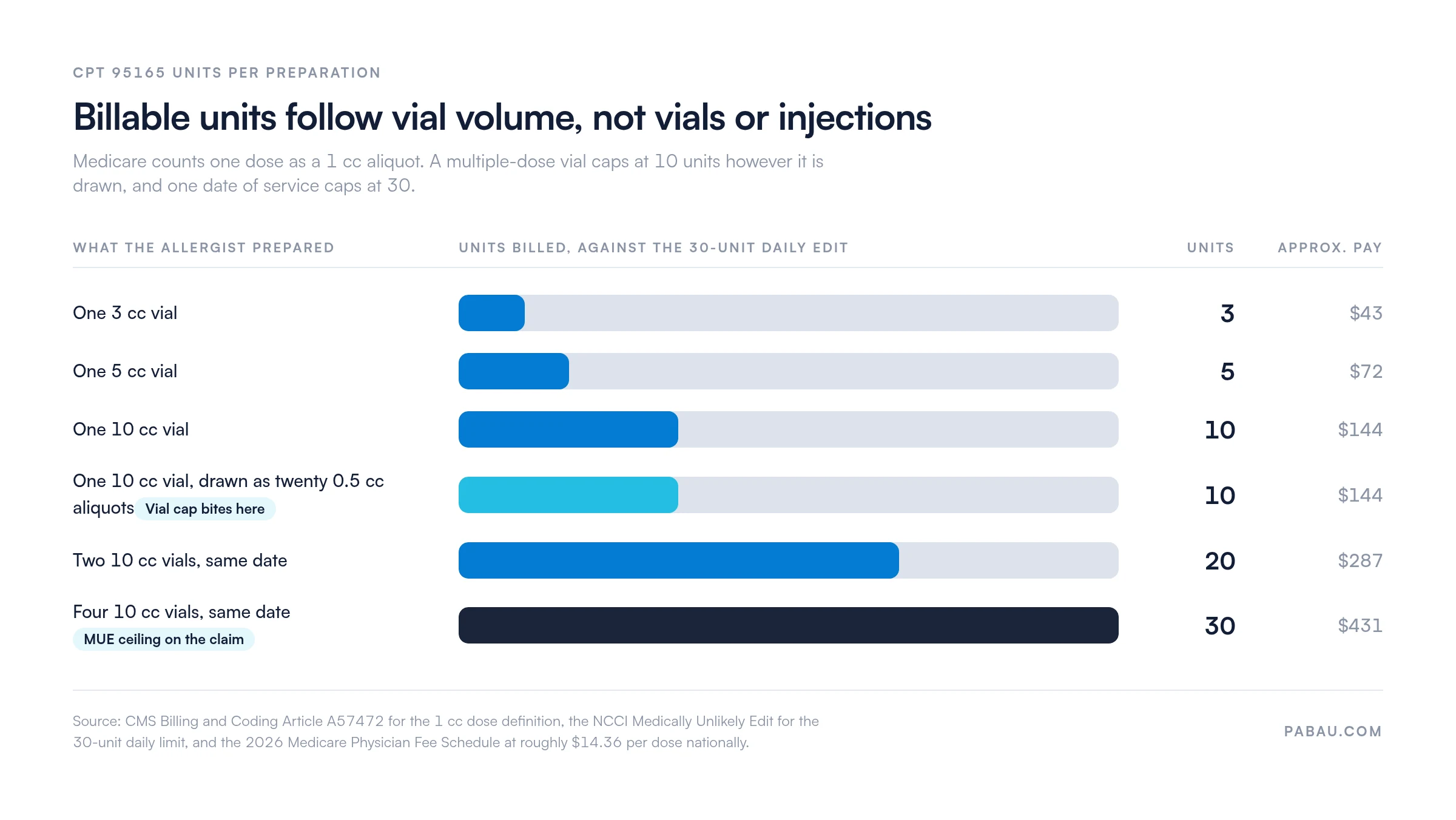
The MPFS Look-Up Tool also breaks out the work, practice expense, and malpractice RVUs behind that total. Rates move with each annual MPFS update and any budget neutrality adjustment. So confirm the current figure before you finalize a practice fee schedule.
Most CPT 95165 claims need no modifier at all. Still, three come up often enough in allergy billing to be worth a written policy.
Some commercial payers apply a bundling edit when CPT 95165 and CPT 95117 land on the same date. Where the payer allows unbundling, modifier 59 identifies antigen preparation as a distinct service, and the more specific XU is often preferred. Apply it only when the payer policy supports it, because routine use draws audits.
Modifier GA reports that a signed Advance Beneficiary Notice is on file, where the practice expects Medicare to deny for medical necessity. In contrast, modifier GZ reports that no ABN was obtained. GZ produces a provider-liable denial, so it protects compliance rather than revenue.
When the allergist provides a separately identifiable E/M service on the preparation date, modifier 25 goes on the E/M code. By contrast, it never goes on CPT 95165 itself.
Incomplete documentation is the second most common denial driver for CPT Code 95165, after unit miscounting. CMS Billing and Coding Article A57472 sets out what the medical record must hold to support medical necessity and unit accuracy. The 837P claim file sent to the payer has to match what sits in the patient chart.
Practices that keep antigen preparation in a dedicated log, on paper or in the EHR, face far fewer documentation denials. The vial log is the most auditable document behind a CPT 95165 claim, because it carries the volume the unit count depends on.
CMS Billing and Coding Article A57472 lists the ICD-10-CM diagnosis codes that support medical necessity for CPT Code 95165. Even so, a claim without a covered diagnosis is denied regardless of documentation quality. The table below shows the families used most often, and the full list should be checked against the current version of the article.
Always use the most specific ICD-10 code the record supports. Unspecified codes such as J30.9 raise audit risk, and some commercial payers require a coded allergen specification. Commercial acceptance can differ from the CMS list, so verify individual payer policies separately.
Run a quarterly audit of your CPT 95165 claims. Pull every submission from the last 90 days and check three things. First, the unit count matches the aliquots the logged vial volume supports. Second, the diagnosis code sits on the Article A57472 list. Third, physician supervision is documented on the preparation date. Most 95165 denials trace back to one of those three checks.
Allergy specialty bodies group the top CPT 95165 denial triggers into a few clear categories. In fact, the American Academy of Otolaryngic Allergy and the American College of Allergy, Asthma and Immunology both publish guidance along these lines.
The common denial codes seen most on 95165 claims are CO-151, CO-97, and CO-197. They flag units above what the payer supports, bundling, and absent precertification or authorization. So reading the remittance after each payment cycle surfaces the pattern early enough to fix it.
CPT Code 95165 rarely appears in isolation. Instead, a complete immunotherapy billing workflow uses several related codes, and knowing where each one sits prevents both missed revenue and unbundling errors. The AAPC CPT code lookup carries descriptor detail for the full allergen immunotherapy family.
Two distinctions decide the code before any unit is counted. Single-dose vials go on CPT 95144, while multiple-dose vials go on CPT 95165. Medicare does not accept the complete service codes 95120 through 95134 at all, so component billing is the only route for a Medicare claim.
Manual vial logging is where CPT Code 95165 billing most often breaks down. The preparation is recorded in one system, and the units are typed into another days later. Instead, practice management software like Pabau keeps the preparation note and the claim in the same patient record.
Pabau claims management software builds the claim from that record, with built-in CPT code libraries and structured fields for units and diagnosis codes. Your biller still applies the 1 cc dose rule and the 10-dose cap, working from the logged vial rather than a retyped figure. The claims management software page has the detail.
Claim.MD, our clearinghouse partner, handles 837P transmission to thousands of US payers. Eligibility checks before each preparation cycle confirm active coverage and prior authorization status. They also surface any payer bundling rule that changes how CPT 95165 sits alongside 95115 or 95117.
Generating the superbill from the preparation event, rather than the injection visit, keeps the unit count tied to the vial that supports it. Pabau reporting also tracks CPT 95165 claim status across payers. A practice can spot a unit-count denial pattern in weeks rather than at year end.
Reconcile your vial log against the billing system weekly during peak immunotherapy season. Compare three numbers for each patient and date: the vial volume in cc, the units on the claim, and the 10-dose cap. A mismatch found before submission costs a few minutes, while the same mismatch found in a remittance costs an appeal.

Pabau claims management software and the Claim.MD integration keep the logged vial details, the unit count, and the diagnosis codes on one record. See how it works in a live demo.

The unit count is the one part of a CPT 95165 claim a practice can get wrong tenfold without noticing. Volume decides it, the vial caps it at 10, and the date of service caps it at 30. In short, the rest of the claim is ordinary billing hygiene.
So the fix sits upstream of the biller. Record the vial volume at preparation, in a field the claim can read, and the count stops being a judgment call. Chase it after the remittance instead, and each correction costs an appeal.
Pabau claims management software and the Claim.MD connection give allergy practices that structure. To see how it handles immunotherapy billing end to end, book a demo.

Need a full breakdown of how medical billing works in the US? What is medical billing covers the end-to-end revenue cycle from patient visit to payment posting.
Want to understand how clearinghouse submission works for CPT claims? Medical claims clearinghouse explains how 837P files route from practice management to payer adjudication.
Struggling with recurring claim rejections across your allergy practice? Denial management in healthcare outlines a systematic approach to tracking, appealing, and preventing denials by code type.
Billing the injection visit as well as the preparation? CPT Code 95117 covers two or more allergen immunotherapy injections at the same visit.
Coding the testing that establishes medical necessity? CPT Code 95004 covers percutaneous allergy testing with allergenic extracts, billed per test.
CPT Code 95165 covers the professional supervision of preparing and providing antigens for allergen immunotherapy from a multiple-dose vial, billed per dose. It pays for the allergist work in formulating and overseeing the vial, not for the injection. Instead, administering the shot is billed separately under CPT 95115 or CPT 95117.
Medicare counts one dose as a 1 cc aliquot drawn from a single multiple-dose vial, a definition that has applied since January 1, 2001. A standard 10 cc vial therefore supports 10 billable doses. The number of antigens mixed into the vial does not change that count, because the count follows volume.
A multiple-dose vial of 10 cc or more caps at 10 units, however many aliquots the allergist draws from it. A vial of 20 half-cc aliquots still bills as 10 units. Vials under 10 cc cap at their volume, so a 5 cc vial supports 5 units and a 3 cc vial supports 3.
Use CPT 95144 when the allergist prepares single-dose vials, and report one unit per vial. Instead, CPT 95165 applies only to multiple-dose vials, where units follow the 1 cc aliquots the vial supports. Recording the vial type in the preparation log is the simplest way to keep the two codes apart.
CPT 95165 covers the professional service of supervising antigen preparation and provision. CPT 95117 covers administering two or more allergen immunotherapy injections. They describe different services and can generally be billed together on the same date, though some commercial payers apply bundling edits. Check the payer CCI policy before billing both on one claim.
Commercial payers vary. Some adopt the Medicare 1 cc aliquot definition, some pay per vial, and some set their own limit per treatment period. Prior authorization is more common than under Medicare, and a few plans bundle CPT 95165 into 95115 or 95117. Verify each policy before submitting, since applying Medicare rules to a commercial claim is a common denial source.
The frequent triggers are an incorrect unit count and units above the 10-dose vial cap. A daily total above the 30-unit Medically Unlikely Edit denies as well. Missing supervision documentation, a diagnosis code outside the Article A57472 list, commercial bundling, and missing prior authorization account for most of the rest. Each one can be caught before submission.
Generally yes under Medicare, when antigen preparation and injection administration fall on the same date. However, commercial plans differ, and some apply bundling edits that deny the pair. CPT 95165 should never be reported with CPT 95120 through 95134, because those are complete service codes that Medicare does not accept at all.



