

CCSD code G5100: Bypass of duodenum billing guide
CCSD code G5100 bills a bypass that leaves the duodenum in place CCSD code G5100...

Last Updated: Oct 16, 2026
93924 is the CPT code for a noninvasive physiologic study of the lower extremity arteries, at rest and following treadmill stress testing, complete bilateral study. Both legs get Doppler waveforms or volume plethysmography at rest. The patient then walks a standardized motorized treadmill protocol, and ankle/brachial indices are repeated immediately afterward and at timed intervals.
The treadmill is what separates this code from its neighbors, since ABIs belong to 93922 and 93923 too. A complete resting study without stress is 93923. Most denials come from billing 93924 without documented stress, adding modifier 50, or reporting 93922 or 93923 alongside it.
Let Pabau's smart automation suggest the right codes, reduce claim denials, and keep your practice compliant—effortlessly.
Automate repetitive tasks and focus on what matters most—your patients.
Reduce coding errors and ensure compliance with the latest regulations.
Clean claims, fewer denials, and faster reimbursements.
Powerful insights and reporting to help your practice thrive.
HIPAA compliant SOC 2 certified GDPR-compliant Trusted by 4,000+ clinics worldwide

CPT code 93924 reports a complete bilateral lower extremity arterial study at rest and after a standardized treadmill test.
Ankle-brachial indices are part of 93922, 93923 and 93924, so the treadmill sets 93924 apart, not the ABI.
A complete resting study without treadmill stress is 93923, and billing it as 93924 is a denial and audit risk.
93924 is already bilateral, so leave off modifier 50 and LT/RT, and don’t report 93922 or 93923 alongside it.
Medicare’s CY2026 national non-facility payment is about $165, based on 4.95 total RVUs and global indicator XXX.
CPT code 93924 reports a noninvasive physiologic study of the lower extremity arteries, at rest and following treadmill stress testing. It is a complete bilateral study, so both legs are always included.
The American Medical Association (AMA) descriptor sets out what the study must contain:
The code sits in the Medicine section, under noninvasive vascular diagnostic studies (93880-93998). Within that range, it belongs to the extremity arterial studies group, 93922-93931.
Physicians order it to unmask peripheral arterial disease (PAD) that looks mild at rest. A patient with claudication can have a near-normal resting ABI. Walking drops the ankle pressure, and the post-exercise values reveal it.
A 93924 session runs in a fixed order. Each step leaves a value the report needs.
If the treadmill step never happens, the session is not a 93924. The next section shows where it lands instead.
All three codes include ankle/brachial indices, so the ABI can’t be the dividing line. What changes is the number of levels, the limbs studied, and whether a treadmill is used.
Two rules follow from the table. A complete resting study of both legs is 93923, however thorough it is. Reactive hyperemia is a provocative maneuver under 93923, so it can’t stand in for the treadmill.
Billing 93924 without documented treadmill stress is a denial and audit risk. Reviewers read the report against the descriptor, and a missing exercise protocol fails it.
The decision path below puts those checks in the order a coder should run them.
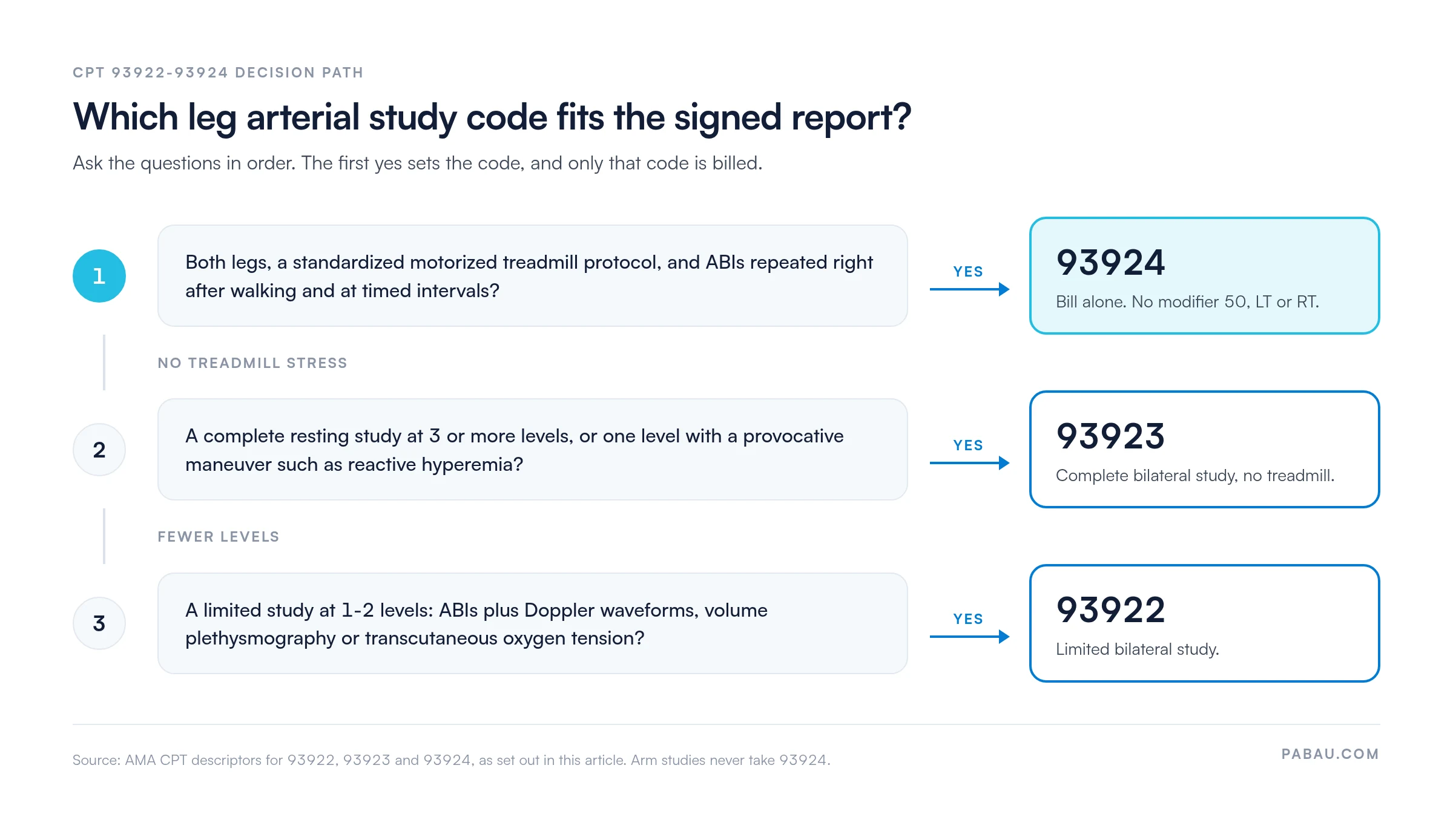
Take a hypothetical patient who reports calf pain after walking two blocks. The physician orders a lower extremity arterial study.
Version A. The lab records waveforms and pressures at four levels in each leg, with ABIs at rest. Nobody walks on a treadmill. That is a complete bilateral resting study, so the claim goes out as 93923.
Version B. The lab runs the same resting study, then adds a standardized treadmill walk. Symptoms start at two minutes, and the patient stops at four. ABIs are repeated right after walking and at timed intervals until pressures recover. Now 93924 fits, and only 93924 is billed.
The patient and the diagnosis are identical in both versions. The documented treadmill protocol is the only reason the code changes.
Under the CMS Physician Fee Schedule for calendar year (CY) 2026, 93924 carries 4.95 total relative value units (RVUs). The conversion factor turns those units into dollars.
These national figures come from the CMS CY2026 relative value file. The global amount applies when one provider owns the equipment and reads the study, as in an office or independent lab.
In a hospital outpatient department, the physician bills modifier 26 and the hospital is paid separately for the technical side. Check the 26 and TC amounts for your locality in the CMS Physician Fee Schedule lookup tool.
Rates change every January and vary by locality, so update fee sheets each year. Medicaid programs and commercial payers set their own rates.
Medical necessity rides on the right ICD-10-CM code. Your Medicare Administrative Contractor’s LCD and its billing article list the covered diagnoses. Commercial payers publish their own policies, so check both.
Code the most specific diagnosis the record supports. Coverage lists are updated, so confirm the current LCD version against the CMS ICD-10 resources before you rely on a code.
Most modifier errors on this code come from forgetting that it already covers both legs.
Pull last quarter’s 93924 claims and filter for modifier 50, LT or RT. Then check each report for a documented treadmill protocol. Either problem on a paid claim may mean an overpayment to review.
A 93924 claim passes through several hands before payment. Each handoff has its own failure point.
Catch these before submission and you send a clean claim the first time.
Most 93924 denials repeat the same handful of patterns. Here is each one with its fix.
Track which row your denials fall into each month. That pattern shows where your denial management effort should go first.
Run through this list before the claim leaves the practice. A superbill built around these fields makes the check routine.
If any treadmill item is missing, stop and recheck the code. A complete resting study may still qualify as 93923. Holding claims until the report is signed is part of basic medical billing compliance.
National Correct Coding Initiative (NCCI) edits bundle 93922 and 93923 into 93924. For the same legs in the same session, report 93924 only.
Every edit pair carries a modifier indicator. Check the current CMS NCCI table before you append 59 or an X modifier, because some pairs never allow a bypass.
93925 is a duplex scan, which is a different technology. When both studies are ordered, performed and documented separately, check the current edit pair and payer policy before billing them together.
On the fee schedule, 93924 carries global indicator XXX. That means the global surgery concept doesn’t apply, so no global period bundles same-day services into it. A same-day visit still needs its own documentation and any modifier an edit requires.
Traditional Medicare doesn’t usually require prior authorization for 93924. Instead, it relies on the LCD’s medical necessity rules and post-payment review.
Medicare Advantage and commercial plans often do require it, and their rules change by plan year. Approval usually rests on criteria like these:
Keep a short list of the plans you see most and whether each needs auth for 93922-93924. Review it every January, so the auth request starts at scheduling, not after the study.
Once the study is coded, the next risk is a claim that stalls without anyone noticing. Someone has to send it, watch it, and act on the response.
Pabau, the practice management platform we build, submits claims electronically through clearinghouse integrations. For US practices, that clearinghouse is Claim.MD.
Each claim’s status stays in one view, so claims management gets faster for your billing team. They see a rejection early, fix the cause, and resubmit before the follow-up deadline passes.

Pabau submits claims electronically through its clearinghouse integrations and tracks each one. Your team spots a rejected vascular study claim early and resubmits it faster.

Code 93924 from the signed report, not from the order. If the report shows both legs, a standardized treadmill protocol and timed post-exercise ABIs, bill 93924 alone. If it shows a thorough resting study, bill 93923 instead.
That single check removes the biggest audit exposure on this code. The remaining fixes are mechanical: no modifier 50, no lower-level code alongside it, and a diagnosis your LCD covers.
After that, tracking the claim matters as much as coding it. Book a demo to see how Pabau sends and tracks vascular study claims through to payment.

Curious how claims travel from your system to the payer? Claim.MD clearinghouse overview explains how CPT claims route through a clearinghouse before they reach the payer.
Want fewer 93924 claims bounced back for missing details? Superbill best practices covers the fields and sign-off steps behind clean vascular study billing.
Looking for the 837P transaction details behind vascular claims? Understanding 837 claim files breaks down the electronic format used to submit CPT 93924 claims.
Need the limited version of this study? CPT code 93922 covers the bilateral arterial study at 1-2 levels, with no treadmill stress.
No. 93924 covers the lower extremities only. Upper extremity physiologic studies are reported with 93922 or 93923, depending on the levels studied and any provocative maneuvers.
Then 93924 doesn’t apply, because the treadmill phase is required. A complete resting study at three or more levels is reported as 93923. So is a single-level study with provocative maneuvers. Record why exercise testing wasn’t possible.
No. Ankle-brachial indices are a component of 93922, 93923 and 93924, not a separate service. Each code also needs the waveform, plethysmography or other recordings its descriptor sets out.
XXX means the global surgery concept doesn’t apply to 93924. No pre- or post-procedure days are bundled into its payment. Same-day services stand on their own documentation and any NCCI edits.



