CCSD Code M2510: Ureterocele excision billing guide
CCSD Code M2510: Definition and clinical scope CCSD Code M2510 is the Clinical C...

Last Updated: Nov 3, 2026
93886 is the CPT code for transcranial Doppler study of the intracranial arteries; complete study. It covers an ultrasound assessment of the right and left anterior circulation and the posterior circulation, with a signed physician interpretation.
It sits in the cerebrovascular arterial studies range, 93880-93893. A study of fewer territories is reported with 93888, the limited study. Since 2025, add-on codes report extra services performed with a complete study.
Let Pabau's smart automation suggest the right codes, reduce claim denials, and keep your practice compliant—effortlessly.
Automate repetitive tasks and focus on what matters most—your patients.
Reduce coding errors and ensure compliance with the latest regulations.
Clean claims, fewer denials, and faster reimbursements.
Powerful insights and reporting to help your practice thrive.
HIPAA compliant SOC 2 certified GDPR-compliant Trusted by 4,000+ clinics worldwide

CPT code 93886 reports a complete transcranial Doppler study of the right and left anterior circulation and the posterior circulation.
A study of fewer territories is reported with 93888, the limited study, and the report must name the vessels examined.
Medical necessity documentation must name the clinical indication and every vessel examined, because a missing element is the leading denial trigger.
Since 2025, vasoreactivity, emboli detection and shunt detection performed with a complete study are reported with add-ons +93896, +93897 and +93898.
Pabau’s claims management software scrubs each claim for missing or invalid details and carries prior authorizations through to the claim.
CPT code 93886 is defined by the American Medical Association (AMA) as: “Transcranial Doppler study of the intracranial arteries; complete study.”
It sits in the 93880-93893 cerebrovascular arterial studies range, part of the non-invasive vascular diagnostic studies section (93880-93998). A complete study covers the right and left anterior circulation and the posterior circulation, with a signed physician interpretation.
A “complete” TCD study under CPT code 93886 samples the intracranial arterial circulation on both sides. The technologist or physician interrogates vessels on each side of the brain and records spectral waveforms. The report documents flow velocity and direction in each major named intracranial artery.
Vessels typically evaluated in a complete study:
What 93886 does NOT cover:
A common miscoding error is reporting 93886 when only part of the circulation was evaluated. That scenario belongs to CPT 93888, a limited study of fewer than the complete set of vessels, and the report must name the vessels studied. Upgrade from 93888 to 93886 only when documentation confirms every territory was sampled.
Payers require a covered ICD-10 diagnosis to establish medical necessity for CPT code 93886. Medicare Administrative Contractors (MACs) publish Local Coverage Determinations (LCDs) that specify which diagnosis codes support the study. The following table reflects commonly accepted diagnostic pairings across major MACs, but coders must verify their specific MAC LCD before submitting.
Codes like R51.9 (headache, unspecified) or Z00.00 (routine exam) will not support CPT code 93886 under Medicare LCDs and will trigger an automatic denial. Always pair the claim with a diagnosis that maps to a neurological or cerebrovascular indication specifically named in your MAC’s LCD.
CPT 93886 covers the complete study of every intracranial territory. CPT 93888 covers a limited study of fewer than the complete set of vessels. Billing 93886 when the documentation supports only 93888 is one of the most frequent upcoding flags auditors raise on TCD claims.
Three further TCD services can be performed with a complete study or on their own. Each has its own code, and the code depends on whether a complete 93886 study was done in the same session.
With 93886, report the matching add-on code from the 2025 code set. Without a complete study, report emboli detection as 93892 and shunt detection as 93893. The 2025 changes deleted 93890, the old vasoreactivity code, so verify descriptors against the current AMA CPT manual.
Billing any of these codes without a separately documented protocol is a top audit flag. The 93886 report and each additional study must appear as distinct, interpreted sections in the final report.
Document each add-on code’s protocol in a separate paragraph of the TCD report. Auditors look for bundled narrative: a single block of text claiming emboli detection, vasoreactivity, and bilateral flow cannot support three separate codes. Distinct protocol headings, timing windows, and interpreted results for each service are what survive an LCD review.
CPT code 93886 is a global procedure code, meaning it bundles both the technical component (equipment, technologist) and the professional component (physician interpretation and report). The appropriate modifier depends on who performs each component and the billing setting.
Modifier 50 (bilateral) is never appropriate for CPT code 93886 because bilateral is inherent to the “complete study” descriptor. Applying modifier 50 will result in a claim edit or overpayment recoupment on audit.
Medicare pays for CPT code 93886 under the Medicare Physician Fee Schedule (MPFS), adjusted by geographic practice cost indices (GPCIs) that vary by locality. Look up the current-year RVUs and national payment in the CMS MPFS lookup tool, or with an RVU calculator such as FastRVU.
Commercial payers negotiate their own rates, often as a percentage of Medicare or under a separate fee schedule. Compare each contracted rate with the current MPFS figure before payer contract negotiations.
Coverage for CPT code 93886 under Medicare is governed by Local Coverage Determinations published by individual MACs. There is no single national coverage decision (NCD) for transcranial Doppler studies. Key MAC LCDs include those from Noridian, CGS, and Palmetto GBA, all of which can be accessed through the CMS Medicare Coverage Database.
Indications commonly covered across MAC LCDs include:
Uses that are typically not covered include:
Prior authorization is not universally required under traditional Medicare but is increasingly common under Medicare Advantage plans. Verify with each individual payer before scheduling the study.
Solid insurance eligibility verification at the point of scheduling catches prior-auth requirements before the appointment, not after the claim is denied. Building a reliable process for medical billing compliance also helps practices align documentation with LCD criteria before submission.
TCD denials follow a handful of predictable patterns, so knowing them is the fastest way to raise first-pass acceptance. Proactive denial management workflows protect revenue better than reactive appeals. Coders should also know the common denial codes to read remittance advice accurately.
Submitting a clean claim for CPT code 93886 means every required data element is in place before the claim leaves the practice. That covers the ICD-10 diagnosis, the modifier, the place of service, and the signed report. Retroactive corrections add billing staff time and delay payment by weeks.
Build a two-question pre-submission gate for every 93886 claim: (1) Is the ICD-10 code in your MAC’s LCD covered list? (2) Does the report contain a signed interpretation with all major intracranial vessels addressed? If either answer is no, hold the claim. Releasing without both items resolved is the single fastest way to inflate your denial rate.
The most efficient practices run a pre-submission checklist against their MAC’s LCD before each TCD billing cycle. Claims management software that automates these cross-checks removes the manual lookup burden from coding staff.
Three code families generate the most coding confusion alongside CPT code 93886. The critical differentiator is anatomy, because 93886 is exclusively intracranial. Once a vessel crosses outside the skull base, it belongs to a neck-vessel code such as 93880. The diagram below maps each TCD and neck-vessel code to the study it describes.
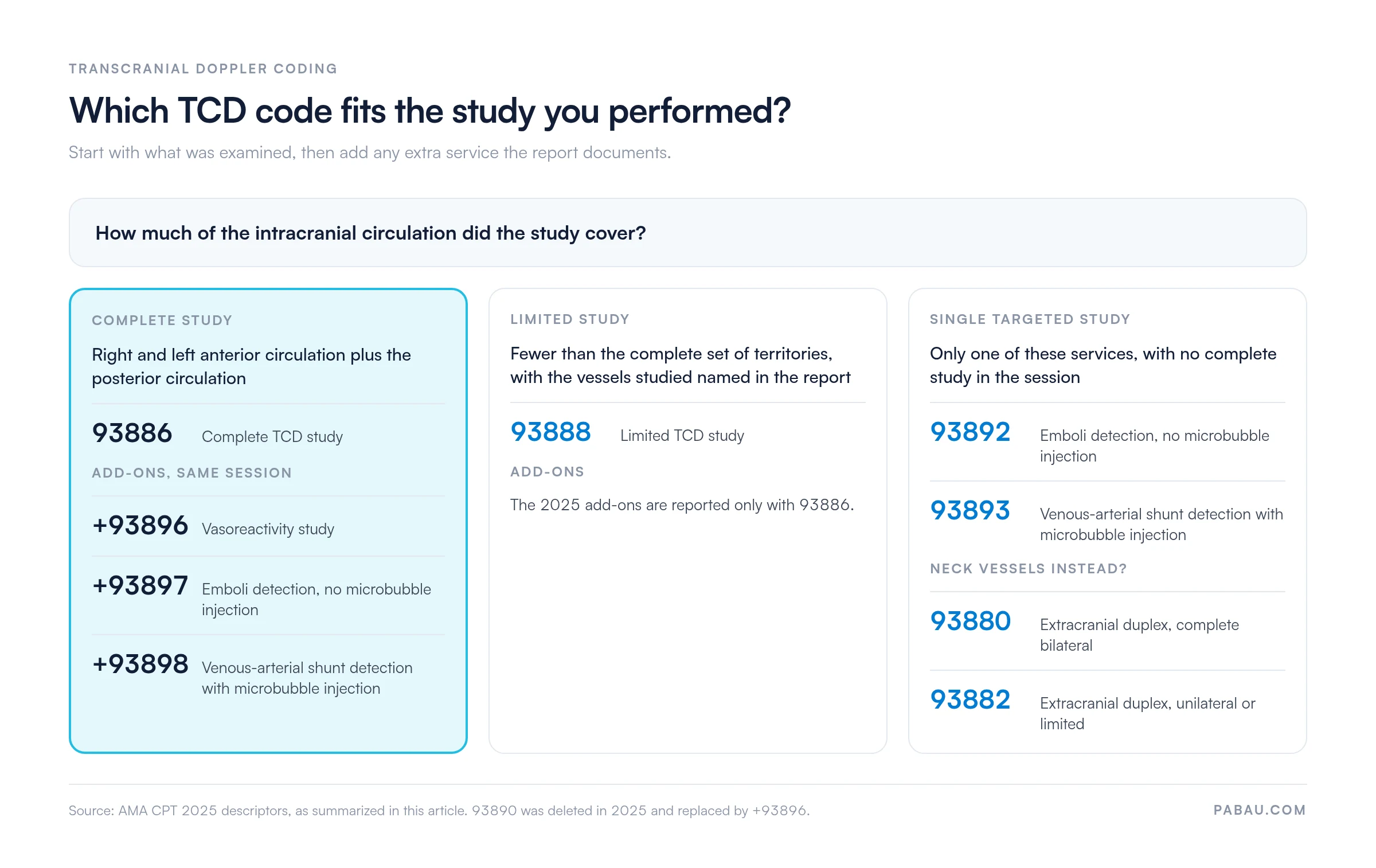
Each neighboring code differs from 93886 in anatomy or in scope, as the table sets out.
The AMA revised the TCD family in the 2025 CPT code set. The 93886 descriptor did not change. CPT added add-ons +93896, +93897 and +93898, deleted 93890, and revised 93893 to venous-arterial shunt detection. Practices using older code sheets should confirm descriptors against the current CPT manual.
If your practice receives a MAC prepayment review notice for TCD claims, respond with a complete documentation packet. Include the physician order, the signed interpretation report, the technologist worksheet, and the ICD-10 diagnosis documentation from the ordering provider’s record.
Most 93886 denials can be prevented at charge entry, and few are recovered cheaply after the fact. Many practices still check diagnosis pairings, modifiers and prior authorizations by hand before each TCD claim goes out.
Pabau, the practice management platform we build, moves those checks into the billing workflow. In the US, it verifies insurance eligibility through Claim.MD before the visit. Each prior authorization is stored as a case, and its code follows the appointment through to the claim.
Before submission, Pabau’s claim validation scrubs each claim for missing or invalid details. Claims then go to thousands of US payers through Claim.MD, and each one is tracked until it is paid. High-volume TCD programs see fewer denials reach the remittance stage.

Pabau scrubs each claim for missing or invalid details, carries prior authorizations through to the claim, and submits through Claim.MD. See how neurology and vascular practices get TCD claims paid faster.

CPT code 93886 pays reliably when the report proves a complete study. Before each claim goes out, confirm that every territory was sampled, the diagnosis appears in your MAC’s LCD, and the interpretation is signed.
When one of those checks fails, code what the documentation supports, whether that is 93888 or a separate study code. Since 2025, an extra service performed with a complete study also needs its add-on code.
The trade-off is a few minutes of review per claim against weeks of rework after a denial. Book a demo to see how Pabau catches these errors before your TCD claims reach the payer.

Need to understand how clearinghouse claim submission works end-to-end? Our medical claims clearinghouse guide explains how 837P files move from practice to payer.
Want to see how electronic remittance works after claim adjudication? Electronic remittance advice (ERA) explained walks through reading 835 files and posting ERAs accurately.
Looking to benchmark your billing compliance posture? What is revenue cycle management outlines the full end-to-end framework that keeps neurology billing programs compliant and efficient.
CPT code 93886 covers a complete transcranial Doppler ultrasound study of the intracranial arteries. It includes bilateral sampling of the major cerebral vessels (MCA, ACA, PCA, vertebral, and basilar arteries), spectral waveform recording and physician interpretation. It does not cover extracranial neck vessels, echocardiography, or MRA/CTA studies.
CPT 93886 is the complete TCD study. CPT 93888 is the limited study, covering fewer than the complete set of intracranial vessels. Bill 93886 only when documentation confirms every territory was sampled, because billing it for a partial study is upcoding and a common audit trigger.
Modifier 26 applies when the physician interprets only, and modifier TC applies when the facility performs the technical component only. No modifier is needed for global billing when the physician owns the equipment and employs the technologist. Modifier 50 (bilateral) is never appropriate because bilateral is inherent to the complete-study descriptor.
Prior authorization is not universally required under traditional Medicare but is frequently required under Medicare Advantage and commercial plans. Verify prior-auth requirements with each individual payer before scheduling. Policies differ by plan and are not standardized across payers.
Send a complete documentation packet for each claim under review. Include the physician order, the signed interpretation report, the technologist worksheet, and the ICD-10 diagnosis documentation from the ordering provider’s record. Check your MAC’s LCD in the CMS Medicare Coverage Database for its current documentation requirements.
Billing CPT code 93886 (intracranial TCD) and 93880 (extracranial carotid duplex) on the same date is subject to NCCI edits and requires careful review. When both studies are separately documented and clinically distinct, modifier 59 or the XS modifier may apply. Verify current NCCI edit tables before submitting both codes together.