

CCSD code G5100: Bypass of duodenum billing guide
CCSD code G5100 bills a bypass that leaves the duodenum in place CCSD code G5100...

Last Updated: Oct 16, 2026
93797 is the CPT code for physician or other qualified health care professional services for outpatient cardiac rehabilitation without continuous ECG monitoring, reported per session.
When continuous ECG monitoring runs during the session, CPT 93798 applies instead. Under Medicare, a physician or nonphysician practitioner must be immediately available and accessible for medical consultations and emergencies during every session, under either code. Medicare covers up to 36 sessions per qualifying event, with up to 36 more at the contractor's discretion.
Let Pabau's smart automation suggest the right codes, reduce claim denials, and keep your practice compliant—effortlessly.
Automate repetitive tasks and focus on what matters most—your patients.
Reduce coding errors and ensure compliance with the latest regulations.
Clean claims, fewer denials, and faster reimbursements.
Powerful insights and reporting to help your practice thrive.
HIPAA compliant SOC 2 certified GDPR-compliant Trusted by 4,000+ clinics worldwide

CPT code 93797 reports one outpatient cardiac rehab session without continuous ECG monitoring. CPT 93798 is the same service with monitoring.
A physician or nonphysician practitioner must be immediately available during every session under either code, so supervision never decides between them.
Medicare covers up to 36 sessions per qualifying event. Sessions 37 to 72 are at the contractor’s discretion and carry Modifier KX.
The top denial triggers are a non-qualifying ICD-10 diagnosis, missing treatment plan elements, and 93797 billed with 93798 on the same date.
Pabau, the practice management and EHR platform we build, keeps session notes and the treatment plan on one record and submits claims through Claim.MD.
CPT code 93797 reports one outpatient cardiac rehabilitation session in which the patient exercises without continuous ECG monitoring. The American Medical Association descriptor reads: “Physician or other qualified health care professional services for outpatient cardiac rehabilitation; without continuous ECG monitoring (per session).” One unit equals one session.
The descriptor says nothing about supervision level. Monitoring is the only factor that separates 93797 from its companion code, 93798. Medicare requires the same supervision for both codes, by a physician or nonphysician practitioner, so supervision never decides which one you report.
Under 42 CFR 410.49, a Medicare cardiac rehab program must include five components. These are physician-prescribed exercise each session day, cardiac risk factor modification, psychosocial assessment, outcomes assessment, and an individualized treatment plan (ITP). The session note should show which components the patient received that day.
Continuous ECG monitoring is the single factor that separates CPT 93797 from CPT 93798. Report 93797 when the patient exercises without continuous ECG monitoring, and 93798 when monitoring runs during the session. Choose the code session by session from what the note documents.
Medicare pays both codes. CMS Change Request 6850 instructs contractors to pay 93797 for cardiac rehab without continuous monitoring and 93798 for sessions with it.
Report one code or the other for a date of service, never both. The National Correct Coding Initiative (NCCI) pairs the two codes, and the edit fires before a human reviewer sees the claim. If a session included continuous ECG monitoring, the correct code is 93798.
Billing 93797 requires both an approved provider type and an eligible setting. Medicare pays cardiac rehabilitation only in physician offices and hospital outpatient departments that meet its program standards. A standalone wellness gym cannot bill this code, regardless of who delivers the session.
The American Association of Cardiovascular and Pulmonary Rehabilitation (AACVPR) certifies programs that meet its quality benchmarks. Medicare fee-for-service does not require it, but some Medicare Advantage and commercial plans do. Confirm each payer’s requirement before the patient’s first session to prevent retroactive denials.
Medicare covers cardiac rehabilitation under 42 CFR 410.49. The standard benefit allows up to 36 sessions, and the Medicare contractor may approve up to 36 more. Sessions beyond 36 carry Modifier KX on the claim to attest that medical necessity documentation is on file.
For a single date of service, these coverage rules combine with the monitoring question into three checks, run in the order below.
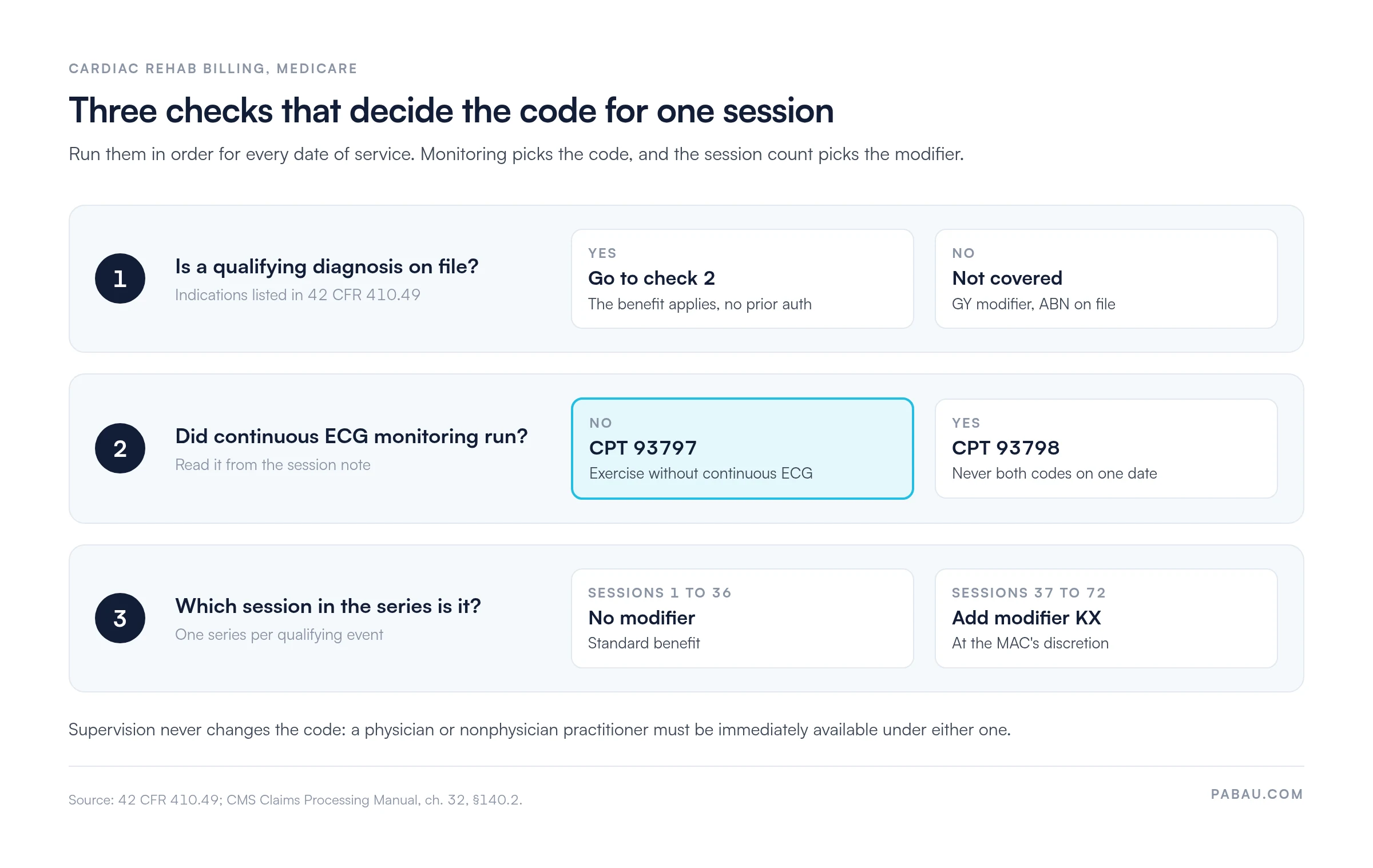
42 CFR 410.49 lists the indications that qualify a patient for cardiac rehabilitation. Submitting 93797 with a non-qualifying diagnosis is one of the most common reasons claims are denied before medical review. Confirm the diagnosis against this list before the program admission date.
Always check the exact ICD-10-CM list your Medicare Administrative Contractor (MAC) accepts. Contractors publish their own billing articles, and the accepted codes can differ in detail between jurisdictions. For a heart attack more than four weeks old, the table points to I25.2, so confirm the event date in the chart.
Track your cardiac rehab patients’ session counts in a dedicated field within their treatment records. When a patient approaches session 36, prompt the supervising physician to document medical necessity for sessions 37 through 72 before the session occurs, not after. Retroactive medical necessity documentation is an audit red flag and is harder to defend on appeal.
Incomplete session documentation is the most consistent reason 93797 claims fail on audit. Missing even one required element gives the reviewer grounds to deny the claim as insufficiently documented, not as clinically inappropriate.
A defensible session note for medical billing purposes includes every item below. Review your EHR template against this list before billing begins. Submitting a clean claim starts with documentation that survives the first-pass edit.
Traditional Medicare fee-for-service does not require prior authorization for CPT code 93797. The benefit applies to qualifying diagnoses under 42 CFR 410.49, provided the program meets CMS conditions. Medicare Advantage plans and commercial payers set their own rules, and prior auth requirements vary by plan.
Run insurance eligibility verification at intake, not at the first session. Many Medicare Advantage and commercial plans require precertification, a cardiologist referral, and evidence of AACVPR certification. Prior auth obtained after sessions are delivered creates a billing problem that is hard to resolve.
Medicare payment for CPT code 93797 is set annually through the Physician Fee Schedule (PFS). Rates differ between facility and non-facility settings. For current national rates, use the CMS MPFS Look-Up Tool, because rates change each January and locality adjustments vary by geographic practice cost index (GPCI).
For exact dollar amounts by locality, use the FastRVU lookup tool, which pulls from CMS PFS data files. Hospital outpatient departments bill the facility side of 93797 under the Outpatient Prospective Payment System (OPPS), with revenue code 0943 on a 13X bill type. Confirm billing instructions with your MAC to avoid duplicate-payment issues.
Four modifiers can appear on CPT code 93797 claims, though only KX is routine. Each has a specific trigger condition. Using the wrong one, or using one without adequate documentation, generates denials or attracts audit risk.
Modifier 22 is a poor fit for 93797. Medicare pays the code per session and caps patients at two 1-hour sessions a day. Extra effort within one session does not generally raise payment. Verify with your MAC before you append it.
Most 93797 denials fall into a handful of recurring categories. Strong denial management for cardiac rehab programs tracks denial reason codes by category. Each root cause is then fixed at the process level, not claim by claim.
For appeals, attach the complete session note, the signed ITP, and a copy of the NCCI edit or policy that the denial references. Review common denial codes in medical billing to decode the CARC reason codes on your 835 remittances before drafting the appeal letter.
Run a monthly audit of your 93797 claim volume against your session-count logs. If the number of KX-modified claims is zero but your program regularly serves patients beyond session 36, your billing team may be missing that modifier. An internal audit catches it cheaply, while a MAC audit can mean repaying every affected claim.
Medicare pays CPT code 93797 only when the place of service is 11 or 22. A claim with any other POS code is denied, regardless of the clinical quality of the session.
The service site must have cardiopulmonary, emergency, diagnostic, and therapeutic life-saving equipment available for every session. That typically means a defibrillator, emergency resuscitation equipment, and emergency medications. Programs that rely on a code team in another building do not meet this standard.
Cardiac rehab billing depends on session notes, the ITP, and claim status staying in one place. Many programs still split them across a paper binder, an EHR, and a clearinghouse portal. That split means a biller checks three places to answer a single question about one claim.
Pabau keeps session notes and the treatment plan on the patient record. Its claims management workflow runs eligibility checks, submits claims electronically through Claim.MD, and tracks each claim’s status.
Session documentation and claim submission then sit in one system, so your team can track each claim’s status from submission to payment.
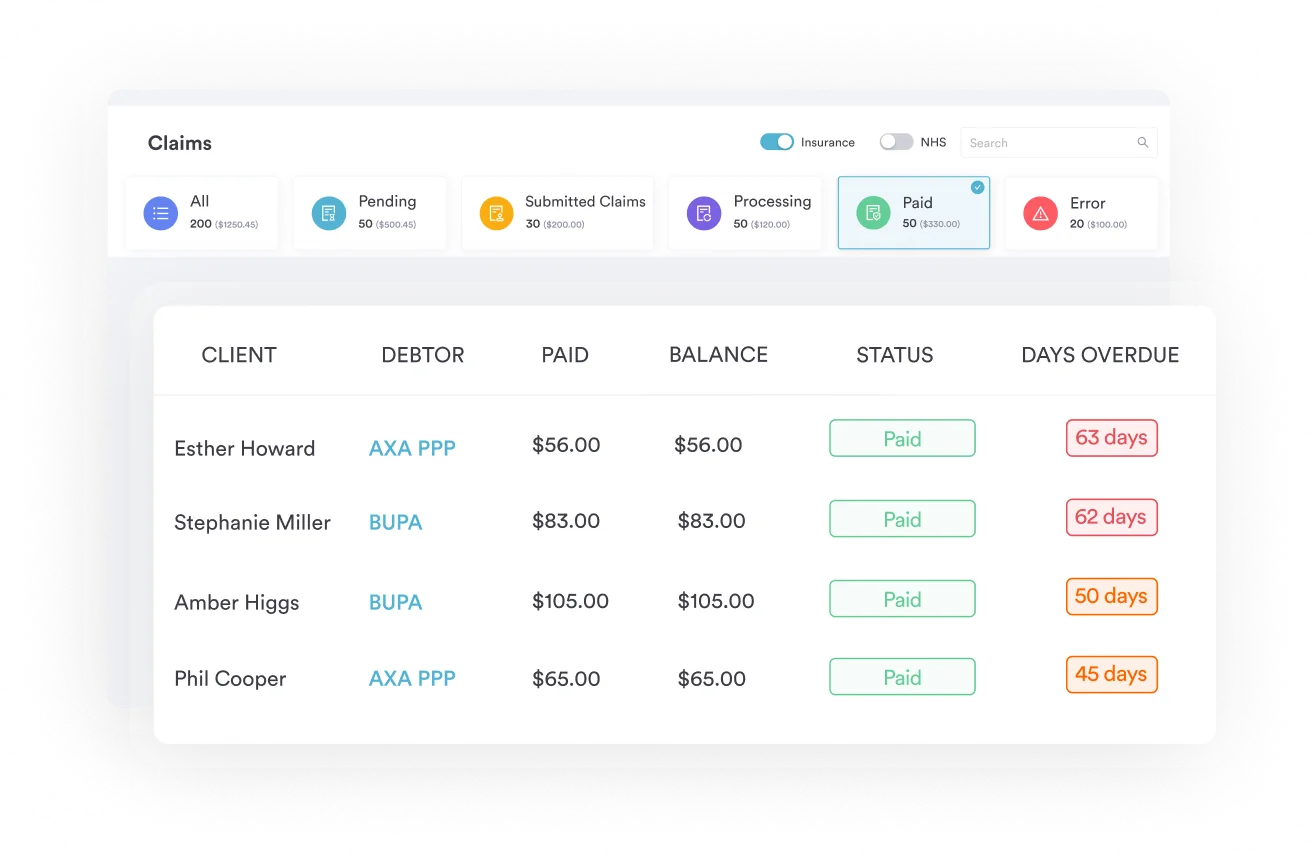

Pabau keeps session notes and treatment plans on the patient record and submits claims through Claim.MD. Your billing team can track every claim’s status from submission to payment.

CPT 93797 turns on one documented fact: whether continuous ECG monitoring ran during the session. Supervision does not change the code, since Medicare requires an immediately available physician or nonphysician practitioner for every session under either one. Write the monitoring status into each note, and the choice between 93797 and 93798 follows from it.
The remaining denials come from session counts, KX, and the ITP’s 30-day signature. Check all three before each claim goes out, because each is a documentation fix that is far cheaper before submission than on appeal. To see how Pabau’s revenue cycle management tools handle cardiac rehab billing, book a demo.

Need to understand how your clearinghouse processes 93797 claims? Our Claim.MD clearinghouse guide explains how electronic claim submission works for outpatient procedure codes.
Getting 835 remittances back with unfamiliar denial codes? Electronic remittance advice covers how to read ERAs and match denial CARC codes to their root causes.
Want to reduce pre-submission errors on all your billing codes? Medical billing compliance outlines the documentation and audit standards that apply across CMS-covered services.
CPT code 93797 is the per-session code for outpatient cardiac rehabilitation delivered without continuous ECG monitoring. It covers Phase II sessions of physician-prescribed exercise, risk factor modification, and education. Medicare still requires a physician or nonphysician practitioner to be immediately available during every session.
Modifier 22 is rarely appropriate on CPT 93797, because the code is paid per session and Medicare caps patients at two 1-hour sessions a day. Use it only when the session note documents unusual effort, such as repeated hemodynamic instability during exercise. Medicare does not generally pay more for it, so verify with your MAC before use.
Traditional Medicare fee-for-service does not require prior authorization for 93797. The 42 CFR 410.49 benefit applies automatically for qualifying diagnoses. Medicare Advantage plans and commercial payers frequently do require prior auth. Confirm requirements at patient intake, not after sessions begin, to avoid retroactive denial exposure.
The most common denial reasons are sessions 37-72 billed without Modifier KX, and a non-qualifying ICD-10 diagnosis. Others are 93797 and 93798 billed on the same date, and an incomplete or unsigned individualized treatment plan. A note that records continuous ECG monitoring also needs 93798, not 93797. Each has a fix at the workflow level.



