

CCSD code G5100: Bypass of duodenum billing guide
CCSD code G5100 bills a bypass that leaves the duodenum in place CCSD code G5100...

Last Updated: Oct 16, 2026
20143 is the CCSD code for removal of implantable ECG loop recorder (including reporting).
The bundled reporting element is where most claims on this code go wrong. Billers who treat the findings report as a separately billable item create duplicate claims, and insurers routinely reject them.
Let Pabau's smart automation suggest the right codes, reduce claim denials, and keep your practice compliant—effortlessly.
Automate repetitive tasks and focus on what matters most—your patients.
Reduce coding errors and ensure compliance with the latest regulations.
Clean claims, fewer denials, and faster reimbursements.
Powerful insights and reporting to help your practice thrive.
HIPAA compliant SOC 2 certified GDPR-compliant Trusted by 4,000+ clinics worldwide

CCSD code 20143 covers the full removal episode, including device extraction and the bundled findings report, billed as one code
The reporting element is indivisible, so billing a separate report code alongside 20143 is a duplicate claim that UK private insurers reject
Pre-authorization is typically required by Bupa, AXA Health, Vitality, and Aviva, though requirements vary by insurer and policy year
20142 is the insertion code and 20143 is the removal code, while 20141 covers external ambulatory ECG monitoring and neither device procedure
CCSD code 20143 is the UK Clinical Coding and Schedule Development procedure code for removal of an implantable ECG loop recorder, including reporting. The code applies to the explantation episode only.
Once the device has been retrieved, the cardiologist or cardiac physiologist produces a findings report. That report counts as part of the same procedural episode, not a separate clinical act.
The official descriptor is maintained by the CCSD, the body that governs private medical insurance coding in the UK.
20143 sits in the schedule’s investigation codes group, alongside the rest of the CCSD procedure codes used in UK private cardiology. Private medical insurers including Bupa, AXA Health, Vitality, and Aviva all recognize the code for reimbursement when a valid pre-authorization reference is in place.
An implantable loop recorder (ILR) is a subcutaneous cardiac monitor roughly the size of a USB drive. It sits just beneath the skin of the chest wall.
It records cardiac rhythm continuously for up to three years, transmitting data remotely to a clinical team. Cardiologists use it to investigate unexplained syncope, detect paroxysmal atrial fibrillation (AF), and monitor patients after cryptogenic stroke.
Removal becomes clinically indicated when one of the following applies. A busy private cardiology practice tends to see all four reasons within a single year:
The three devices most commonly removed in UK private practice are the Medtronic Reveal LINQ, the Abbott Confirm Rx, and the Biotronik BioMonitor. Each has its own programmer and data-download workflow, but the CCSD coding for removal is the same regardless of manufacturer.
ILR removal is a minor procedure performed under local anesthetic, typically in an outpatient or day-case setting. The procedural steps matter for documentation, because the procedure note must reflect each stage to support the 20143 claim.
The entire episode typically takes 20-40 minutes. Because it is a minor procedure, it does not routinely require an anesthetist or a surgical team. That keeps the coding straightforward, since CCSD code 20143 covers the complete episode as a single code.
The parenthetical “(including reporting)” in the 20143 descriptor decides how the claim is built. The findings report, the data download, and the written summary of the monitoring period are all bundled into the single 20143 fee. You cannot unbundle them.
The four elements below all sit inside that one fee. That is what makes the second code in the diagram a duplicate rather than an addition.
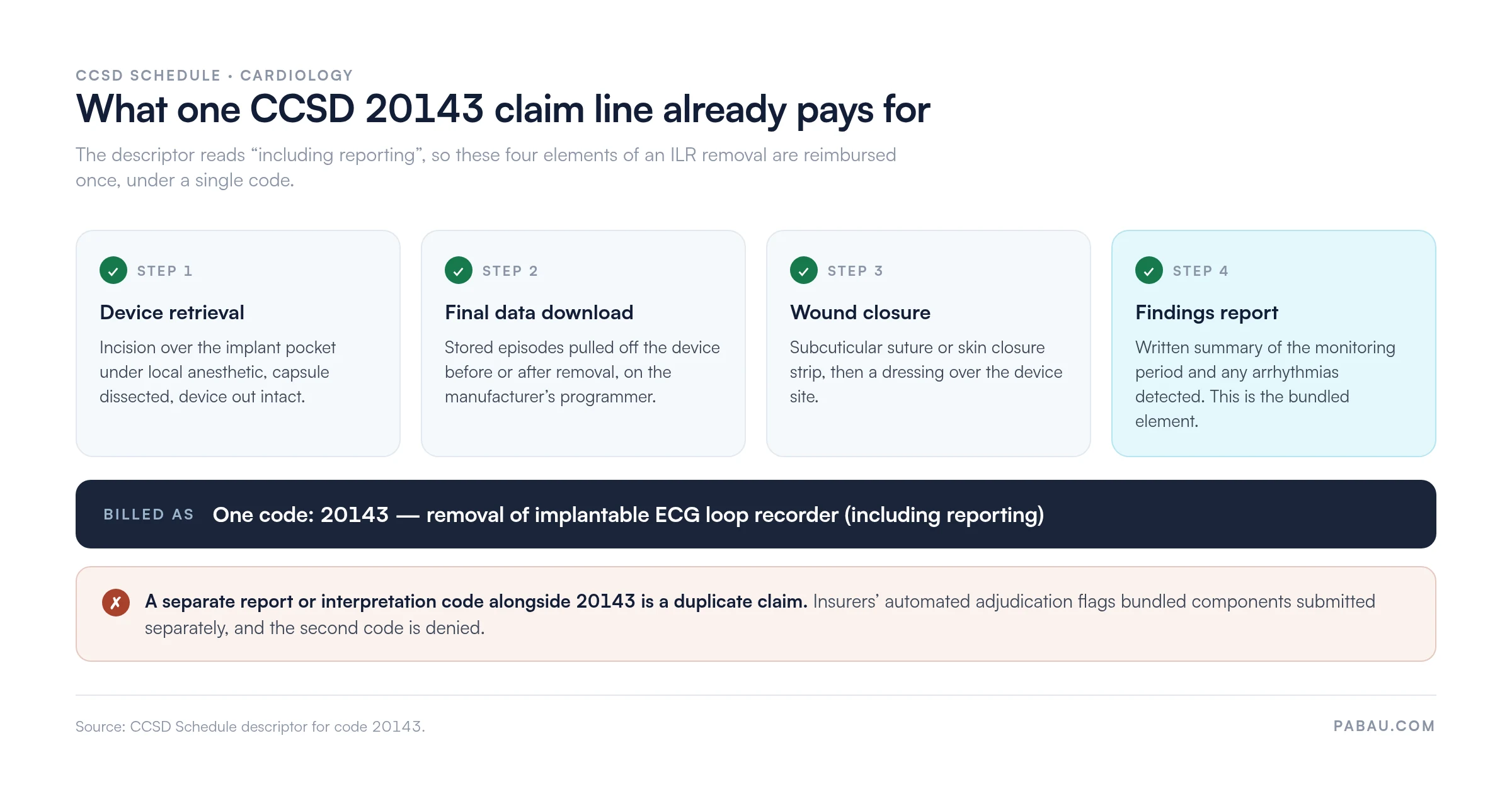
A cardiologist who submits 20143 plus a separate report or interpretation code is making a duplicate claim. Insurers’ automated adjudication systems flag bundled components submitted separately, and the second code is denied.
Some services sit outside the CCSD bundle, such as a separately coded procedure carried out at a different visit. Those cases need their own clinical justification and are the exception. When in doubt, verify with the insurer’s provider team rather than assume separate billing is permissible.
The procedure note should explicitly describe both the physical removal and the data review. That shows both elements were performed and completed within the same episode. This satisfies the insurer’s audit requirements for a bundled code.
Private cardiology billing in the UK operates through the CCSD schedule, with claims typically submitted via Healthcode or the insurer’s own provider portal. For an ILR removal, the billing workflow runs from pre-authorization through to claim submission, and each stage creates a documentation requirement.
Practice management software like Pabau supports CCSD-coded claims and links each procedure code to the patient record. Its medical claims management tools also produce the structured documentation private insurers ask for on cardiac device procedures.

Pre-authorization is required by most UK private medical insurers before ILR removal proceeds. Requirements vary by insurer and policy year, so always verify directly with the payer. Current general practice across the four main insurers is as follows:
Pre-authorization documentation for a 20143 claim typically includes the referring cardiologist’s letter and the clinical rationale for removal. It should also carry the patient’s ILR implant date and the original reason for implantation.
For planned removal at battery end-of-life, this is straightforward. For unplanned removal due to infection or wound complication, include clinical photographs and a brief written summary of the complication.
Request pre-authorization before booking the removal procedure, not on the day. Most insurers require at least 48 hours’ notice, and removals flagged as emergency or unplanned may need additional clinical justification. Document the reason for removal explicitly in the referral or pre-auth request, so the insurer’s medical team has no reason to query it later.
CCSD code 20143 sits in a short run of cardiac monitoring codes that are easy to mix up on a claim form.
The pairing that matters is 20142 and 20143. 20142 covers putting the loop recorder in and 20143 covers taking it out, each bundling its own reporting element. The code immediately below them, 20141, is not a loop recorder code at all.
The Bupa CCSD codes reference shows how all three appear on Bupa fee schedules.
Note what is missing from that list. The CCSD schedule carries no single replacement code for an implantable loop recorder. There is no one code to reach for when an old device comes out and a new one goes in.
That episode is a removal and an insertion, and whether both are payable together depends on the insurer’s multiple-procedure rules. Settle the position with the payer at pre-authorization rather than assuming a combined code exists.
The same removal-and-insertion split runs through other chapters of the CCSD schedule. CCSD code A1430 covers removal of a cerebroventricular shunt, and the replacement system is billed under its own insertion code. Ophthalmology works the same way, where C5480 covers removal of silicone oil and the insertion falls under a separate vitrectomy code.
The second trap is 20141. Its number sits directly below the two device codes, but it describes long term ambulatory ECG monitoring. That means an external recorder, worn rather than implanted, with no procedure attached.
Choosing it from a code list because the number looks adjacent submits a claim for a completely different service. The two device codes also sit in different Bupa benefit categories, so 20142 and 20143 do not attract the same fee. Verify the current amount for each on the insurer’s own schedule before you submit.
Exercise testing is coded separately again. A supervised treadmill or cycle stress test is billed under 20130, which already covers the baseline 12-lead ECG and the report.
Four patterns account for the majority of rejected and queried 20143 claims in UK private cardiology. Each is avoidable with the right documentation workflow. Private practice billing sits under a different compliance framework from NHS coding. For teams moving across from the NHS, the CCSD’s bundling conventions cause the most confusion.
Practices managing high volumes of cardiac device episodes benefit from a standardized procedure note template. It prompts the clinician to record each stage of the 20143 episode.
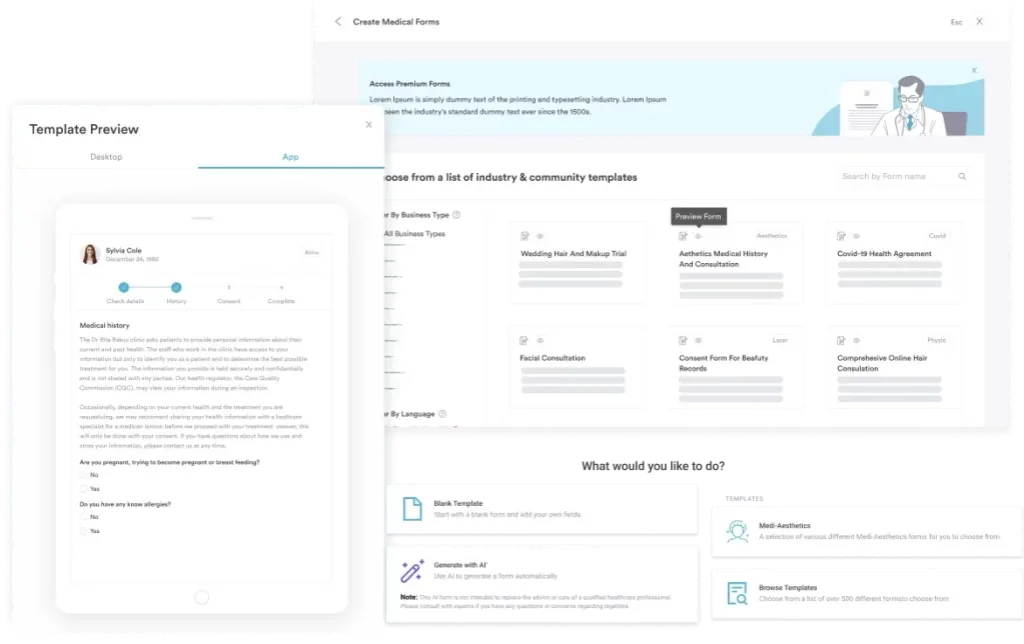
Pabau’s digital forms let cardiology teams build those templates once. Each one captures the device details, removal rationale, data download confirmation, and report summary inside the patient record, creating a complete and auditable claim file.
A well-structured procedure note does two jobs. It supports safe clinical care, and it defends the claim when an insurer audits it. For 20143 those two jobs align closely, because the audit criteria map directly onto the clinical steps of the procedure.
Your procedure note for a 20143 episode should contain the following elements:
Some practices keep the procedure note and the findings report as separate documents within the patient record. That is clinically appropriate. For billing purposes, both must be present and time-stamped to the same episode date, so the complete bundled service is evidenced.
CCSD code 20143 sits within a wider billing framework that governs private cardiology work in the UK. Knowing where it fits helps practices avoid systemic errors that go beyond any single code.
In England, the Care Quality Commission (CQC) regulates the clinical settings where ILR removal is performed. The other UK nations have their own regulators: Healthcare Improvement Scotland, Healthcare Inspectorate Wales, and the RQIA in Northern Ireland.
NICE diagnostics guidance DG41 covers implantable cardiac monitors for detecting atrial fibrillation after cryptogenic stroke. It informs the clinical indications insurers apply when they assess a pre-authorization request.
Bupa updates its procedure codes fee schedule periodically. Many other UK private insurers reference it as the benchmark when setting their own cardiac device fees.
Practices billing 20143 to several insurers should verify each current fee independently rather than assuming fee parity. The CCSD technical guide, published on the CCSD website, is the authoritative reference for how the schedule itself is structured.
Healthcode, the UK’s primary electronic billing platform for private medical claims, processes CCSD-coded invoices for all major insurers. Practices still submitting on paper wait longer for payment and field more queries. Bundled codes like 20143 suffer most, because the adjudication system has to confirm the bundle was not split before it pays.
Audit your 20143 claims once a quarter against three checks. Every submitted claim should carry a pre-authorization reference. No claim should carry a co-submitted report code. And every procedure note should record both a data download and a written report summary. Catching the pattern yourself costs far less than answering a retrospective query from the insurer.
Most private cardiology teams assemble a 20143 claim from three separate places. The procedure note sits in one system, the device report in another, and the pre-authorization reference on an email thread. Pulling them together at invoicing is where the reporting element gets forgotten.
Pabau holds the whole episode in one patient record. The procedure note template prompts for the device serial number, the removal rationale, the data download, and the report summary. The pre-authorization reference is stored against the invoice, and the CCSD code is attached to the episode rather than typed in weeks later.
So your biller submits a complete claim file the first time. An audit request then takes minutes to answer, instead of a hunt through three systems. Every Pabau subscription includes the whole platform, so a single-consultant practice works the same way a multi-site group does.

Pabau keeps procedure-coded claims, structured clinical notes, and insurer documentation in one patient record. See how UK cardiology teams use it to get 20143 claims paid first time.

CCSD code 20143 is a straightforward code carrying one trap. The reporting element is bundled, and most rejected claims on this code trace back to billing it twice. The other frequent cause is reaching for 20142 when the procedure was a removal.
Get the pre-authorization in place before the procedure, and write a note that evidences both the removal and the report. The claim should then clear first time.
The judgment worth keeping is that the descriptor tells you how many codes to submit. Read it before the invoice goes out, not after the rejection arrives. To see how a structured CCSD workflow handles cardiac device episodes, book a demo.

Managing Bupa claims across several CCSD codes? Bupa procedure codes fee schedule explains how Bupa structures its fee schedule and what code recognition means for your invoices.
Billing the consultation that precedes the procedure? CCSD code 20300 covers the initial face-to-face outpatient consultation and how it is billed.
Comparing billing systems for a UK private practice? Best medical billing software in the UK compares the platforms UK practices use to submit insurer claims.
CCSD code 20143 is the UK private healthcare procedure code for removal of an implantable ECG loop recorder, including the bundled findings report. UK private medical insurers including Bupa, AXA Health, Vitality, and Aviva use it to reimburse the complete ILR explantation episode as a single code.
ILR removal is a minor surgical procedure performed under local anesthetic. The cardiologist or cardiac physiologist makes a small incision over the device and frees it from the surrounding tissue. Any stored cardiac data is downloaded, then the wound is closed. A findings report summarizing the monitoring period is produced as part of the same episode.
CCSD code 20142 covers insertion of an implantable ECG loop recorder, including reporting. 20143 covers the removal. Neither should be confused with 20141, which is long term ambulatory ECG monitoring using an external recorder and involves no implanted device. The CCSD schedule has no separate replacement code. If a device is explanted and a new one fitted in the same session, check the insurer’s multiple-procedure rules first.
Four errors account for most rejected 20143 claims. Submitting a separate report code alongside 20143 creates a duplicate claim, because reporting is bundled. Using 20143 when the procedure was an insertion is also wrong, as insertion is 20142. The third is picking 20141, an external ambulatory ECG monitoring code, simply because the number looks adjacent. The fourth is proceeding without a valid pre-authorization reference, or writing a procedure note that fails to document the data download and the report.
Yes, Bupa recognizes CCSD code 20143 for reimbursement, subject to pre-authorization and policy coverage. Use the Bupa code search tool to confirm the current fee and pre-authorization requirements for each patient’s policy before booking the procedure.
CCSD code 20143 is generally submitted as a standalone code for removal-only episodes. It is not routinely combined with other cardiac device codes in the same claim. If a complication or additional procedure occurred during the same session, consult the CCSD technical guide and verify with the insurer before adding further codes.



