HCPCS Code G0163: Skilled nursing observation and assessment
What is HCPCS Code G0163? HCPCS Code G0163 is a deleted Level II code for skille...

Last Updated: Oct 15, 2026
CPT code 93016 is the physician supervision component of a cardiovascular stress test. It covers continuous oversight of the procedure, without the interpretation or the written report. It belongs to the 93015-93018 stress test code family maintained by the American Medical Association (AMA). It surfaces most often when supervision and interpretation are split between two providers or across different settings.
Billing it on the same date as CPT 93015, by the same provider, denies automatically under NCCI. This guide covers the component versus global decision, 2026 Medicare rates, ICD-10 medical necessity, documentation requirements, and the four denial patterns that recur most.

CPT code 93016 covers physician supervision of a cardiovascular stress test only, with no interpretation or report included.
The same provider cannot bill 93016 and the global code 93015 on one date of service, and no modifier overrides that edit.
Component codes 93016, 93017 and 93018 together equal the global code 93015.
Split billing is appropriate only when providers or settings genuinely divide the work.
Pabau’s claims management tools flag the 93015/93016 conflict before a claim leaves the practice.
The AMA defines CPT code 93016 as a cardiovascular stress test using maximal or submaximal treadmill or bicycle exercise. The descriptor adds continuous electrocardiographic monitoring and/or pharmacological stress, with physician supervision only, without interpretation and report.
Three elements make up the full description. They are the type of stress protocol (treadmill, bicycle, or pharmacological), the monitoring method (continuous ECG), and the scope of physician involvement (supervision only). The code covers the physician being physically present, directing the test, managing any acute responses, and attesting to that oversight in the medical record.
This is a component code, not a standalone service. It represents one third of the clinical work described by the global code 93015. The code excludes interpretation. A practice billing 93016 alone must confirm that 93017 and 93018 are billed by the appropriate providers.
Understanding the relationship between these four codes prevents the most expensive mistakes in cardiovascular billing. The global code 93015 packages the whole service. The component codes allocate each piece of work to the provider who performed it, and the breakdown below shows which code covers which third.
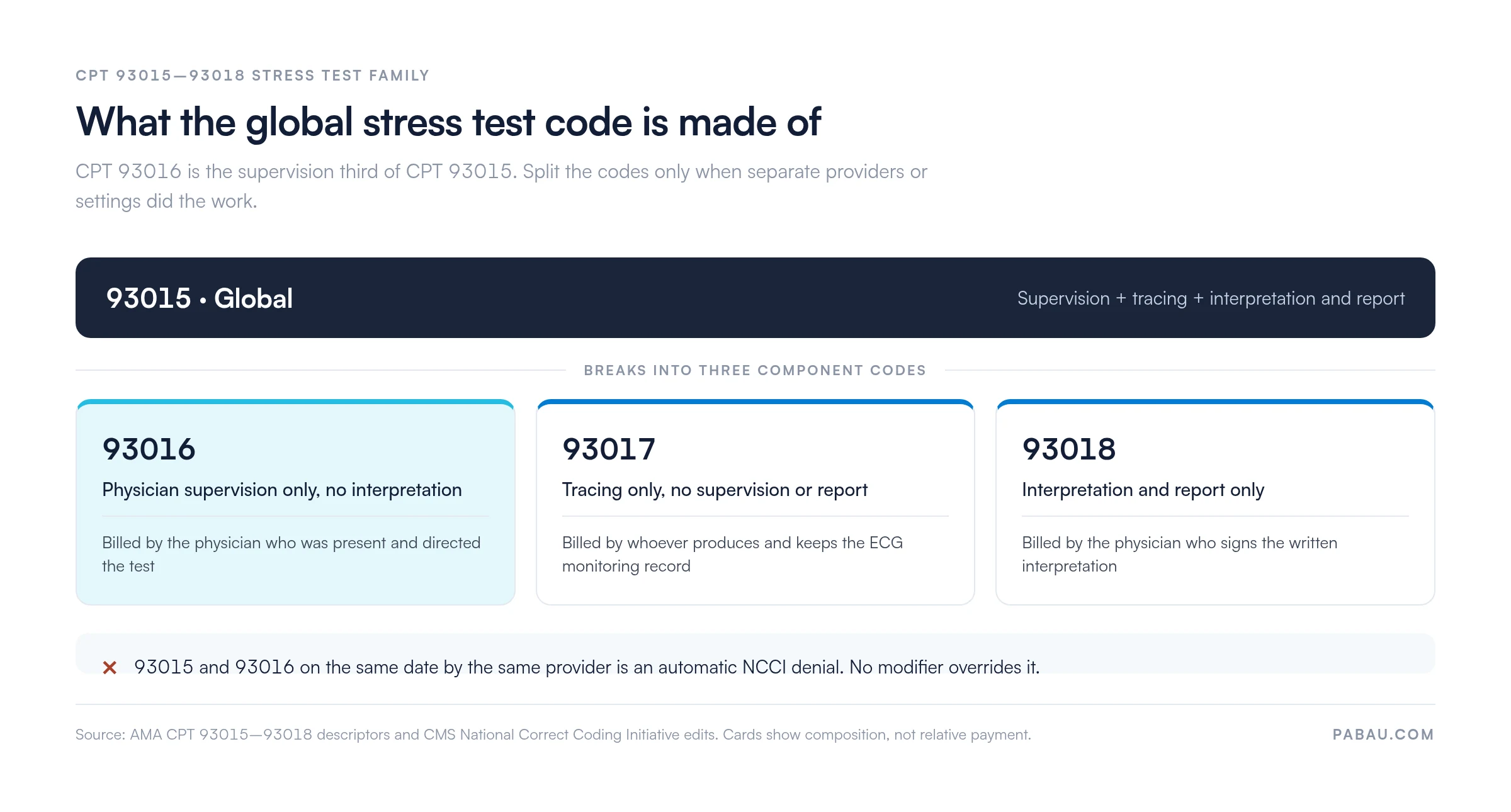
The total reimbursement for 93016 + 93017 + 93018 is equivalent to 93015 when billed by the same provider. Split billing makes sense only when the work is genuinely divided. One example is a supervising cardiologist in a hospital outpatient department and a separate reading physician who interprets remotely.
The decision between these two codes depends entirely on who performs each component of the stress test. Use this decision framework before selecting a code.
The mutual exclusivity rule is a hard edit in most payer systems. Billing 93015 and 93016 on the same date by the same provider generates an automatic denial under the National Correct Coding Initiative (NCCI). No modifier overrides it.
When the supervising physician and the interpreting physician are different individuals, component billing distributes the work across each provider’s claim. Each provider bills only the components they personally performed.
Never use component codes simply to increase reimbursement when one provider performed the full service. That pattern constitutes unbundling and creates audit exposure.
Medicare pays roughly $20 for CPT 93016, and the amount varies by geographic locality rather than by setting. The figures below reflect approximate national averages from the 2026 Medicare Physician Fee Schedule. Verify exact rates for your MAC jurisdiction using the CMS PFS lookup tool before billing.
The facility and non-facility amounts are effectively the same for 93016. The code pays for physician supervision, so there is almost no practice-expense difference between a hospital outpatient department and an office.
Place of service still has to match where the test happened. A mismatch produces a POS rejection rather than a smaller payment, so it costs rework time instead of revenue. Use the FastRVU lookup tool to check the work, practice expense, and malpractice RVU components for your region.
Rates change each January with the CMS Physician Fee Schedule update. Pull your MAC’s locality-adjusted amount for 93016 at the start of each calendar year. Update the fee schedule in your billing system at the same time, so remittances reconcile without manual adjustment.
Every CPT 93016 claim requires a supporting ICD-10 diagnosis code that establishes medical necessity under the applicable CMS Local Coverage Determination (LCD). CMS Article ID 57184 identifies covered indications for cardiovascular stress testing. The table below lists commonly accepted diagnosis codes. Verify the full list against your MAC’s current LCD before billing, because covered indications vary by jurisdiction.
Using an unsupported or overly nonspecific diagnosis code, such as Z00.00 for a routine exam, is a primary denial driver. The ICD-10 code should reflect the clinical indication documented in the ordering note, not a generic “stress test ordered” entry.
Adequate documentation is what converts a technically correct claim into a paid one. For CPT 93016, the medical record must demonstrate that the physician supervised the test rather than merely ordering it. According to CMS Article ID 57184, the following elements are required.
Practices that use structured note templates for stress test supervision report fewer documentation-related denials. Generating a superbill from that note carries the supervising provider’s details onto the claim. It also links the CPT code to the documented diagnosis, which cuts missing-element denials at the clearinghouse.
Four denial patterns account for the majority of 93016 rejections across cardiology practices. Each one has a specific trigger, and each one can be caught before the claim is submitted.
Each denial pattern above can be caught before a claim reaches the payer. Reading the remark codes on your remittances against a reference for denial codes shows which of the four patterns is costing the practice most.
Run a quarterly audit of your 93016 claims and pull every denial carrying remark code CO-97 or CO-7. More than three or four in a quarter points at the supervision note template rather than a one-off coder error. Fixing the template removes the pattern at its source.
Medicare’s LCD for cardiovascular stress testing (CMS Article ID 57184) sets the baseline coverage framework, but commercial payers write their own medical policies. Those policies often diverge from Medicare on covered indications, documentation standards, and prior authorization requirements.
The practical step is to pull the payer’s specific policy for CPT 93016 before the first claim of each year, not after the first denial. Use the AAPC Codify CPT lookup to cross-reference coding guidance, and contact the plan’s provider relations line for policy documents. Record the policy version and date in your billing notes for audit protection.
The denial patterns above share one root. They depend on an individual biller catching every rule on every claim, every time. Practice management software like Pabau applies those rules as a pre-submission edit instead, so the claim stops inside the practice rather than at the clearinghouse.
Pabau’s claims software for cardiology runs the 93015/93016 mutual exclusivity check at the claim level. For a practice putting through high volumes of stress test claims, that single edit can prevent dozens of CO-97 denials a month.
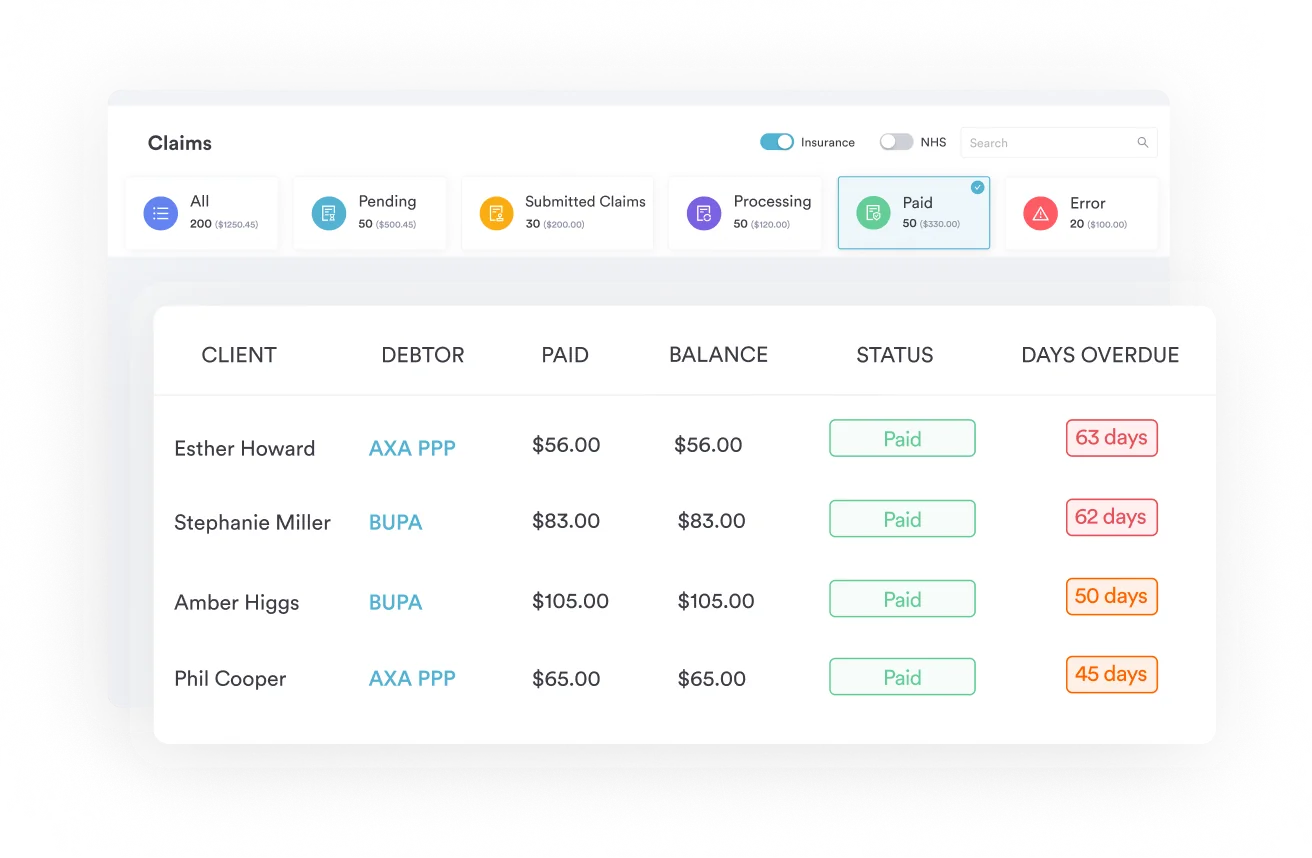
Structured note templates for physician supervision sit inside the encounter workflow. The attestation, the test protocol, and the patient response are captured at the point of care rather than reconstructed afterwards. The claim record then matches what the physician actually did.

Pabau’s claims management tools flag mutual exclusivity conflicts and missing documentation before your stress test claims leave the practice. See how it works for cardiology billing teams.

CPT code 93016 is narrow by design. It covers supervision only, with no interpretation and no report. That narrowness is why it denies so readily when it stands in for the global service.
Choose the code from who did the work, never from what pays better. Verify the place of service, link a covered ICD-10 diagnosis, and get the supervision attestation signed before the claim leaves the practice. The reimbursement is modest either way, so the money is in the claims you do not have to rework.
Book a demo to see how Pabau catches a 93015/93016 conflict before your cardiology claims reach the payer.

Need a framework for reducing cardiology claim denials? Denial management in healthcare walks through the systematic approach to identifying and resolving recurring rejection patterns.
Want to understand the full billing lifecycle? Revenue cycle management explained covers the end-to-end process from eligibility check through payment posting.
Looking for clearinghouse integration options? Claim.MD clearinghouse overview details how Pabau connects with the clearinghouse for real-time eligibility and ERA processing.
CPT code 93016 is the physician supervision component of a cardiovascular stress test. It covers the physician’s on-site presence and oversight during the procedure, without the ECG interpretation or the written report. It is one of three component codes (93016, 93017, 93018) that together equal the global stress test code 93015.
CPT 93015 is the global code that includes supervision, ECG tracing, and interpretation and report in a single billing unit. CPT 93016 covers supervision only, with no interpretation or report included. Use 93015 when one provider performs the entire service. Use 93016 when supervision and interpretation are genuinely split between different providers or settings.
No. Billing 93015 and 93016 on the same date by the same provider triggers an automatic NCCI edit denial. There is no modifier that overrides this mutual exclusivity rule. The correct approach is to use 93015 alone when one provider performs all three components of the stress test.
Medicare pays roughly $20 for CPT 93016 in 2026, and the facility and non-facility amounts are close to identical. The code pays for physician supervision, so there is almost no practice-expense difference between settings. Rates vary by geographic locality, so confirm the exact amount for your MAC jurisdiction using the CMS Physician Fee Schedule lookup tool.
Required documentation includes a signed supervision attestation confirming the physician was on-site and immediately available. You also need the clinical indication linked to a covered ICD-10 code and the stress test protocol used. Add the ECG monitoring record, a note on the patient’s response and reason for termination, and the supervising physician’s dated signature.
Use the three component codes instead of 93015 when supervision and interpretation are performed by different providers. The same applies when the test is split across settings. One example is a hospital that supervises and monitors while the office physician reads and interprets remotely. Component billing purely to increase reimbursement, when one provider performed the full service, constitutes unbundling.
Nuclear stress tests use a separate code set. CPT 78451 and 78452 cover myocardial perfusion imaging (SPECT), and 78453 and 78454 cover planar imaging. These are distinct from the treadmill and exercise stress test family (93015-93018), and they are not interchangeable with CPT 93016 for billing purposes.