HCPCS code V5259: Digital binaural ITC hearing aid billing
HCPCS code V5259 reports a digital ITC hearing aid pair HCPCS code V5259 reports...

Last Updated: Oct 22, 2026
93456 is the CPT code for coronary angiography with right heart catheterization. It covers coronary catheter placement, intraprocedural contrast injections, and imaging supervision and interpretation, plus right heart catheterization in the same session.
The code sits in the 93451-93461 cardiac catheterization series. It applies when the right heart is catheterized and native coronaries are imaged, with no left heart catheterization and no bypass graft angiography. Pharmacologic stress testing is not part of 93456 and is reported separately with add-on code 93463.
Let Pabau's smart automation suggest the right codes, reduce claim denials, and keep your practice compliant—effortlessly.
Automate repetitive tasks and focus on what matters most—your patients.
Reduce coding errors and ensure compliance with the latest regulations.
Clean claims, fewer denials, and faster reimbursements.
Powerful insights and reporting to help your practice thrive.
HIPAA compliant SOC 2 certified GDPR-compliant Trusted by 4,000+ clinics worldwide

CPT code 93456 covers coronary angiography with right heart catheterization, without left heart catheterization or bypass graft imaging.
The code bundles vascular access, catheter advancement, hemodynamic pressure measurements, and coronary imaging supervision into a single billable unit.
Whether a left heart component was performed decides between 93456, 93458 and 93460. Mixing them up is the most common error in the cardiac cath family.
Pharmacologic stress testing is never part of 93456, so report add-on code 93463 whenever it is performed.
Pabau’s claims management software validates each claim before submission through Claim.MD, so coding errors surface before the payer sees them.
CPT code 93456 describes coronary angiography performed together with right heart catheterization in the same session. A catheter is advanced from a peripheral vein through the right atrium and right ventricle into the pulmonary artery to record pressures. The coronary arteries are then selectively injected with contrast and imaged.
The official descriptor covers catheter placement in the coronary arteries, the intraprocedural injections, and imaging supervision and interpretation. Pharmacologic stress testing is not part of the code. When it is performed, report it separately with add-on code 93463.
Neighboring codes in the 93451-93461 series differ by a single component, so the cath report decides the code. If your team is newer to procedure coding, our guide to medical billing fundamentals explains how CPT and ICD-10 codes work together on a claim.
Several services are bundled into CPT 93456 by the AMA and cannot be billed separately. Billing any of these alongside 93456 will trigger a National Correct Coding Initiative (NCCI) edit and result in denial or downcoding.
The most common coding error in this family is substituting 93458 (left heart catheterization with coronary angiography) for 93456, or the reverse. Both include coronary angiography, but 93456 pairs it with right heart work and 93458 with left heart work. When both sides are catheterized in the same session, 93460 replaces both.
When to use 93456 vs 93460: If the cardiologist entered both sides of the heart in the same session, 93460 is correct. If the right heart was catheterized and coronaries were imaged but the left ventricle was not entered, 93456 is correct.
When to use 93456 vs 93457: The difference is bypass graft angiography. 93457 includes everything in 93456, coronary angiography plus right heart catheterization, and adds imaging of the bypass grafts. Use 93457 whenever grafts are imaged alongside the native coronaries, and 93456 when only native vessels are imaged.
Two questions place any of these procedures: which heart chambers were catheterized, and whether bypass grafts were imaged. The grid below maps every answer to its code.
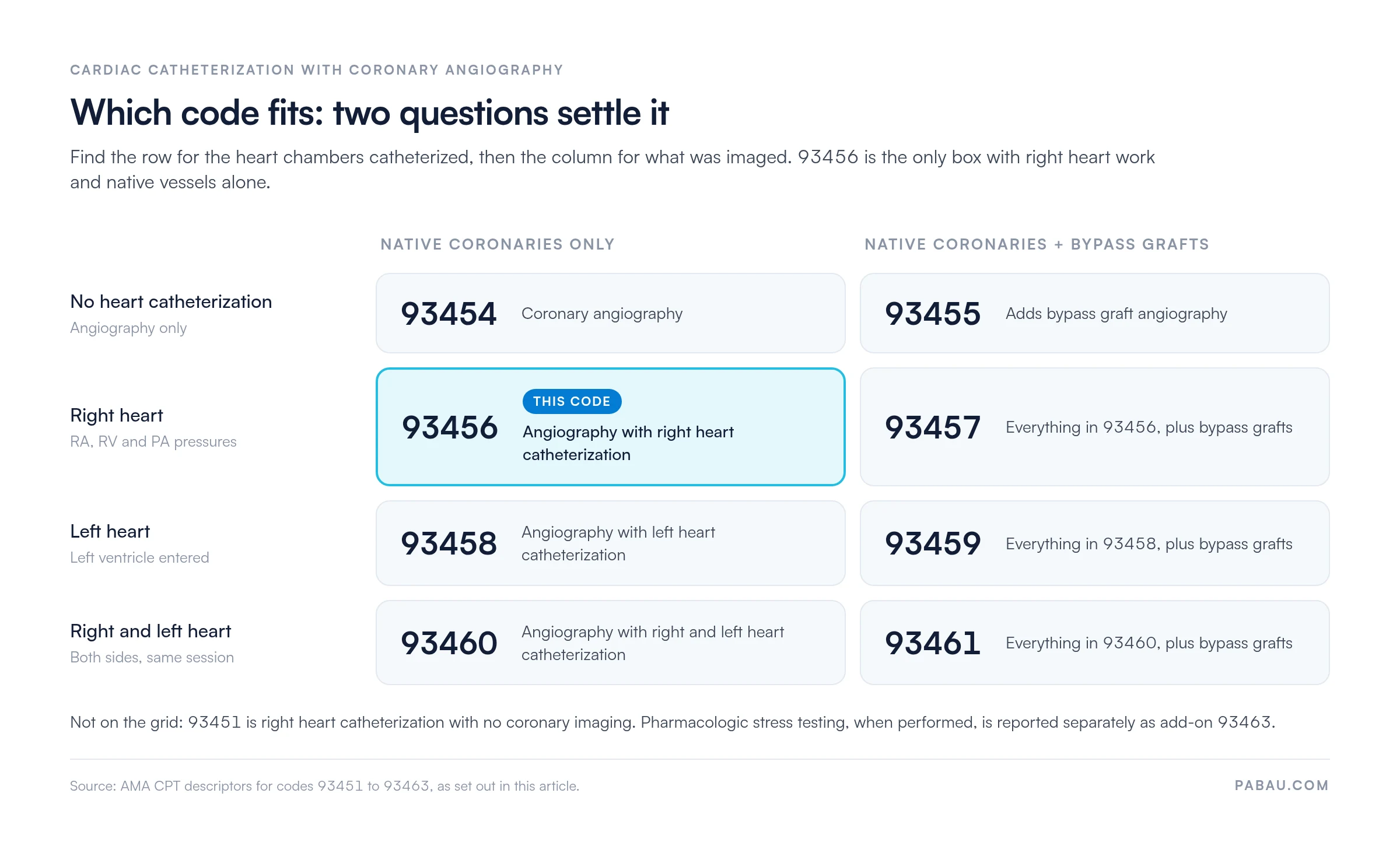
The grid leaves out 93451, which is right heart catheterization with no coronary imaging at all.
The cath lab report must document each component the code bundles. A claim submitted without evidence that all required components were performed is the second most common denial reason after incorrect code selection.
Running insurance eligibility verification before the encounter cuts payer-side rejections that happen before the claim reaches clinical review. The procedure note itself must include these elements:
Keeping a superbill with itemized procedure components alongside the cath lab report strengthens the claim and simplifies appeals when a denial occurs.
Several add-on and supplementary codes can be reported alongside CPT 93456 when those services are performed and documented. Never add one to raise reimbursement when the service did not happen.
Check the current CMS NCCI edits file each quarter before assuming add-on reportability for 92978 and 92979. NCCI column 2 edits change with each quarterly update. A pairing allowed last quarter may now need a modifier or be fully bundled.
Medicare reimbursement for CPT code 93456 is set annually through the CMS Medicare Physician Fee Schedule. Because rates change each calendar year and vary by geographic practice cost index (GPCI), this article intentionally does not hardcode a dollar figure.
Use the CMS PFS lookup tool or the FastRVU 2026 RVU lookup to retrieve current work, practice expense, and malpractice RVU values for your locality.
Several payer-facing factors affect net reimbursement for this code. The billing variables below help practices set accurate reimbursement expectations before the claim is filed.
Denials on CPT code 93456 fall into five predictable categories. Each has a specific fix. Structured denial management workflows that track these patterns by denial code catch repeat errors before they accumulate into write-offs.
The supporting ICD-10-CM diagnosis must justify both the right heart catheterization and the coronary angiography components. Using a diagnosis that supports only one component increases denial risk. The AAPC Codify CPT lookup provides crosswalk data for CPT-to-ICD-10 medical necessity pairings.
Coronary artery disease coded as I25.10 supports the angiography, but the note still has to show elevated pressures to cover the right heart work. When two diagnoses each partially justify the procedure, bill both ICD-10 codes in order of clinical significance.
That gives the claim its strongest medical necessity profile. MAC local coverage determinations for cardiac catheterization should be reviewed for the specific diagnoses your MAC requires as covered indications.
In many cardiology practices, a coder reads the cath report, picks a code from the 93451-93461 series, and keys it into a separate billing system. A wrong sibling code or an unbilled 93463 then surfaces only when the remittance comes back short.
Pabau, the practice management platform we build, keeps the visit, the invoice and the claim in one patient record. It checks insurance eligibility through Claim.MD before the patient reaches the cath lab. Its claims software for cardiologists then validates each CMS-1500 claim for missing or invalid details before it leaves.
A claim that still comes back rejected is flagged Needs action, with a link straight to the field that needs correcting. Payments are settled from the electronic remittance advice (ERA) file, so a short-paid 93456 claim stands out while it can still be appealed.
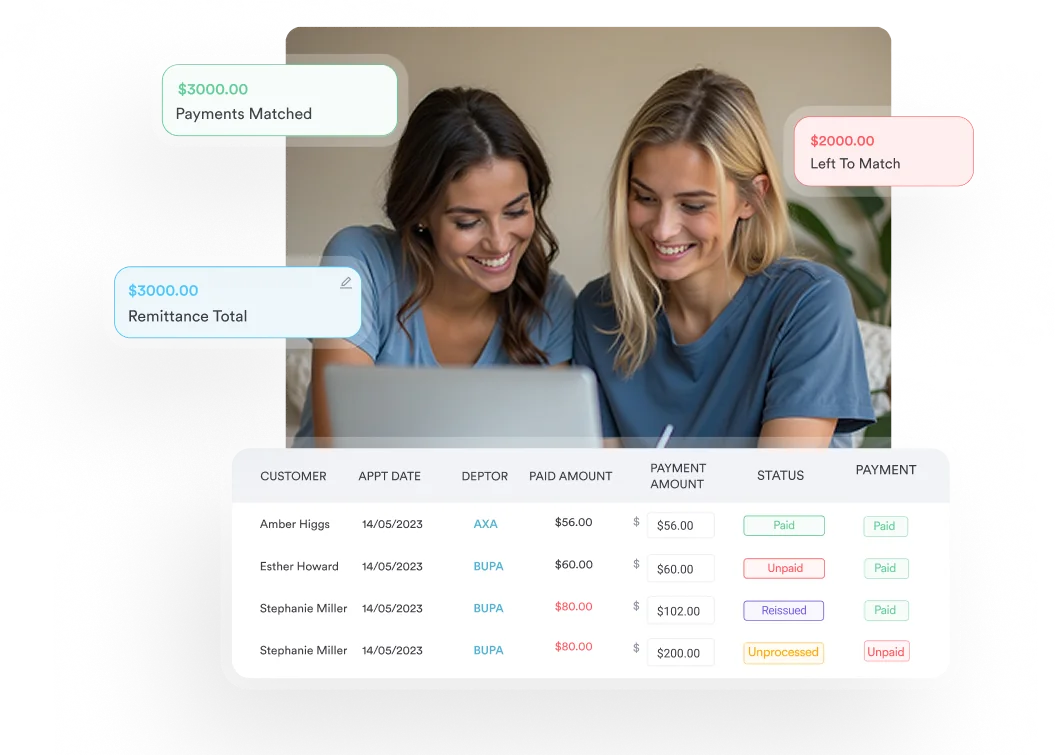

Pabau checks eligibility, validates each claim and submits it through Claim.MD, then settles payment from the ERA file. Your team spends less time reworking denied cath claims.

Code 93456 rewards the coder who reads the cath report before the charge sheet. Confirm four facts from the note:
If any one of those fails, a sibling code applies, and the claim should change before it goes out. That check takes minutes at the front end and saves an appeal later. It also stops add-ons like 93463 from going unbilled.
Book a demo to see how Pabau validates cardiology claims before they reach the payer.

Need to understand how cardiac claims move through the clearinghouse? Medical claims clearinghouse guide explains how electronic claims are validated, scrubbed, and transmitted to payers.
Want to reduce repeat denials across your practice? Revenue cycle management fundamentals covers the full claim lifecycle from eligibility through payment posting.
Submitting 837P files for cardiac procedures? 837 EDI file guide breaks down the transaction format, loop structure, and common submission errors.
CPT code 93456 is the billing code for coronary angiography with right heart catheterization. It does not include left heart catheterization, bypass graft imaging or pharmacologic stress testing, which are coded separately.
CPT 93456 covers coronary angiography with right heart catheterization, while CPT 93458 covers coronary angiography with left heart catheterization. They are mutually exclusive. If both sides were catheterized in one session, use 93460 instead.
CPT 93460 adds left heart catheterization to everything in 93456. Use 93460 when the cardiologist entered both the right and left heart chambers in the same encounter. Use 93456 when only the right heart was catheterized alongside the coronary imaging.
Medicare reimbursement for CPT 93456 changes annually with each Physician Fee Schedule update and varies by geographic locality. Use the CMS Physician Fee Schedule search tool at cms.gov or a current RVU lookup tool. Both return the facility and non-facility rates for your locality and the current year.
It may be billable when supported by adequate documentation, but payer approval is not guaranteed. The procedure note at the billing facility must explain why the prior results were clinically insufficient. Common reasons are a new clinical question, new symptoms, or poor image quality. Include the prior cath date and facility name on the claim. Before submitting, check the MAC local coverage determination and your commercial payer’s repeat-procedure policy.
FFR/iFR measurement (93571, 93572), intravascular ultrasound (92978, 92979), pulmonary angiography injection (93568), and pharmacologic stress add-on (93463) are the most common separately reportable services. Confirm current NCCI edit status for each pairing before billing, as bundling rules are updated quarterly.