

HCPCS code E0198: Water pressure pad billing guide
HCPCS code E0198 is a water pad for a standard mattress HCPCS code E0198 is the ...

Last Updated: Oct 13, 2026
92611 is the CPT code for motion fluoroscopic evaluation of swallowing function by cine or video recording. It covers the modified barium swallow study, where a speech-language pathologist analyzes a patient's swallow across different bolus textures under real-time X-ray.
The code sits in the Special Otorhinolaryngologic Services range of the Medicine section, next to 92610, the clinical swallowing evaluation done without imaging. Dysphagia affects an estimated 8% of the global population, and the modified barium swallow study is a primary instrumental evaluation tool for diagnosing it.
Let Pabau's smart automation suggest the right codes, reduce claim denials, and keep your practice compliant—effortlessly.
Automate repetitive tasks and focus on what matters most—your patients.
Reduce coding errors and ensure compliance with the latest regulations.
Clean claims, fewer denials, and faster reimbursements.
Powerful insights and reporting to help your practice thrive.
HIPAA compliant SOC 2 certified GDPR-compliant Trusted by 4,000+ clinics worldwide

CPT code 92611 covers the motion fluoroscopic (real-time X-ray) evaluation of swallowing. The bedside evaluation billed as 92610 needs no imaging.
Modifier -26 bills the professional interpretation only, and -TC bills the technical component only. No modifier means one provider performed both (global billing).
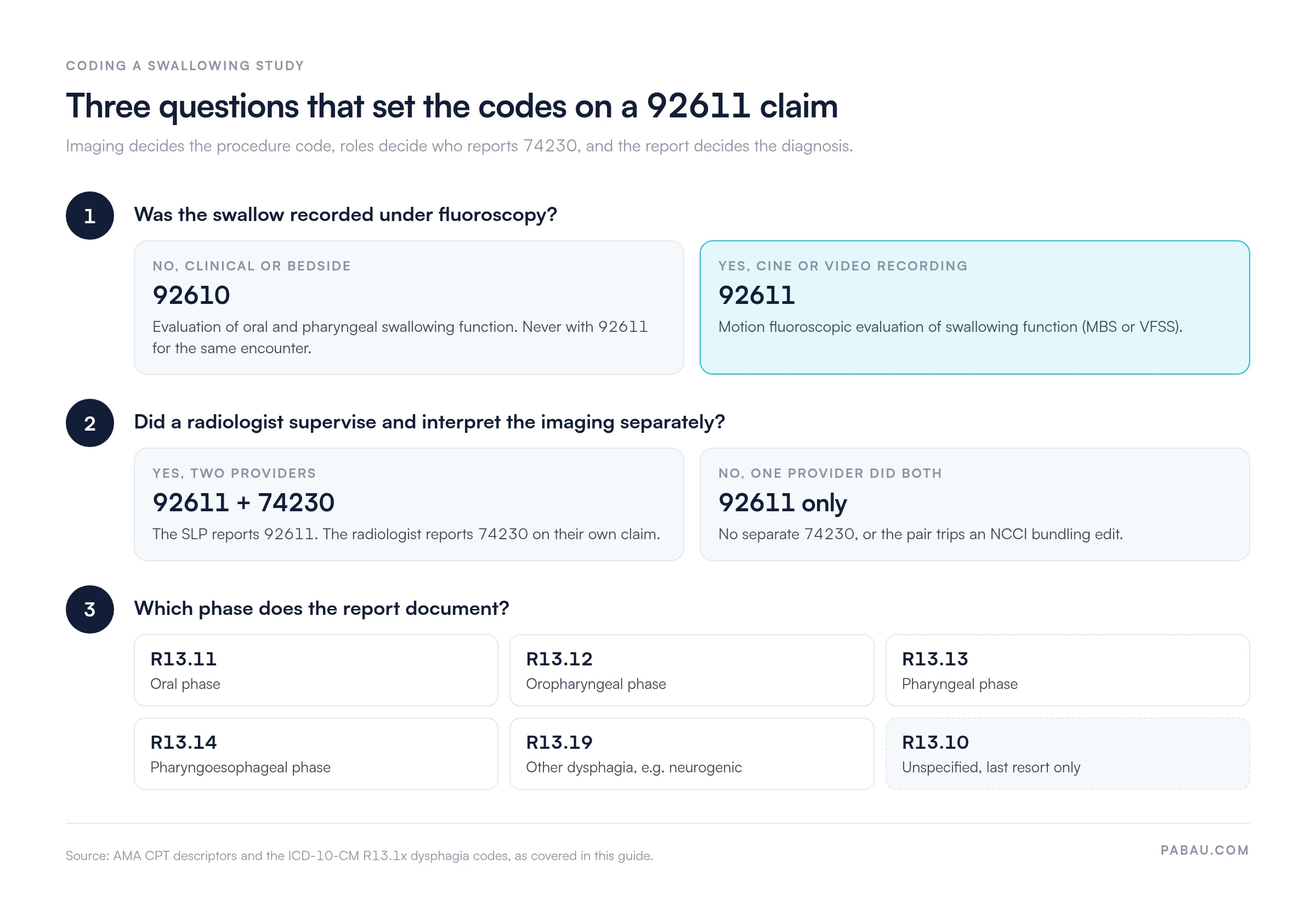
ICD-10 R13.10 (dysphagia, unspecified) is the most common supporting diagnosis. The phase-specific codes R13.11 to R13.14, plus R13.19, reduce denial risk under most MAC LCDs.
Pabau’s claims management software runs validation checks before each claim is sent and submits 92611 claims through the Claim.MD clearinghouse integration.
CPT code 92611 is described by the American Medical Association (AMA) as: “Motion fluoroscopic evaluation of swallowing function by cine or video recording.” The code captures the clinical work of a physician or qualified healthcare professional using real-time fluoroscopic imaging. They analyze a patient’s swallowing mechanics across multiple bolus types and consistencies.
The study is performed jointly by a speech-language pathologist (SLP) and a radiologist in most hospital outpatient settings. The SLP directs the patient through bolus trials and interprets swallowing function in real time. The radiologist supervises the fluoroscopy equipment and may generate an independent imaging interpretation.K
The study is also called a videofluoroscopic swallowing study (VFSS) or modified barium swallow study (MBS). Those terms describe the same clinical procedure and map to the same billing code. Speech therapy practices and hospital outpatient departments both report it. For neighboring codes in the same family, our CPT code library lists each one with its billing rules.
CPT code 92611 requires fluoroscopic imaging, while CPT 92610 does not. That single distinction decides which code applies to a swallowing evaluation, and mixing them up is a common coding error in this family.
92610 and 92611 are mutually exclusive for the same swallowing encounter. Billing both on the same date of service for the same patient triggers an NCCI edit and a bundling denial. Document which type of evaluation was performed before selecting the code, then work through the three questions below.
The modifier you append (or omit) on a CPT code 92611 claim shows which component of the study is billed, and by whom. Getting it wrong is a frequent cause of 92611 denials.
In most hospital outpatient settings, the SLP bills 92611-26 and the radiology department bills 92611-TC. In a private SLP practice that owns its own fluoroscopy equipment (rare), global billing with no modifier may apply. Using claims management software that runs pre-submission checks catches missing claim details before the payer does.
ICD-10 R13.10 is the most common supporting diagnosis paired with CPT code 92611, covering dysphagia, unspecified. Most Medicare Administrative Contractor (MAC) Local Coverage Determinations (LCDs) accept the whole R13.1x family as covered diagnoses. Specificity within the family still matters for claim acceptance.
Document the specific phase of swallowing impairment in the clinical report before selecting a code. Selecting R13.10 when the record documents a pharyngeal-phase impairment is a specificity error that some MACs flag during audit. Secondary diagnoses (such as I69.391 for dysphagia following cerebral infarction) can strengthen medical necessity documentation when an underlying neurological condition is the clinical context.
Medicare covers CPT code 92611 under the Medicare Physician Fee Schedule (MPFS) when medical necessity is established. The service must also meet the criteria in the applicable MAC’s Local Coverage Determination. Coverage is not automatic. The provider must document a clinical indication for the fluoroscopic study rather than a bedside evaluation alone.
The CMS Medicare Physician Fee Schedule lookup tool publishes the current rates each year. Medicare pays speech-language pathology services at the non-facility rate in every setting. An SLP’s 92611 claim isn’t cut to a facility rate in a hospital.
Always verify current rates using the FastRVU RVU lookup tool or the CMS fee schedule search, as rates are updated each January. The geographic practice cost index (GPCI) adjusts the payment for your locality, so your payment will differ from the national figure. Pabau connects to the Claim.MD clearinghouse to submit 92611 claims electronically to thousands of US payers. Its real-time eligibility checks surface coverage details before the study is performed.
Check your MAC’s LCD before scheduling a modified barium swallow study for a patient whose primary diagnosis is not in the R13.1x family. Some MACs include neuromuscular diagnoses (G35, G12.21) as covered indications, while others require the dysphagia code to appear as the primary claim diagnosis.
Yes, CPT 92611 and 74230 can be billed together when two separate providers each perform a distinct role in the same modified barium swallow study. 74230 is the radiology code for the radiologist’s supervision and interpretation of the swallowing fluoroscopy. 92611 covers the SLP’s clinical swallowing analysis.
NCCI edits may bundle 92611 and 74230 when the same provider submits both without appropriate modifiers. The edit tables change each quarter, so verify the edit status for the current period before submitting. When a single provider performs both roles, the appropriate code is 92611 with no modifier, and 74230 should not be separately billed.
The place of service (POS) code on a CPT code 92611 claim changes who else bills for the study, but not the SLP’s Medicare rate. Medicare pays SLP services at the MPFS non-facility rate in every setting, so the POS code mostly shapes the billing split around the SLP.
Hospital outpatient departments are paid for their share of the study under the Outpatient Prospective Payment System (OPPS). OPPS uses Ambulatory Payment Classifications (APCs) rather than the MPFS. The SLP’s own claim is still paid from the MPFS at the non-facility rate. Private-practice SLPs who own fluoroscopy equipment are rare.
A CPT code 92611 claim is denied most often because the documentation does not establish medical necessity. The other frequent cause is a report too thin to distinguish the fluoroscopic study from a clinical swallowing evaluation. Every element below must be present in the medical record before the claim is submitted.
Submitting a clean claim for 92611 means all of these elements are in the record before the claim leaves the practice. Retrospective documentation after a denial is possible but creates audit risk. Build the checklist into the SLP’s report template so each element is captured during the study.
Same-day billing of CPT code 92611 (evaluation) with 92526 (swallowing treatment) or 92507 (speech and language treatment) is possible with the right documentation. Several payers bundle these codes unless a modifier separates them.
When billing 92611 and 92526 on the same date, the record must show that the treatment was a distinct, separately documented service. It can’t read as a continuation of the evaluation encounter. Add modifier -59 to 92526 to signal a distinct service, and document the start and stop time of each service separately. Medicare and commercial payers vary on whether they allow this combination. Check your payer’s edit policy before billing it routinely.
Most CPT code 92611 denials trace back to one of six root causes. Each has a specific corrective action.
A structured denial management workflow that categorizes 92611 rejections by CARC code lets billing teams spot patterns. They can then fix the upstream documentation or authorization step instead of working appeals one at a time.
Build a 92611 pre-submission checklist into your billing workflow. Confirm the physician order, the R13.1x code, a modifier that matches the provider role, and prior authorization for commercial plans. If 74230 is on the claim too, check the modifier separation. Running this before submission cuts denial volume by catching errors that would otherwise become appeals.
Medicare does not require prior authorization for CPT code 92611 as a standard national policy. Individual MAC LCDs still set coverage criteria that work as a documentation hurdle. Commercial payer requirements vary significantly and must be verified payer by payer before scheduling.
Retro-authorization (seeking approval after the study is performed) is possible with some commercial payers when prior auth was overlooked. Approval is not guaranteed and varies by payer. The most defensible approach is confirming authorization status and eligibility in writing before the patient enters the fluoroscopy suite.
In many SLP billing workflows, the study report sits in one system and the claim is built in another. A biller re-keys the codes, checks payer details by hand, and learns about a missing authorization number when the rejection arrives.
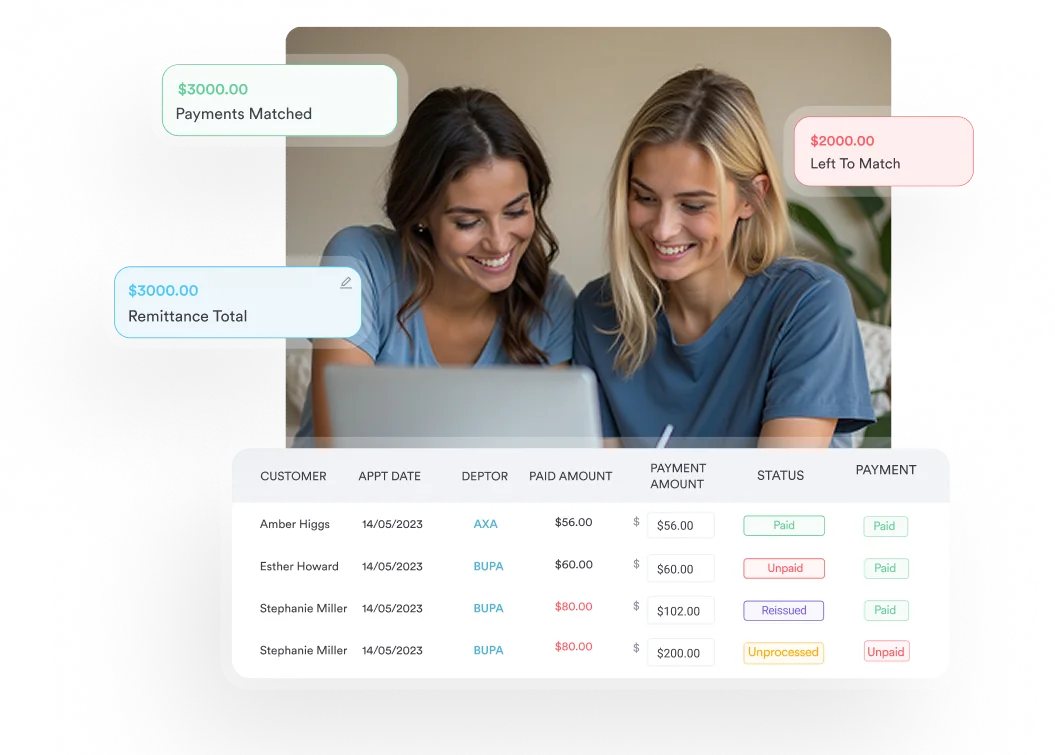
Pabau keeps the swallowing study report on the same patient record the claim is created from. Validation checks run before each claim is sent, catching missing details such as membership numbers and authorization codes. Finished claims go out through the Claim.MD clearinghouse integration, and claim status and remittances come back into the same billing workflow.
Your billing team spends less time rebuilding 92611 claims that bounced for avoidable reasons, and more of each study gets paid on the first submission.

Pabau connects your swallowing study reports to claim submission. It runs validation checks before each claim is sent and submits 92611 claims through our Claim.MD clearinghouse integration.

Treat every 92611 claim as a question about roles before it becomes a question about codes. Confirm who ran the fluoroscopy and who interpreted the swallow, then decide whether 74230 belongs on a separate radiology claim.
Code to the phase the report documents. A fluoroscopic study exists to show where the swallow breaks down. A claim that falls back on R13.10 suggests the report is missing a finding.
The trade-off is admin work up front. Checking the order, the authorization, and the payer’s edit policy before the study costs minutes. Working a denial afterward means pulling the record, correcting the claim, and resubmitting it.
Is your team still reworking 92611 claims after denials? Book a demo to see how Pabau checks each claim before it’s sent, then submits it through Claim.MD to thousands of US payers.

Keeping your SLP billing audit-ready? Medical billing compliance covers the rules and checks that keep claims defensible when a payer audits them.
Working through a 92611 denial? Denial codes in medical billing explains what each denial code means and how to correct the claim.
New to the claims cycle? What is medical billing explains the end-to-end claims workflow, from charge capture to payment.
Submitting 92611 claims electronically? 837 file guide covers the EDI transaction format used for electronic claim submission to Medicare and commercial payers.
CPT code 92611 covers the motion fluoroscopic evaluation of swallowing function, recorded by cine or video. A physician or qualified healthcare professional performs or directs it. It captures the clinical interpretation of real-time X-ray imaging of a patient’s swallowing mechanics across multiple bolus consistencies. Bedside or clinical swallowing evaluations without imaging are billed under 92610 instead.
CPT 92610 is a clinical swallowing evaluation performed at the bedside or in an office without imaging. CPT 92611 requires real-time fluoroscopic imaging (a modified barium swallow study). The two codes are mutually exclusive for the same swallowing encounter on the same date of service.
Yes, Medicare covers CPT code 92611 when medical necessity is documented and the service meets the criteria in the applicable MAC’s Local Coverage Determination. The provider must document a clinical indication for fluoroscopic evaluation rather than a clinical evaluation alone. Medicare Advantage plans may impose additional prior authorization requirements beyond traditional Medicare.
The most common denial reasons are a missing physician order, an unsupported ICD-10 diagnosis code, and an incorrect modifier (especially -26 vs. -TC). Others are bundling with 74230, missing commercial prior authorization, and a non-covered setting. Each denial reason maps to a specific upstream documentation or workflow fix.
Traditional Medicare does not require prior authorization for 92611 nationally, though MAC LCDs establish coverage criteria. Commercial payers commonly require prior authorization, and requirements vary by plan, so verify them before scheduling. Medicare Advantage and Medicaid plans have their own rules that may differ from traditional Medicare.
Yes, when two separate providers perform distinct roles. The SLP bills 92611-26 for clinical swallowing interpretation and the radiologist bills 74230 for fluoroscopy supervision and imaging interpretation. NCCI edits may bundle both codes when the same provider submits them without appropriate modifiers. Modifier discipline matters most when one provider performs both functions.



