

HCPCS Code L0472: Hyperextension TLSO billing guide
HCPCS code L0472: Official descriptor and device definition HCPCS code L0472 des...

Last Updated: Nov 5, 2026
92612 is the CPT code for flexible endoscopic evaluation of swallowing by cine or video recording. The clinician passes a flexible scope through the nose, records the patient swallowing foods and liquids, then interprets the study and writes the report.
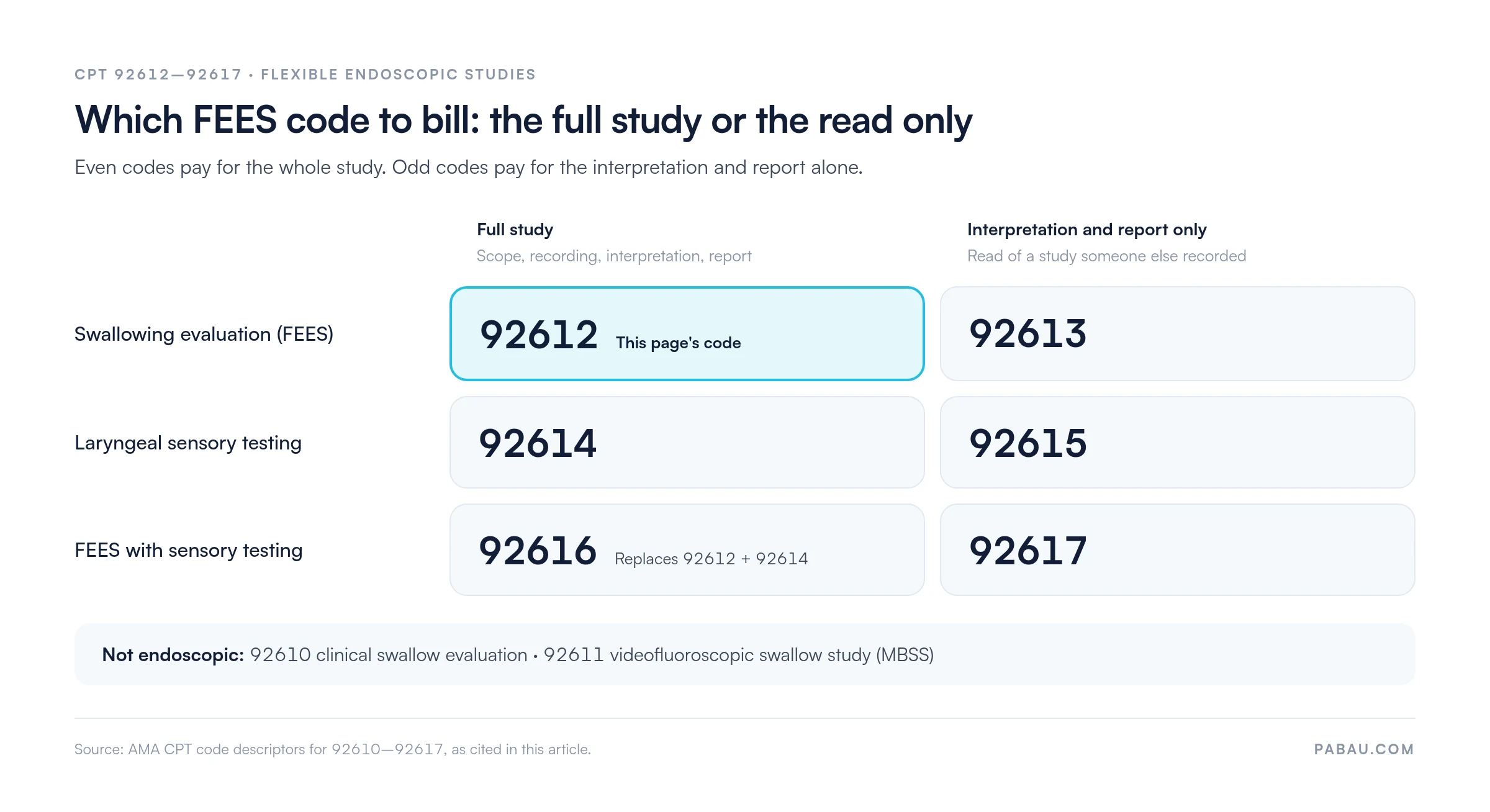
92612 bills the full study. A physician who only reads a study someone else recorded bills 92613, and FEES with laryngeal sensory testing moves to 92616. Billing 92612 with 92610 on one date can trigger an NCCI denial, so verify the current edit pair. Miss the right ICD-10 pairing and medical necessity falls apart just as fast.
Let Pabau's smart automation suggest the right codes, reduce claim denials, and keep your practice compliant—effortlessly.
Automate repetitive tasks and focus on what matters most—your patients.
Reduce coding errors and ensure compliance with the latest regulations.
Clean claims, fewer denials, and faster reimbursements.
Powerful insights and reporting to help your practice thrive.
HIPAA compliant SOC 2 certified GDPR-compliant Trusted by 4,000+ clinics worldwide

CPT code 92612 covers a full FEES study with cine or video recording. Add laryngeal sensory testing in the same session and the whole service becomes 92616.
A physician who only interprets a FEES study someone else recorded bills 92613, the interpretation-only code.
92610 is a clinical swallow evaluation and 92611 is the videofluoroscopic study (MBSS). Check the current NCCI edit pair before billing either one with 92612 on the same date.
Medical necessity requires documented dysphagia symptoms, a physician referral, and an ICD-10 code supported by your MAC’s Local Coverage Determination.
Pabau’s claim validation scrubs each FEES claim for missing or invalid details before it reaches the clearinghouse.
CPT code 92612 is the American Medical Association’s designated procedure code for “flexible endoscopic evaluation of swallowing by cine or video recording.”
The procedure involves passing a flexible laryngoscope transnasally to visualize the pharynx and larynx while the patient swallows food and liquid of varying consistencies. The clinician records the study on cine or video, then produces a written interpretation and report.
Speech-language pathologists and otolaryngologists are the primary provider types billing this code. The AMA’s CPT code set places 92612 in the Special Otorhinolaryngologic Services section (codes 92502-92700), reflecting its dual use across ENT and SLP practices.
92612 pays for the complete study: scope passage, swallowing trials with varied bolus consistencies, the recording, and the clinician’s interpretation and written report. The provider who bills 92612 never adds a separate interpretation code for the same study. When a physician only reads a study that someone else recorded, that read is billed as 92613.
Knowing where 92612 stops prevents the most common coding errors. The table below maps what is included, what requires a separate code, and what needs an edit check before it shares a date with 92612.
The exclusion that trips up most facility claims is the interpretation-only read. When a physician interprets a FEES study that an SLP recorded, the physician reports 92613 rather than 92612. A few payers still ask for component modifiers on 92612 instead, so confirm the payer’s policy before you split a study.
92612 (FEES) and 92611 (the modified barium swallow study, or videofluoroscopy) evaluate the same clinical problem with different instruments. Reporting the wrong one misstates the procedure in the medical record as well as on the claim. 92610 is neither study: it is the clinical evaluation of oral and pharyngeal swallowing function that often comes first.
When a patient needs both studies and the clinical picture justifies it, document why each one answers a different question. Check the current NCCI edit pair before you bill them on the same date. An active edit denies the second line whatever the clinical rationale.
Several codes share procedural overlap with 92612. Knowing how they relate prevents both undercoding and unbundling errors.
The table gives the full descriptor for each code and how it relates to 92612.
Medical necessity is the leading denial driver for 92612 claims. Each Medicare Administrative Contractor (MAC) publishes a Local Coverage Determination (LCD) that specifies the clinical criteria a FEES study must meet to be covered. Maintaining medical billing compliance starts with understanding what each MAC requires before the scope is passed.
Documentation must establish all of the following before billing:
MAC LCDs vary by region. What Noridian accepts as sufficient documentation may differ from Novitas or CGS requirements. Always review the active LCD for your jurisdiction before coding.
Before the FEES appointment, pull the patient’s referring physician note and confirm it documents a specific dysphagia complaint, not just ‘rule out dysphagia.’ A vague referral reason is one of the fastest paths to a medical necessity denial on 92612.
Pairing 92612 with an unsupported ICD-10 code is a primary denial trigger. MACs and commercial payers most widely accept the diagnosis codes below for a FEES evaluation. The full ICD-10-CM codes set covers the rest.
Use the most specific dysphagia code the documented findings support. R13.12 (oropharyngeal phase) is the most defensible pairing for a standard FEES evaluation of pharyngeal swallowing function. Reserve R13.10 for a referral that has not yet placed the problem in a phase.
An audit-ready FEES report for 92612 contains more than a summary of findings. Each element below must appear in the procedure note to support both the CPT code and the ICD-10 linkage. Missing any one of them gives a payer grounds for denial or recoupment. Structuring your note around a clean claim submission captures every required element before the claim goes out.
A short addendum on medical necessity adds protection in a post-payment audit. It should say why FEES rather than MBSS, and why the evaluation was needed now.
Modifier selection for 92612 depends on who performs the study, who interprets it, and where the service takes place. Using the wrong modifier, or omitting one when required, is a common denial trigger that falls under incorrect coding rather than a coverage dispute.
In an office setting where the SLP owns the scope and performs the full study, bill 92612 with no component modifier. When the study and the read are split between two providers, the dedicated interpretation codes (92613 and 92617) do the work that -26 does elsewhere. Check with your MAC or commercial payer before you apply -26 or -TC to 92612.
National Correct Coding Initiative (NCCI) edits are the most common source of unexpected 92612 denials. The billing team needs to know what each edit pair prohibits before the claim is built.
CMS updates NCCI edits quarterly, so treat the pairs above as general policy. Check the current pair in the CMS NCCI procedure-to-procedure edit tables before you make a coding decision based on it.
Speech-language pathologists and otolaryngologists are the two provider types that most commonly bill CPT code 92612. Each has a different billing pathway under Medicare.
SLPs billing under their own NPI: Medicare covers FEES performed by an SLP who holds the appropriate credentials, when the service meets medical necessity criteria. SLPs must be enrolled in Medicare and bill the study they perform under their individual NPI.
Incident-to billing: Medicare’s incident-to rules apply to services furnished under the direct supervision of a physician or non-physician practitioner, who then bills the service. An SLP cannot be the supervising provider for incident-to billing. Direct supervision means the physician is in the office suite and immediately available. Incident-to eligibility varies by payer, so verify it with your MAC and each commercial plan before relying on it.
Medicare pays different rates for 92612 depending on whether the service is performed in a facility or non-facility setting. Non-facility rates are higher because the practice overhead (scope, recording equipment, supplies) is not separately reimbursed by the facility. Figures below are national averages, and the payment you receive varies by geographic payment locality.
CMS updates the Medicare Physician Fee Schedule annually, and geographic factors shift the payment by locality. A single dollar figure here would mislead more readers than it helps. Use the CMS Physician Fee Schedule lookup to find current year payment for your MAC jurisdiction. For work, practice expense, and malpractice RVU breakdowns by code, cross-reference with the FastRVU lookup tool.
Traditional Medicare Part B does not require prior authorization for CPT code 92612 as a standard rule. Medicare Advantage plans, however, operate under different coverage rules set by each plan administrator, and many do require prior auth for FEES. Always verify with the specific Medicare Advantage plan before scheduling.
Commercial insurers vary widely. Some require prior authorization for any instrumental swallowing evaluation; others cover FEES without pre-approval when medical necessity is documented. Medicaid managed care plans in some states require prior auth regardless of the referring diagnosis. Completing insurance eligibility verification at scheduling is the first step, because it surfaces prior auth requirements before the patient arrives.
When prior auth is required, submit the physician referral, the dysphagia diagnosis, and any prior conservative treatment records. Add a clinical justification for why endoscopic evaluation is necessary. Some payers also ask for documentation that a less resource-intensive intervention was attempted or considered first.
Most 92612 denials fall into five categories. Each is preventable with the right documentation and claim-scrubbing workflow. A solid denial management workflow for FEES claims catches these before the claim leaves the practice.
Mobile FEES means performing the endoscopic swallowing study at a skilled nursing facility, a long-term care facility, or the patient’s home. Place of service then affects both reimbursement and documentation.
Place-of-service codes most commonly used for mobile FEES billing:
When billing mobile FEES under POS 12 (home), confirm with your MAC that home-based FEES is a covered service under the applicable LCD. Some MACs restrict FEES to outpatient and facility settings. Mobile FEES providers should also document why the evaluation had to happen at the patient’s location. This matters most when the patient is not homebound by Medicare’s definition.
For mobile FEES in a SNF, check whether the SNF is in a Medicare Part A stay. During a Part A stay, the SNF’s daily rate is intended to bundle most ancillary services. Billing 92612 under Part B for a patient in a Part A SNF stay can trigger a claim rejection. Verify the patient’s current Medicare benefit status before submitting.
SLP and ENT practices often build a FEES claim by hand from the procedure note. The missing modifier or diagnosis link then surfaces only when the denial comes back. Pabau, the practice management platform we build, raises each claim from the patient’s invoice instead. The visit, the codes and the payer details are already on it.
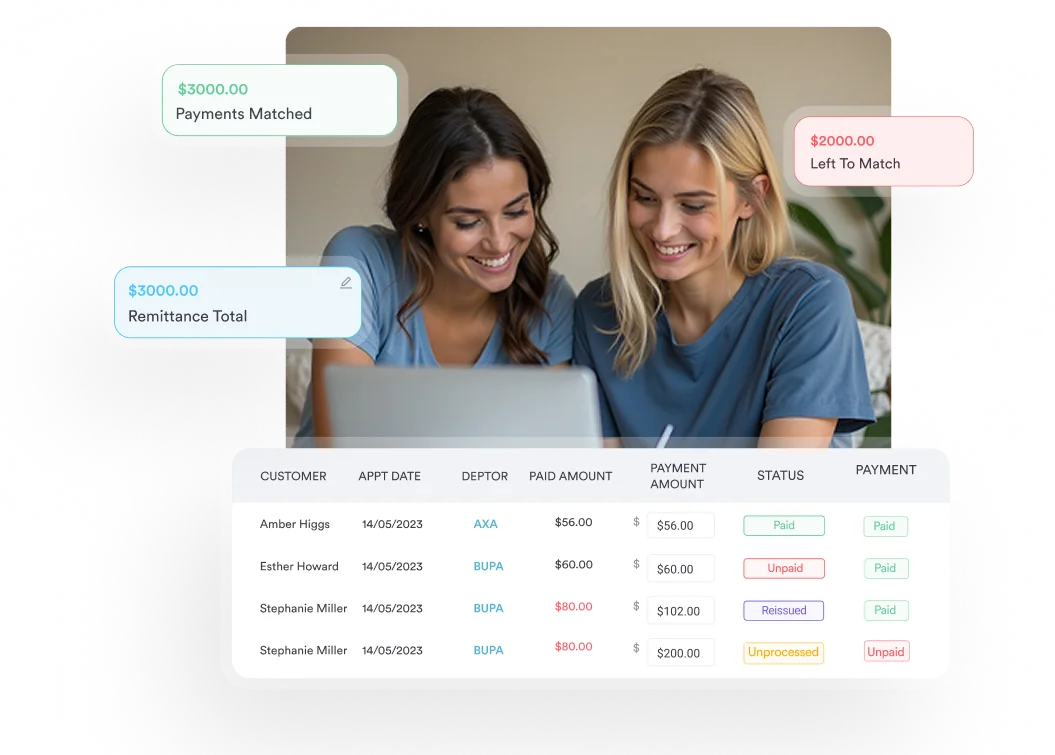
Pabau’s claims management software runs claim validation before submission. It scrubs every claim for missing or invalid details. A 92612 line without a rendering provider or a linked dysphagia code gets fixed in seconds. A claim the payer still rejects is flagged Needs action, with the reason attached.
In the US, Pabau submits CMS-1500 claims through Claim.MD and checks eligibility before the visit. Prior authorizations for Medicare Advantage or commercial plans are stored as a case and attached when you book the FEES appointment. The authorization code then follows the study through to the claim.

Pabau’s claim validation scrubs claims for missing or invalid details before submission. See how SLP and ENT practices raise FEES claims from the invoice and track each one to paid.

Most 92612 denials come from choosing the wrong code in the swallow family, not from the study itself. Settle three questions before the claim is built. Did the provider perform the full study or only read it? Did sensory testing happen in the same session? Was a clinical evaluation or a videofluoroscopic study billed on the same date?
Answer those and the code follows: 92612, 92613, 92616 or 92617. Then check the current NCCI pair for any other code billed that date, and link the most specific dysphagia code the note supports. The trade-off is a few minutes of checking per claim against weeks spent on appeals.
Pabau’s claim validation catches missing or invalid details before a FEES claim reaches the clearinghouse. Book a demo to see how SLP and ENT practices get more swallow-study claims paid on the first submission.

Need a full reference on the claims submission process? Pabau’s Claim.MD clearinghouse guide explains how electronic claim submission works from CPT coding through ERA receipt.
Getting repeated denials without clear CARC codes? Denial codes in medical billing breaks down the most common remittance advice codes and what each means for your appeal.
Billing the clinical swallow evaluation that comes before FEES? CPT code 92610 covers the documentation and billing rules for the oral and pharyngeal swallowing evaluation.
Treating the dysphagia FEES confirmed? CPT code 92526 explains how to bill swallowing therapy sessions alongside or after an instrumental study.
Want to see where a FEES claim sits in the bigger billing picture? Understanding revenue cycle management maps every step from patient scheduling through final payment posting.
CPT code 92612 covers flexible endoscopic evaluation of swallowing (FEES) with cine or video recording. That includes scope passage, visual assessment during bolus trials, and the clinician’s written interpretation and report. It does not include laryngeal sensory testing (use 92616 for that) or treatment of swallowing dysfunction (use 92526).
92610 is a clinical evaluation of oral and pharyngeal swallowing function, performed without an instrument. 92612 is an instrumental study in which a flexible endoscope records the patient swallowing and the clinician interprets the recording. Billing both on one date can trigger an NCCI denial, so verify the current edit pair. The fluoroscopic alternative to FEES is 92611, the modified barium swallow study.
Yes. Traditional Medicare Part B covers CPT code 92612 when medical necessity criteria are met and the service follows the applicable MAC Local Coverage Determination. Medicare Advantage plans set their own coverage rules and may require prior authorization. Medicare does not require prior auth for 92612 under traditional Part B.
Yes, SLPs enrolled in Medicare bill CPT code 92612 under their own NPI when they perform the complete FEES evaluation. Incident-to billing applies only under the direct supervision of a physician or non-physician practitioner, never an SLP. Verify incident-to eligibility with your MAC and each commercial payer.
The most common denial reasons are an unsupported ICD-10 diagnosis code and thin medical necessity documentation. Others are billing 92612 with 92616 on the same date, or with 92610 or 92611 without checking the edit pair. Billing 92612 for an interpretation-only read, and billing by a non-enrolled provider, round out the list. Most are preventable with pre-submission claim scrubbing.
Medicare reimbursement for 92612 differs between non-facility (office) and facility settings, and non-facility pays more because practice overhead is not separately reimbursed. Rates vary by geographic payment locality and are updated annually with the Medicare Physician Fee Schedule. Use the CMS MPFS lookup tool or FastRVU for current-year figures in your locality.
No. CPT guidelines direct you to report 92616 alone when FEES and laryngeal sensory testing happen in the same session, because 92616 includes both. Bill 92616 rather than 92612 plus 92614. Billing 92612 with 92616 on the same date triggers a bundling denial.



