CPT code 93567: Supravalvular aortography billing guide
CPT code 93567 covers aortography above the aortic valve CPT code 93567 reports ...

Last Updated: Nov 20, 2026
92597 is the CPT code for evaluation for use and/or fitting of voice prosthetic device to supplement oral speech. It covers a speech-language pathologist's assessment of whether a patient can use a voice prosthetic, plus the selection and fitting of the device.
The most common case is a tracheoesophageal voice prosthesis after a total laryngectomy, but the code also applies to artificial larynges and voice amplifiers. The device itself and its surgical insertion are billed under separate codes.
Let Pabau's smart automation suggest the right codes, reduce claim denials, and keep your practice compliant—effortlessly.
Automate repetitive tasks and focus on what matters most—your patients.
Reduce coding errors and ensure compliance with the latest regulations.
Clean claims, fewer denials, and faster reimbursements.
Powerful insights and reporting to help your practice thrive.
HIPAA compliant SOC 2 certified GDPR-compliant Trusted by 4,000+ clinics worldwide

CPT code 92597 covers the evaluation for use and/or fitting of a voice prosthetic device to supplement oral speech, usually billed by a speech-language pathologist.
The code covers the visit only. The device is billed under HCPCS L-codes, and its surgical insertion under CPT 31611.
Medicare Part B may cover 92597 when a physician orders it as medically necessary, but coverage rules vary by MAC jurisdiction.
Most denials come from a symptom code standing in for the underlying diagnosis, a missing physician referral, or same-day bundling with 92507.
Pabau, the practice management platform we build, checks eligibility, tracks prior authorizations and flags denied claims, so missing paperwork surfaces before it costs you.
CPT code 92597 is the code for an evaluation for use and/or fitting of a voice prosthetic device to supplement oral speech. ASHA’s Medicare coding rules list it with that descriptor and apply it to tracheoesophageal prostheses, artificial larynges and voice amplifiers. The most common case is a speech-language pathologist (SLP) assessing a patient for a tracheoesophageal (TE) voice prosthesis after a laryngectomy.
The code sits in the Medicine section, under Evaluative and Therapeutic Services in the Otorhinolaryngologic Services range (92502-92700). The official descriptor is: Evaluation for use and/or fitting of voice prosthetic device to supplement oral speech.
The American Medical Association (AMA) maintains the CPT code set and owns its descriptor language. Copy the 92597 descriptor exactly into fee sheets and superbills, because a paraphrase can drift from what the code covers.
CPT code 92597 covers the clinical evaluation and fitting visit only. It does not cover the voice prosthetic device or its surgical insertion. The device is billed under HCPCS Level II L-codes, and mixing the two up on one claim is a common source of denials. Objective acoustic and aerodynamic voice testing is also a separate service, reported under CPT code 92520. The table below maps each part of a voice prosthesis episode to the code that bills it.
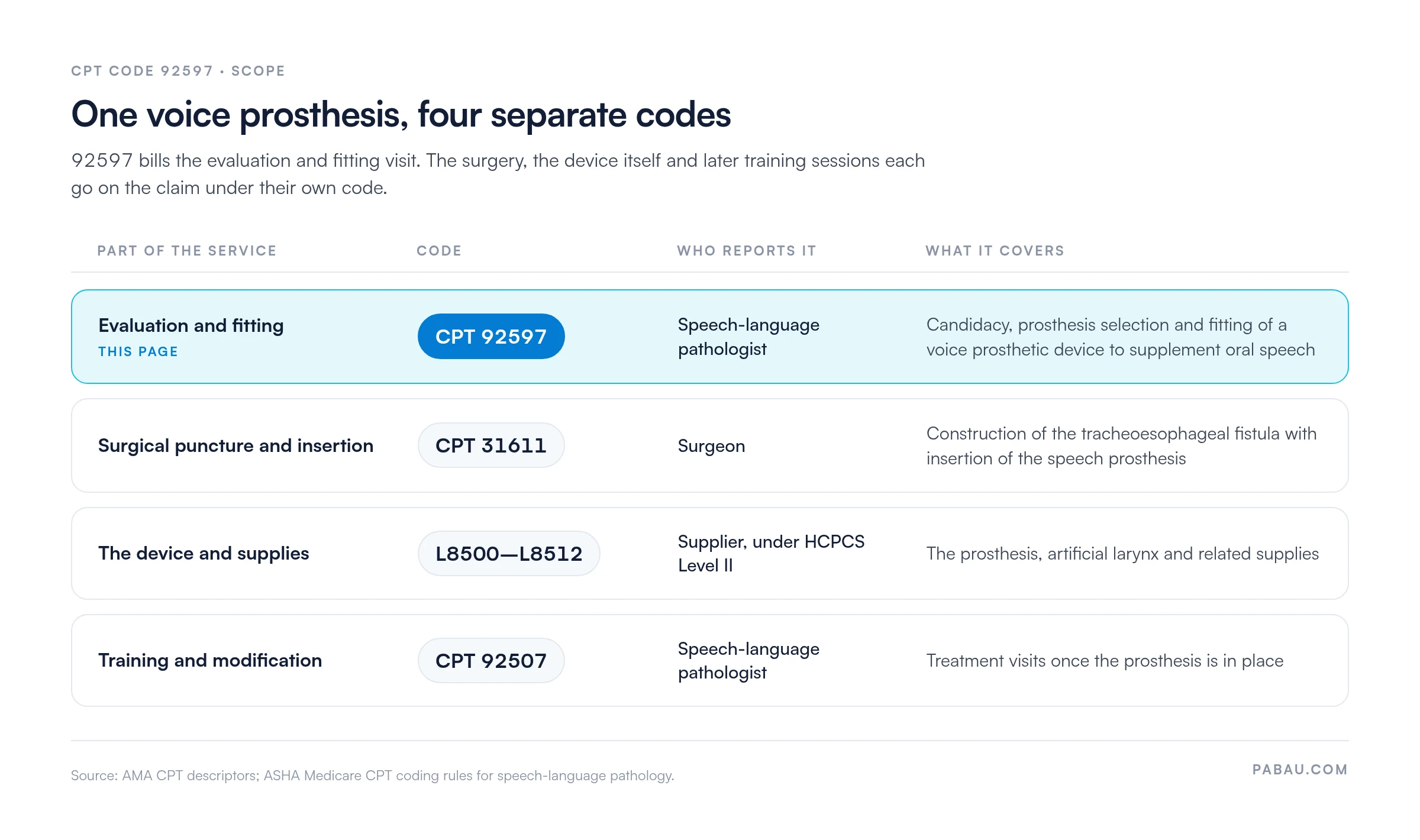
A common mis-code is billing CPT 92507 (individual speech-language treatment) for a visit that was mainly evaluative. A 92597 visit ends in a candidacy decision and a plan. Training and modification visits after the prosthesis is placed use 92507, not 92597.
Payers judge medical necessity for CPT code 92597 from the clinical note. A reviewer looks for a candidacy decision backed by objective clinical findings.
Notes that simply state “patient seen for voice prosthesis evaluation” without clinical findings routinely draw CO-11 (diagnosis inconsistent with procedure) or medical necessity denials. Every element above should appear in the note before the claim is submitted.
The diagnosis on a 92597 claim should name the condition behind the evaluation, not a vague voice symptom. For a patient who has had a laryngectomy, that is the acquired absence of the larynx or the cancer that led to it.
Z90.02 is the highest-specificity code for most 92597 encounters and the primary diagnosis payers expect. Using R49.0 (dysphonia) alone as the primary diagnosis commonly triggers CO-11 (diagnosis inconsistent with procedure) denials. Always verify current code validity in the CDC/NCHS ICD-10-CM web tool, as codes update every October 1.
Link Z90.02 (acquired absence of larynx) as the primary ICD-10 code on 92597 claims when the patient has had a total laryngectomy. Code R49.0 (dysphonia) as a secondary code if the claim form has room for a second diagnosis, but never as the primary. A claim with R49.0 as its only diagnosis says nothing about surgical history, which is what justifies the evaluation.
Several speech-language pathology codes sit close to 92597, and picking the wrong one is a frequent billing error. The table shows which of them can share a date of service with a 92597 visit.
A same-day swallowing study is the pairing that comes up most after laryngectomy, and CPT code 92610 needs its own note to survive review. When the visit also includes a formal voice and resonance analysis, that work goes under 92524 instead.
The National Correct Coding Initiative (CCI) edits decide which code pairs bundle automatically on Medicare claims. CMS publishes the current tables on its NCCI procedure-to-procedure edits page. Commercial payers can apply their own bundling rules, so check each one before billing a code pair.
Modifiers on a 92597 claim tell the payer about circumstances that affect payment. Using the wrong modifier and omitting a required one are both denial triggers.
ASHA’s Medicare guidance notes that CMS requires -GN on every code an SLP renders under a speech-language pathology plan of care. The -GA modifier needs an Advance Beneficiary Notice of Noncoverage (ABN) signed by the patient before the service. Appending -GA without a completed ABN in the chart exposes the practice to liability recovery.
Medicare coverage for CPT code 92597 depends on your jurisdiction. Check the local rules before you treat the visit as covered or non-covered.
Under Medicare Part B, speech-language pathology services are covered when medically necessary, and ASHA lists 92597 among the services billed under the therapy benefit. CPT 92597 may be covered when a physician orders it for a patient with a documented need for a voice prosthetic device. The critical variable is Local Coverage Determination (LCD) policy.
Medicare Administrative Contractors (MACs) publish LCDs that set the medical necessity criteria for speech-language pathology services in their jurisdiction. Some MACs explicitly address tracheoesophageal voice prosthetic evaluations, and others do not. Check the applicable MAC LCD before assuming coverage applies.
Commercial payers vary widely on 92597 coverage. Check whether the plan requires a physician referral and whether prior authorization (PA) is needed. Also check whether the payer treats the evaluation as a covered service or an excluded device-related one.
The American Speech-Language-Hearing Association (ASHA) publishes payer coverage alerts and Medicare billing guidance for CPT 92597 and related SLP codes. Checking ASHA’s reimbursement resources before billing a new payer for the first time saves denial cycles.
Medicare pays CPT code 92597 under the 2026 Medicare Physician Fee Schedule (MPFS) at the national values below. Actual payment varies by locality through the Geographic Practice Cost Index (GPCI) adjustment.
The payment figure uses the 2026 conversion factor of $33.4009, which applies to clinicians outside an advanced alternative payment model. The practice expense value is the same in both settings, so the office and hospital outpatient rates match. For locality-specific rates, use the CMS Physician Fee Schedule look-up tool. Commercial payers negotiate their own rates, which often differ from Medicare’s.
Always attach a year to reimbursement figures when you discuss them with patients or staff. The Medicare conversion factor changes every January 1, so the 2025 rate and the 2026 rate differ. Quoting the wrong year during patient financial counseling sets the wrong payment expectation. Bookmark the CMS MPFS look-up tool and re-check rates at the start of each calendar year.
CPT code 92597 denials follow the same few patterns across payers, and knowing them before submission prevents most of them. The remark codes below are claim adjustment reason codes, and our guide to medical billing denial codes explains each one in more depth.
Systematic denial management workflows catch these patterns before they become write-offs. Track denials for 92597 over a 90-day period to see which of the five dominates in your practice. You can then correct that one documentation habit instead of overhauling the whole process.
CPT code 92597 billing follows a consistent sequence of pre-visit checks, documentation, submission, and follow-up. Working through each stage in order removes the most common denial triggers.
At high SLP claim volumes, submitting a clean claim the first time depends on a consistent pre-submission scrub. That scrub checks all seven steps above. If you’re newer to insurance work, our guide to medical billing fundamentals shows where each step sits in the wider claim workflow.
In many SLP practices, the evaluation note lives in one system and the claim is built in another. Someone re-keys the diagnosis, checks the referral by hand and chases the remittance weeks later. Each handoff is a chance for a 92597 claim to go out without the referral or authorization it needs.
Pabau keeps the patient record and the claim in one place. Its claims management software supports 92597 billing in four ways:
The result is fewer 92597 claims coming back for a missing referral or authorization, and less staff time spent on appeals. That shortens your revenue cycle management loop without adding a single clinical visit.

Pabau checks eligibility before the visit, tracks prior authorizations, and flags denied claims as soon as the remittance arrives. Your 92597 claims go out with the referral and authorization already on file.

CPT code 92597 pays for an SLP’s judgment on a voice prosthetic device, and the claim has to show that judgment. Most denials trace back to two fixable causes: A symptom code like R49.0 standing in for the surgical history, and a missing physician order.
Fix those two first. Put Z90.02 or the underlying diagnosis in the primary slot, file the order before the visit, and append -GN under an SLP plan of care. The remaining denial reasons on this page are rarer and easier to catch.
Pabau checks eligibility, tracks prior authorizations and flags denied claims as soon as the remittance arrives. A missing order or authorization then surfaces before it costs you. Book a demo to see how the claims workflow handles SLP billing in practice.

Need a claims submission workflow overview? Claim.MD clearinghouse guide explains how electronic claim routing works and what to expect from ERA responses.
Seeing recurring claim rejections? Denial codes in medical billing breaks down the most common CARC codes and the corrective actions for each.
Looking to streamline eligibility checks? Insurance eligibility verification covers how real-time eligibility checks prevent coverage-related denials before the visit.
CPT code 92597 covers the evaluation for use and/or fitting of a voice prosthetic device to supplement oral speech. It includes candidacy assessment, prosthetic selection, fitting and patient counseling, most often for a tracheoesophageal prosthesis after laryngectomy. The device itself is billed under HCPCS L-codes, and its surgical insertion under CPT 31611.
Medicare Part B may cover CPT 92597 when a physician orders the evaluation as medically necessary for a patient who needs a voice prosthetic device. Coverage depends on the Local Coverage Determination (LCD) for speech-language pathology services in the billing provider’s jurisdiction. Some MACs cover it, and others do not. Check the relevant LCD before billing, and obtain an ABN if coverage is uncertain.
Z90.02 (acquired absence of larynx) is the preferred primary ICD-10-CM code for most 92597 claims involving post-laryngectomy patients. Secondary codes such as C32.0 or C32.9 (laryngeal malignancy) can be added when the underlying condition is relevant. Using R49.0 (dysphonia) as the sole primary diagnosis commonly triggers denials, because it does not establish the surgical history that justifies the evaluation.
Medicare requires -GN on 92597 when an SLP bills it under a speech-language pathology plan of care. Use -GA when an ABN is on file for a visit Medicare may not cover, and -KX once the patient passes the annual KX threshold. Modifier -52 marks an evaluation that was not completed in full. Modifier -59 marks a distinct service billed alongside a code that has a CCI bundling edit. Verify each payer’s requirements before submission.
Generally no. Most payers bundle CPT 92507 (individual speech-language treatment) with CPT 92597 when both are billed on the same date of service. If the services were genuinely distinct and separately documented, modifier -59 may allow both to be paid. Check the current CCI edit table and the specific payer’s policy before submitting.
The most common reason is a non-specific diagnosis, such as R49.0 alone instead of Z90.02. Other frequent causes are a missing physician order, thin documentation that fails medical necessity, and bundling with 92507 on the same date without modifier -59. An incorrect place of service code also triggers denials. Fixing diagnosis linkage and the physician order resolves most of them.