

CCSD code G5100: Bypass of duodenum billing guide
CCSD code G5100 bills a bypass that leaves the duodenum in place CCSD code G5100...

Last Updated: Oct 16, 2026
92524 is the CPT code for behavioral and qualitative analysis of voice and resonance. Speech-language pathologists and otolaryngologists bill it when they assess voice quality, pitch, loudness, and resonance perceptually. Language, fluency, and speech sound production belong to the companion codes 92521, 92522, and 92523.
Two avoidable problems drive most denials on this code. The documentation omits the perceptual analysis, or the claim carries 92524 and 92523 on the same date of service.
Let Pabau's smart automation suggest the right codes, reduce claim denials, and keep your practice compliant—effortlessly.
Automate repetitive tasks and focus on what matters most—your patients.
Reduce coding errors and ensure compliance with the latest regulations.
Clean claims, fewer denials, and faster reimbursements.
Powerful insights and reporting to help your practice thrive.
HIPAA compliant SOC 2 certified GDPR-compliant Trusted by 4,000+ clinics worldwide

CPT 92524 covers behavioral and qualitative analysis of voice and resonance, separate from the speech sound and language scope of 92523.
Speech-language pathologists and otolaryngologists bill it, and supervision requirements vary by payer and state.
Commonly paired ICD-10 codes include R49.0 (dysphonia), R49.1 (aphonia), and R49.8 (other voice and resonance disorders).
Medicare covers 92524 when it is medically necessary, and CCI edits block 92524 and 92523 on the same day.
Pabau’s claims management software supports superbill generation and electronic claim submission for SLP practices billing voice evaluation codes.
CPT Code 92524 is the procedure code for behavioral and qualitative analysis of voice and resonance disorders. The descriptor comes from the American Medical Association’s CPT code set.
The evaluation encompasses acoustic and perceptual analysis of voice quality, pitch, loudness, resonance, and phonation. It does not include language, fluency, or speech sound production assessment. An endoscopic view of velopharyngeal function is a different service. Speech-language pathologists who perform it may report nasopharyngoscopy under CPT code 92511, though payer eligibility varies.
The code sits in the Special Otorhinolaryngologic Services and Procedures subsection (92502-92700), inside the CPT Medicine section (90281-99607).
Unlike the other codes in the 92521-92524 family, 92524 is specific to voice and resonance only. A patient presenting with dysphonia after vocal nodule surgery would be evaluated under 92524 rather than the three companion codes.
Speech-language pathologists are the primary provider type billing CPT 92524 for voice and resonance disorder evaluations. Otolaryngologists may also bill this code when performing behavioral and qualitative voice analysis as part of their scope. Provider eligibility, however, is not uniform across all payers.
Medicare requires that services be provided by a qualified SLP or under appropriate physician supervision, depending on the practice setting.
The American Speech-Language-Hearing Association (ASHA) provides specialty-specific guidance on billing the 92521-92524 code family, including credential and supervision requirements by setting. Verify provider eligibility with each commercial payer before submitting claims, as supervision rules vary by state and plan.
Credentialing and payer enrollment decide whether a 92524 claim is payable long before the clinical work starts. Confirm that each provider’s NPI is enrolled with the relevant payer, and that the plan recognizes SLPs as billing providers.
Medical necessity for CPT 92524 requires a supporting ICD-10-CM diagnosis code that documents a voice or resonance disorder. The three most frequently accepted codes are R49.0, R49.1, and R49.8. Payers vary in which additional codes they accept, so verify coverage against your MAC’s local coverage determination (LCD) before submitting.
Code to the highest degree of specificity your documentation supports. Using R49.8 when the record clearly documents hypernasality is a common coding error that can trigger medical necessity reviews. The CDC/NCHS ICD-10-CM web tool is the authoritative source for verifying current code validity and descriptions.
The diagnosis carries the medical necessity argument, so an imprecise code weakens an otherwise clean claim. Our reference library of ICD-10-CM codes lists the current description for each of the codes above.
Documentation for a 92524 claim must establish medical necessity and describe the method used. It also has to record the clinical findings in enough detail to withstand a payer audit. Missing one element can trigger a denial or a request for additional documentation (ADR).
The checklist below reflects CMS national policy and common MAC requirements. Individual MACs may impose additional standards through their LCDs; always check your MAC’s specific coverage article before submitting.
Structured intake and clinical note templates prompt the clinician for each required finding while the patient is still in the room. Practice management software like Pabau lets a practice build evaluation-specific forms that capture those fields at the point of care. MAC requirements can change annually, so verify against your MAC’s current LCD.
Medicare reimburses CPT 92524 through the Medicare Physician Fee Schedule (MPFS). Most codes pay more in a non-facility setting, because the practice carries the overhead. CMS assigns 92524 the same practice expense RVU in both settings, so payment does not change with the place of service. Rates are updated annually with each MPFS final rule.
The figures above apply the CY2025 conversion factor of 32.3465 to a total of 3.30 RVUs, before geographic adjustment. Payment then varies by geographic practice cost index (GPCI). Use the CMS Physician Fee Schedule Look-Up Tool to pull the exact rate for your locality.
Commercial payer rates for 92524 are negotiated separately and usually run between 100% and 140% of the Medicare fee schedule. Medicaid rates vary by state and can sit well below Medicare. Verify the rate in your payer contract before relying on any estimate.
Pull your 92524 rate from each commercial payer contract and compare it against the CMS rate. If a payer reimburses below 80% of Medicare, flag the contract for renegotiation. Voice evaluation is a high-effort service with little room for time savings, so underpayment compounds quickly across an SLP caseload.
Getting 92524 claims paid on first submission takes accurate code selection, correct modifiers, and clean documentation. The two most frequent denial triggers are same-day bundling conflicts with 92523 and thin behavioral analysis documentation.
A claim that goes out clean the first time removes the cost of rework later. Practices that file electronically through a clearinghouse catch code-level errors before the payer sees them. Pabau integrates with Claim.MD, a US clearinghouse that validates CPT and ICD-10 codes and checks eligibility at the point of booking. It submits 837P claims to thousands of US insurance payers, so 92524 and its companion codes take one submission path.
Denial patterns repeat, so the fix usually belongs upstream in the documentation rather than in the appeal. Our guide to denial management sets out how to track reason codes by payer and act on them.
The four codes the AMA defines for speech-language pathology evaluations are frequently confused with each other. Each one covers a distinct clinical domain, and choosing the wrong code is among the most common SLP billing errors. The map below routes each domain to its code, and the table under it adds the denial trigger each code attracts.
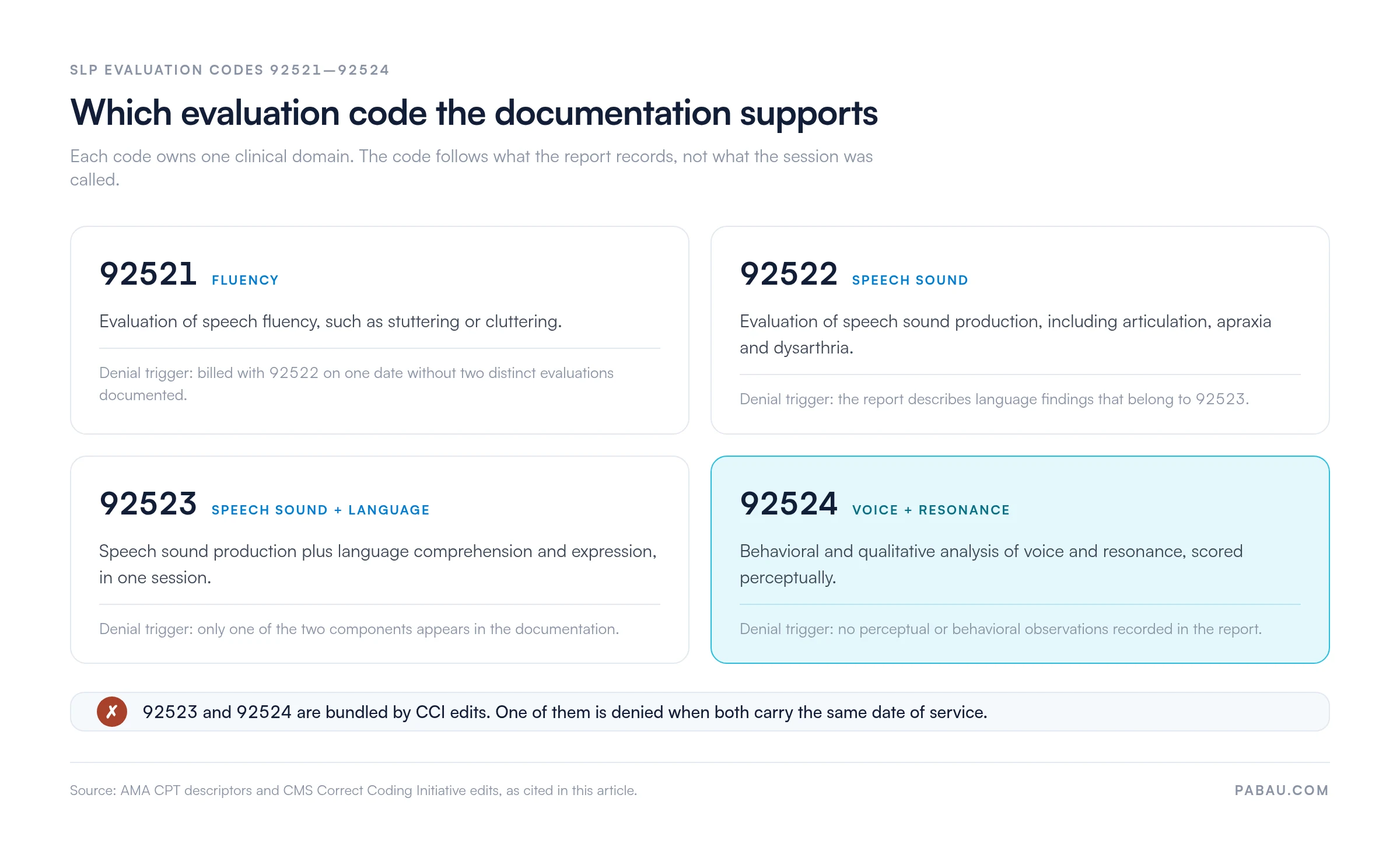
The denial trigger column in the table below is the part most coding references leave out.
The distinction between 92523 and 92524 causes most of the code-family confusion. A patient with both aphasia and dysphonia after a stroke can look like a case for both codes. CCI edits still block them on the same date of service. When the presentation spans several domains, choose the code that reflects the primary purpose of the session, and document that reasoning.
When fluency leads the presentation, the session belongs to CPT 92521 rather than 92524. Stuttering and cluttering fall under that descriptor, so the evaluation report needs to document those findings.
CPT 92524 can be billed on the same date as several companion codes, though bundling rules restrict which combinations are permitted. The CCI edits table governs same-day billing. The summary below reflects current guidance, so verify it against the live CCI edits at CMS, which are updated quarterly.
When 92524 and 92507 are billed on the same date, the evaluation and treatment must each be documented as clinically distinct services. A single session note that blurs evaluation and treatment activities creates audit risk. Keep evaluation documentation and treatment session notes separate in the patient record.
When several codes share one claim, each line needs its own diagnosis pointer and its own supporting note. Check that line-level detail before submission rather than after the remittance advice arrives.
Medicare covers CPT 92524 when the service is medically necessary and properly documented. The CMS Medicare Coverage Database article on speech-language pathology services confirms that position. Private payer and Medicaid coverage is less consistent.
Verifying benefits at the point of scheduling is the cheapest control a practice has over voice evaluation revenue. A patient whose plan excludes 92524 can be told before the appointment rather than invoiced after it. Record the benefit check and any authorization number in the patient record, so an appeal has something to cite.
SLP practices billing 92524 run a workflow that spans evaluation documentation, diagnosis coding, superbill generation, claim submission, and denial follow-up. Every handoff between those steps is a place where errors collect.
The risk compounds for practices co-located with ENT or other clinical services. When SLP billing runs on its own platform, code-level errors and denial patterns go unnoticed across specialties until they reach accounts receivable.
Pabau lets SLP and ENT teams manage scheduling, clinical documentation, and claim submission in one system. Its claims management software supports CPT and ICD-10 code entry, superbill generation, and clearinghouse submission.
For practices billing through US Medicare, Pabau integrates with Claim.MD to reach thousands of US insurance payers over 837P electronic claims. The integration handles eligibility verification, electronic remittance advice (ERA/835), and denial management with CARC reason codes. An SLP practice can see why a 92524 claim was rejected and correct it before resubmission.
Review your 92524 denial rate quarterly, broken down by denial reason code. The two most common patterns are CCI bundling conflicts (denial code CO-97) and medical necessity failures (CO-50). Identify the payer generating most of those denials. Then audit whether your documentation template captures every behavioral analysis field that payer asks for.

Pabau supports superbill generation, ICD-10 and CPT code entry, and electronic claim submission for speech-language pathology practices. See how it handles voice evaluation billing from documentation through payment.

CPT Code 92524 is narrow by design. It pays for behavioral and qualitative analysis of voice and resonance, and for no other evaluation domain. The practices that get it paid are the ones whose report reads like a voice evaluation rather than a general SLP assessment.
Two habits protect the revenue. Name the perceptual findings in the note, and check the date of service against 92523 before the claim leaves the practice.
For practices billing voice evaluations alongside other clinical services, Pabau’s claims management and its Claim.MD connection cut the manual steps between evaluation and payment. Book a demo to see how a 92524 claim travels from the evaluation note to a paid remittance.

Turning an evaluation note into a bill? Superbill essentials explains which codes, charges and provider details the document has to carry.
Dealing with a high denial rate across your SLP claims? Denial codes in medical billing explains the most common CARC reason codes and how to address each one at the documentation level.
Want to understand how claim submission works end to end? Medical claims clearinghouse overview explains how clearinghouses validate and route claims before they reach the payer.
Credentialing SLP providers with new payers? How to get credentialed with insurance companies walks through the enrollment process for clinical practices adding provider panels.
CPT Code 92524 covers behavioral and qualitative analysis of voice and resonance disorders. The evaluation includes perceptual assessment of voice quality, pitch, loudness, and resonance features such as hypernasality or hyponasality. It does not cover speech fluency, language assessment, or speech sound production testing. Those components fall under the companion codes 92521, 92522, and 92523.
Speech-language pathologists and otolaryngologists are the primary provider types eligible to bill CPT 92524. SLP assistants cannot bill independently. Supervision requirements and provider eligibility vary by payer and state. Verify with each payer before submitting claims, and confirm that the billing NPI is enrolled with the relevant plan.
CPT 92523 covers evaluation of speech sound production together with language comprehension and expression. CPT 92524 covers only behavioral and qualitative analysis of voice and resonance. CCI edits stop the two from being billed on the same date of service. Choose the code that reflects the primary clinical purpose of the session.
The codes accepted most often with CPT 92524 are R49.0 for dysphonia, R49.1 for aphonia, and R49.8 for other voice and resonance disorders. R49.21 covers hypernasality and R49.22 covers hyponasality. Structural causes such as J38.2 for vocal cord nodules may also support medical necessity. Code to the highest degree of specificity your documentation supports, because a vague R49.8 can trigger a medical necessity review.
Yes, Medicare covers CPT 92524 when the service is medically necessary and performed by a qualified provider. The documentation must include a valid diagnosis, an evaluation report, and a treatment plan. Coverage is subject to Medicare therapy policy and any applicable MAC local coverage determinations. Commercial and Medicaid coverage varies by plan and by state.
The record needs a physician referral or order where the payer requires one. It also needs a signed evaluation report carrying the perceptual and behavioral voice findings. That report states the voice or resonance diagnosis behind the ICD-10 code on the claim, and sets out a treatment plan. Add progress notes when the visit is a follow-up evaluation. MAC-specific LCDs may impose further requirements, so check your MAC’s current coverage article.



