

HCPCS Code Q4175: Billing, coverage, and documentation guide
HCPCS Code Q4175: Code Description and Product Identity HCPCS Code Q4175 is the ...

Last Updated: Nov 20, 2026
92520 is the CPT code for laryngeal function studies (ie, aerodynamic testing and acoustic testing). It's reported once per session and covers acoustic measures such as pitch, jitter and shimmer plus aerodynamic measures such as airflow and subglottic pressure.
Speech-language pathologists and otolaryngologists use it to measure voice disorders and track change over time. When only one of the two tests is completed, the code takes modifier 52.
Let Pabau's smart automation suggest the right codes, reduce claim denials, and keep your practice compliant—effortlessly.
Automate repetitive tasks and focus on what matters most—your patients.
Reduce coding errors and ensure compliance with the latest regulations.
Clean claims, fewer denials, and faster reimbursements.
Powerful insights and reporting to help your practice thrive.
HIPAA compliant SOC 2 certified GDPR-compliant Trusted by 4,000+ clinics worldwide

CPT code 92520 reports acoustic and aerodynamic voice testing together, as one unit per session rather than one unit per test.
Add modifier 52 when only one of the two tests is completed, and record in the note why the other wasn’t done.
Stroboscopy (31579) and diagnostic laryngoscopy (31575 or 31525) are billed on their own lines, never inside 92520.
Medicare’s 2026 national rate is about $90.85 in an office and about $32.40 in a facility, before geographic adjustment.
Pabau, a practice management platform, sends US claims through Claim.MD, runs eligibility checks first and tracks claim status and denials.
CPT code 92520 reports laryngeal function studies, the objective acoustic and aerodynamic measurements of how the larynx produces voice.
ASHA’s Medicare coding rules list the descriptor as aerodynamic plus acoustic testing and add modifier 52 when only one test is performed. You report it once per session, whether you ran one protocol or ten.
The official descriptor in the AMA’s CPT code set reads “Laryngeal function studies (ie, aerodynamic testing and acoustic testing).” That “ie” matters. It means both tests make up the full service, so doing only one is a reduced service.
Acoustic analysis measures pitch, intensity, jitter, shimmer and harmonics-to-noise ratio with calibrated software. Aerodynamic studies measure airflow, subglottic pressure and phonation threshold. Together they put numbers on a voice disorder, guide treatment planning and show change over time.
Speech-language pathologists and otolaryngologists perform and bill most laryngeal function studies. An SLP enrolled in Medicare bills 92520 under their own NPI, within their scope of practice. Otolaryngologists bill it under their own NPI too, usually in an ENT office.
When an SLP performs the study under a speech-language pathology plan of care, Medicare also expects the GN modifier on the line. Commercial payers may add their own credentialing or supervision rules. Confirm who the plan will pay for 92520 before the first patient is booked, not after the first denial.
Medical necessity is the documentation test 92520 lives or dies on. Payers want the note to tie the study to a diagnosis that explains why objective laryngeal measurement is needed now. These ICD-10-CM codes come up most often.
Accepted diagnoses vary by payer and by Medicare Administrative Contractor (MAC). Check your MAC’s policy before submitting, especially for neurogenic voice disorders, where a physician referral note often carries the claim.
Modifiers tell the payer how the session differed from the full descriptor. A missing 52 or GN is one of the most common reasons a 92520 line comes back.
Modifier 52 in practice: A patient who can’t tolerate the aerodynamic mask gets 92520-52, with the reason in the note. Some payers cut the fee proportionally, while others pay in full when the justification is clear. Check the payer’s 52 policy before you rely on either.
Coders most often confuse 92520 with the visual exams done in the same visit and with treatment. The flow below shows which line each part of a voice workup belongs on.
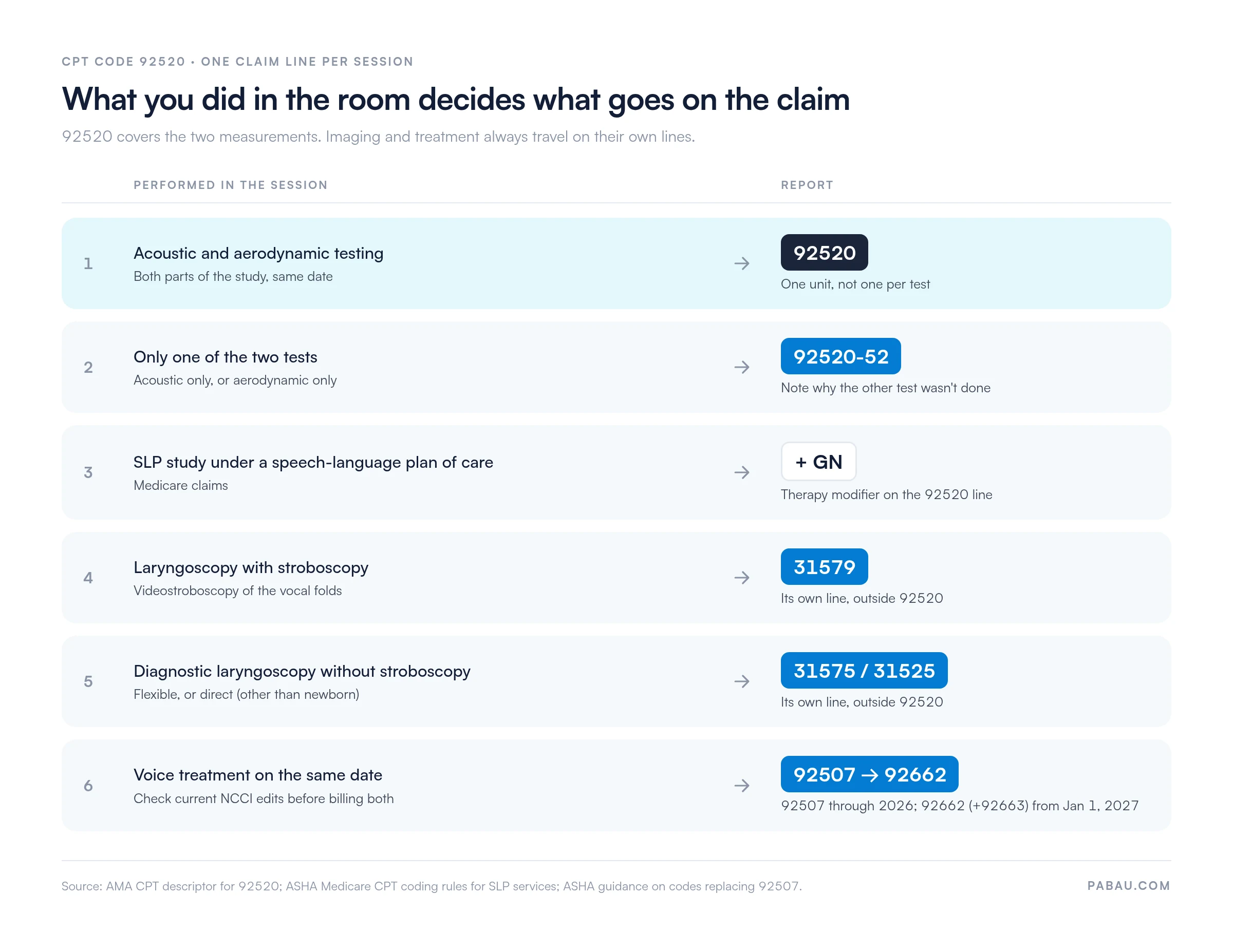
Stroboscopy is the pairing that trips people up. The two services can share a session, but 31579 needs its own indication and its own documentation. Don’t reach for 92511 as a stroboscopy code either, because 31579 and 92511 form a non-bypassable NCCI pair.
Treatment on the same date is the other common question. Check the current NCCI edit table for the quarter before billing 92520 with 92507, because the edit status between them has changed before.
From January 1, 2027, 92507 is replaced by 10 time-based codes, and voice treatment moves to 92662 plus add-on +92663. Group treatment stays on 92508. Re-check every same-day pairing against the new codes, as ASHA’s guide to the replacement codes sets out.
An E/M visit can go on the same date when a physician provides a separately identifiable evaluation. Document it apart from the study and put modifier 25 on the E/M line.
Before billing 92520 with a treatment code on the same date, run both through the current CMS NCCI edit table. If an edit exists, check whether it allows a modifier, then document the services as separate and distinct in the note. From 2027, run the same check with 92662 in place of 92507.
Medicare pays 92520 under the Physician Fee Schedule. For 2026 it carries 0.73 work RVUs and 2.72 total non-facility RVUs. At the $33.4009 conversion factor, that’s about $90.85 nationally in an office and about $32.40 in a facility, before geographic adjustment.
For your exact allowable, enter your ZIP code and place of service in the CMS Physician Fee Schedule lookup tool. The FastRVU 2026 RVU lookup tool mirrors the same CMS data with locality math built in. Commercial rates depend on each contract, so quote patients from your own fee schedule.
Medicare Part B doesn’t routinely require prior authorization for 92520. Many commercial and managed care plans do, especially when the study is ordered on its own rather than as part of a wider ENT workup.
A missing authorization is one of the easiest 92520 denials to prevent. Insurance eligibility verification before the visit shows both coverage and any prior auth rule, so the front desk can act days ahead.
A good 92520 note does two jobs. It proves medical necessity to the payer, and it gives the treating team a baseline to measure against.
A superbill that carries the 92520 line, its modifiers and the linked ICD-10-CM code cuts retyping between the note and the claim. Before each billing year, check the descriptor and any annual changes in the AAPC Codify CPT lookup.
Audit your 92520 claims once a quarter. Pull the last 90 days of submissions and check each note against the documentation list above. If notes are missing measurements or an interpretation, retrain the documenting providers before the next payer audit.
Most 92520 problems are set up before the patient sits down. Here’s how the claim travels in a typical SLP or ENT office.
Run through this list before the claim leaves the building. Each line answers a question that makes a clean claim on the first pass.
Most 92520 denials trace back to thin documentation, a bundling slip or a missing authorization. Good denial management starts by knowing which ones recur for this code.
When a denial does land, the remittance code tells you which row you’re in. Our guide to denial codes decodes the CARC and RARC codes payers return.
Three habits cause most repeat denials for this code. Teams bill the full code when the mask wasn’t tolerated, forget GN on Medicare SLP claims, and treat a stroboscopy as part of 92520. Each one is a coding habit, so one short refresher with the team fixes it.
In many voice practices, the study lives in one system, the claim in another, and denials in a spreadsheet. Staff retype codes between them, and an eligibility problem shows up only when the claim comes back.
Pabau’s claims management software keeps those steps on the patient record. It pre-fills the CMS-1500 from the record, checks that required claim fields are complete, and sends US claims electronically through Claim.MD. Eligibility checks run before the visit, and claim status, remittances and denials are tracked in one place.
The result is fewer rejected claims for avoidable reasons, and a billing team that spends its time on appeals worth winning.

Pabau checks eligibility before the visit, sends claims through Claim.MD and tracks status and denials. Your SLP and ENT billing team spends less time on rework.

92520 pays reliably when the note shows the numbers and the claim matches what happened in the room. Code the full study only when both tests were done, and keep imaging and treatment on their own lines.
The bigger change is coming in January 2027. Practices that map 92507 to its replacement codes now won’t be learning the new NCCI pairings from their first denials. Book a demo to see how Pabau keeps your voice study claims moving and your denials in view.

Assessing voice behavior rather than measuring it? CPT code 92524 covers behavioral and qualitative analysis of voice and resonance.
Want to see what a clearinghouse checks? Understanding the 837 file format explains how electronic claim files are built and screened before they reach the payer.
Decoding a 92520 remittance? Denial codes in medical billing covers the CARC and RARC codes payers return on rejected claims.
Adding a new SLP to your billing roster? Getting credentialed with insurance companies outlines the steps before a payer will cover their services.
New to the billing cycle? What is medical billing walks through how a claim moves from visit to payment.
No. 92520 is an untimed code, so you report one unit per session however long the study takes. That’s why a partial study takes modifier 52 rather than fewer units.
No. Medicare lists 92520 with the global indicator XXX, which means the global surgery concept doesn’t apply. Any follow-up visit is billed on its own merits.
Acoustic analysis uses a calibrated microphone and voice analysis software. Aerodynamic testing uses a face mask with airflow and pressure sensors to capture airflow and estimate subglottic pressure.
CPT sets no frequency limit. Payers expect a clinical reason for each repeat, such as measuring change after surgery, an injection or a course of voice therapy. Check plan limits before booking a follow-up study.
Only when the current NCCI edit allows it and the services are separate and distinct. From January 1, 2027, run the same check against 92662, which replaces 92507 for voice treatment.





