CCSD code A7310: Biopsy of peripheral nerve
CCSD code A7310: definition and procedure scope CCSD code A7310 is the South Afr...

Last Updated: Oct 7, 2026
93662 is the CPT code for intracardiac echocardiography during therapeutic/diagnostic intervention, including imaging supervision and interpretation. It's an add-on code, so it only pays when a qualifying primary procedure sits on the same claim.
The physician threads an ultrasound catheter into the heart to guide work such as SVT ablation, septal closure or TAVR. It's reported once per encounter. Since 2025, it can't go with 93656, because that AF ablation code now includes ICE. One wrong pairing turns the line into a denial, so the pairing rules, payment figures and documentation checks below are worth getting right.
Let Pabau's smart automation suggest the right codes, reduce claim denials, and keep your practice compliant—effortlessly.
Automate repetitive tasks and focus on what matters most—your patients.
Reduce coding errors and ensure compliance with the latest regulations.
Clean claims, fewer denials, and faster reimbursements.
Powerful insights and reporting to help your practice thrive.
HIPAA compliant SOC 2 certified GDPR-compliant Trusted by 4,000+ clinics worldwide

CPT code 93662 is an add-on code, so it’s only paid with a qualifying primary procedure, such as 93653 or 93654, on the same claim.
Since January 1, 2025, AF ablation code 93656 includes intracardiac echocardiography, so 93662 is never reported with it.
The classic mix-up is 93662, with the catheter inside the heart, versus 93312, with the probe in the esophagus.
Report 93662 once per encounter, never per vessel, and never append modifier -51.
Claim scrubbing through a clearinghouse such as Claim.MD, plus eligibility checks and ERA matching, catches errors before and after a 93662 claim goes out.
CPT code 93662 reports intracardiac echocardiography, or ICE, performed during a therapeutic or diagnostic intervention. It includes the imaging supervision and interpretation. The American Medical Association (AMA) lists it as a Category I add-on code, marked with a “+” in the CPT codebook.
It sits under Medicine, then Cardiovascular, in the Intracardiac Electrophysiological Procedures/Studies range, 93600-93662. You report it once per encounter, and only next to a qualifying primary procedure code. It’s never billed per vessel or per imaging view.
To perform ICE, the physician advances a miniaturized ultrasound catheter through a vein into the right heart chambers. They then steer it to image cardiac structures in real time. Surface echo images from outside the chest, and transesophageal echo images from the esophagus. ICE puts the imaging element right beside the target anatomy, which is why it’s used to guide catheter and device work.
The code covers the full supervision-and-interpretation service for the imaging session, not individual image acquisitions. It isn’t reported again for each catheter position or view.
Common procedures where ICE guidance appears:
The code doesn’t cover a diagnostic echo done outside an intervention. Billing 93662 with no qualifying primary on the claim leads to an automatic denial.
Add-on codes capture a secondary service performed alongside a primary procedure, so they can’t stand alone. For 93662, the claim needs at least one qualifying primary code from the list below. Both codes must describe work performed in the same session.
Payers treat the add-on as extra payment attached to the primary, not as a separate event. Structural work counts as well, including septal defect closure under 93580. The one code to watch is 93656, which now absorbs the ICE payment.
This list isn’t exhaustive. The 2025 list also covers transcatheter mitral and tricuspid codes and several heart-catheterization codes. Confirm the current pairings in the AMA CPT code set for the code year, because add-on pairings change.
Both codes describe echo guidance during a cardiac procedure. The imaging route, code type and typical case differ, though. Transesophageal echo uses 93312, which is a standalone code. Mixing the two up is a common coding error in EP billing, and the procedure note settles which one applies.
The quickest self-audit: look for “intracardiac catheter” or “ICE catheter advanced via femoral vein” in the procedure note. If that language is missing, 93662 isn’t supported. Review the claim before it goes out.
93662 shares claims with the comprehensive EP ablation codes. Choosing among them takes the standalone vs add-on split, plus one 2025 bundling change.
Since January 1, 2025, 93656 includes intracardiac echocardiography and 3D mapping. So 93662 is never reported with it, even when the note documents ICE in detail. With 93653 or 93654, list 93662 as its own add-on line, without modifier -51.
Medicare pays 93662 on top of the primary procedure payment. CMS sets the rates each year in the Medicare Physician Fee Schedule (MPFS) final rule, effective January 1.
The table shows 2024 national MPFS values for the professional component, 93662-26. Verify current-year figures with the CMS Physician Fee Schedule lookup tool or a tool such as FastRVU before quoting rates.
Facility vs non-facility: CMS sets national RVUs only for the professional component. The global code and the -TC line are contractor-priced, so the Medicare Administrative Contractor (MAC) decides any technical payment. In a hospital EP lab, the hospital’s facility claim covers the equipment and staff. That’s why the physician’s claim usually carries 93662-26.
Before quoting reimbursement figures to cardiologists or administrators, pull the current-year MPFS data directly from CMS. The conversion factor changes every year. A prior-year rate in a physician compensation model can misstate expected revenue across a high-volume EP program.
Here’s one case from note to payment. An electrophysiologist ablates AVNRT in a hospital EP lab and uses ICE to guide catheter placement.
Now swap the case for an AF ablation under 93656. The second line disappears, because the ICE work is already paid inside the ablation code.
Vague documentation is a frequent audit trigger for 93662. Payers look for proof of three things in the procedure note. ICE was performed inside the heart, the physician supervised and interpreted it, and the primary intervention needed it.
A clean claim for 93662 needs a note that covers these elements:
Good medical billing compliance treats documentation problems as a pre-submission issue, not a post-denial one. A note that only says “ICE used during procedure” won’t survive a medical necessity review.
Run these checks on the chart and the claim before 93662 goes out:
The same checks work as a decision path. Answer them in order, and stop at the first one that fails:
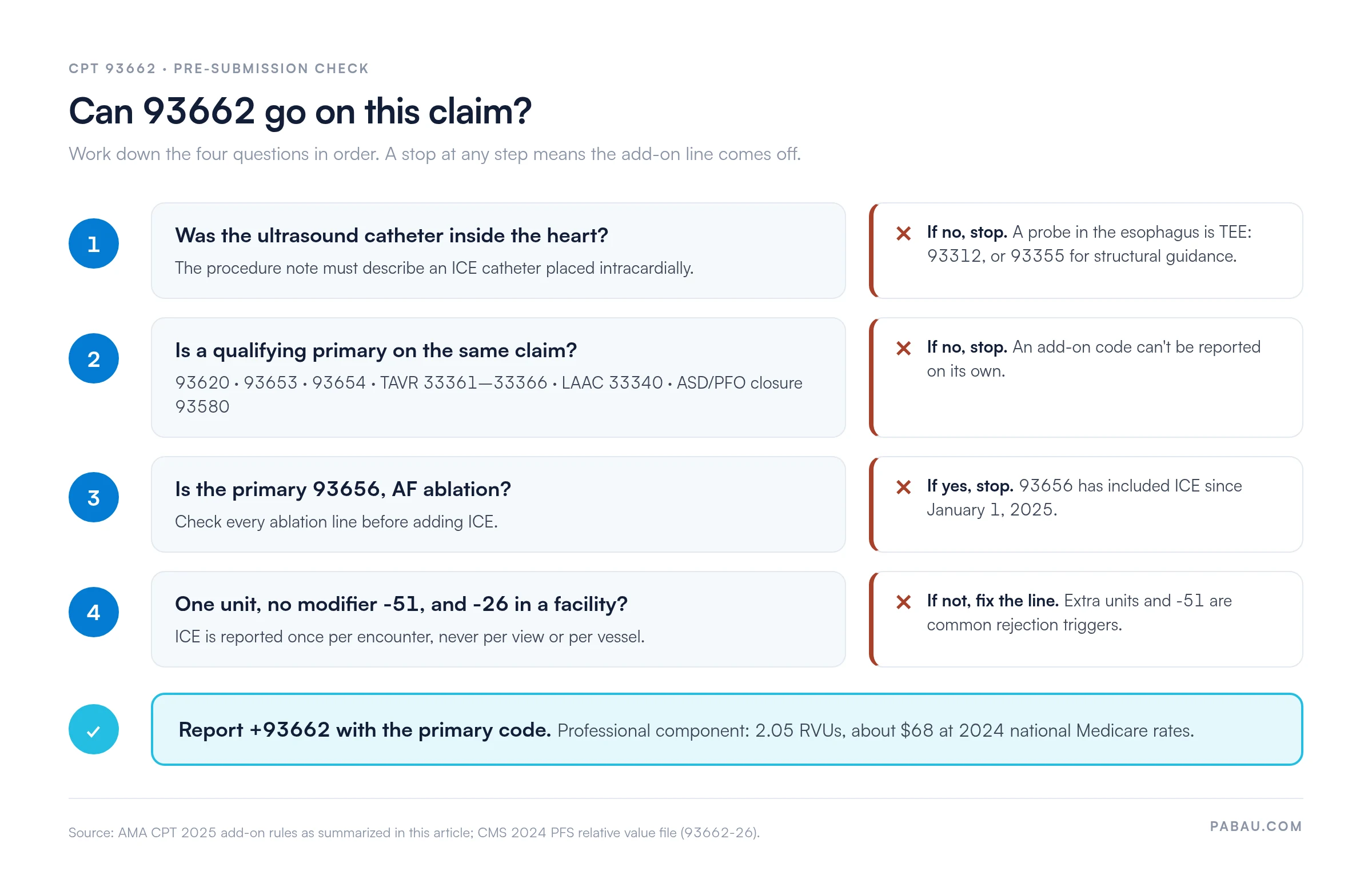
Medicare generally doesn’t require separate prior authorization for an add-on billed with a covered EP procedure. When the primary procedure, such as 93653, is authorized, its add-ons usually ride on that approval. Many commercial payers do require authorization for the primary. Some apply it to the whole procedure bundle, so 93662 coverage depends on that approval.
Check each payer’s portal before scheduling, as part of a steady prior authorization process. For commercial plans, put the medical necessity rationale for ICE in the request for the primary procedure.
Most 93662 denials fall into six groups. Clear denial management workflows and a working list of medical billing denial codes help teams resolve them faster:
CPT guidance and most payer policies allow 93662 once per encounter. The code covers the whole ICE session, however many catheter positions or views were obtained. CMS Medically Unlikely Edits (MUEs) set the limit at one unit per day. Billing two or more units without a payer-specific exception leads to rejections. Check the current CMS MUE tables before you update billing templates.
Four modifiers come up in 93662 billing:
The setting decides both the payment rate and who submits which part of the bill:
In many EP programs, coders key each add-on line by hand. Rejections then come back through separate payer portals, and someone has to match them to the right case.
Pabau, the practice management platform we build, includes claims management software that pre-fills each claim from the patient record. The CPT codes attached to the service land on the charge lines. Required fields are checked before the claim can be sent.
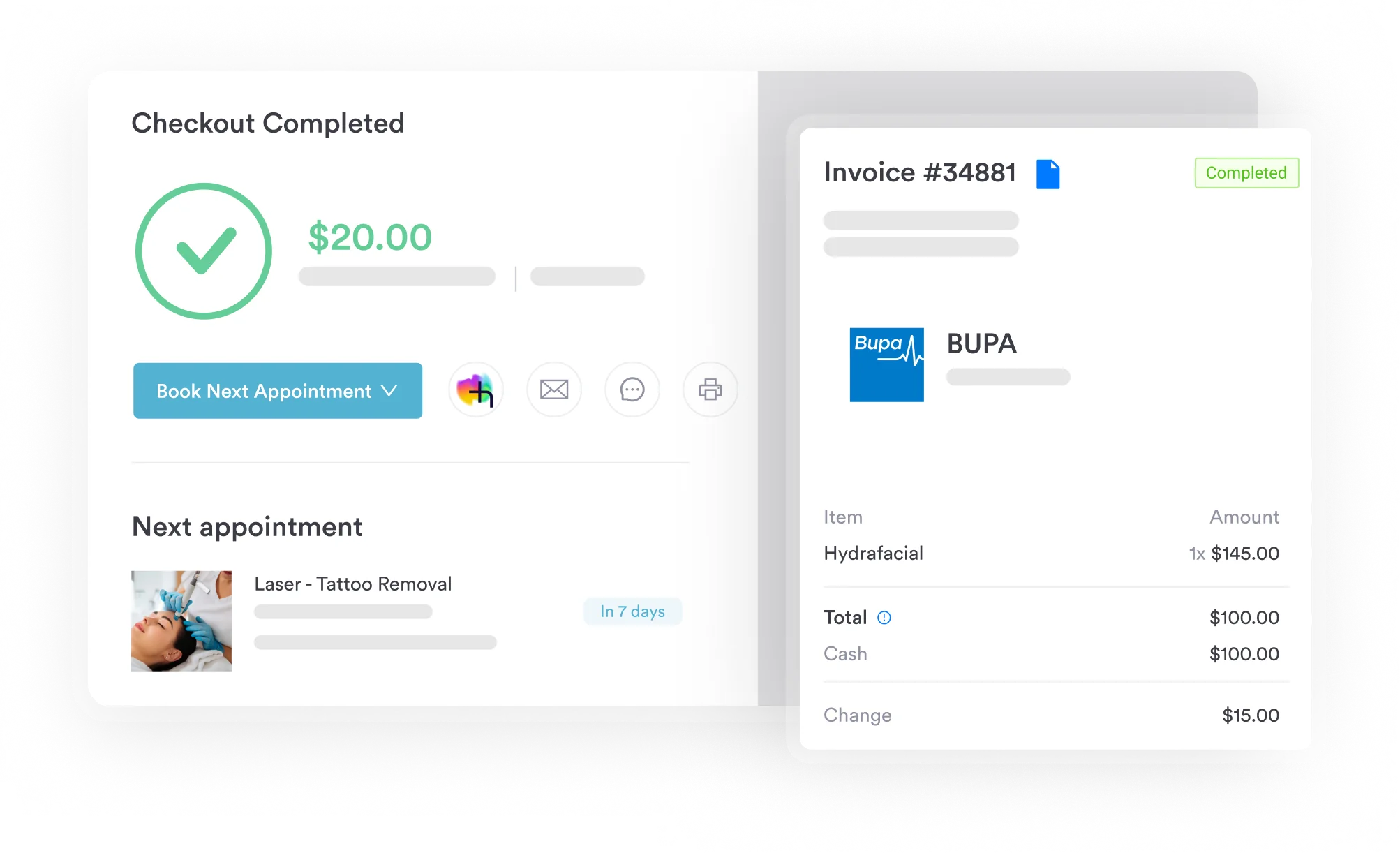
Claims go out through Claim.MD, a US medical claims clearinghouse, in 837P or CMS-1500 format. Its claim scrubbing catches format errors before a payer sees them. Remittances come back as ERAs, with their CARC reason codes, in the same workflow.
For EP coding teams, this means:

Pabau builds the claim from the patient record and sends it through Claim.MD, with eligibility checks before the procedure and ERA matching after. Book a demo to see the claims workflow.

The coding call for 93662 happens before anyone opens the claim form. Read the procedure note, confirm the catheter sat inside the heart, and check which primary code it supported.
If that primary is 93620, 93653, 93654 or a qualifying structural heart code, add 93662 once, with -26 in a facility. If it’s 93656, leave ICE off the claim, because the ablation code already pays for it. Make those two calls correctly and the add-on line stops drawing denials.
Want fewer 93662 lines bouncing back from payers? Book a demo to see how Pabau sends EP claims through Claim.MD and matches each remittance to its claim.

Need to understand how claims move through the clearinghouse? Medical claims clearinghouse overview explains how 837P files, eligibility checks, and remittance processing work end to end.
Dealing with recurring EP claim rejections? Electronic remittance advice (ERA) explained walks through how to read 835 files and map CARC denial codes back to the original claim.
Want a broader billing compliance framework? What is revenue cycle management covers the end-to-end process from eligibility verification through final payment posting.
Billing TEE instead of ICE? CPT code 93312 billing guide covers transesophageal echo coding and its rates.
Filing the physician claim on paper? CMS-1500 form template shows each field the add-on and primary lines need.
No. The descriptor has no per-vessel unit, so any version that ends in “each additional vessel” is wrong. 93662 covers the whole ICE session during one intervention, and it’s reported once per encounter.
Not since January 1, 2025. AF ablation code 93656 now includes ICE and 3D mapping, so the imaging is paid inside the ablation. Report 93662 with 93620, 93653, 93654 or a qualifying structural heart code instead.
No. 93355 is transesophageal echo guidance during transcatheter structural heart work, such as TAVR or mitral repair. Its probe sits in the esophagus. 93662 is intracardiac, with the catheter inside the heart.
Use the diagnosis that supports the primary procedure. That’s usually the arrhythmia being ablated or the structural defect being treated. Payers judge the add-on’s medical necessity through the primary, so both lines should point to the same diagnosis.
No. It carries the ZZZ global indicator, which marks a code that’s always billed with another service. The ICE work falls inside the primary procedure’s global period, so there’s no separate follow-up period to track.