CCSD code A7310: Biopsy of peripheral nerve
CCSD code A7310: definition and procedure scope CCSD code A7310 is the South Afr...

Last Updated: Oct 7, 2026
82378 is the CPT code for a carcinoembryonic antigen (CEA) blood test, a tumor marker used to monitor colorectal and some lung and GI cancers. The lab that performs the assay bills it, at a 2026 Medicare national limit of $18.96.
Medicare pays for CEA to monitor known cancer and never for screening. Its NCD 190.26 covers the test for patients with a cancer diagnosis or history, when the result informs treatment. Pair it with a covered diagnosis, respect the frequency window and pick the right marker code, and most denials never happen.
Let Pabau's smart automation suggest the right codes, reduce claim denials, and keep your practice compliant—effortlessly.
Automate repetitive tasks and focus on what matters most—your patients.
Reduce coding errors and ensure compliance with the latest regulations.
Clean claims, fewer denials, and faster reimbursements.
Powerful insights and reporting to help your practice thrive.
HIPAA compliant SOC 2 certified GDPR-compliant Trusted by 4,000+ clinics worldwide

CPT code 82378 reports a quantitative carcinoembryonic antigen (CEA) blood test, billed by the lab that performs it.
Medicare’s 2026 Clinical Laboratory Fee Schedule sets a national limit of $18.96 for 82378, the same as in 2025.
NCD 190.26 supports CEA for colorectal cancer follow-up at treatment decision points and as an alternative marker in some lung and GI cancers.
Screening diagnoses such as Z12.11 do not support medical necessity, so they are the quickest route to a denial.
The NCD limits routine testing to once per chemotherapy cycle, or every two months after colorectal surgery, unless results or symptoms change.
CPT code 82378 reports a quantitative carcinoembryonic antigen (CEA) assay on serum. The American Medical Association places it in the Chemistry subsection of the Pathology and Laboratory section. The result is a number, usually in ng/mL, rather than a positive or negative reading.
CEA is a glycoprotein that rises in several cancers, most often colorectal cancer. Smoking and some benign conditions can raise it too, so the test does not diagnose cancer. Medicare pays for it to follow disease that is already known. That one distinction drives most of the billing rules below.
Plenty of CEA billing errors start with confusion over who bills what. Under Medicare, the laboratory that performs the assay bills 82378. A practice that draws blood and ships it to a reference lab does not bill the test. Here is how a typical CEA claim moves:
If your practice runs CEA in its own lab, you are the performing lab. You then bill 36415 and 82378 on the same claim, and your CLIA certificate must cover the test.
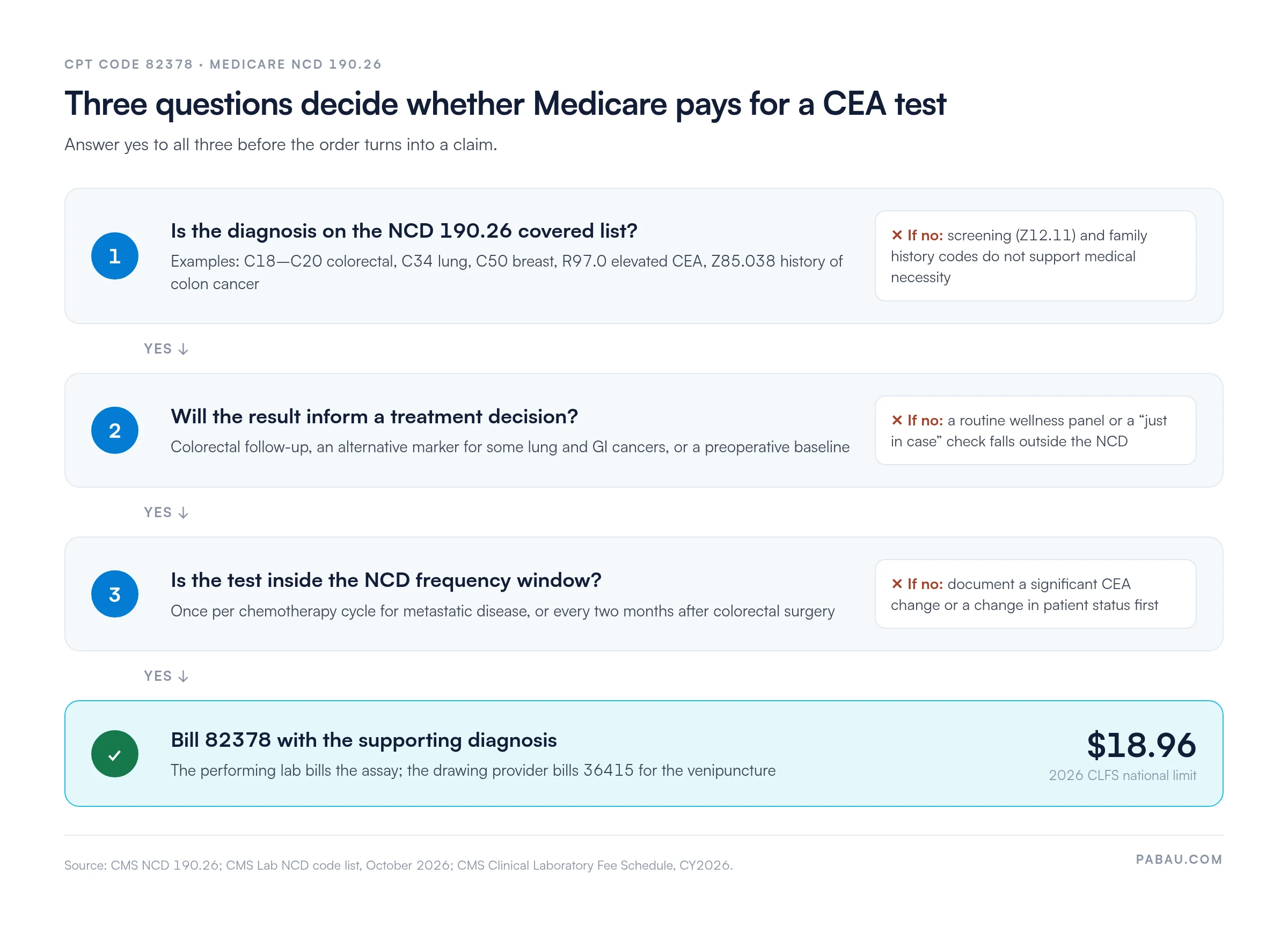
Medicare covers CEA testing under National Coverage Determination 190.26, which binds every Medicare Administrative Contractor (MAC). The NCD describes three situations where the test may be medically necessary:
The NCD also sets expected testing intervals. Check them before you schedule a repeat draw:
A significant change in the prior CEA level, or in the patient’s condition, can justify testing sooner. Record that change in the order, because the claim alone will not show it. Your MAC may also publish local guidance, so check its articles too.
Medicare does not cover tests run without signs, symptoms, complaints or a personal history of disease. Screening codes such as Z12.11 are missing from the NCD’s covered list. Family history codes are listed as not supporting medical necessity. A personal history code is different, and Z85.038 is covered.
Before an order reaches billing, run it through the three checks below.
The diagnosis on the claim is what proves medical necessity. CMS updates the covered ICD-10-CM list for NCD 190.26 every quarter, and the table shows common pairings from the October 2026 list. Confirm current code status with the CDC/NCHS ICD-10-CM tool before you submit.
A patient still in treatment for rectal cancer is billed with C20 rather than a history code. Switch to a Z85 code once treatment has ended and the visit is for surveillance.
Breast cancer needs a closer look. C50 codes sit on the Medicare covered list, yet the NCD text names only colorectal, lung and some GI cancers. For breast and other solid tumors, commercial coverage depends on payer policy. Anthem’s CG-LAB-33, for example, lists metastatic breast cancer.
CEA is paid under the Clinical Laboratory Fee Schedule (CLFS), not the Physician Fee Schedule. CMS sets one national limit amount for each lab code, with no facility or non-facility split. The CMS Clinical Laboratory Fee Schedule files list the current figures each quarter.
Payment can land below the national limit, because Medicare pays the lower of the limit and your billed charge. Load the new figure into your fee schedule each January.
Download the CLFS file from CMS each quarter and search it for 82378 and 36415 before you update your fee schedule. CEA rates rarely move, but a stale entry still creates adjustment lines that someone has to reconcile.
Billing staff never see the draw, so the ordering note is the claim’s only evidence. An auditor reviewing 82378 looks for four elements:
A note that only says “check CEA” will not survive a medical necessity review. Sound medical billing compliance depends on the reason being written in the order, not inferred from older chart entries.
Most CEA claims go out with no modifier at all. When one applies, choose it from the scenario and record the reason in the note.
Payers audit modifiers 91 and 59 closely. Write the reason into the note before the claim goes out, not after a denial arrives.
Several tumor-marker codes sit close to 82378 in the lab section. Picking the wrong one changes the payment and invites a denial. The AAPC Codify CPT lookup confirms each descriptor.
When an oncologist orders CEA and CA 19-9 on the same day, report 82378 and 86301 on separate lines. Each needs its own supporting diagnosis, because neither code includes the other. The payment differs as well, since each look-alike code carries a 2026 national limit of $20.81.
Original Medicare does not require prior authorization for CEA monitoring when the diagnosis is covered. Other plans can be stricter, so check before the draw:
When a plan does require approval, send the diagnosis, treatment history, ordering note and planned testing schedule together. Our guide to the prior authorization process shows how to keep requests moving. An incomplete request can stall approval before a claim even exists.
CEA denials follow a predictable pattern, and each trigger maps to a check you can run at order entry. Our guide to medical billing denial codes explains how each reason reads on the remittance.
On the remittance, CARC 50 (not medically necessary) and CARC 11 (diagnosis inconsistent with procedure) are the most common on 82378 claims. Good denial management treats these triggers as checks before submission. Fixing a denial after the fact costs more staff time than preventing it at order entry.
Pull last month’s 82378 denials once a month and sort them by reason code. A cluster of CARC 50 or CARC 11 lines often traces back to one order template that defaults to a screening diagnosis.
These checks take seconds once they live in a written checklist. Keep it next to your payer list and walk every CEA claim through it:
A claim that clears every line goes out as a clean claim and skips a round of rework.
Many practices still key lab charges and diagnoses into a billing system by hand. Each retyped code is another chance for a screening diagnosis or the wrong marker to reach the claim.
Pabau, the practice management and billing platform we build, pre-fills the claim from the patient record. The CPT code attached to the service lands on the charge line, and ICD-10 slots draw from the recorded problem list. Built-in ICD-10-CM and CPT lookup libraries let staff confirm a code without leaving the claim.
Before a claim can be sent, Pabau’s claims management software checks that required fields are complete. US claims go through Claim.MD, Pabau’s clearinghouse partner, which also runs real-time eligibility checks. It returns 835 remittance data for ERA posting, so CARC 50 and CARC 11 denials show up quickly.
Checks against NCD 190.26 and the frequency window stay with your team and the checklist above. Pabau removes the rekeying around them.


Pabau pre-fills claims from the patient record, checks required fields before sending, and routes US claims through Claim.MD with ERA posting. Your team spends less time correcting lab claims.

CEA billing rewards discipline at the order, not effort at the appeal. Get the diagnosis, the reason for testing and the interval right, and 82378 pays its $18.96 national limit without a fight.
The trade-off is time spent up front. Every check in this article happens before the draw, when fixing an order takes a minute. After a denial, the same fix means a corrected claim, a resubmission and a wait.
If your team still rekeys lab charges between systems, remove that step first. Book a demo to see how Pabau carries codes from the patient record into a clean lab claim.

Need to see how clearinghouse submission works? Claim.MD clearinghouse guide explains how electronic claim routing and ERA posting cut manual reconciliation.
Want claim data structured before it reaches billing? Superbill guide shows how to capture codes and diagnoses at the visit, so fewer claims need correcting.
Looking for the full revenue cycle behind lab billing? Revenue cycle management fundamentals walks through the process from order entry to collected payment.
Coding a rectosigmoid tumor? ICD-10 code C19 covers a diagnosis that supports many CEA monitoring claims.
Following a patient after breast cancer treatment? ICD-10 code Z85.3 explains the personal history code for breast cancer.
CPT code 82378 reports a quantitative CEA blood test. It monitors known cancer, mainly colorectal plus some lung and GI cancers, when results guide treatment. Medicare does not cover it for screening.
The 2026 Clinical Laboratory Fee Schedule sets a national limit amount of $18.96, unchanged from 2025. Medicare pays the lower of that limit and your billed charge. CMS posts updated CLFS files each quarter.
Yes, for colorectal cancer follow-up at treatment decision points, and as an alternative marker for some lung and GI cancers. The diagnosis must be on the covered list, and screening is excluded.
Yes. R97.0, elevated carcinoembryonic antigen, is on the NCD 190.26 covered list. It suits a repeat test after an abnormal result while a cancer is still unconfirmed. Switch to the cancer code once a diagnosis is made.
Reference ranges vary by lab and assay. Many labs treat results up to about 3 ng/mL as normal in nonsmokers, and smokers often run slightly higher. A trend across tests matters more than one result.