

CCSD code G5100: Bypass of duodenum billing guide
CCSD code G5100 bills a bypass that leaves the duodenum in place CCSD code G5100...

Last Updated: Oct 16, 2026
Billable Code
90887 is the CPT code for explaining psychiatric or other medical examination results to a patient's family or other responsible persons. It also covers advising them on how to help the patient.
The clinician explains findings and advises, the patient is not present, and no therapy takes place. That separates 90887 from the family psychotherapy codes 90846 and 90847, where the family session itself is the treatment.
Let Pabau's smart automation suggest the right codes, reduce claim denials, and keep your practice compliant—effortlessly.
Automate repetitive tasks and focus on what matters most—your patients.
Reduce coding errors and ensure compliance with the latest regulations.
Clean claims, fewer denials, and faster reimbursements.
Powerful insights and reporting to help your practice thrive.
HIPAA compliant SOC 2 certified GDPR-compliant Trusted by 4,000+ clinics worldwide

CPT code 90887 covers explaining exam findings, the treatment plan or the prognosis to a patient’s family or another responsible person, with no therapy delivered.
The patient is not present for a 90887 service. Patient presence and therapeutic intent are what separate 90846 and 90847 from it.
Each note must record the date, duration, who attended and their relationship, the findings explained, the clinical rationale and the consent basis.
Pabau’s medical claims management sends 90887 claims through Claim.MD, with real-time eligibility checks and ERA remittances tracked in the same dashboard.
CPT code 90887 is the code for explaining psychiatric or medical examination results to a patient’s family or another responsible person. It also covers advising them on how to help the patient.
It sits in the Psychiatry section (90785-90899) of the AMA CPT code set, under Other Psychiatric Services or Procedures. It is an active, billable code with no scheduled deletion.
The official AMA descriptor has three parts, and each one matters for billing:
CPT 90887 covers a discrete collateral contact with a family member or responsible person. The clinician explains examination results, the treatment plan or the prognosis, or advises the family on how to help. The patient is not present, and the clinician provides no therapy.
Common covered scenarios include:
The code does not cover:
90887 is easily confused with the family psychotherapy codes 90846 and 90847. The choice turns on two questions. Is the patient present, and does the session have therapeutic intent?
Here is the practical test. If the session’s main goal was to change the family’s behavior or relational patterns, use 90846 or 90847. If the goal was to explain what the clinician found and advise the family on how to help, use 90887.
State the session’s purpose in the progress note. A line such as ‘Collateral contact to explain [finding] to [relationship]. No therapeutic intervention conducted.’ gives reviewers an unambiguous record. A note that reads like a therapy session creates audit exposure, even when the clinician only meant to inform.
Psychiatrists, psychologists, licensed clinical social workers (LCSWs) and licensed professional counselors (LPCs) can bill 90887. So can nurse practitioners with psychiatric scope and physician assistants working in a psychiatric practice. Eligibility varies by state and plan, so check each payer’s behavioral health provider list before billing.
Several rules apply regardless of payer:
A 90887 claim stands or falls on its progress note. Good medical billing compliance means the note captures every element payers check at audit.
Every 90887 note needs six elements. The checklist after this list sets them side by side with example entries.
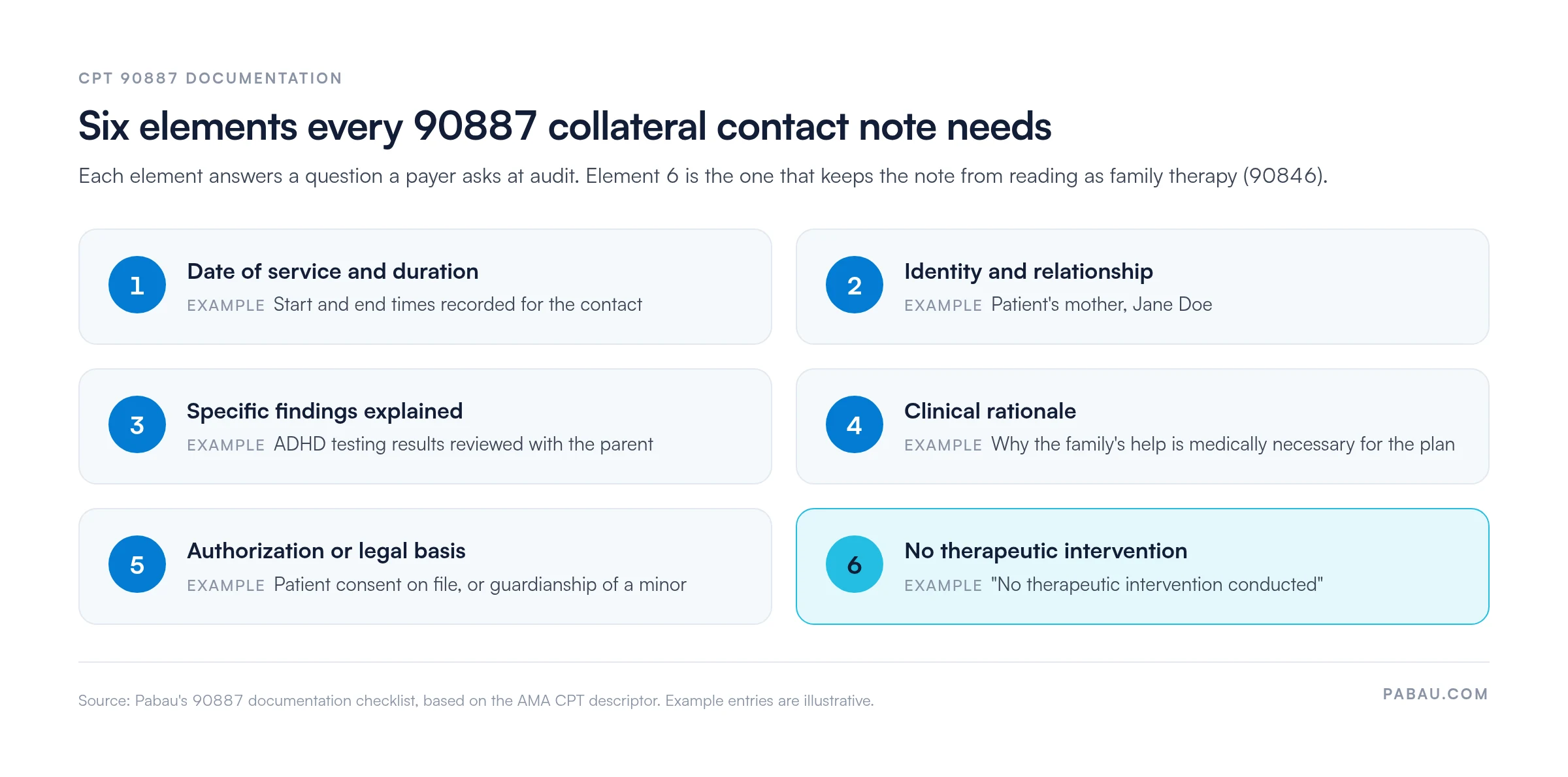
HIPAA (the Health Insurance Portability and Accountability Act) governs disclosure of protected health information in collateral contacts. Record the consent basis in every note, whether that is patient authorization, a treatment exception or legal guardianship. A missing consent basis is both a billing compliance risk and a HIPAA exposure.
Medicare coverage of CPT 90887 depends on your Medicare Administrative Contractor (MAC). Under some Local Coverage Determinations (LCDs), MACs have limited or bundled payment for collateral contacts without a direct patient service on the same date.
Before you submit, check CMS’s Physician Fee Schedule lookup tool and your MAC’s LCD for psychiatry and psychology services. One example is WPS’s LCD L30489, so check the equivalent from your own MAC.
For 2026 rates, look up the national non-facility and facility amounts in the FastRVU 2026 RVU lookup tool, which mirrors current CMS fee schedule data. Third-party rate estimates for 90887 exist, but confirm them against the official CMS source before quoting them to payers or patients. Rates vary by locality, place of service (office or facility) and any MAC payment policy on collateral contact codes.
Key Medicare billing considerations for 90887 include:
Medicaid coverage of CPT 90887 varies by state. Aetna Better Health Medicaid has published provider education materials that reference 90887 as a covered collateral therapy code. Wisconsin ForwardHealth includes 90887 in its outpatient mental health procedure code schedule. Both show that Medicaid managed care organizations (MCOs) can cover the code, though coverage is not universal.
Before billing a Medicaid MCO for 90887, check these points:
Commercial insurers generally follow AMA CPT guidance but may have their own coverage policies. Treat each payer contract separately, and run insurance eligibility verification before each encounter to confirm active behavioral health benefits.
Yes, in many cases, but with conditions. CPT 90887 is generally not subject to a National Correct Coding Initiative (NCCI) edit that blocks it alongside 90837, 90834 or 90791. Payer-specific policies can still bundle it at the MAC or plan level.
When you bill 90887 on the same date as a patient therapy session:
Billing 90887 with 90791 (psychiatric diagnostic evaluation) on the same date is common when a clinician finishes an evaluation and then meets the family. The pairing is often allowed. Document the two encounters separately, and check payer guidance before assuming approval.
No. CPT 90785 is an add-on code for interactive complexity, and CPT guidelines limit it to 90791, 90792, 90832-90838 and 90853. 90887 is not on that list, so 90785 is not reported with 90887.
CPT also excludes translation and interpreter services from interactive complexity. If a collateral contact was unusually difficult, describe the circumstances in the 90887 note itself.
90887 denials follow predictable patterns. Strong denial management workflows start with knowing why claims fail before they’re submitted.
Tracking denials by their Claim Adjustment Reason Codes (CARCs) shows these patterns early. Our guide to denial codes in medical billing explains what each code means. The aim of submitting a clean claim is a complete note before submission, so you aren’t appealing after a denial.
Audit your 90887 claims before submission once a month. Pull the last 20 claims and check that each progress note carries all six documentation elements. A missing element found at this stage takes a minute to fix, while one found by the payer costs you the claim.
When the note lives in one tool and the claim in another, details such as the consent basis or the insurer get lost. Pabau, the practice management platform we build, keeps the note, the invoice and the claim on the same patient record. Its medical claims management tools then carry the claim through to payment.
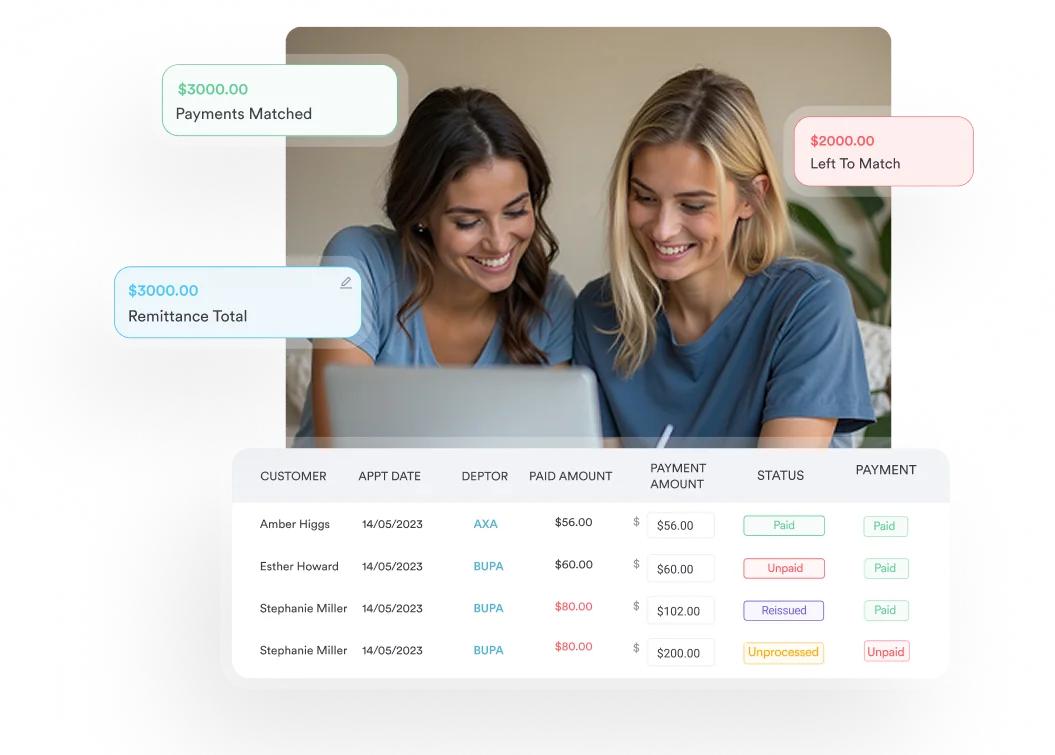
Setting up 90887 in Pabau takes five steps:
Your team spends less time re-keying insurer details and chasing claims that bounced for a missing field. More 90887 claims get paid on the first submission.

Pabau sends 90887 claims through Claim.MD to thousands of US payers, with real-time eligibility checks and validation before every claim goes out. Fewer rejections means less time chasing payments.

CPT 90887 is a legitimate, billable service, but it only gets paid when the note proves what kind of contact took place. If the note reads like a therapy session, the claim will be treated like one.
So start with the note. Use a collateral contact template that captures all six elements, check each payer’s coverage before the first claim, and keep same-day contacts in separate notes. Do that, and 90887 becomes a routine line item rather than a recurring denial.
Book a demo to see how Pabau takes a 90887 claim from the collateral note to the remittance.

Want to understand how clearinghouse submissions work? Medical claims clearinghouse guide explains how 837P electronic claims are routed, validated, and returned with ERA responses.
Billing the initial psychiatric evaluation? CPT code 90791 covers the psychiatric diagnostic evaluation and what its documentation needs to show.
Checking which codes take the interactive complexity add-on? CPT code 90785 explains when interactive complexity applies and which primary codes it attaches to.
CPT code 90887 covers explaining psychiatric or other medical examination results to family members or other responsible persons. It also covers advising them on how to help the patient. The service is informational rather than therapeutic, and the patient is not present during the encounter.
Medicare coverage of 90887 depends on your MAC’s Local Coverage Determination (LCD). Some MACs have limited or bundled payment for collateral contacts without a same-day patient service. Check your own MAC’s LCD (WPS’s LCD L30489 is one example) and the 2026 CMS Physician Fee Schedule before submitting claims.
Check the 2026 rate against the official CMS Physician Fee Schedule, because it varies by locality and place of service. The FastRVU RVU lookup and the CMS PFS search tool both show current national non-facility and facility rates. Third-party estimates exist, but don’t use them as billing benchmarks without CMS confirmation.
CPT 90887 is an informational collateral contact to explain exam results to a family member, with no therapy involved. CPT 90846 is structured family psychotherapy without the patient present, where the family interaction itself is the treatment. If the session had therapeutic intent, use 90846. If it was purely explanatory, use 90887.
The progress note must record the date and duration of the contact, and who attended along with their relationship to the patient. It must also name the findings or treatment plan information explained, the clinical rationale, and the consent or legal basis for disclosure. Finally, it should state that no therapeutic intervention was conducted.
The most common reasons are a missing medical necessity narrative, absent consent documentation and an incorrect place of service code. Same-day bundling without modifier 59 or XP, payer non-coverage and a missing relationship notation also cause denials. Auditing notes against the six documentation elements before submission catches these problems early.



