

CCSD code G5100: Bypass of duodenum billing guide
CCSD code G5100 bills a bypass that leaves the duodenum in place CCSD code G5100...

Last Updated: Oct 16, 2026
90869 is the CPT code for a subsequent TMS session in which the motor threshold is re-determined, with treatment delivery and management. Routine sessions, from session two to the end of a course, are billed as 90868 instead. Bill 90869 only on the session where the clinician re-measures the threshold, such as after a dose change or a treatment break.
On that day, 90869 replaces 90868, and the two are never billed together. Many courses need a re-determination only once or twice, or not at all. The claim must show the new threshold value and the reason it was measured again.
Let Pabau's smart automation suggest the right codes, reduce claim denials, and keep your practice compliant—effortlessly.
Automate repetitive tasks and focus on what matters most—your patients.
Reduce coding errors and ensure compliance with the latest regulations.
Clean claims, fewer denials, and faster reimbursements.
Powerful insights and reporting to help your practice thrive.
HIPAA compliant SOC 2 certified GDPR-compliant Trusted by 4,000+ clinics worldwide

CPT code 90869 is billed only on a TMS session where the motor threshold is re-determined, never on routine sessions.
Routine sessions, from session two to the end of the course, are billed as 90868, the highest-volume TMS code.
On a re-determination day, 90869 replaces 90868, and the two are never billed for the same session.
Expect 90869 often once or twice, or not at all, depending on the course. It usually follows a dose change, a treatment break, or a clinical need to re-measure.
Every 90869 note must record the new threshold value and the reason it was re-determined.
CPT code 90869 reports a subsequent TMS session in which the clinician re-measures the patient’s motor threshold, then delivers and manages the treatment.
The AMA descriptor reads: “Therapeutic repetitive transcranial magnetic stimulation (TMS) treatment; subsequent motor threshold re-determination with delivery and management.”
The key word is re-determination. A routine session after the first one is billed as CPT code 90868. 90869 applies only to the session where the threshold is measured again, and on that day it replaces 90868.
The three TMS codes split a course by the work done in each session, as the table shows.
A standard course typically runs 30 to 36 sessions over about six to nine weeks. Nearly all of those sessions are 90868. 90869 is the exception code, and it should appear only when documented.
The motor threshold sets the stimulation dose. When the clinician has a reason to believe it has shifted, they measure it again. That re-measurement is what turns a 90868 session into a 90869 session.
Common reasons to re-determine the threshold include:
A threshold check done out of habit, with no stated reason, does not support 90869. Bill that session as 90868 and keep the note honest.
Take an illustrative patient on a 36-session course for major depressive disorder. The patient misses a week after session 11. Later, the psychiatrist changes a medication that can affect the threshold.
Here is how the course codes out.
The course totals one 90867, 33 units of 90868, and two units of 90869. Laid out as a timeline, the two re-determination days are easy to spot.
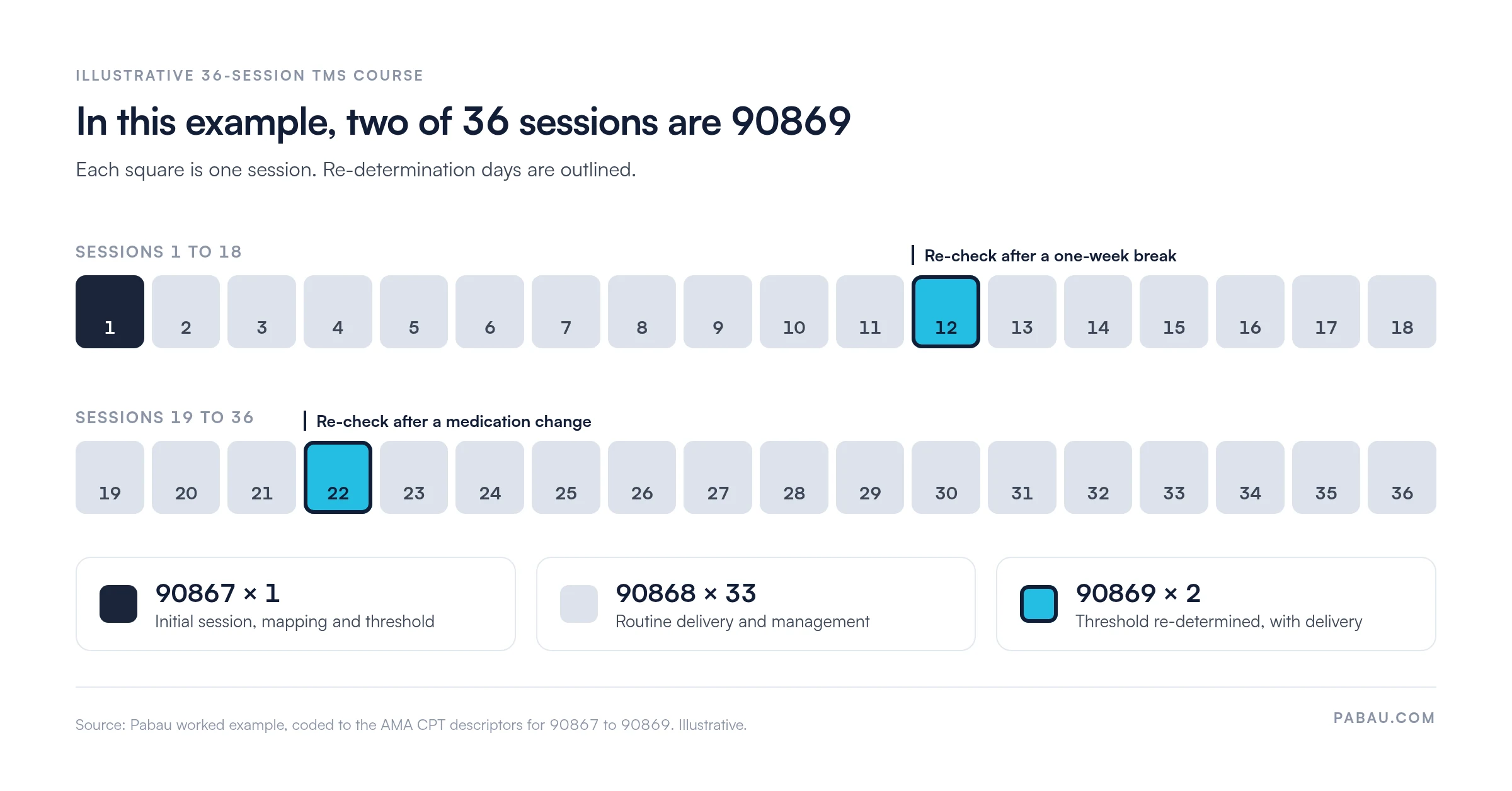
If the claim history showed 90869 on 30 sessions instead, an auditor would ask for 30 re-determination notes.
The re-determination is the billable difference, so the note has to show it happened and why. Copied notes that look the same as a routine session are an audit trigger.
A clean claim depends on that note being retrievable on request. Post-payment reviews of TMS often pull the whole course, not one date. Strong billing compliance habits from session one protect every claim in it.
Add a required threshold field and a reason field to your TMS session note template. When both are filled, the session is a 90869 candidate. When they are blank, the session defaults to 90868. This one rule prevents both over-coding and under-coding.
Payers check the claim’s diagnosis against their covered list of ICD-10-CM codes for TMS. Medicare’s billing article for LCD L37086 lists only the severe, non-psychotic depression codes.
Match the code’s severity to what the psychiatrist documented for that date. Billing F32.2 when the note says moderate invites a post-payment review.
There is no national coverage determination for TMS. Each Medicare Administrative Contractor publishes its own LCD. Noridian’s LCD L37086 sets these core conditions:
The companion billing article A57692 covers up to 20 visits over four weeks, plus five taper visits. Patients with at least 25% improvement may get 10 more visits over two weeks, plus six taper visits. Other MACs publish parallel LCDs, so check yours.
Most commercial and Medicare Advantage plans require prior authorization for the TMS course. The authorization covers a set number of sessions, and 90869 sessions count toward it.
A typical request includes:
Track sessions used against the authorization as the course runs. Request an extension before the cap, with updated progress notes and rating scores.
Medicare pays 90869 from relative value units in the annual Physician Fee Schedule. Rates change each January and vary by locality. Use the CMS Physician Fee Schedule lookup to find the current rate for your area. Commercial rates follow each payer contract.
National Correct Coding Initiative (NCCI) edits govern how the TMS codes combine. Check the current edit tables before you set billing rules for a new program.
Most 90869 denials come from using the code on the wrong day or without proof. Good denial management ties each denial reason to the fix before resubmission.
Run through this list for every session coded as 90869.
Deep TMS and theta burst stimulation bill under 90867, 90868, and 90869, like standard rTMS. No separate CPT codes exist for them. Coverage differs by device and cleared indication, so check both before billing.
Whatever the device, the 90869 rule holds. Bill it only on the session where the threshold was re-determined.
A TMS course means dozens of claims against one authorization. Pabau, the practice management and billing platform we build, stores each prior authorization as a case. It tracks the authorized sessions used, so the team sees the cap coming before it arrives.
Our claims management software submits electronic CMS-1500 claims to US payers through Claim.MD and posts ERA remittances back. Claims that need attention are flagged as Needs action, so the team can fix them quickly.

Pabau tracks authorized TMS sessions used against each prior authorization and submits CMS-1500 claims through Claim.MD. Claims that need a fix are flagged as Needs action.

Treat 90869 as an exception code. Default every session after the first to 90868. Switch to 90869 only when the note shows a re-determined threshold and the reason for it.
Errors in either direction look the same to an auditor, because the claim and the record disagree. Build the threshold value and reason into your session template, and both errors become hard to make.
Book a demo to see how Pabau tracks authorized TMS sessions and claims across a full course.

Billing the first session of the course? CPT code 90867 covers the initial TMS session, with cortical mapping and the first threshold determination.
Need to understand how clearinghouse submission works for psychiatric claims? 837 file submission guide explains how electronic claims reach payers and where errors surface in the transmission.
Want to verify authorization requirements before billing a new TMS payer? Insurance eligibility verification covers how to confirm both eligibility and authorization status before the first session.
Assessing a patient for TMS candidacy? CPT code 90791 covers the psychiatric diagnostic evaluation that usually comes before a course is ordered.
Building your TMS authorization request? Medical prior authorization form gives you a ready-made template for the diagnosis, history, and treatment plan payers ask for.
Per session. Report one unit of 90869 for the treatment session in which the threshold was re-determined. TMS codes are not time-based, so a longer session does not add units.
Yes, if the re-determination was clinically indicated and documented. The code describes the work of re-measuring, not the result. Record the value found, even when it matches the prior threshold, plus the reason for the check.
Most payers treat retreatment as a new course, so its first session is billed as 90867. Under LCD L37086, retreatment needs evidence of a prior response, shown by a greater than 50% improvement on a standard rating scale.
No. Under LCD L37086, treatment is given under the direct supervision of the ordering psychiatrist. The psychiatrist must be present in the area but need not deliver the treatment. Commercial plans set their own supervision rules.



