CPT code 21011: Excision of soft tissue tumor of the face
CPT code 21011: Official descriptor and procedure overview CPT code 21011, as pu...

Last Updated: Oct 8, 2026
CPT Code 90867 bills the initial therapeutic repetitive transcranial magnetic stimulation (TMS) session, including cortical mapping, motor threshold determination, delivery, and management.
It is reported once per treatment course, not once per visit. Medicare pays roughly $153 per initial session nationally in 2026, before any locality adjustment.
Psychiatrists and mental health billing staff report 90867 for the first session of a course treating major depressive disorder. Sessions after the first are billed as 90868 or 90869 instead. Submitting 90867 twice in one course is the denial most TMS practices see.

CPT Code 90867 covers the initial TMS session only, including cortical mapping and motor threshold determination.
Medicare covers 90867 for treatment-resistant major depressive disorder under LCD L37086, with OCD coverage limited to FDA-cleared deep TMS devices.
The 2026 national average Medicare payment for 90867 works out at roughly $153 per session before locality adjustment.
Billing 90867 for a second or later session, instead of 90868, is the denial TMS practices hit most often.
A 90867 claim needs the mapping result, the motor threshold value, and dated evidence of a failed antidepressant trial.
The American Medical Association descriptor reads: “Therapeutic repetitive transcranial magnetic stimulation (TMS) treatment; initial, including cortical mapping, motor threshold determination, delivery and management.” The code sits in the Medicine section of the CPT code set, under Other Psychiatric Services or Procedures.
Three clinical activities are bundled into that one code. Cortical mapping identifies the scalp location over the motor cortex to target. Motor threshold determination establishes the lowest magnetic field intensity that produces a visible motor response in the patient’s hand. Delivery and management covers the stimulation session itself and the clinical oversight around it.
Because all three are included, 90867 is billed once per course of TMS treatment. The number of sessions in that course makes no difference to how often the code is reported.
A standard TMS course for depression runs about 36 sessions over six weeks. Only the first of those sessions uses CPT Code 90867. The rest are reported as 90868, or as 90869 when motor threshold re-determination is performed.
Session number decides the code, so the billing system has to know where each visit sits in the course. Sessions two onward run on 90868 unless the threshold is re-checked, which leaves that code carrying almost all of a course’s volume.
Bill 90867 when TMS is delivered for an FDA-cleared indication and the session includes cortical mapping and motor threshold determination. The Food and Drug Administration has cleared repetitive TMS for treatment-resistant major depressive disorder and for obsessive-compulsive disorder. The OCD clearance covers deep TMS devices such as BrainsWay’s H-Coil system.
Medical necessity rests on pairing the right diagnosis with the procedure code. Anxiety disorders on their own are not a covered TMS indication under most LCD policies. These are the ICD-10-CM codes most commonly paired with 90867:
Treatment resistance is a prerequisite for Medicare coverage. The record has to show that the patient failed at least one adequate antidepressant trial during the current episode, at a therapeutic dose and duration. Most commercial payers apply a similar prior-failure requirement.
Medicare covers CPT Code 90867 for treatment-resistant major depressive disorder under Local Coverage Determination L37086 and the parallel LCDs other MACs issue.
Each LCD has a companion billing and coding article, and its number varies by MAC. Coverage for OCD with deep TMS is handled separately. Check your own MAC’s current policy, because criteria vary by jurisdiction.
The CMS Physician Fee Schedule lookup tool returns locality-specific rates. For 2026, the national average Medicare payment for 90867 is approximately $153 per session before any locality adjustment. High-cost metros such as San Francisco, New York, and Los Angeles are paid above that figure. Rural localities are paid below it.
Claims routed through a clearinghouse reach thousands of US payers, and Claim.MD validates 90867 against covered diagnoses before the claim leaves the practice. Real-time eligibility responses catch most coverage mismatches at submission rather than at remittance, which is five weeks earlier in the cycle.
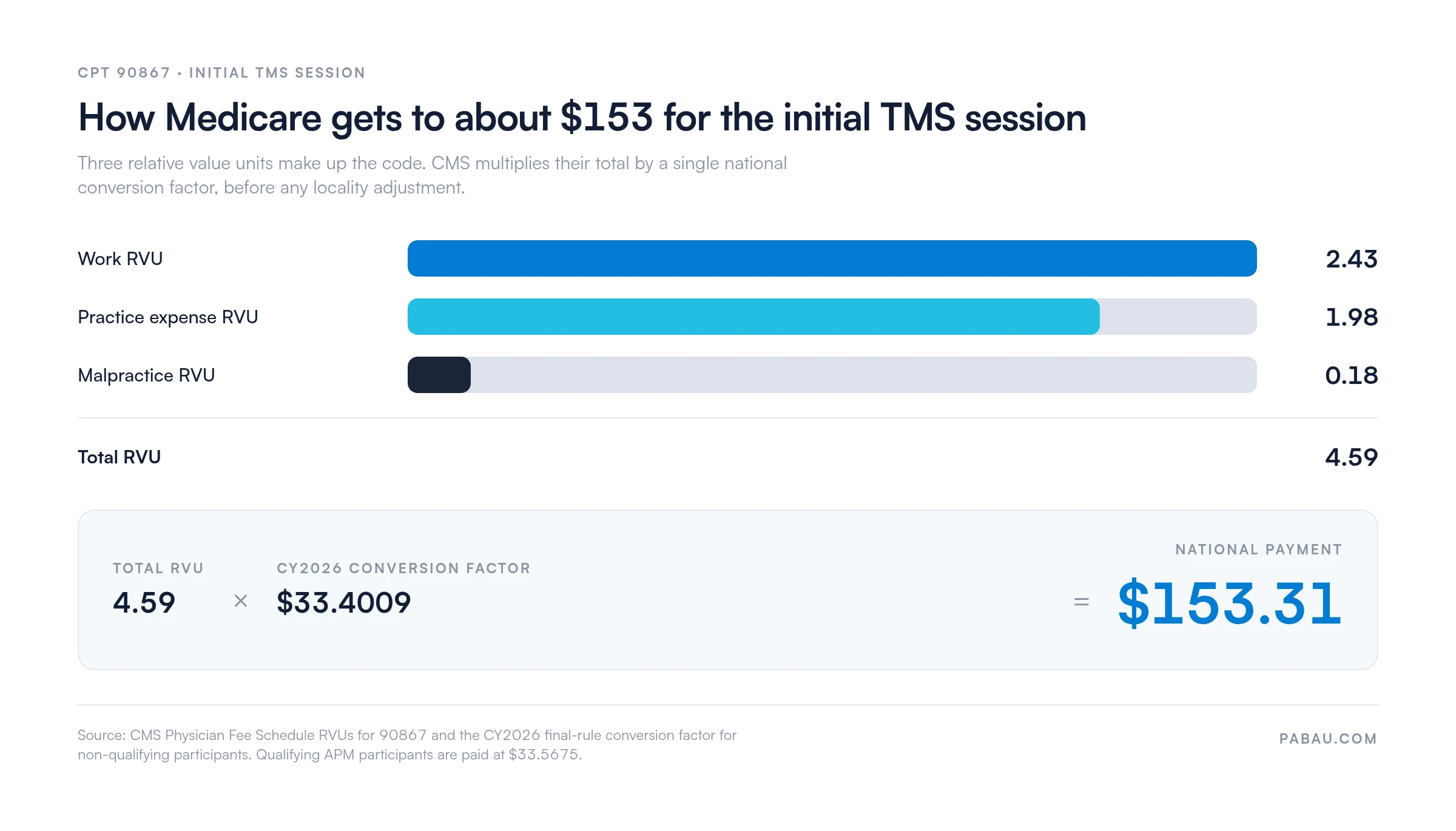
The table below lists the published 2026 RVU components for 90867. Check them against your MAC’s locality adjustment before quoting a rate to a patient.
Multiplying the 4.59 total RVU by the non-qualifying conversion factor of $33.4009 gives $153.31. Qualifying APM participants are paid on $33.5675, which lands at $154.07. Both are national figures, so the geographic practice cost indices for your locality move them in either direction.
RVU values move with each annual final rule. Use the AAPC Codify CPT lookup to confirm the current descriptor, then check the fee schedule for your locality before you finalize a fee estimate.
Medicaid coverage for TMS varies by state. California’s Medi-Cal and New York Medicaid both publish explicit coverage policies for TMS in major depressive disorder. Most other states treat it case by case or do not cover it at all. Check your state program’s current bulletin before billing 90867 to a Medicaid patient.
Commercial payers generally follow LCD criteria, then add their own prior authorization and medical necessity requirements on top. The variation between them concentrates in three places:
Verifying eligibility before the first session confirms which of those three the plan applies. It also stops a full course being scheduled against a plan with no TMS benefit at all.
Run a payer-specific coverage check before you schedule the initial TMS session. Confirm that the plan covers CPT Code 90867 for the patient’s diagnosis. Check how many prior medication failures it requires, and whether it mandates a specific device. Doing this before cortical mapping saves the practice from an unbillable initial session.
Commercial insurers commonly require prior authorization for 90867 and for the TMS course that follows it. Medicare does not require it under most MACs. The workflow below covers most commercial requests.
Every 90867 claim rests on the clinical record. That record has to show medical necessity, the components of the initial session, and the patient’s eligibility for TMS. Missing any element below is a common basis for denial or audit exposure.
Structured note templates can make each of these a required field. A session note then cannot be completed without the mapping result or the motor threshold value. Tying the note to the billing code then stops an incomplete record from reaching the payer at all.
TMS billing produces a predictable set of denials. Most of them trace back to the three-code family structure and to the documentation the initial session demands.
A billing rule catches each of these at the source. Validating the diagnosis-to-code pairing and the session sequence before submission costs far less than appealing the denial afterwards.
A TMS practice runs clinical documentation, insurance authorization, session sequencing, and claim submission across dozens of patients at once.
Those four usually live in separate tools, which is where the session count and the code drift apart. Pabau is practice management software for healthcare practices, and its claims management software keeps them in one record.
Session-type tracking is the part that matters most for TMS. Pabau flags 90867 for the initial session, then populates 90868 or 90869 for the ones that follow. Treatment templates hold structured fields for the mapping result and the motor threshold value, so billing is not triggered on an incomplete note.
Authorization numbers and approval windows are recorded against the patient’s treatment plan, with alerts as sessions approach the authorized limit.
Claims go out through the Claim.MD clearinghouse, which reaches thousands of US payers. Remittance advice comes back into the same workflow, so billing staff can see which 90867 claims were denied and why without leaving the system.

Pabau holds treatment documentation, CPT code assignment, prior authorization tracking, and claim submission in one system. TMS practices stop switching between tools to bill a single course.

The initial session is where a TMS course is won or lost on billing. 90867 packages mapping, threshold determination, and management into one billable event, so it carries more documentation weight than the 35 sessions after it.
Get the authorization, the mapping record, and the threshold value in place before session one. The remaining claims in the course are then close to mechanical. Skip one of them and the denial lands five weeks later, when the course has already finished and the notes are cold.
That sequencing holds much better when the documentation and the claim live in the same system. Book a demo to see how Pabau keeps a TMS course billing correctly from the initial session onward.

Need the code for the evaluation that precedes TMS? CPT Code 90791 covers the psychiatric diagnostic evaluation that usually establishes the diagnosis and severity score.
Want to tighten the prior authorization step? Prior authorization process walks through the submission and tracking workflow that TMS courses depend on.
Want to understand the clearinghouse layer in TMS claims? Claim.MD vs Office Ally compares the two most common US clearinghouses for psychiatric billing practices.
Looking to benchmark your denial rate against industry norms? Denial codes in medical billing covers the most common CARC reason codes and how to address each one.
CPT Code 90867 is used to bill the initial therapeutic repetitive TMS treatment session, which includes cortical mapping, motor threshold determination, delivery, and management. It is billed once per treatment course, not once per session visit. Subsequent sessions in the same course use 90868 (delivery only) or 90869 (delivery with motor threshold re-determination).
The 2026 Medicare national average for CPT 90867 is approximately $153 per session. That figure is the code’s 4.59 total RVU multiplied by the CY2026 conversion factor of $33.4009. High-cost metro localities are paid more, and rural localities less. Check the CMS Physician Fee Schedule lookup for your own locality before quoting a rate.
Yes. Medicare covers CPT Code 90867 for treatment-resistant major depressive disorder under Local Coverage Determination L37086 and the parallel LCDs other MACs issue. Coverage requires documented failure of at least one adequate antidepressant trial. OCD coverage applies only to FDA-cleared deep TMS devices, and the companion billing and coding article number varies by MAC.
CPT 90867 covers the initial TMS session and adds cortical mapping and motor threshold determination to delivery and management. CPT 90868 covers subsequent sessions with delivery and management only, without re-mapping. CPT 90869 covers subsequent sessions where motor threshold re-determination is clinically required, such as after a treatment break. Using 90867 for session two or later is one of the most common TMS billing errors.
Medicaid coverage for CPT 90867 varies by state. California Medi-Cal and New York Medicaid both publish TMS coverage policies for major depressive disorder. Most other state Medicaid programs either do not cover TMS or cover it case by case. Check your state program’s current bulletin before scheduling TMS for a Medicaid-enrolled patient.
Prior authorization requirements depend on the payer. Medicare generally does not require it for TMS under most MAC jurisdictions. Commercial insurers almost always require prior authorization before CPT 90867 can be submitted. They ask for diagnosis severity, prior antidepressant failure history, and the specific TMS device being used. Obtain and record the authorization number before performing the initial session.