HCPCS Code L0472: Hyperextension TLSO billing guide
HCPCS code L0472: Official descriptor and device definition HCPCS code L0472 des...

Last Updated: Nov 5, 2026
90845 is the CPT code for psychoanalysis. It covers sessions built on psychoanalytic technique, such as free association, dream analysis, and transference interpretation, rather than general psychotherapy.
Unlike CPT codes 90832, 90834, and 90837, which bill by time, 90845 has no minimum session length. It is billed once per day, however long the session runs, and that difference is a common reason claims get submitted incorrectly. Most commercial payers cover psychoanalysis, though many require prior authorization. Medicare covers it under Part B with 20% coinsurance after the deductible.
Let Pabau's smart automation suggest the right codes, reduce claim denials, and keep your practice compliant—effortlessly.
Automate repetitive tasks and focus on what matters most—your patients.
Reduce coding errors and ensure compliance with the latest regulations.
Clean claims, fewer denials, and faster reimbursements.
Powerful insights and reporting to help your practice thrive.
HIPAA compliant SOC 2 certified GDPR-compliant Trusted by 4,000+ clinics worldwide

CPT code 90845 covers psychoanalysis specifically, not general psychotherapy. The session note must show psychoanalytic techniques such as free association and transference work.
90845 is an untimed code. It has no minimum session length and is billed once per day, unlike 90832, 90834, and 90837, which need documented face-to-face minutes.
Medicare covers 90845 under Part B, and most commercial payers cover it too, though many require prior authorization before the first session.
Missing psychoanalytic-modality documentation in the treatment plan is a frequent cause of medical necessity denials for 90845 claims.
CPT code 90845 is the code for psychoanalysis, a treatment built on free association, dream analysis, and transference interpretation. The American Medical Association publishes it with a one-word descriptor: Psychoanalysis. It is untimed and billed once per day, however long the session runs. The AMA lists psychoanalysis as its own service, separate from supportive or time-based psychotherapy.
Clinically, psychoanalysis involves intensive, recurring sessions focused on unconscious processes. The core techniques are free association (the patient verbalizes thoughts without censorship), dream analysis, and transference interpretation (the therapist analyzes the patient’s emotional projections). These techniques differentiate psychoanalysis from cognitive behavioral therapy, supportive therapy, or any timed psychotherapy code in the 90832-90837 range.
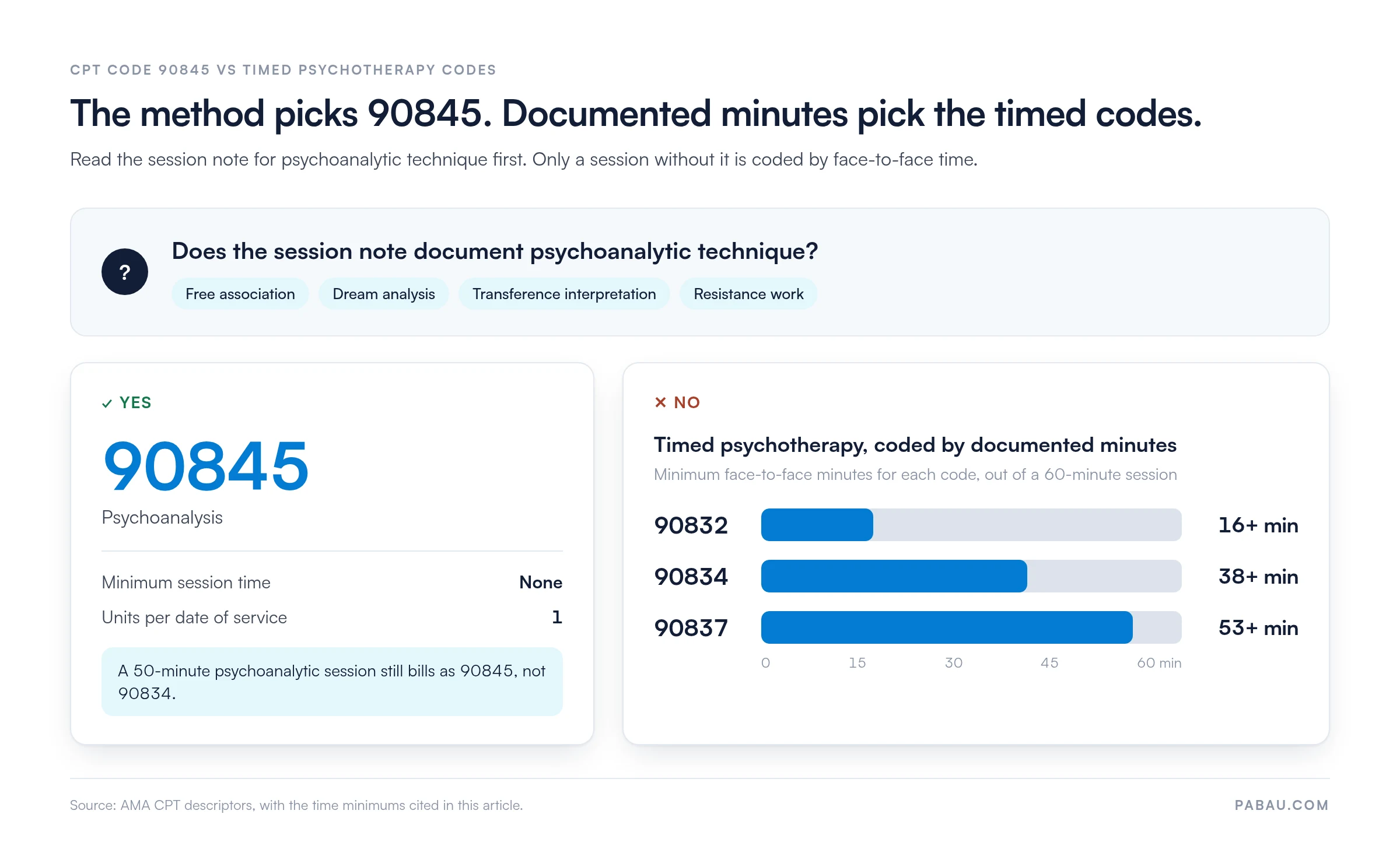
CPT code 90845 has no minimum time requirement. That sets it apart from the timed psychotherapy codes in the 90832-90837 family.
The psychotherapy codes 90832, 90834, and 90837 are time-based, named for 30, 45, and 60-minute sessions. The documented face-to-face time must appear in the session notes. Billing the wrong tier when time falls short of the threshold is a common audit trigger. With 90845, no such threshold exists. The psychoanalytic method qualifies the session, whatever its length.
The once-per-day rule still applies. 90845 cannot be billed twice on the same date of service, regardless of whether the patient had two psychoanalytic sessions in a single day.
A frequent billing error with CPT code 90845 is swapping it with 90837, the 60-minute psychotherapy code. The two codes describe different services, and payers treat them differently.
A psychoanalyst running 50-minute sessions should still bill 90845, not 90834. The session qualifies as psychoanalysis only if it involves the distinctive psychoanalytic techniques. Session length plays no part in the choice, so the decision runs in the order shown below.
Three neighboring codes often turn up in the same episode of care as 90845. Each has its own same-day rule.
Family psychotherapy with the patient present, billed as 90847, is a different service from psychoanalysis. Billing both on one date needs documentation that two separate sessions took place. Without a modifier or a medical necessity rationale, most payers bundle them.
Pairing 90845 with the right ICD-10-CM code is part of the medical necessity case. Payers validate that the diagnosis supports a psychoanalytic treatment plan, and mismatches trigger review. The CMS ICD-10 codes resource provides the current FY code files and coverage guidance.
Payers often flag F43.x (adjustment disorders) when it is paired with 90845. They may question why the condition needs psychoanalysis rather than time-limited therapy. Acute stress presentations paired with 90845 carry a higher denial risk than chronic or recurrent conditions.
Medicare covers CPT code 90845 under Part B as an outpatient mental health benefit. The patient pays 20% coinsurance once the annual Part B deductible is met. Medicare does not limit mental health coverage to CBT-style therapy, and psychoanalysis sits among its covered services.
Coverage for mental health practices billing 90845 to Medicare depends on two additional conditions. First, the provider must be enrolled in Medicare and credentialed for the service type. Second, the documentation must meet CMS’s medical necessity standard: The service must be reasonable and necessary for the diagnosis. The treatment plan must also specify the psychoanalytic modality.
The Mental Health Parity and Addiction Equity Act (MHPAEA) covers psychoanalysis too. It bars commercial payers from limiting mental health benefits more tightly than comparable medical or surgical benefits. For 90845, a payer’s session limits, prior authorization rules, and visit caps can be no stricter than its rules for comparable physical care.
Medicaid coverage varies by state. States are not required to cover psychoanalysis as a Medicaid benefit, and coverage policies differ significantly. Practices billing Medicaid for 90845 should verify coverage with their state Medicaid agency before treating patients. Some states leave psychoanalysis off their covered service list entirely.
The Medicare Physician Fee Schedule sets the benchmark reimbursement rates for 90845. Rates are updated annually each January and vary by geographic location through Medicare’s Geographic Practice Cost Indices (GPCIs). The CMS Physician Fee Schedule lookup tool gives current rates by HCPCS code and locality. Check your own locality rate there rather than relying on national averages.
Non-facility rates (office-based sessions, POS 11) are higher than facility rates (hospital outpatient, POS 22). In the office, the practice carries the overhead itself. The FastRVU lookup tool breaks 90845 into work, practice expense, and malpractice RVUs. Apply your locality’s adjustments and the annual Medicare conversion factor to estimate payment.
Commercial payer rates are typically negotiated separately and may be higher or lower than Medicare rates depending on the payer contract. A real-time eligibility check before submission shows whether the patient’s plan covers psychoanalysis and at what cost-sharing level.
Verify your 90845 reimbursement rates by locality, not national averages. Run the CMS Physician Fee Schedule lookup for your specific Medicare Administrative Contractor (MAC) jurisdiction each January after the new fee schedule takes effect. A practice in a high-cost metro area can be paid well above the national average rate.
Applying the right modifier and place of service (POS) code to a 90845 claim affects both reimbursement and claim acceptance. Telehealth delivery in particular requires careful modifier selection, as policies have continued to evolve since the end of the COVID-19 public health emergency.
Telehealth policy caution: Check the current year’s CMS telehealth code list before applying Modifier 95 to a Medicare claim for 90845. Telehealth coverage rules have changed multiple times since 2020. Commercial payers have their own telehealth modifier requirements that may differ from Medicare’s. Verify your specific payer’s requirements before billing telehealth sessions under 90845.
Insufficient documentation is a frequent denial cause for 90845 claims. Payers do not simply accept that a session labeled “psychoanalysis” qualifies for the code. The clinical record must demonstrate that the session involved psychoanalytic techniques. Any primer on medical billing fundamentals makes the same point: The clinical record is what a clean claim rests on.
These elements are required or strongly recommended in the documentation for a defensible 90845 claim:
A compliant superbill that pulls from the session note carries the modality, diagnosis, and techniques into every 90845 submission.
Many commercial payers and some Medicare Advantage plans require prior authorization before billing CPT code 90845. This varies significantly by payer and plan. No single rule applies, so verify requirements plan by plan before the first session. Billing compliance requirements for mental health services have been an area of heightened payer scrutiny, particularly for specialty modalities like psychoanalysis.
When a commercial payer requires prior authorization for 90845, the submission typically requires:
If authorization is denied, most payers allow an appeal. Include a letter of medical necessity from the treating provider and further documentation of the treatment rationale. Cite MHPAEA if the denial holds psychoanalysis to stricter criteria than the payer applies to comparable medical services.
CPT code 90845 claims face a distinct denial profile compared to standard timed psychotherapy codes. Knowing the most common failure points reduces rework and accelerates revenue. Claims management software tracks denial patterns by code, so practices can identify whether their 90845 denials cluster around one root cause or several. Integrating denial management workflows into the billing cycle prevents the same denial reasons from recurring across claim batches.
Each denial arrives on the remittance advice with a reason code. Our guide to medical billing denial codes explains what each one means and how to respond.
Not every licensed mental health provider can bill CPT code 90845. Payer credentialing requirements are the binding constraint, not just state licensure. The AAPC CPT code reference outlines the procedural context, but billing eligibility depends on payer-specific enrollment status.
Provider types who may bill 90845, depending on payer and state:
Some payers require evidence of formal psychoanalytic training (such as completion of a recognized psychoanalytic institute program) as a condition of credentialing for 90845. This requirement is payer-specific and not universal. Verify credentialing requirements with each payer before the first 90845 claim is submitted.
In many mental health practices, the clinician writes the session note in one system and the biller builds the claim in another. The biller then has to judge from free text whether the session met the psychoanalytic bar. That judgment call is where 90845 claims slip, either downcoded or denied for medical necessity.
Pabau, the practice management and EHR platform we build, keeps the note and the claim in one patient record. Custom clinical forms capture the technique, the diagnosis, and the treatment-plan modality in structured fields. The claim is built from that record and sent through the Claim.MD clearinghouse, with an eligibility check before it goes.
The result is a 90845 claim that matches its note on the day it is filed. Prior authorizations, denials, and appeals sit on the same record, so an appeal starts from documentation you already have.

Pabau links the psychoanalytic session note to the 90845 claim, so the modality, diagnosis, and techniques payers check travel with every submission. Book a demo to see the mental health billing workflow.

Code 90845 by method and set the clock aside. A note that shows free association, transference, or interpretation work supports the claim at any session length. A note that reads like supportive therapy leaves the claim exposed, however long the session ran.
The checks that protect the claim happen before the first session. Confirm prior authorization and the provider’s credentialing with each payer, and name psychoanalysis in the treatment plan. Those minutes up front cost far less than an appeal later.
Book a demo to see how Pabau carries the psychoanalytic session note straight into the 90845 claim.

Coding the intake before psychoanalysis starts? CPT code 90791 covers the psychiatric diagnostic evaluation that often comes before psychoanalysis.
Seeing family members without the patient? CPT code 90846 covers family psychotherapy without the patient present.
Looking to understand how clearinghouse submission works for mental health codes? Claim.MD clearinghouse overview explains how electronic claims reach payers and where they stall before adjudication.
Trying to reduce denied claims across your psychiatric billing workflow? What makes a clean claim walks through the submission elements that prevent rejections before they reach the adjudication stage.
CPT code 90845 is the AMA billing code for psychoanalysis, a distinct psychotherapeutic modality involving free association, dream analysis, and transference interpretation. It is an untimed code billed once per day, regardless of session length, and covers only psychoanalytic sessions rather than general psychotherapy.
No. CPT code 90845 is limited to one unit per day. Even if a patient attends two psychoanalytic sessions on the same date of service, only one unit of 90845 may be billed for that date.
No. Unlike CPT codes 90832, 90834, and 90837, which require documented face-to-face minutes, 90845 has no minimum session length. The billing criterion is the psychoanalytic modality, not the duration of the session.
Yes. Medicare covers CPT code 90845 under Part B as an outpatient mental health benefit with 20% coinsurance after the annual deductible. The provider must be enrolled in Medicare and the documentation must demonstrate medical necessity for the psychoanalytic approach.
Prior authorization requirements vary by payer and plan. Many commercial payers and some Medicare Advantage plans require prior authorization for CPT code 90845. Original Medicare does not require prior authorization, but medical necessity documentation standards still apply. Verify with each payer before the first session.
CPT 90845 covers psychoanalysis specifically, with no minimum time requirement and a once-per-day billing limit. CPT 90837 covers any 60-minute psychotherapy session (minimum 53 documented minutes) across any therapeutic modality. A psychoanalytic session that runs 50 minutes should still use 90845, not 90837.