CPT code 57283: Uterosacral ligament suspension billing guide
CPT code 57283: Official descriptor and procedure overview CPT code 57283 descri...

Last Updated: Oct 15, 2026

CPT code 90834 covers individual psychotherapy of 38 to 52 minutes, billed as a 45-minute session.
The Medicare national non-facility rate is about $104.16 for 2025 and about $113.90 for 2026, before GPCI locality adjustment.
Upcoding to CPT 90837 below 53 minutes is the most common billing error, so document exact start and stop times.
Practice management software like Pabau ties CPT code submission, session notes, and electronic claims into one workflow.
CPT code 90834 is the billing code for individual psychotherapy, 45 minutes. It covers any session where the psychotherapy itself runs 38 to 52 minutes.
It is the most commonly billed psychotherapy code in outpatient behavioral health. That 15-minute window is what makes it awkward. Two minutes either side of it moves the claim onto a different code at a different rate.
This guide covers the descriptor, the time rules, and 2025 and 2026 Medicare rates. It also covers code comparisons, add-on codes, telehealth billing, and the documentation payers ask to see.
CPT codes are maintained by the American Medical Association (AMA), which updates the full code set every year. Every rate below comes from the CMS Physician Fee Schedule. Treat the figures as national averages, not as what your own payer will pay.
CPT code 90834 describes individual psychotherapy lasting approximately 45 minutes. The AMA’s official descriptor reads: Psychotherapy, 45 minutes with patient.
It applies to interactive, face-to-face psychotherapy with one patient, including the telehealth equivalent. The work being billed is evaluating and treating a mental health condition through verbal therapeutic technique.
The code is for licensed mental health professionals billing standalone psychotherapy. It carries no evaluation and management (E&M) component. When a psychiatric E&M service happens in the same session, an add-on code applies instead.
Time is the most audited element of a 90834 claim. The AMA specifies 90834 when the psychotherapy portion of the session lasts 38 to 52 minutes. Below 38 minutes the claim belongs to CPT 90832. At 53 minutes or more it belongs to CPT 90837.
Those boundaries carry more money than a session note usually suggests. Mapped against the 2026 fee schedule, the 90834 band is the narrowest of the three and sits directly below the biggest jump in rate.
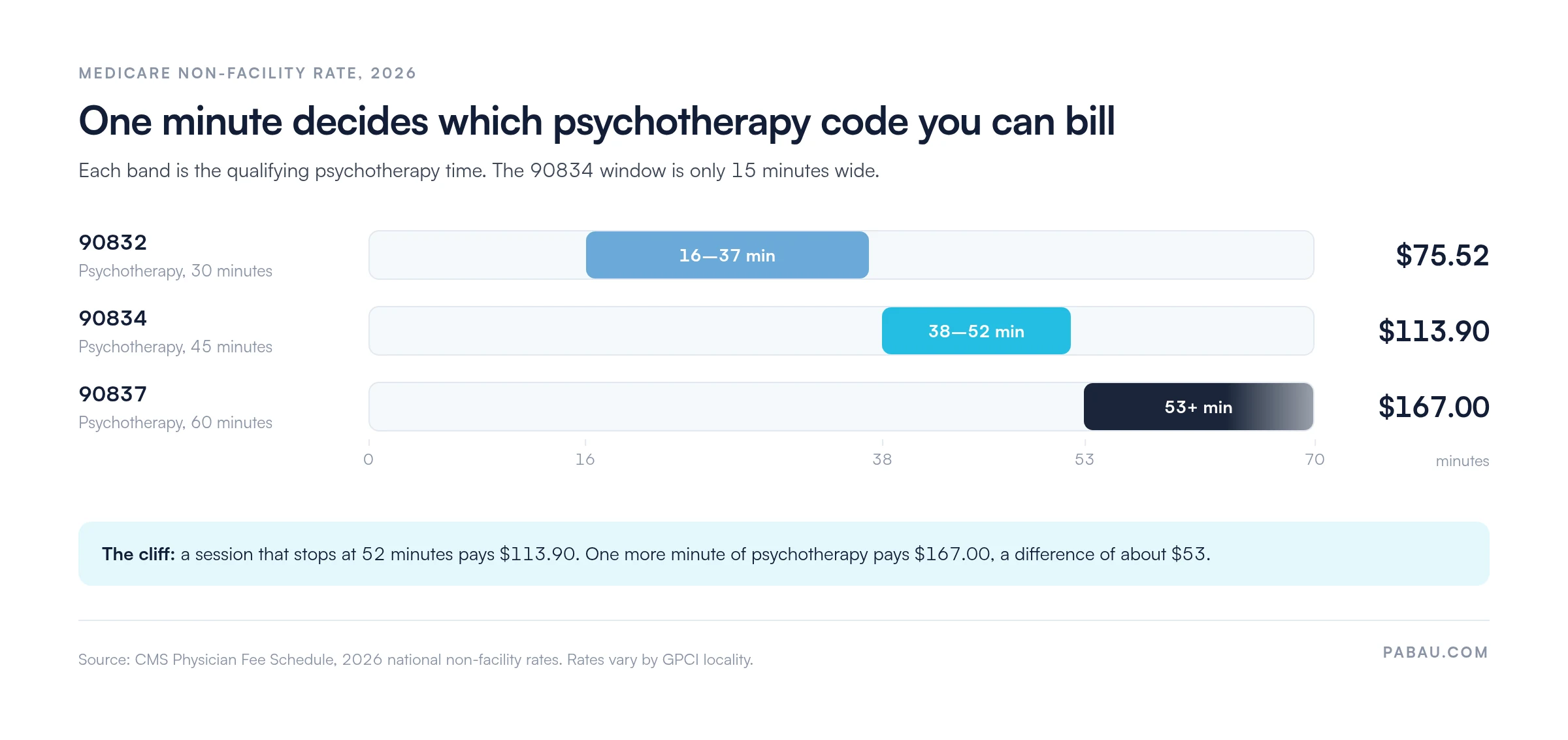
Session notes have to record the clock start and stop time of the psychotherapy contact, not a duration estimate. Payers request records for time-based codes as a matter of routine. A note reading only “45 minutes” with no timestamps is the easiest claim on your list for a reviewer to pull.
Any licensed mental health professional credentialed to provide individual psychotherapy can bill 90834. The provider types below are the usual ones. Payer contracts and state licensure laws still govern who qualifies, so confirm your credentials with each payer before you bill.
Residents and trainees billing under a supervising provider’s NPI follow the incident-to or supervision rules written into their payer agreements. Medicare sets its own conditions for behavioral health providers billing under Part B, and those are published in CMS guidance for outpatient mental health services.
Medicare’s national non-facility rate for CPT code 90834 is about $104.16 for 2025 and about $113.90 for 2026. Rates are adjusted by the CMS Geographic Practice Cost Index (GPCI).
A therapist in San Francisco is paid differently from one in rural Mississippi for the same code. Check your own figure with the CMS Physician Fee Schedule lookup tool for your locality and fee schedule year.
Tracking reimbursement per CPT code is how a practice catches an underpayment before it compounds across a year of sessions.
For out-of-network patients, a superbill carrying 90834 and the matching diagnosis code lets the patient claim from their insurer directly. Verify any figure against the current fee schedule before you build a budget on it.
Upcoding 90834 to 90837 is the most frequently cited billing error in individual psychotherapy. The rule itself is simple. A session of 38 to 52 minutes is 90834, and 53 minutes or more is 90837. The failure comes from skipping the stop time and defaulting to the code that pays more.
CPT 90832 covers sessions of 16 to 37 minutes. It suits brief check-ins, medication management follow-ups with a short therapy component, and cases where clinical necessity supports a shorter contact.
Many practices use 90832 for follow-ups and keep 90834 for primary treatment contacts. Under the 2026 fee schedule the difference between the two is about $38 a session, which is what makes the timestamp worth writing down.
Those are the 2026 CMS national non-facility figures, and each one shifts with your GPCI locality. The 2025 equivalents were roughly $75 to $80 for 90832, $104.16 for 90834, and $154.29 for 90837.
The psychotherapy family is one small corner of a much larger set. Our library of CPT codes covers the other procedure codes a behavioral health practice bills through the year.
Some sessions include both a psychiatric E&M service and psychotherapy. In that case the psychotherapy is billed with an add-on code rather than standalone 90834. Add-on codes cannot be billed on their own. Each one has to accompany a primary E&M code.
A psychiatrist running a medication management visit alongside 45 minutes of psychotherapy bills the E&M code plus add-on 90836. Billing 90834 next to an E&M code without that add-on structure usually comes back denied. AAPC’s CPT code reference and the AMA add-on code guidelines both confirm the correct pairing.
Crisis work has its own add-on, and it never pairs with 90834. 90840 covers each extra 30 minutes of crisis psychotherapy beyond 74 minutes, billed only alongside base code 90839. CCI edits bundle it with 90834, so one date of service cannot carry both.
CPT code 90834 sits on the Medicare list of telehealth services. The mental health telehealth flexibility that started with the COVID-19 public health emergency has been extended by later legislation. Those provisions still depend on renewal, so check current CMS policy before you bill a remote session.
Practices running teletherapy alongside in-person sessions should audit their note templates. The place of service, the modifier, and the session start and stop time have to be captured in both modes.
A 90834 note needs seven elements, and the start and stop time is the one a reviewer checks first. CMS requires outpatient mental health services to meet medical necessity criteria and to be supported by adequate documentation.
A structured intake note, carried through in the same format at every progress note, is what builds that record over a course of treatment.
What matters is that every required element appears in every note, every time. Practices that formalize this find audits faster and denial rates lower. Behavioral health has less room for error than most specialties on medical billing compliance, because so much of its revenue rides on time-based codes.
Denials for 90834 cluster around a short list of repeating errors. Each one is cheaper to prevent at the point of documentation than to appeal after the fact.
Audit your 90834 claims once a month. Pull every session billed in the past 30 days. Check each note for a start time, a stop time, and a DSM-5 diagnosis with medical necessity language. Catching a missing timestamp yourself is far less disruptive than answering a records request for 50 sessions at once.
Most behavioral health practices keep the session note in one system and the claim in another. The code itself often lives in a spreadsheet, or in a biller’s head. Every hand-off is another chance for the timestamp to go missing. The 38 to 52 minute window is narrow enough that three extra minutes change the billable code.
Practice management software like Pabau puts the three in one place. Session note templates can prompt for the start time, the stop time, and the diagnosis code while the clinician is still writing.
The code then travels with the note, so the claim is built from what was documented rather than from what someone remembers.
Claims go out electronically through an integrated clearinghouse, and claim status comes back on the same screen. Pabau’s claims management software also reports denial rates by payer and by code.
That tells you which insurer is creating friction on your 90834 claims. You can then fix the note template instead of appealing one claim at a time.

Pabau brings CPT code submission, session documentation, and electronic claims into one platform. Mental health practices use it to cut coding errors and speed up reimbursement.

The 90834 window is narrow and the code above it pays about $53 more. That combination is why payers audit this code so hard. A practice that writes a clock time on every note has already won the argument before a reviewer starts it.
So the change worth making is a small one. Make the timestamp automatic, and the coding decision stops being a judgment call at the end of a long day.
There is a trade-off to remember. Honest time documentation will occasionally push a session down to 90832 and cost you about $38. That is far cheaper than an extrapolated overpayment finding across a year of upcoded claims. Book a demo to see how Pabau prompts for session start and stop times and files the 90834 claim from the same note.

Need the intake visit coded too? CPT code 90791 covers the psychiatric diagnostic evaluation that usually opens a course of 90834 sessions.
Session turned into a crisis? CPT code 90839 sets out the crisis psychotherapy code and the time rules that separate it from 90834.
Billing a state Medicaid program? HCPCS code H0032 covers a mental health service code that many state programs use alongside CPT.
Want the claim to pass first time? What makes a clean claim lists the fields a payer checks before it accepts a claim for processing.
Already sitting on 90834 denials? Denial management in healthcare walks through triaging, appealing, and preventing repeat rejections.
CPT code 90834 is the billing code for individual psychotherapy of 45 minutes. It qualifies when the psychotherapy runs 38 to 52 minutes. Licensed mental health professionals use it for standalone sessions in office, outpatient, and telehealth settings.
Between 38 and 52 minutes of psychotherapy time. Below 38 minutes, bill 90832. At 53 minutes or more, bill 90837. Only the psychotherapy contact counts, not note-writing or administrative time.
90834 covers 38 to 52 minutes of individual psychotherapy, and 90837 covers 53 minutes or more. The Medicare gap between them is roughly $50 to $53 a session. Billing 90837 for a 48-minute session is upcoding, and it is a common audit trigger.
The national non-facility rate is about $104.16 for 2025 and about $113.90 for 2026. GPCI adjusts it by locality. Check the CMS Physician Fee Schedule lookup tool for your own MAC region and fee schedule year.
Yes. CPT code 90834 is on the Medicare list of telehealth services. Claims need the correct place of service code, either POS 02 or POS 10, and most commercial payers also want modifier 95. Confirm current CMS policy before you bill.
When psychotherapy accompanies an evaluation and management service, use add-on code 90836 instead of standalone 90834. Codes 90833 and 90838 do the same job for the 30-minute and 60-minute bands. No add-on code can be billed without a companion E&M code.
The note needs session start and stop times, the type of psychotherapy, and clinical content tied to treatment goals. It also needs medical necessity linked to an active DSM-5 diagnosis, a brief mental status observation, and a signature with credentials. Missing timestamps are the top denial reason.