

HCPCS code E0198: Water pressure pad billing guide
HCPCS code E0198 is a water pad for a standard mattress HCPCS code E0198 is the ...

Last Updated: Oct 13, 2026
90707 is the CPT code for measles, mumps and rubella virus vaccine (MMR), live, for subcutaneous use. It covers the vaccine product only, so a separate administration code goes on every claim.
The American Medical Association maintains 90707 in the Vaccines, Toxoids section of the CPT code set. Denials usually trace back to a missing administration code, the wrong administration code for the patient's age, or a VFC-supplied dose reported incorrectly.
Let Pabau's smart automation suggest the right codes, reduce claim denials, and keep your practice compliant—effortlessly.
Automate repetitive tasks and focus on what matters most—your patients.
Reduce coding errors and ensure compliance with the latest regulations.
Clean claims, fewer denials, and faster reimbursements.
Powerful insights and reporting to help your practice thrive.
HIPAA compliant SOC 2 certified GDPR-compliant Trusted by 4,000+ clinics worldwide

CPT code 90707 covers the MMR vaccine product only, so every claim needs a paired administration code.
Use CPT 90460 through age 18 when counseling is documented, and CPT 90471 for every other patient.
Report a VFC-supplied dose as 90707 with modifier SL at a $0.00 charge, plus the administration code.
Medicare Part B does not routinely cover MMR for adults, so check the CMS National Coverage Determinations database.
CPT code 90707 is the AMA-assigned procedure code for the Measles, Mumps, and Rubella (MMR) vaccine, live, for subcutaneous use. It appears in the Vaccines, Toxoids section of the CPT code set and covers only the vaccine product itself.
The two FDA-approved MMR vaccine products billed under this code are M-M-R II, manufactured by Merck, and Priorix, manufactured by GSK. Both are live-attenuated formulations given as a single subcutaneous injection, usually in the outer upper arm or anterolateral thigh. The AMA’s CPT code set does not differentiate by manufacturer, so either product bills under 90707.
Any licensed provider who administers the MMR vaccine in an outpatient setting may bill CPT 90707, provided their payer agreement covers immunization services. The most common billers are pediatricians, family medicine physicians, internists, OB-GYNs, and travel medicine practices.
Providers new to immunization coding should read their payer contracts before submitting. Two eligibility considerations affect who bills and how:
Charging a payer for a VFC-supplied vaccine product is a compliance violation with False Claims Act exposure. Reporting that same dose at $0.00 is what the program expects instead. Check your VFC agreement terms before submitting any claim involving government-purchased doses, because the two claim shapes differ on a single line.
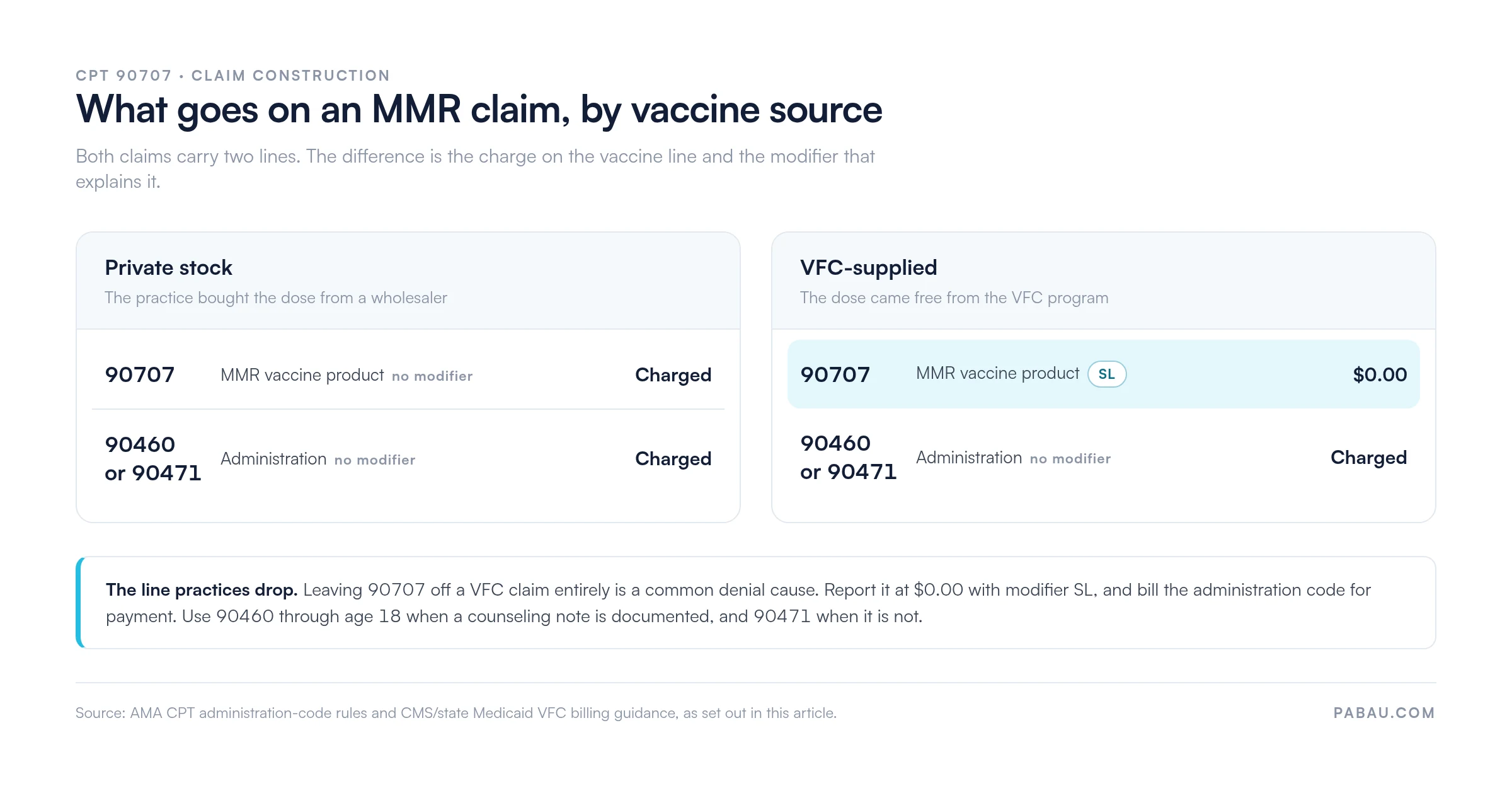
CPT 90707 covers only the vaccine product. A separate administration code is required on every claim, and the correct code depends on the patient’s age and whether counseling was documented.
For patients through age 18, CPT 90460 requires documented face-to-face counseling about the vaccine at the time of administration. A missing counseling note is one of the most consistent audit findings on pediatric immunization claims. Where counseling was not documented, 90471 is the correct administration code, whatever the patient’s age.
When MMR is given at the same visit as a second vaccine, add one unit of 90461 for each additional component reported under 90460. Under 90471, add one unit of 90472 for each additional vaccine.
Hepatitis A is a common pairing at that visit, because its pediatric two-dose series starts at 12 months. That product is billed under CPT code 90633, which also needs its own paired administration code.
A COVID-19 vaccine at the same visit works differently. That dose takes 90480, which includes counseling, so it adds no unit of 90461 or 90472. The MMR still needs its own 90460 or 90471.
Three modifiers appear regularly on CPT 90707 claims. Applying the wrong one, or omitting a required one, is a reliable path to denial.
Modifier SL is the most consequential for practices enrolled in the VFC program. It tells the payer the dose came from government stock, which is why that 90707 line carries no charge. Omitting SL when VFC stock was used can trigger a recoupment demand.
Check your VFC agreement annually. CMS updates VFC billing instructions each year, and some state Medicaid programs publish separate modifier guidance that supersedes the federal default. Flag VFC patients in your scheduling system before the visit, not at claim time.
Reimbursement for CPT 90707 varies by payer type, geographic locality, and whether the vaccine was purchased privately or supplied through VFC. The table below shows approximate 2026 national ranges. Verify exact rates via the CMS Physician Fee Schedule lookup tool and your state Medicaid fee schedule before billing.
For a precise 2026 work RVU and reimbursement estimate, use the FastRVU 2026 RVU lookup tool. Rates in the table above are national approximations and will differ by geographic locality and payer contract.
Practice management software like Pabau can submit CPT 90707 claims electronically through its Claim.MD integration, which connects to thousands of US payers. Remittance advice returns as 835 files, so billing staff can match payments and spot underpayments on 90707 claims without manual reconciliation.
Medicare Part B does not routinely cover the MMR vaccine for adults. Influenza, pneumococcal and Hepatitis B vaccines are designated preventive benefits under Part B. MMR sits outside that adult preventive vaccine benefit.
Coverage may apply in specific clinical situations, such as post-transplant or immunocompromised patients with documented clinical indications. Confirm via the CMS National Coverage Determinations database before billing Medicare for an adult MMR.
Shingrix, the adult shingles vaccine, follows a different Medicare route. Part D covers both the vaccine and its administration, so 90750 bills to the patient’s Part D plan, not Part B.
State Medicaid programs cover the MMR vaccine for eligible children, usually through the VFC program. Coverage rules and reimbursement rates vary significantly from state to state. Key points:
Incomplete documentation is among the top reasons 90707 claims are denied or flagged on audit. Every required data point has to be captured at the point of care, rather than reconstructed from the record days later.
Building a structured superbill that captures lot number, manufacturer and expiration date as required fields keeps the most common omissions off the claim. When a lot number is missing at submission, many payers reject outright rather than request an addendum.
Practices that document digitally can set Pabau’s claims software for practices to flag incomplete vaccine records before the claim is submitted. Pabau captures lot number, manufacturer, expiration date, injection site and VIS provision date at the point of care through structured clinical record fields.

The same errors appear repeatedly on 90707 claims across practices of all sizes. Knowing which one is most likely for your patient mix is where denial prevention starts.
Reviewing your 90707 claim history against the common denial codes each quarter shows which of these patterns is hitting your practice hardest.
CPT 90707 describes the standard three-component MMR vaccine. Two related codes are frequently confused with it.
The most common mix-up is between 90707 and 90710. When a provider administers ProQuad, the MMRV combination product, the correct code is 90710. Billing 90707 for an MMRV administration underbills the vaccine product and misstates the clinical record.
Advisory Committee on Immunization Practices (ACIP) guidance drives which product is clinically preferred by age group. That preference then decides which of the two codes belongs on the claim.
Audit your 90707 and 90710 claims together quarterly. If you see 90707 billed for patients under 13 who received ProQuad, you likely have a systematic code selection error. Cross-check the lot number in the clinical record against the product administered to confirm.
Knowing the billing rules for CPT 90707 is one job. Applying them across hundreds of immunization visits is another, and that is where revenue leaks. A reference page states the rules. Practice management software applies them at the moment of billing.
Pabau’s integrated billing workflow covers the three most common failure points on 90707 claims:
Eligibility verification runs before the visit, so Medicaid-enrolled children who are VFC-eligible are flagged while the billing pathway can still be set correctly. Correcting that pathway after a denial costs a rework cycle the practice never needed to spend.

Pabau’s claims management tools capture immunization documentation at the point of care and route 90707 claims electronically through Claim.MD to thousands of US payers. See how it works.

CPT code 90707 is straightforward in principle. Bill the vaccine product, pair it with the right administration code, and report a VFC-supplied dose at $0.00 with modifier SL. The denials accumulate at the edges: The missing lot number, the wrong administration code, the VFC line left off the claim entirely.
Pabau’s claims management tools handle those edges. They capture vaccine documentation at the point of care, flag VFC-eligible patients before billing begins, and route claims through the Claim.MD clearinghouse connection.
To see how Pabau handles immunization billing workflows, book a demo with the team.

Need to understand how electronic claims reach payers? Pabau’s Claim.MD clearinghouse guide explains how 837P files are validated and routed to thousands of US payers.
Want to reduce claim rejections before they reach the payer? Understanding the 837 file format walks through the EDI transaction structure that carries CPT codes like 90707 to payers electronically.
Looking for the compliance standards behind vaccine billing? Medical billing compliance covers the documentation and audit requirements that keep immunization claims defensible.
Trying to get more claims paid on the first pass? What makes a clean claim sets out the fields payers check before they adjudicate a submission.
Are denials already piling up? Denial management in healthcare walks through triaging, appealing and preventing repeat rejections.
CPT code 90707 is the billing code for the Measles, Mumps, and Rubella (MMR) vaccine, live, administered via subcutaneous injection. It covers the vaccine product only and must be paired with a separate administration code on every claim.
Use CPT 90460 for patients through age 18 when face-to-face counseling is documented. Use CPT 90471 for every other patient, including adults and anyone without a counseling note. Add 90461 or 90472 for each additional vaccine component given at the same visit.
No, Medicare Part B does not routinely cover the MMR vaccine for adults. Coverage may apply in limited clinical situations involving specific documented indications. Verify coverage via the CMS National Coverage Determinations database before billing Medicare for an adult MMR administration.
Yes, the MMR vaccine is covered under the Vaccines for Children (VFC) program for eligible children. Report 90707 on the claim with modifier SL and a $0.00 charge, then bill the administration code for payment. Leaving the 90707 line off the claim is a frequent cause of denial.
CPT 90707 covers the MMR vaccine (Measles, Mumps, Rubella), while CPT 90710 covers MMRV, which adds a varicella component. When ProQuad (the combination MMRV product) is administered, use 90710, not 90707. Billing 90707 for an MMRV administration is a coding error.
Five errors account for most denials. Practices bill 90707 without an administration code, pick the wrong administration code for the age, or omit the 90707 line on a VFC claim. The rest come from leaving modifier SL off a VFC claim and submitting without a vaccine lot number.



