HCPCS Code L0472: Hyperextension TLSO billing guide
HCPCS code L0472: Official descriptor and device definition HCPCS code L0472 des...

Last Updated: Nov 5, 2026
90658 is the CPT code for influenza virus vaccine, trivalent (IIV3), split virus, 0.5 mL dosage, for intramuscular use. It reports the vaccine product only, so the injection goes on a second line with an administration code such as G0008 or 90471.
Coders often confuse it with 90656, the preservative-free trivalent vaccine, and with quadrivalent 90686. That confusion is a common cause of wrong-code denials on flu claims.
Let Pabau's smart automation suggest the right codes, reduce claim denials, and keep your practice compliant—effortlessly.
Automate repetitive tasks and focus on what matters most—your patients.
Reduce coding errors and ensure compliance with the latest regulations.
Clean claims, fewer denials, and faster reimbursements.
Powerful insights and reporting to help your practice thrive.
HIPAA compliant SOC 2 certified GDPR-compliant Trusted by 4,000+ clinics worldwide

CPT code 90658 reports the trivalent, split-virus flu vaccine at a 0.5 mL intramuscular dose, for products that contain a preservative.
Bill 90658 and its administration on separate lines. Use G0008 for Medicare, 90471 for commercial payers, or 90460 for patients through age 18 with counseling.
Medicare Part B covers 90658 with no cost-sharing, and the CMS payment limit for the 2026-27 season is $22.281 per dose.
Z23 is the first-listed ICD-10-CM code for routine flu vaccination visits, and an active flu diagnosis on the same claim invites a denial.
Quadrivalent codes such as 90686 are being phased out, because US flu vaccines returned to trivalent from the 2024-25 season.
CPT code 90658 is the American Medical Association’s procedure code for influenza virus vaccine, trivalent (IIV3), split virus, 0.5 mL dosage, for intramuscular use.
The AMA’s CPT code set classifies it under the Vaccines, Toxoids section of the Medicine chapter. The code reports the vaccine product only, so the injection itself goes on a separate administration line.
The descriptor does not say “preservative-free,” which is why coders read 90658 as the code for trivalent split-virus products that contain a preservative. The attributes below separate 90658 from its neighbors, and each one must match the product you administered.
In practice, multi-dose vials usually carry a preservative and single-dose syringes usually do not. The code still follows the product rather than the vial, so read the product name and NDC before you choose between 90658 and 90656.
CPT 90658 covers the vaccine product only. It does not include administration, counseling, or any ancillary service. Billing staff often confuse the product code with the administration code, which leads to unbundling errors and duplicate-service denials.
Covered by 90658: Trivalent, split-virus influenza vaccine, 0.5 mL dose, for intramuscular use, where the product contains a preservative. Afluria Trivalent in the multi-dose vial is a common example. Confirm the product name and NDC before you code it.
Not covered by 90658 (use the correct code instead):
90658 is a current code. US flu vaccines returned to trivalent from the 2024-25 season. CMS’s 2026-27 list carries trivalent products such as Fluzone Trivalent, Fluad Trivalent, Flublok Trivalent, and FluMist Trivalent. Quadrivalent codes such as 90686 are being phased out, so check that your fee schedule and code tables no longer default to them.
The influenza vaccine code family is unusually dense, with more than a dozen active CPT codes covering different formulations. Picking the wrong product code is a frequent cause of flu claim denials. The table below maps the key distinctions.
The 90658/90656 swap is the error coders make most often. Both codes describe a trivalent split-virus vaccine at a 0.5 mL dose. The preservative is the product trait that separates them, since 90656 is preservative-free. Check the product name and NDC on the packaging before you submit the claim.
Every flu shot claim needs two codes, one for the product and one for the injection. The picker below pairs each trivalent product with its code and the administration line each payer expects.
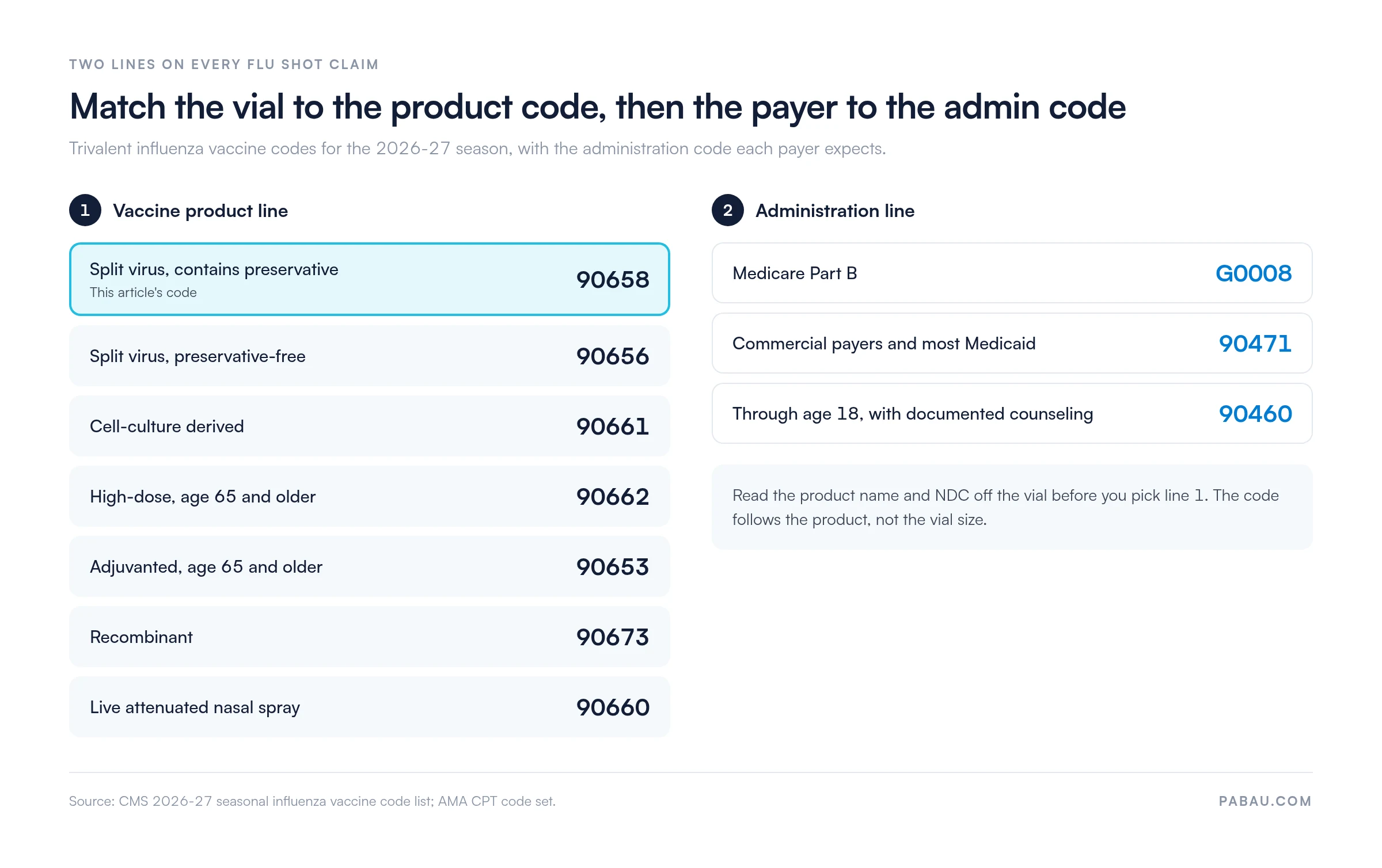
CPT code 90658 covers the vaccine product only. Bill the administration on a separate line, using the code that matches the payer and the patient’s age. A claim with the product but no administration code, or with both on one line, will deny.
Using G0008 on a commercial payer claim is a common billing mistake. G0008 is a Medicare-specific HCPCS code, billed on the same CMS-1500 claim as 90658. For other payers, use 90471. Billing 90460 requires documented face-to-face counseling by a physician, nurse practitioner, or physician assistant, and billing it without that note is an audit trigger.
Before flu season starts, audit your vaccine inventory to confirm which NDC you are stocking and cross-reference it with the correct CPT code. A multi-dose Afluria Trivalent vial, which contains a preservative, maps to 90658. The preservative-free prefilled syringe of the same brand maps to 90656. Stocking both and billing both under 90658 produces repeat wrong-code denials that are hard to catch mid-season.
Medicare Part B covers the influenza vaccine, including CPT code 90658, as a preventive benefit with no cost-sharing. The patient pays no deductible, no copay, and no coinsurance when a Medicare-enrolled provider who accepts assignment gives the vaccine.
CMS sets a national payment limit for each flu vaccine every season on its vaccine pricing page. For 2026-27, the limit for 90658 is $22.281 per dose, effective August 1, 2026 through July 31, 2027. Administration pays separately. First Coast Service Options lists the 2026 national Medicare rate for G0008 at $34.62, and your MAC may adjust it by locality.
Submit influenza vaccine claims electronically through a clearinghouse to shorten turnaround time.
Every CPT 90658 claim must carry an ICD-10-CM diagnosis code that supports the vaccination encounter. A wrong or missing diagnosis code triggers a medical-necessity denial, even when the vaccine and administration codes are correct.
Z23 is the standard first-listed code for a standalone flu vaccination visit. The CDC/NCHS ICD-10-CM tool confirms it as the encounter-for-immunization code, with no extra specificity needed for routine flu shots. Comorbidities such as asthma, diabetes, or pregnancy may be listed as secondary diagnoses to support high-risk vaccination, but Z23 stays primary.
Avoid coding an active influenza diagnosis (J09-J11) alongside 90658. Active flu on a vaccination visit tells thCPT code 90658 is the American Medical Association’s procedure code for influenza virus vaccine, trivalent (IIV3), split virus, 0.5 mL dosage, for intramuscular use.e payer you vaccinated a patient who already has the disease. Some payers auto-deny claims that pair those codes with a flu vaccine code, and Z23 keeps the claim clear of that edit.
A clean 90658 claim starts with complete documentation at the time of administration, not afterward. A payer’s claim edits catch any missing data point, and the same checklist underpins every clean claim for a vaccine service.
Many practices use a vaccine administration superbill that pre-populates the NDC field from inventory. This cuts transcription errors and keeps the NDC on the claim matched to the vial used.
Set up a vaccine-specific documentation template in your EHR that includes fields for lot number, manufacturer, expiration date, NDC, administration site, and VIS date. When a nurse or medical assistant completes it during administration, the claim data is complete before the encounter closes. The billing team then has no follow-up to chase.
CPT 90658 denials follow predictable patterns. Most trace back to three root causes. The vaccine code does not match the product, the NDC is missing where the payer requires one, or the ICD-10 pairing is wrong. A systematic approach to denial management is the fastest route to recovering these claims without resubmitting from scratch.
For a fuller reference on denial codes in medical billing, the CO-4 and CO-11 combination is the clearest signal of a code-selection error. When you see both on a 90658 claim, start with the NDC and cross-reference it to the vaccine administered. Usually, the code does not match the product stocked.
An eligibility check before the flu visit prevents most CO-27 and CO-242 denials. The AAPC’s CPT coding reference lists the full 90658 descriptor and its neighboring codes for coders cross-referencing billing edits.
Wrong-code flu denials usually start with a manual step. Someone reads the vial, picks a product code from memory, and keys the administration line separately at the end of a busy day.
Pabau, the practice management platform we build, keeps vaccine stock, the treatment note, and the invoice in the same patient record. Its claims management software builds the claim from that encounter, with the 90658 product line and its administration line side by side. Claims then go out electronically through Pabau’s Claim.MD clearinghouse integration.
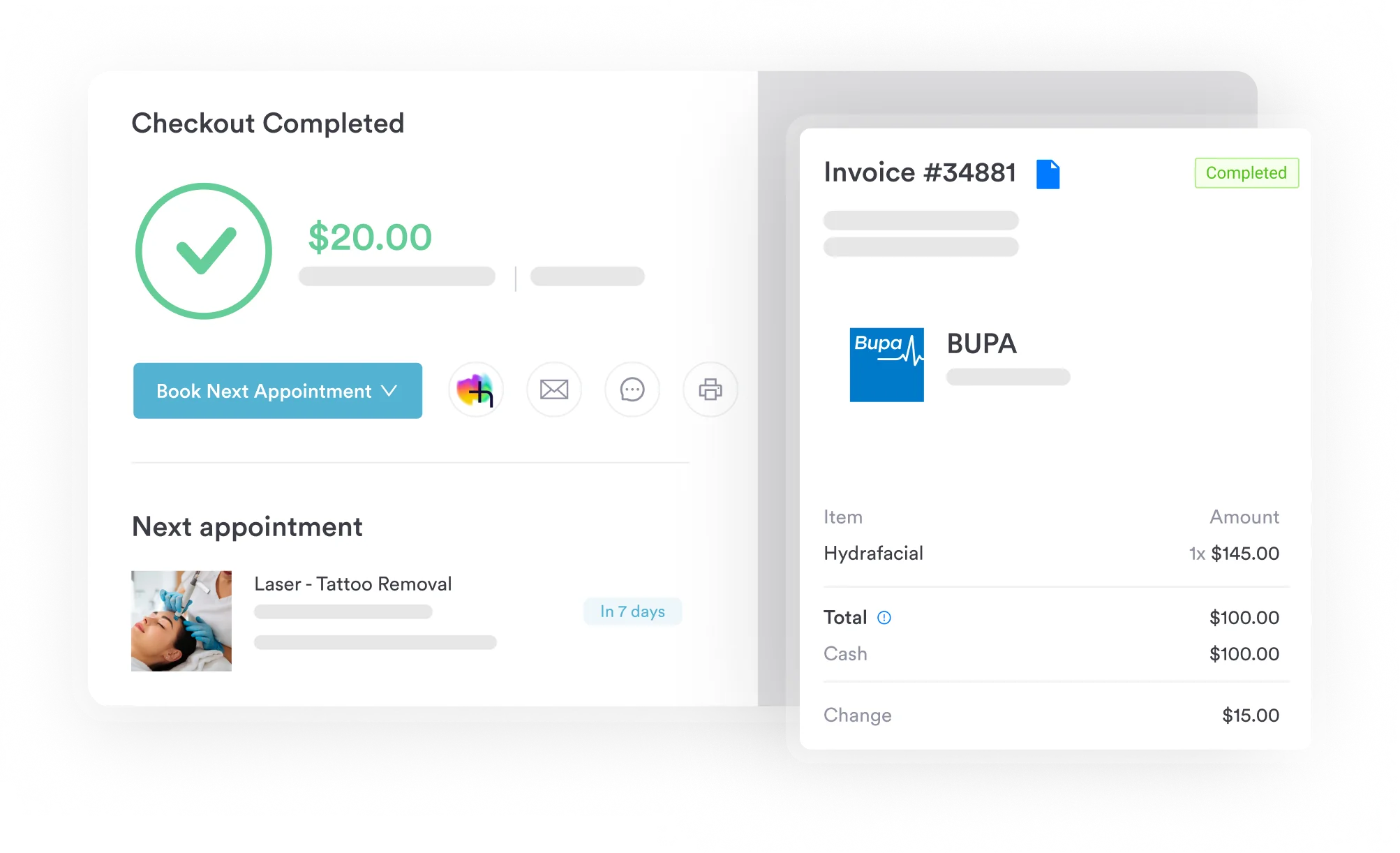
Your billing team then reviews a claim built from what was given, rather than rebuilding it from memory after a flu shot session. Fewer claims come back with CO-4, and the ones that do are faster to trace.

Pabau keeps vaccine stock, treatment notes, and claim lines in one patient record, so your 90658 claims go out matched to the product you gave.

CPT code 90658 pays cleanly when three things agree. The product code matches the vial, the administration code matches the payer, and Z23 is listed first. Settle the first one at the stock shelf, before the claim screen.
This season makes that check matter more. With US flu vaccines back to trivalent, 90658 and 90656 carry many of this season’s claims, and the preservative is the trait that separates them. A practice that records the NDC at administration can correct a wrong code in minutes instead of working a denial.
Book a demo to see how Pabau ties each vaccine dose to the right claim lines in your practice.

Need to understand how clearinghouse submission works for vaccine claims? Medical claims clearinghouse explains how 837P electronic claim files reach payers and what happens when they don’t.
Getting CO-16 denials on NDC-related edits? Revenue cycle management fundamentals covers the end-to-end claim lifecycle from coding through payment posting.
Want to reduce manual entry errors across all vaccine billing? Medical billing fundamentals outlines the core workflow steps where automation reduces vaccine claim errors the most.
CPT code 90658 covers the trivalent, split-virus influenza vaccine given as a 0.5 mL intramuscular dose, for products that contain a preservative. It covers the vaccine product only. Administration is billed separately using G0008 (Medicare) or 90471 (commercial payers).
CPT 90658 is the trivalent split-virus flu vaccine for products that contain a preservative, such as the multi-dose Afluria Trivalent vial. CPT 90656 is the preservative-free trivalent split-virus vaccine. Both describe a 0.5 mL intramuscular dose. Confirm the product name and NDC before you code, because billing 90658 for a preservative-free product invites a CO-4 denial.
Yes. Medicare Part B covers CPT code 90658 as a preventive benefit with no deductible, copay, or coinsurance. The provider must be enrolled in Medicare and accept assignment. Bill G0008 on a separate line for the administration. Include the NDC only if your payer or MAC requires it.
Yes, but only on Medicare Part B claims. G0008 is a Medicare-specific HCPCS code for influenza vaccine administration. Bill 90658 on one claim line and G0008 on a separate line. For commercial payers, replace G0008 with CPT 90471, since G0008 on a commercial claim draws a CO-4 denial.
Z23 (Encounter for immunization) is the primary ICD-10-CM code for routine influenza vaccination visits. Use it as the first-listed diagnosis on every standalone flu shot claim. If the vaccine is given during a preventive wellness visit, Z00.00 or Z00.01 may be the primary code, depending on whether abnormal findings were addressed.
The most common reason is a wrong vaccine code, such as 90658 billed when the product given was 90656 or 90686. Other causes include a missing NDC where the payer requires one and G0008 sent to a commercial payer. An active flu diagnosis coded with the vaccine also triggers denials. An eligibility lapse on the date of service also denies the claim. Each of these needs a corrected claim rather than an appeal.
For the 2026-27 season, the CMS Medicare payment limit for CPT code 90658 is $22.281 per dose, effective August 1, 2026 through July 31, 2027. Administration is billed separately with G0008, which has a 2026 national Medicare payment rate of $34.62. Commercial payer rates vary, so check your contract.
For patients 65 and older who qualify for an enhanced vaccine, use CPT 90662 (trivalent high-dose split-virus) or CPT 90653 (trivalent adjuvanted). Both are preservative-free and indicated for the 65+ age group. CPT 90658 is not appropriate for high-dose formulations, whatever the patient’s age.