



HCPCS code E0198: Water pressure pad billing guide
HCPCS code E0198 is a water pad for a standard mattress HCPCS code E0198 is the ...

Last Updated: Oct 13, 2026
CPT Code 90620 is the billing code for the meningococcal group B vaccine given on a 2-dose intramuscular schedule. The product billed under it is Bexsero, from GlaxoSmithKline.
The code pays for the vaccine product only. Pair every dose with an administration code. Use 90471 for a patient aged 19 or older, or 90460 when a patient under 19 receives counseling. According to the American Medical Association’s CPT code set overview, vaccine product codes never include the administration service.
Medicare covers this vaccine under Part D rather than Part B, and Medicaid covers most children through the Vaccines for Children program. This guide covers the official descriptor, clinical indications, administration code pairing, 90620 against 90621, modifiers, 2026 reimbursement, payer coverage, and a billing checklist.

CPT Code 90620 covers the Bexsero MenB vaccine on a 2-dose intramuscular schedule, separate from Trumenba, which bills as 90621.
Every 90620 claim needs an administration code, usually 90471 for the first vaccine and 90472 for each additional one.
Medicare covers MenB under Part D rather than Part B, with no beneficiary copay since 2023.
Medicaid coverage varies by state, and VFC-eligible children get the vaccine free with only the administration billed.
Practice management software like Pabau links the vaccine record to the claim, so 90620 and its administration code travel together.
CPT Code 90620 sits in the Vaccines, Toxoids section of the CPT code set. It covers the meningococcal group B (MenB) vaccine given on a 2-dose intramuscular schedule. The brand billed under this code is Bexsero, made by GlaxoSmithKline. The code does not cover the administration service, which is reported separately.
The Advisory Committee on Immunization Practices (ACIP) recommends MenB vaccination for adolescents and young adults aged 16 to 23, under shared clinical decision-making. It also recommends the vaccine for anyone aged 10 or older at increased risk from asplenia, complement deficiency, or a community outbreak. The 2-dose schedule under 90620 spaces doses at least one month apart.
Tracking dose 1 against dose 2 in the patient record keeps the series on schedule. A second-dose claim submitted before the minimum interval has elapsed will be denied.
The official AMA CPT descriptor reads: Meningococcal recombinant protein and outer membrane vesicle vaccine, serogroup B, 2 dose schedule, for intramuscular use. This wording appears in the Vaccines, Toxoids category of the CPT code set. It applies to dates of service under the current annual CPT update.
Key elements of the descriptor that matter for billing accuracy are the “2 dose schedule” qualifier and the “intramuscular use” route. Billing this code for a subcutaneous injection, or for a single-dose administration outside the approved schedule, creates a mismatch that payers flag during claim adjudication.
Use CPT Code 90620 when administering Bexsero to a patient on the 2-dose MenB schedule. The code applies to each dose in the series, not to the full course. A practice billing dose 1 and dose 2 reports 90620 twice, on two claims.
ACIP-defined eligible populations include adolescents aged 16 to 23 years on a shared decision-making basis, plus high-risk patients aged 10 and older. Document the specific clinical indication in the patient record to support medical necessity. Commercial payers review MenB claims more closely than routine childhood vaccines.
CPT Code 90620 covers the vaccine product only. Payers require a separate administration code on every claim. Submitting 90620 on its own produces an automatic denial, because the claim is incomplete under CPT billing rules. The AAPC CPT code lookup guidelines set out the same requirement.
The correct administration code depends on the patient’s age and whether counseling is provided:
A patient may receive 90620 alongside another vaccine at the same visit, such as Tdap. Report 90471 for the first vaccine and 90472 for the second. The order in which the vaccines are given does not decide which code takes the primary position.
The same pairing applies when the second vaccine is a pediatric hepatitis A dose, reported with product code 90633. Each vaccine product on the claim still carries its own administration code.
Verify the patient’s age at the time of administration before selecting between 90460 and 90471. A patient who turns 19 during the MenB series shifts administration code categories between doses. Submitting 90460 for a 19-year-old generates an age-mismatch denial.
The most common coding confusion on MenB claims is selecting the wrong brand code. CPT 90620 covers Bexsero only. CPT 90621 covers Trumenba, from Pfizer. Both vaccines target meningococcal group B, but they use different antigen formulations and dosing schedules, which is why the AMA assigned separate codes.
Practices sometimes receive a vial of Bexsero and a vial of Trumenba in the same shipment and mistakenly use 90621 for a Bexsero dose. Reconciling the vaccine lot number against the CPT code at the point of documentation prevents this error before the claim is generated.
Vaccine product codes carry a modifier 51 exemption. Do not append modifier 51 to 90620 when billing several vaccines at one encounter. A payer that sees modifier 51 on a vaccine product code may apply a multiple-procedure reduction in error.
A 90620 claim carries two payment lines. One pays for the vaccine product, the other for the administration service, and each is adjudicated separately on the remittance. The two lines are priced from different sources, which is where most rate research goes wrong.
Vaccine product codes are not RVU-priced, so 90620 has no relative value units to look up. CMS publishes vaccine product payment limits in a separate pricing file built from average wholesale and average sales price data. Commercial and Medicaid rates for the product come from the plan’s own fee schedule instead.
The CMS Physician Fee Schedule lookup tool prices the administration code, not the vaccine. Search 90471 there and apply your locality code for the administration half of the claim. National averages understate rates in high-cost urban areas and overstate them in rural localities.
Practice management software like Pabau submits 90620 claims electronically through a US clearinghouse that reaches more than 4,000 payers. Real-time eligibility checks confirm the patient’s insurance benefits and plan coverage before the visit. They do not assess clinical risk, so the clinician still decides whether the patient meets the ACIP criteria.
Under Medicare, the meningococcal B vaccine falls to Part D rather than the Part B benefit. Part B pays for four vaccines only, namely influenza, pneumococcal, COVID-19, and hepatitis B for at-risk beneficiaries. MenB sits alongside Tdap and shingles on the Part D side of the benefit.
Influenza sits on the Part B side of that split, where the quadrivalent preservative-free dose is billed as 90686. Tetanus and diphtheria turn on the indication instead. Part B pays for a Td dose given as wound prophylaxis, billed as 90714, though a routine booster generally is not covered.
Under the Inflation Reduction Act, ACIP-recommended adult vaccines on Part D have carried no beneficiary cost sharing since January 1, 2023. A Medicare patient pays nothing for a Bexsero dose once their Part D plan processes the claim.
The practical catch is that Part D is a pharmacy benefit. A medical practice cannot bill 90620 to Part B, and cannot send it to the MAC on a standard CMS-1500. Most practices either route the claim through a pharmacy-benefit billing vendor or send the patient to a pharmacy for the dose.
Checking coverage before the vial is drawn up is the clearest way to avoid a post-service denial. Confirm which plan will actually receive the claim, rather than the patient’s Medicare enrollment status alone.
Medicaid coverage for MenB varies by state. Most states cover the vaccine for VFC-eligible children and adolescents through the Vaccines for Children program. The state supplies the dose at no cost, and the practice bills only the administration code with modifier SL. For adults outside VFC, state Medicaid coverage is inconsistent, so verify with the program before administering.
A structured checklist for each 90620 claim lowers the denial rate. The item practices most often leave out is the vaccine lot number and expiration date. Many commercial payers and state Medicaid programs require both as proof of product authenticity.
Vaccine-only encounters also need a diagnosis code, and Z23 is the one payers expect on the claim line. Attach it as the primary diagnosis when the visit exists solely to give the dose.
A finished 90620 claim carries two code lines, one diagnosis, and the product detail that proves what was given.
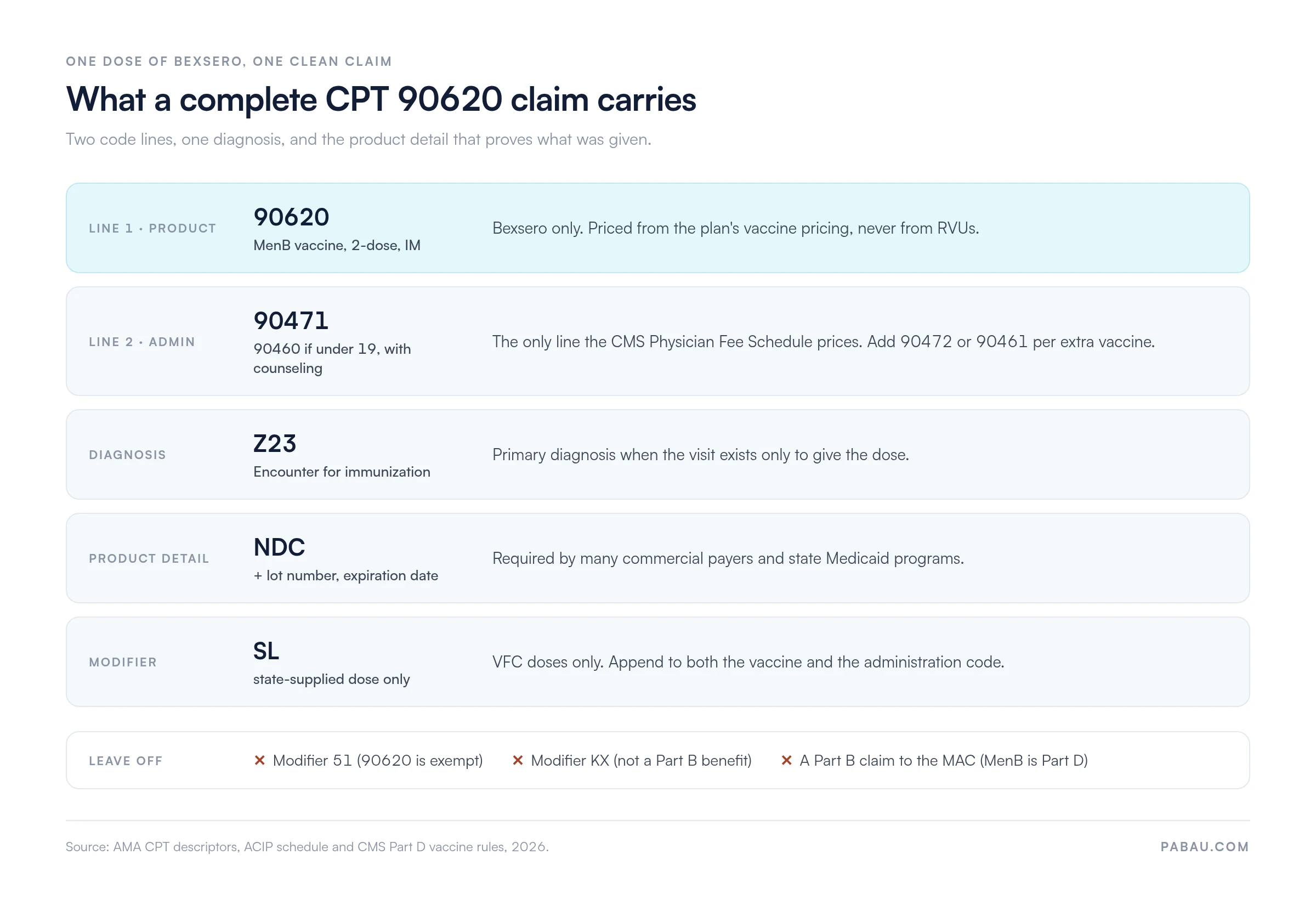
Run a monthly audit of 90620 claims rejected in the prior 30 days. Filter by denial code to see whether failures cluster around missing administration codes, age eligibility mismatches, or absent NDC numbers. Fixing the largest cluster first clears more claims than reworking them one at a time.
MenB vaccine claims have a distinct denial pattern compared to routine childhood vaccines, because payer medical necessity criteria are stricter. Understanding where claims fail is the most direct route to a better first-pass acceptance rate. Reading the common denial codes alongside this list shows which CARC value each error produces.
Pabau’s connected claims management software links the clinical record to the claim, so the vaccine code and its administration code leave the practice together. Billing staff confirm the CPT code, check that 90471 or 90460 is attached, and send the claim from the same screen.
Series tracking in the patient record flags anyone overdue for dose 2 of the Bexsero course. The recall goes out before the interval lapses, so the second claim carries a date of service the payer accepts.
A single vaccine dose is worth too little to justify a 30-day denial cycle. Getting the pair right on the first submission is what protects the margin on preventive visits.

Pabau connects clinical documentation with claim submission, so your team can select CPT 90620, pair the correct administration code, and submit claims without switching platforms. See how it works.

Two decisions carry almost all the denial risk on a MenB claim. Choose the code that matches the vial in your hand, then attach the administration code that matches the patient’s age.
The Part D routing is the part that catches practices out. A Medicare patient’s dose is covered and free to them, but the claim does not go where a Part B claim goes. Settle that route before you stock Bexsero for an older population.
Build both checks into the encounter rather than the billing queue, and the rework disappears. Book a demo to see how Pabau pairs 90620 with its administration code before the claim leaves your practice.

Need a structured approach to clean claims? Clean claim requirements in medical billing covers the documentation and code accuracy standards that prevent automatic rejections on vaccine and other preventive care claims.
Submitting claims electronically across multiple payers? 837 file format in medical billing explains how electronic claim transactions work and what billing teams need to prepare for EDI submission.
Tracking remittances after claim submission? Electronic remittance advice (ERA) in medical billing breaks down how to read ERA files and reconcile vaccine claim payments against expected reimbursement.
CPT Code 90620 is used to report the Bexsero meningococcal group B vaccine, 2-dose schedule, administered intramuscularly. It applies to each individual dose in the series. Pair it with a separate administration code, using 90471 for adults or 90460 for pediatric patients with counseling.
Use CPT 90471 for the first vaccine given to a patient aged 19 or older. Add 90472 for each additional vaccine at the same encounter. For patients under 19 where counseling is provided, use 90460 as the primary administration code and 90461 for additional antigens.
Yes, but under Medicare Part D rather than Part B. Part B covers only influenza, pneumococcal, COVID-19, and hepatitis B for at-risk beneficiaries. Since January 2023, ACIP-recommended Part D vaccines carry no beneficiary copay, so a Medicare patient pays nothing for Bexsero.
Modifier SL applies when the vaccine is state-supplied through the Vaccines for Children (VFC) program. Modifier 59 may apply when billing 90620 alongside another vaccine to indicate a distinct service. CPT 90620 is modifier 51 exempt, so never append modifier 51 when billing multiple vaccines at the same encounter.
Part D is a pharmacy benefit, so the claim does not go to the Part B MAC on a CMS-1500. Practices either submit through a pharmacy-benefit billing vendor that connects to Part D plans, or refer the patient to a pharmacy for the dose.



