Pabau Engage inbox

Pabau Engage is here: every patient conversation in one inbox.

Learn more
Book a demo Book a demo
☰
CPT Code

CPT code 89337 – Mature oocyte cryopreservation


Code Definition

89337 is the CPT code for cryopreservation, mature oocyte(s), the lab service that freezes a patient's mature eggs after retrieval. It is reported once per freezing session, whatever the number of eggs frozen.

The egg count stays in the embryology record, not the units field. Most denials come from the wrong stage code, missing prior authorization or indication notes, or storage billed under the wrong code.

Section
80047-89398 Pathology and laboratory
Subsection
89250-89398 Reproductive medicine procedures
Unit of service
One per freezing session, whatever the egg count
Billable
No
Code also known as
egg freezing, oocyte vitrification, elective egg freezing, fertility preservation, oncofertility
Save time. Improve accuracy. Get paid faster.
Automate coding with Pabau

Let Pabau's smart automation suggest the right codes, reduce claim denials, and keep your practice compliant—effortlessly.

  • AI-powered code suggestions
  • Real-time compliance checks
  • Faster claims, fewer denials
Why practices choose Pabau
Save hours every week

Automate repetitive tasks and focus on what matters most—your patients.

Improve accuracy

Reduce coding errors and ensure compliance with the latest regulations.

Get paid faster

Clean claims, fewer denials, and faster reimbursements.

Grow with confidence

Powerful insights and reporting to help your practice thrive.

HIPAA compliant SOC 2 certified GDPR-compliant Trusted by 4,000+ clinics worldwide

Key takeaways

Key takeaways

CPT code 89337 is reported once per freezing session, with one unit, however many mature eggs the lab vitrifies.

Stage decides the code: 89337 for unfertilized mature eggs, 89258 for embryos and 89346 for each year of oocyte storage.

Pair the claim with Z31.84, the fertility preservation procedure code, and list the malignancy first on an oncofertility claim.

Most 89337 denials trace back to the wrong stage code, missing prior authorization or indication notes, or storage billed in the wrong place.

Pabau, a practice management platform, sends claims through Claim.MD validation, which helps catch unit-count errors before submission.

CPT code 89337 is billed once per freezing session

CPT code 89337 reports cryopreservation of mature oocytes, and it goes on the claim once per freezing session.

UnitedHealthcare’s infertility and fertility preservation policy lists it as “Cryopreservation, mature oocyte(s)” and ties its preservation benefit to diagnosis code Z31.84. The “(s)” in that descriptor matters, because one service covers one egg or twenty.

So a cycle that freezes eight mature eggs is still 89337 with one unit. The egg count belongs in the embryology report, where it backs up the claim if a payer asks.

FieldDetail
CPT code89337
Official descriptorCryopreservation, mature oocyte(s)
Code rangePathology and Laboratory, Reproductive Medicine Procedures (89250-89398)
Unit of serviceOne unit per freezing session (date of service), whatever the egg count
Companion codes58970 retrieval, 89258 embryos, 89346 storage, 89356 thaw, 58974 transfer
Diagnosis codeZ31.84, Encounter for fertility preservation procedure
Code setMaintained by the AMA in the CPT code set

Billing full IVF cycles too? Our guide to IVF procedure codes sets out the retrieval, culture and transfer codes around 89337.

What 89337 covers, step by step

89337 covers the lab work of freezing mature eggs for later use. Vitrification is the standard method, a rapid-cooling technique that limits damaging ice crystals. The American Society for Reproductive Medicine (ASRM) dropped the experimental label for oocyte cryopreservation in 2012.

  • Maturity check: The embryologist confirms each egg is mature (metaphase II, or MII) before freezing. Immature eggs fall outside 89337.
  • Vitrification: Mature eggs go into cryoprotectant solution and are flash-cooled in liquid nitrogen at -196°C.
  • Loading for storage: The vitrified eggs are loaded into labeled storage devices. Ongoing storage is a separate service, reported with 89346 each year.

For billing, maturity decides whether 89337 applies, not how many units go on the line. Ten eggs retrieved and seven frozen is still one unit, and the lab report records the seven.

What 89337 leaves to other codes

Several neighboring services get pulled under 89337 by mistake. Each has its own code, or no dedicated code at all.

  • Embryo freezing: Fertilized embryos are reported with 89258, Cryopreservation; embryo(s). Using 89337 for embryos is a stage error.
  • Sperm freezing: Report 89259, Cryopreservation; sperm. 89260 is a different service, a simple sperm wash prep, and neither code splits by vial count.
  • Immature eggs and ovarian tissue: Neither belongs under 89337. Ovarian tissue freezing goes to unlisted code 89398, and immature egg freezing has no code of its own, so check the payer’s instructions.
  • Thawing: Warming frozen eggs later is 89356, Thawing of cryopreserved; oocytes, each aliquot. It is billed when the thaw happens.
  • Storage: Annual storage is 89346, Storage (per year); oocyte(s), with one unit per year. Our guide to CPT code 89346 covers storage renewals.

Stage picks the code: 89337 vs its neighbors

These are the codes most often confused with 89337. In each case, what the lab froze, and when, settles the choice.

CPT codeDescriptorHow it differs from 89337Unit
89337Cryopreservation, mature oocyte(s)Mature (MII) eggs, frozen before fertilizationOne per session
89258Cryopreservation; embryo(s)Embryos, frozen after fertilizationOne per session
89346Storage (per year); oocyte(s)Keeps frozen eggs stored; not the freeze itselfOne per year
89356Thawing of cryopreserved; oocytes, each aliquotWarms stored eggs for later useEach aliquot
58970Follicle puncture for oocyte retrieval, any methodThe clinical retrieval before the freezePer procedure
58974Embryo transfer, intrauterineA later transfer, after thaw and fertilizationPer transfer

The embryology report is the deciding document. It shows whether eggs or embryos went into storage, and the code follows that record.

How an 89337 claim moves from retrieval to payment

An 89337 claim starts weeks before the freeze. Teams that build it alongside the cycle catch most problems before the payer does.

  1. Confirm the indication. Record whether the freeze is medically indicated, such as before chemotherapy, or elective. The indication drives coverage and the diagnosis codes.
  2. Check the patient’s plan. Look at the specific plan, not the payer’s general policy. Note any state mandate, ERISA status and prior authorization rule.
  3. Get prior authorization if the plan requires it. Send the physician’s notes and, for oncofertility, the oncology referral. Most plans that require it want it before retrieval.
  4. Bill the retrieval and the freeze. Report 58970 for the retrieval and 89337 once for the freezing session, with 1 in the units field.
  5. Keep the egg count in the lab record. The embryology report lists eggs retrieved, eggs confirmed mature and eggs vitrified. The count supports the claim but does not set the units.
  6. Link Z31.84 in the diagnosis pointer. For oncofertility, list the malignancy code first and Z31.84 after it, unless the payer’s policy says otherwise.
  7. Submit through a clearinghouse. Pre-submission checks flag a unit count above one, a missing authorization number or a stage mismatch before adjudication.
  8. Start storage billing. Set up 89346 so the first year of storage goes out under its own code.

A worked example: One cycle, eight eggs, one unit

Take an illustrative patient with breast cancer who freezes eggs before chemotherapy. The retrieval yields 11 eggs. The lab confirms eight as mature and vitrifies all eight that day.

The claim carries 58970 for the retrieval and 89337 with one unit for the freeze. The diagnosis pointers list the C50 breast cancer code first, then Z31.84. The embryology report records 11 retrieved, eight mature and eight frozen.

Storage then runs under 89346, one unit for the year. If the patient later freezes eggs from a second retrieval, that new session gets its own 89337 line.

Laid out stage by stage, the same cycle shows where each code and unit lands.
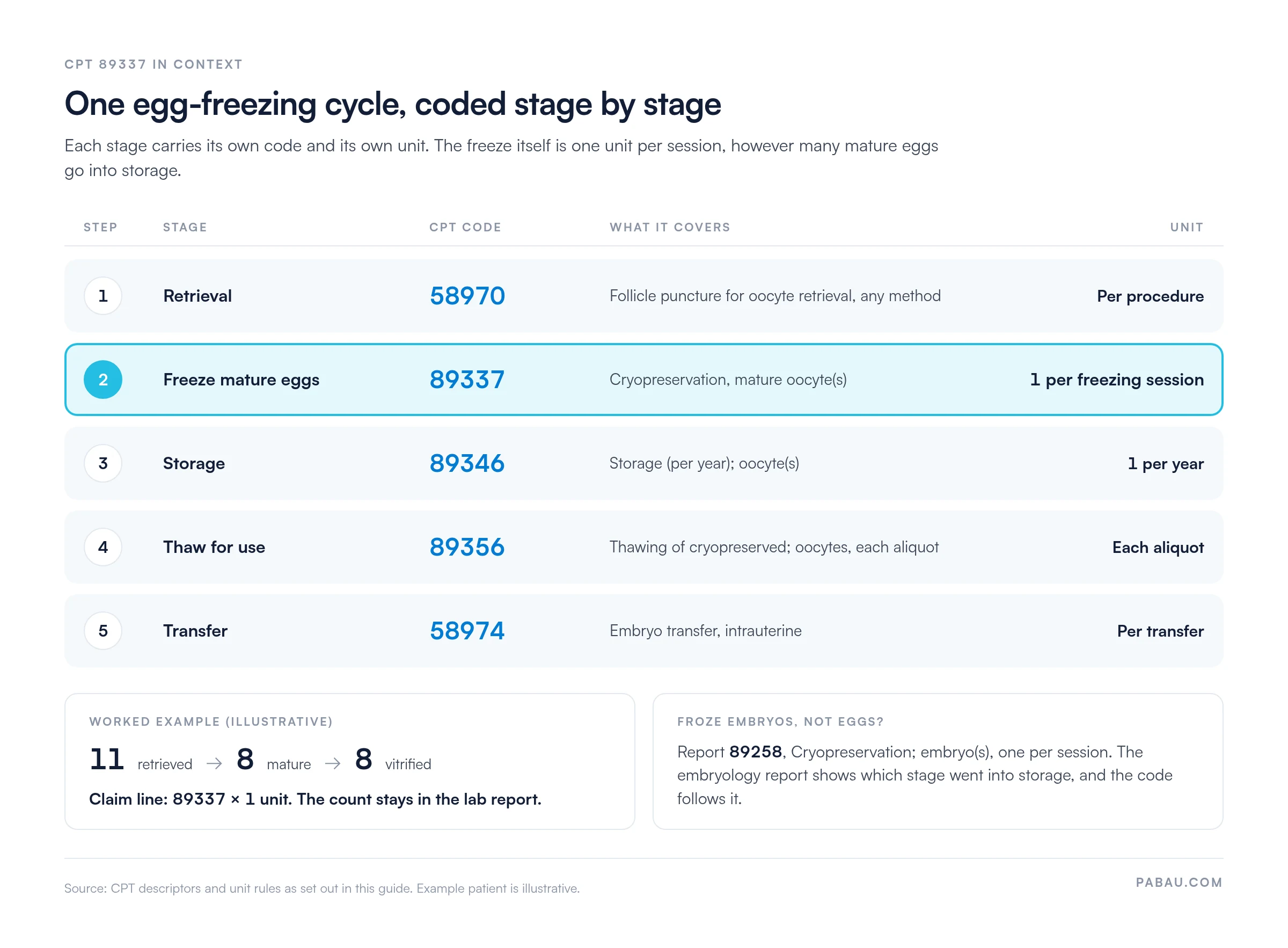
Five-stage table of codes for one egg-freezing cycle
Only the freeze stage depends on egg maturity, and it still bills one unit however many eggs go in. Descriptors and unit rules are those set out in this guide.

Pair 89337 with Z31.84, not a counseling code

The diagnosis code tells the payer why the eggs were frozen. Z31.84 describes the preservation procedure itself, and some payers need it to apply a fertility preservation benefit.

ICD-10-CM codeDescriptionUse when
Z31.84Encounter for fertility preservation procedureEvery 89337 preservation claim, as the encounter code
C00-C96 malignancy codesPrimary malignancy (for example, C50.- for breast cancer)Oncofertility claims, listed first, with Z31.84 after it
E28.39Other primary ovarian failureFreezing prompted by premature ovarian insufficiency, alongside Z31.84
Z31.62Encounter for fertility preservation counselingCounseling visits only, never the freezing procedure

Check each code against the current year in the CDC/NCHS ICD-10-CM browser tool. The code set updates every October 1. Our library of ICD-10-CM codes covers each diagnosis that can sit beside 89337.

Pro Tip

On an oncofertility claim, list the malignancy code first and Z31.84 second, unless the payer’s policy sets another order. Keep Z31.62 and Z31.61 off the freezing claim. Z31.62 covers counseling visits, and Z31.61 covers natural family planning advice.

Coverage depends on the plan, not the code

Few 89337 claims go to Medicare, because most patients freezing eggs are under 65. Commercial plans carry most of the volume, and three factors decide coverage.

  • State mandates: A growing number of states require fully insured plans to cover fertility preservation when treatment such as chemotherapy threatens fertility. Some laws reach elective freezing too, so read the state’s text.
  • Self-funded plans: Employer self-funded plans fall under federal ERISA law, not state mandates. A patient in a mandate state can still get a denial.
  • Prior authorization: Many commercial plans require it before the cycle starts. A missing authorization is one of the most common reasons 89337 claims fail.

What sets the rate for 89337

No single national rate applies to 89337. Payment comes from the payer contract, or from the practice’s self-pay fee schedule for elective freezing.

Use the CMS Physician Fee Schedule lookup tool to check the code’s Medicare status before billing Medicare. For contract benchmarking, the FastRVU 2026 RVU lookup shows RVU components where CMS publishes them.

Payer typeCoverage statusRate guidance
MedicareRarely billedCheck the code’s status in the Physician Fee Schedule lookup first
Commercial, fully insured, mandate stateOften covered under state lawContracted rate, one unit per freezing session
Commercial, ERISA self-fundedDepends on plan designRead the Summary Plan Description, since state mandates do not apply
Elective self-payNot billed to insurancePractice fee schedule, with freezing and annual storage quoted separately

Before you submit: A six-point check

Run these checks on every 89337 line before it leaves the practice. Each one maps to a common denial, and together they make a clean claim far more likely.

  • Stage confirmed: The lab report shows mature eggs, not embryos, so 89337 and not 89258 is on the line.
  • Units set to one: One freezing session gets one unit. A second session on a new date gets its own line.
  • Authorization on file: The prior authorization number is on the claim if the plan requires one.
  • Indication documented: The physician’s notes state the indication and match the diagnosis codes.
  • Z31.84 linked: The diagnosis pointer links Z31.84, with the malignancy first on oncofertility claims.
  • Storage kept separate: Storage goes on 89346, never folded into the 89337 charge.

The denials that trip 89337 claims, and how to fix them

Most 89337 denials come down to the wrong stage code, missing authorization or indication notes, or storage billed in the wrong place. Our guide to denial management covers the appeal workflow. The table covers the 89337 specifics.

Denial reasonRoot causeCorrective action
Wrong stage code89258 billed for eggs, or 89337 billed for embryosCheck the lab report for the stage, correct the code and resubmit
Missing prior authorizationNo authorization in place before retrievalAppeal with notes showing urgency for oncofertility, or bill the patient where the plan allows
Medical necessity not establishedIndication undocumented, or Z31.62 or Z31.61 used in place of Z31.84Resubmit with Z31.84, the malignancy code where it applies, and the physician’s notes
Storage billed wrongStorage folded into 89337, or 89346 billed per eggBill storage on 89346, one unit per year
Units above oneEgg count typed into the units fieldCorrect to one unit and keep the count in the lab record
Non-covered servicePlan exclusion or self-funded plan designBill the patient under the self-pay fee schedule, with a financial agreement signed before treatment

Pro Tip

Once a quarter, pull every 89337 line with more than one unit on a single date of service. Each one usually means someone typed the egg count into the units field. Correct the claim, then trace where the count entered the billing step.

Modifiers for 89337: Quick answers

  • Does 89337 need modifier 50? No. Bilateral modifier 50 does not apply, because one unit covers the whole freezing session, whichever ovary the eggs came from.
  • What about LT or RT? No. Egg freezing is a lab service with no laterality.
  • When does modifier 59 apply? Only when a payer edit wrongly pairs 89337 with a distinct service on the same date. Document why the services are separate, and check whether the payer prefers an X modifier such as XU.
  • What is modifier 90 for? It marks a service performed by an outside reference lab and billed by the practice. Use it only where the payer accepts that arrangement.

NCCI edits update every quarter. Check the current edits and the AAPC CPT code reference before pairing 89337 with another reproductive code on one date. Your medical claims clearinghouse reports will also flag NCCI conflicts.

How Pabau helps 89337 claims go out clean

Fertility practices often build the 89337 claim by hand, days after the freeze. Someone copies codes from the lab sheet, and the egg count can land in the units field.

Pabau keeps the appointment, clinical notes and billing on one patient record. Its claims management sends each claim through Claim.MD, which validates it before submission.

Those checks help catch unit-count errors, missing authorization numbers and diagnosis mismatches before the payer sees them. Your team spends less time on resubmissions and more on the next cycle.
Pabau claims management screen validating a claim before submission
Pabau’s claims tools check each 89337 claim before it is sent, so a wrong unit count gets caught before the payer sees it.

Send cleaner oocyte cryopreservation claims

Pabau claims management and Claim.MD validation help catch unit-count and coding errors on 89337 claims before submission. That means fewer resubmissions and faster payment for your practice.

Pabau fertility practice management software

Conclusion

Treat 89337 as a session code. The units field says one, and the embryology report holds the egg count. Most clean 89337 claims follow from that single habit.

The denials that remain are about stage, paperwork and storage. Confirm eggs versus embryos, get authorization before retrieval, link Z31.84 and start 89346 for the first storage year.

Book a demo to see how Pabau’s claims management and Claim.MD validation help your practice catch 89337 errors before submission.

Continue your research

Continue your research

Freezing embryos rather than eggs? CPT code 89258 covers embryo cryopreservation, the stage code most often swapped with 89337.

Billing the storage year after the freeze? CPT code 89346 explains annual oocyte storage billing and renewals.

Need a broader IVF billing reference? IVF procedure codes covers the full set of ART billing codes used alongside 89337 in a retrieval cycle.

Quoting elective egg freezing to self-pay patients? Good faith estimate form helps you set out the expected charges before treatment starts.

Want to reduce claim rejections across the practice? Medical billing compliance covers the documentation and claim hygiene standards that prevent denials.

Frequently asked questions

Can 89337 be billed twice in one IVF cycle?

Yes, if eggs are frozen on two separate dates of service. Each freezing session is generally reported on its own date. Confirm with the payer first, since some plans cap preservation cycles.

What CPT code is used for egg retrieval?

Egg retrieval is CPT 58970, Follicle puncture for oocyte retrieval, any method. Ultrasound guidance for the aspiration is reported separately with 76948. Both sit on the claim alongside 89337 when the eggs are frozen.

How are frozen eggs billed when they are used later?

Thawing is billed with 89356, Thawing of cryopreserved; oocytes, each aliquot. Fertilization and transfer codes follow, such as 89280 or 89281 for ICSI and 58974 for the transfer.

Does insurance cover egg freezing before cancer treatment?

Often, in states with fertility preservation mandates, when the plan is fully insured. Self-funded employer plans can exclude it. Claims usually need Z31.84 and notes on the planned treatment.

What code did egg freezing use before 89337?

Category III code 0059T. It was deleted when 89337 took effect on January 1, 2015, so 0059T should not appear on a current claim.
Avatar photo
Monika Lazarevska
Content Writer

Monika Lazarevska writes content for owners and healthcare professionals who want clear, no-fluff content that actually helps them run their practice better. With a background in storytelling and SEO, she knows how to make even the driest topics worth reading. Off the clock, you'll find her in a café somewhere in Europe, probably with a good book and an even better coffee.
×