CPT Code 25210: Excision of a single carpal bone
CPT Code 25210: Official descriptor and quick-reference data CPT Code 25210 is a...

Last Updated: Nov 26, 2026
88365 is the CPT code for in situ hybridization (eg, FISH), per specimen; initial single probe stain procedure.
Labs use it when a pathologist reads one FISH, chromogenic ISH (CISH), or silver ISH stain qualitatively. Each further single-probe stain on the same specimen adds 88364, and a multiplex stain is 88366. The code sits in the Surgical Pathology subsection of the AMA CPT code set. Most denials trace back to probe-unit counting or missing medical necessity documentation.
Let Pabau's smart automation suggest the right codes, reduce claim denials, and keep your practice compliant—effortlessly.
Automate repetitive tasks and focus on what matters most—your patients.
Reduce coding errors and ensure compliance with the latest regulations.
Clean claims, fewer denials, and faster reimbursements.
Powerful insights and reporting to help your practice thrive.
HIPAA compliant SOC 2 certified GDPR-compliant Trusted by 4,000+ clinics worldwide

CPT code 88365 reports the first single-probe in situ hybridization (ISH) stain on a specimen, read qualitatively by a pathologist.
Each additional single-probe stain on the same specimen is reported with add-on code 88364. A multiplex probe stain is reported with 88366.
88341 and 88342 are immunohistochemistry codes, so neither one belongs on an ISH claim as a probe add-on.
When the pathologist counts signals to produce a number, such as a HER2/CEP17 ratio, a morphometric ISH code replaces 88365.
Medicare pays 88365 under the Physician Fee Schedule, with global, professional (26) and technical (TC) billing options.
CPT code 88365 is defined by the American Medical Association (AMA) as: In situ hybridization (eg, FISH), per specimen; initial single probe stain procedure.
Chapter X of the Medicare NCCI policy manual counts each single or multiplex probe stain as one unit per specimen. That is why a second probe needs its own code. 88365 sits in the 88364-88366 in situ hybridization group of the CPT code set.
ISH uses labeled nucleic acid probes to find a specific DNA or RNA sequence inside intact tissue or cells. It shows gene amplifications, rearrangements, and viral or light-chain RNA that routine staining cannot reveal. The code covers the stain and the pathologist’s qualitative read of it.
CPT 88365 covers any ISH method that applies one probe stain to one specimen. The parenthetical “(eg, FISH)” names the most common method as an example. Chromogenic ISH (CISH) and silver ISH (SISH) fall under the same descriptor.
Units rule: Report one unit of 88365 for the first single-probe stain on each specimen. Several blocks or slides from the same specimen still count as one unit. Each further single-probe stain on that specimen is one unit of 88364. NCCI also bars more than one ISH code for the same probe on the same specimen.
Documentation starts at specimen receipt and runs unbroken to the pathologist’s signed report. Each step below leaves a record that payers check when they audit 88365 claims.
Before billing 88365, check two lines in the pathology report: the probe name and the method of reading. A qualitative read supports 88365. A signal count or a calculated ratio points to a morphometric code instead.
The three codes in the 88364-88366 group describe one technique counted three ways. The deciding questions are how many probe stains ran on the specimen, and whether one stain carried several separately reportable probes. Immunohistochemistry code 88342 appears below only for contrast.
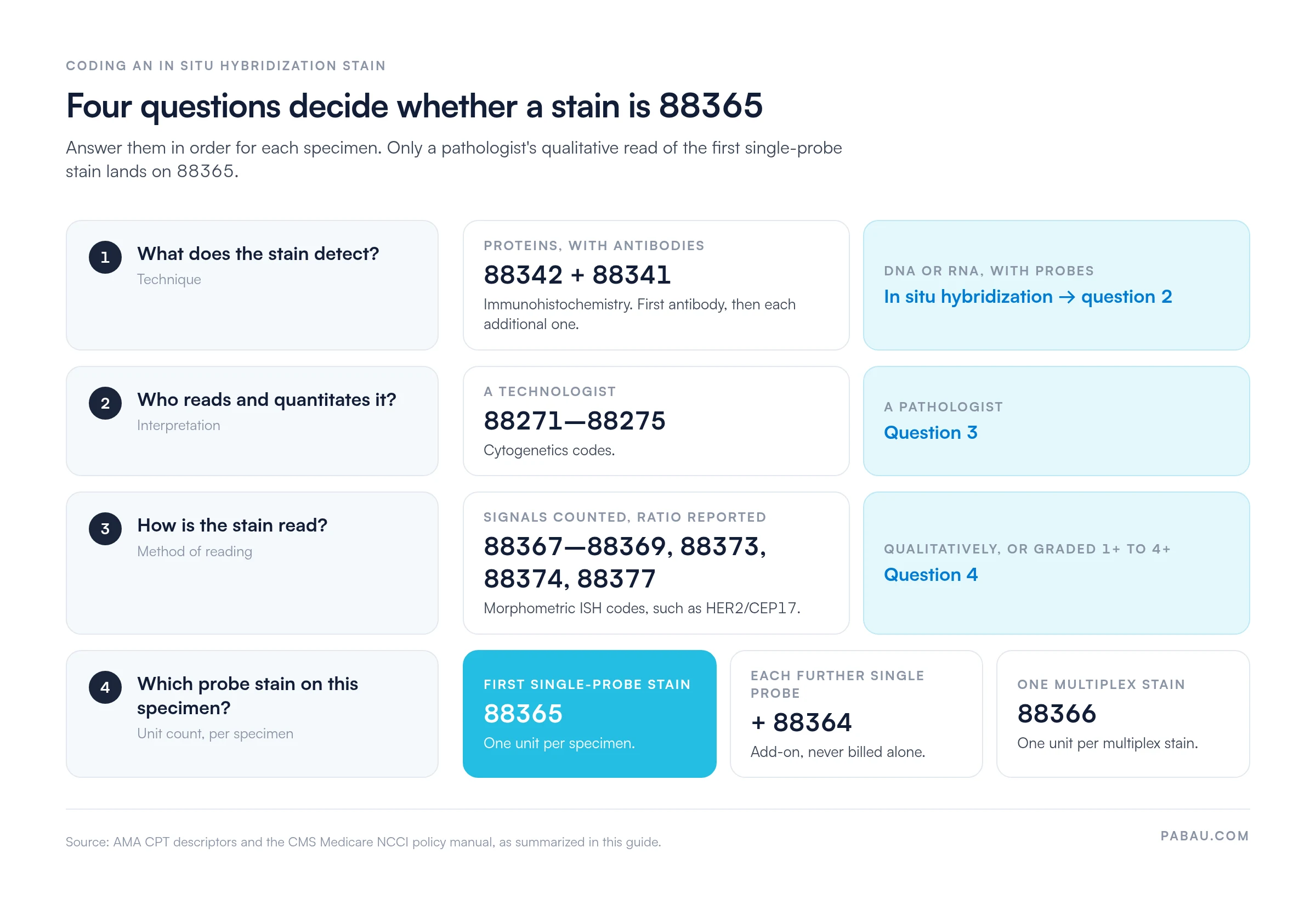
The probe count only matters once two earlier questions are settled: who read the stain, and how. The chart below runs all four checks in the order a coder meets them.
88364 is the add-on code for each additional single-probe ISH stain on the same specimen. It is never reported alone. It goes on the same claim and date of service as the 88365 for that specimen.
Kappa and lambda light-chain ISH is a common example. Say the lab runs the kappa probe and the lambda probe as two separate stains on one specimen. Report 88365 for the first and one unit of 88364 for the second. If both probes run in one multiplex stain with two separate results, report one unit of 88366 instead.
A second specimen starts its own count. Each specimen gets its own 88365 for its first single-probe stain, and 88364 only for further stains on that same specimen.
88342 and 88341 belong to immunohistochemistry (IHC), which detects proteins with antibodies. 88342 reports the first antibody stain on a specimen, and 88341 reports each additional antibody stain. Neither code can stand in for an ISH probe, and 88341 is never an add-on to 88365.
The two techniques often meet in one workup. A breast biopsy may get HER2 IHC under 88342, then reflex to HER2 ISH when the IHC score is equivocal (2+). The IHC and the ISH are then billed in their own code families.
CPT 88365 fits tests where the pathologist reads the stain qualitatively: present or absent, positive or negative, or graded 1+ to 4+. Typical examples include the following.
Many oncology FISH tests are scored differently. HER2/CEP17 testing counts signals in at least 20 tumor cells to calculate a ratio. ALK break-apart testing reports the percentage of positive nuclei. Those counts make them quantitative, so NCCI sends them to the morphometric codes rather than 88365.
Probe count still drives units under those codes. 1p/19q codeletion testing runs two probe sets, one for 1p and one for 19q, so it is two probe stain procedures. Read qualitatively, that is 88365 plus one unit of 88364. Counted manually, it is 88368 plus one unit of 88369.
Medicare pays CPT 88365 under the Medicare Physician Fee Schedule (MPFS), not the Clinical Laboratory Fee Schedule. The code carries a professional component (modifier 26) and a technical component (modifier TC). A lab that performs and interprets the test bills the global code.
Payment is built from relative value units and adjusted by the Geographic Practice Cost Index for each Medicare locality. Look up the current-year rate for your locality, by component, before you quote it to billing staff. CMS updates the schedule each January.
Medical necessity for CPT 88365 is set by Local Coverage Determinations (LCDs) and articles from Medicare Administrative Contractors (MACs). MACs work by jurisdiction, so the covered ICD-10-CM codes and clinical criteria vary from region to region.
Generally accepted indications include a malignancy workup, choosing a targeted therapy, and confirming an infection or lineage that changes the diagnosis. The ordering clinician should document the clinical question and how the result will change management.
Prior authorization: Original Medicare does not usually require prior authorization for 88365, but some Medicare Advantage plans do. Commercial requirements vary widely. Some plans exempt ISH run within a surgical pathology workup but review standalone orders. Check each payer contract before billing.
Payers audit four variables on 88365 claims: modifier selection, unit counting, place of service, and global versus component billing.
ISH claims fail more often than routine lab claims because they carry coverage rules and documentation rules at once. The claim adjustment reason codes below account for most 88365 denials.
Cross-checking the ordering diagnosis against the MAC’s coverage rules before submission prevents most CO-11 and CO-50 denials. Our CARC denial code reference explains each code’s appeal rights and filing timelines.
Run a weekly denial audit by CARC code for all 88365, 88364, and 88366 claims. A cluster of CO-97 denials usually means a qualitative code and a morphometric code went out for the same probe. One crosswalk fix can clear a backlog of pended claims.
The checklist below lists what the documentation package needs for an 88365 claim to pass payer edits on first submission.
An ISH claim is only as clean as the link between the pathology report and the claim line. The probe count, the reading method, and the specimen count all have to agree before 88365, 88364, or 88366 goes out. Most denials start where that link breaks.
Pabau, a practice management platform with billing built in, keeps the pathology record and the claim in one system. Pabau’s claims management software handles submission, eligibility checks, claim status, and remittance posting in that same place. Claims route through the Claim.MD clearinghouse, which reaches thousands of US payers.
Remittances come back against the same patient record. Reading electronic remittance advice line by line shows whether a payer paid the 88365 and quietly dropped the 88364. That is the underpayment a month-end reconciliation tends to miss.

Pabau’s claims management software submits claims through the Claim.MD clearinghouse, checks patient eligibility, tracks claim status, and posts remittances against the patient record.

Two facts in the pathology report decide every ISH claim: how many probe stains ran on each specimen, and how the pathologist read them. A qualitative read of one probe is 88365. Each further single-probe stain is 88364, and a multiplex stain is 88366. A signal count moves the service to the morphometric codes.
The IHC codes 88342 and 88341 never enter that count. Once the codes are right, the denials that remain come from the diagnosis link and the medical necessity record, so check both before submission. Book a demo to see how Pabau keeps pathology documentation and claim submission in one workflow.

Running a manual morphometric count on an IHC stain instead? CPT code 88360 covers quantitative tumor immunohistochemistry, per specimen, scored by manual count.
Billing the tissue exam that comes before the ISH stain? CPT code 88305 explains Level IV surgical pathology, the gross and microscopic exam most biopsies carry.
Is the FISH result going into a cytogenetics report? CPT code 88291 covers the cytogenetics and molecular cytogenetics interpretation and report.
No specific code fits the molecular test you ran? CPT code 81479 walks through billing an unlisted molecular pathology procedure.
CPT code 88365 reports the initial single-probe in situ hybridization (ISH) stain on one specimen, read qualitatively by a pathologist. It applies to FISH, CISH, and silver ISH. Each additional single-probe stain on the same specimen is reported with add-on code 88364.
Medicare pays 88365 under the Physician Fee Schedule, not the Clinical Laboratory Fee Schedule. The code can be billed globally, as the professional component with modifier 26, or as the technical component with modifier TC. Rates vary by locality, so check the CMS look-up tool each January.
CPT 88365 covers in situ hybridization, which uses nucleic acid probes to find DNA or RNA sequences. CPT 88342 covers immunohistochemistry, which uses antibodies to find proteins. They are different techniques, and one can never be billed in place of the other.
Usually not. HER2/CEP17 FISH is scored by counting signals in at least 20 cells and calculating a ratio. NCCI treats that count as quantitative, so it is reported with a morphometric ISH code, such as 88377 for a manual count. 88365 applies only when the stain is read qualitatively.
Yes. When several single-probe ISH stains run on one specimen, report 88365 for the first and one unit of 88364 for each additional stain. 88364 is an add-on and is never billed alone. A multiplex stain is reported with 88366 instead, and 88341 never applies to ISH.
The most common reasons are CO-11, when the diagnosis is not on the MAC’s covered list, and CO-50, when medical necessity is not shown. CO-97 follows when 88365 and a morphometric code go out for the same probe. A missing pathologist signature or prior authorization accounts for most of the rest.