HCPCS Code A4627: Spacer and valved holding chamber
HCPCS Code A4627: official descriptor and code definition HCPCS Code A4627 is th...

Last Updated: Oct 21, 2026
88271 is the CPT code for "Molecular cytogenetics; DNA probe, each (eg, FISH)." It covers the technical work of applying and scoring one DNA probe in a fluorescence in situ hybridization (FISH) study.
The code is billed per probe, so a four-probe CLL FISH panel goes on the claim as four units of 88271. The cell analysis (88272 to 88275) and the interpretation and report (88291) are billed separately.
Let Pabau's smart automation suggest the right codes, reduce claim denials, and keep your practice compliant—effortlessly.
Automate repetitive tasks and focus on what matters most—your patients.
Reduce coding errors and ensure compliance with the latest regulations.
Clean claims, fewer denials, and faster reimbursements.
Powerful insights and reporting to help your practice thrive.
HIPAA compliant SOC 2 certified GDPR-compliant Trusted by 4,000+ clinics worldwide

CPT Code 88271 is billed per DNA probe, so every probe used is one billable unit.
The code covers the technical performance of FISH only, and the interpretation is billed separately under 88291.
Codes 88272 to 88275 describe the cell analysis by cell count and are billed once per probe set, alongside 88271.
Non-covered ICD-10 diagnoses and incorrect unit counts are the two most common denial triggers for 88271 claims.
Medicare’s MDS FISH billing and coding articles, such as A57661, cover MDS diagnoses only.
CPT Code 88271 is the American Medical Association (AMA) procedure code for “Molecular cytogenetics; DNA probe, each (eg, FISH).” The key word is “each.” You bill one unit for every probe, so a panel never goes on the claim as a single unit.
The code describes the technical work of hybridizing a single labeled DNA probe to a cell preparation, then scoring the hybridization signals under fluorescence microscopy. It does not include:
This scope boundary decides the claim. Take a lab that runs a four-probe CLL FISH panel and issues a report. It bills 88271 x 4 units, one cell-analysis code, and 88291 x 1 for the interpretation. Bundling all four probes into one unit of 88271 underreports the service under CPT’s “each” rule.
The five codes 88271 through 88275 make up the molecular cytogenetics family. Picking the wrong one is a common billing error, because the codes look alike and the cell-count thresholds are easy to confuse.
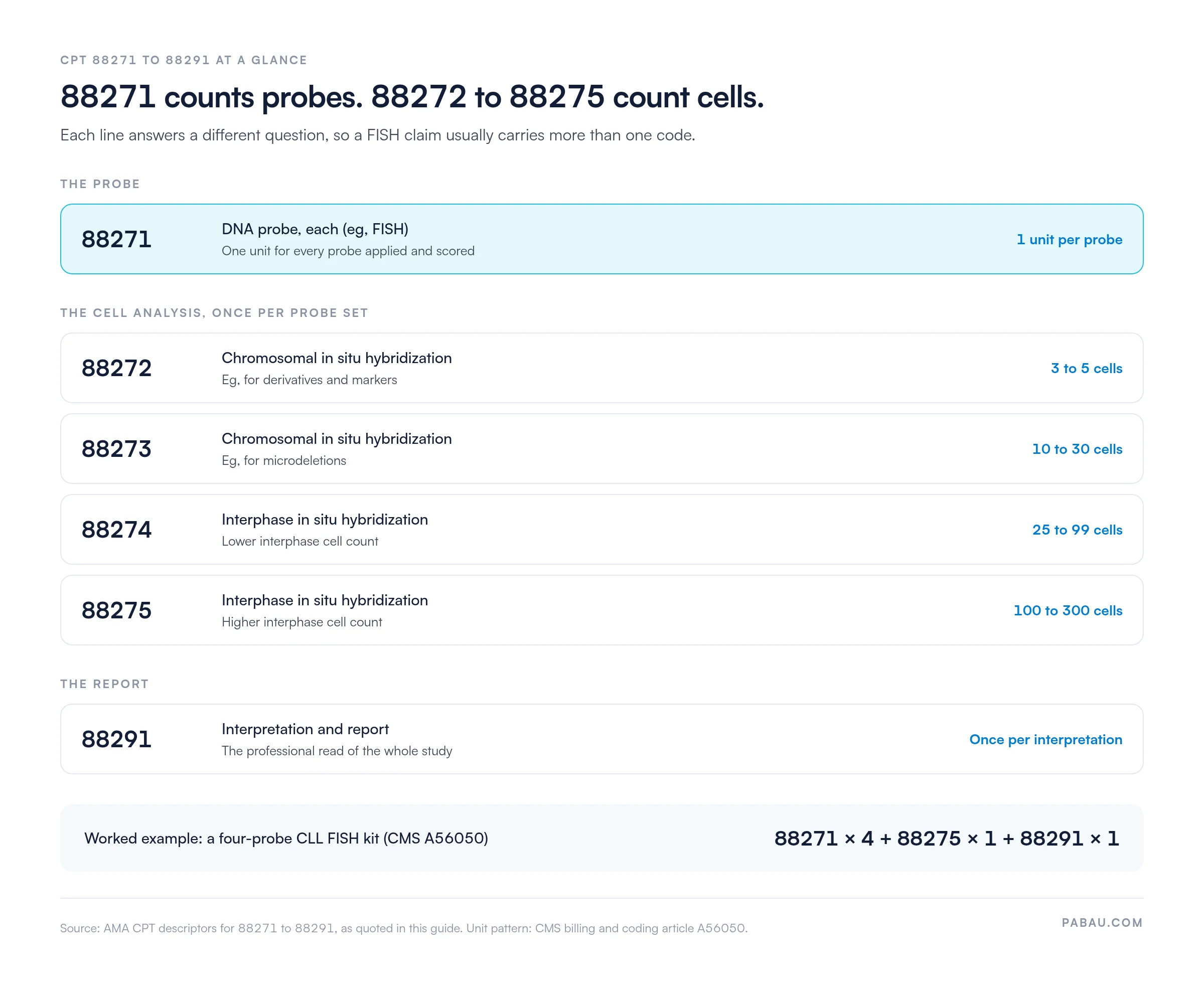
The most common confusion point: 88271 counts probes, while 88272 through 88275 count the cells analyzed. A hematology FISH panel carries 88271 for each probe, plus the analysis code that matches the documented cell count.
An interphase study that scores 25 to 99 cells points to 88274, and one that scores 100 to 300 cells points to 88275. The map below shows which question each code answers, so check the lab’s cell count documentation against it before coding.
FISH testing under 88271 is used mainly for hematologic malignancies, where the chromosomal findings guide treatment. Medicare’s MDS FISH billing and coding article A57661 lists covered diagnoses for myelodysplastic syndromes (MDS) only. For the other indications below, coverage depends on your MAC’s own policies.
Using an unsupported ICD-10-CM diagnosis code is the single most common denial trigger for 88271 claims. Before you submit, check that the ordering physician’s diagnosis maps to a covered code in the applicable coverage article. Covered lists differ by Medicare Administrative Contractor (MAC), so confirm against your MAC’s current version.
Before billing CPT Code 88271, pull the current billing and coding article from your MAC’s website instead of a saved copy. MolDX articles are revised often, and the covered diagnosis list can change between versions.
CPT Code 88271 is billed per individual DNA probe. One probe applied and scored equals one unit on the claim. A lab that runs a CLL FISH panel using four probes bills 88271 with a quantity of four in the units field. Submitting the panel as one unit underreports the probes CPT counts.
The cell-analysis code works differently. Bill 88272, 88273, 88274 or 88275 once per probe set, not once per probe. A CMS example for a four-probe CLL kit lists 88271 x 4, 88275 x 1 and 88291 x 1.
One caution for MDS claims: the Medicare MDS FISH billing and coding articles tell billers to “Enter 1 unit of service.” Ask your MAC how it wants probe units reported before you bill multiple units on an MDS FISH claim.
CPT Code 88271 is a laboratory procedure code. Place of service code 81 (independent laboratory) applies in most outpatient lab settings. Hospital-based labs use the applicable inpatient or outpatient facility POS.
The revenue code on a UB-04 is typically 0300 (Laboratory). Bill on a CMS-1500 for independent labs; use a UB-04 for hospital-based facilities.
Medicare reimburses 88271 at the clinical laboratory fee schedule rate, not the physician fee schedule. Rates are set nationally with no geographic adjustment for clinical laboratory services under Section 1833(h) of the Social Security Act. Check the figures below against the current Clinical Laboratory Fee Schedule before billing.
After payers process claims and post payments, electronic remittance advice (ERA/835) files transmit the payment and adjustment details back to the lab’s billing system. Reconciling ERAs against per-probe unit counts is the fastest way to catch payment shortfalls on 88271 claims.
Insufficient documentation is the second most common reason payers deny 88271 claims, after incorrect ICD-10 coding. The documentation package must support both medical necessity and the specific number of probes billed.
Payers conducting post-payment audits will request the original physician order, lab report, and interpretation together. If any probe billed on the claim does not appear by name in the lab report, expect a recoupment request for that unit.
Medicare does not require prior authorization for CPT Code 88271, but the service must meet all LCD medical necessity criteria at the time of billing. A claim that fails those criteria is denied, even though no authorization was needed upfront.
Commercial payers work differently. Insurance eligibility verification before ordering a FISH panel should include a check for prior authorization requirements. Some Aetna, Cigna and UnitedHealthcare policies require prior authorization for FISH panels billed under the 88271 code family.
Requirements vary by plan and by the panel ordered. Confirming authorization before the specimen is collected protects you from a denial for a test the lab has already run.
MolDX contractor jurisdictions, such as Palmetto GBA and Noridian, add their own rules for molecular tests. For FISH, the MolDX MDS FISH billing and coding articles state that a DEX Z-code identifier is not required. If you submit one anyway, it goes in the claim’s narrative field next to the CPT code.
Most 88271 denials trace back to five fixable causes, each with its own corrective action. The payer reports the cause on the remittance as a claim adjustment reason code (CARC), which our guide to medical billing denial codes decodes.
A structured denial management workflow that categorizes 88271 denials by CARC code makes recurring patterns visible. When one denial reason shows up on more than three claims in a billing period, trace it to the process step that produces it. Building a clean claim checklist specific to cytogenetic codes reduces first-pass denial rates before rework is needed.
Two current Medicare billing and coding articles shape most 88271 claims for MDS FISH. Each one applies to a different contractor jurisdiction, so your MAC decides which covered diagnosis list governs your claims.
These A-numbered articles are not LCDs themselves. Each one carries the billing and coding detail for an LCD, which has an L-number and sets the coverage rules.
For medical billing compliance, labs should maintain a coverage article tracking log updated each time a MAC publishes a revision. NCCI edits between 88271 and related cytogenetic codes are published quarterly by CMS. The AAPC’s CPT code lookup tool provides crosswalk guidance and bundling edit references for the 88271 family alongside the official CMS sources.
CPT Code 88271 covers the technical procedure only. Every FISH panel also requires an interpretation code to capture the professional work of reporting results.
NCCI (National Correct Coding Initiative) edits govern which code combinations are billable on the same date of service. Never assume two cytogenetic codes can be billed together without checking current NCCI tables. CMS publishes updated NCCI edits quarterly, and edits between the 88271 family and interpretation codes have changed in recent years.
Build a charge master entry for your most common FISH panels that pre-populates the correct 88271 unit count and 88291 pairing. A four-probe CLL panel should auto-generate 88271 x 4, one analysis code and 88291 x 1 rather than requiring manual unit entry each time.
Cytogenetic claims usually go wrong in two places. Unit counts scale with panel size, and diagnosis codes have to match your MAC’s coverage article. Pabau, the practice management platform we build, keeps the claim, the eligibility check and the remittance together in its claims management software.
Claim validation scrubs every claim for missing or invalid details before it leaves Pabau. A line missing its diagnosis code or modifier gets fixed in seconds, instead of returning weeks later as a denial.
Claim.MD, our US clearinghouse partner, runs a real-time eligibility check before the specimen is collected. Claims then go out electronically as CMS-1500s, and you can track each one’s status. Electronic remittance advice comes back into Pabau, so you can match each payment to the probe count you billed.

Pabau scrubs each claim for missing or invalid details and runs a real-time eligibility check through Claim.MD before it goes out. See how it fits your hematology or pathology billing.

The per-probe rule is where 88271 claims are won or lost. When the lab report names every probe and the claim carries one unit for each, most audit questions answer themselves.
The remaining risk is coverage. Medicare’s MDS FISH articles cover MDS diagnoses only, so check every other hematologic indication against your MAC’s policy before you bill. Commercial plans need their own prior authorization check.
If your team still counts units by hand, that’s the step to automate first. See how revenue cycle management works end to end, or book a demo to watch Pabau check and submit a cytogenetic claim.

Need to understand how clearinghouse claim validation works? Medical claims clearinghouse guide explains how electronic claims move from provider to payer and where validation errors occur.
Want to reduce coding errors before claims leave your system? Superbill documentation guide covers how to structure charge documentation to support accurate CPT and ICD-10 code selection.
CPT code 88271 covers the technical performance of a single DNA probe for in situ hybridization (FISH). It is billed per probe and does not include interpretation, cell analysis by count, chromosome analysis by karyotype, or specimen preparation.
Each individual DNA probe applied and scored equals one unit of 88271. A four-probe CLL FISH panel is billed as 88271 with a quantity of four, not as a single unit. MDS claims work differently. The Medicare MDS FISH billing articles say to enter 1 unit of service, so confirm units with your MAC first.
CPT 88271 counts each DNA probe used in a FISH study. CPT 88272 describes chromosomal in situ hybridization with 3 to 5 cells analyzed, for example for derivatives and markers. A claim can carry both, because 88271 counts probes and 88272 counts cells.
None, in most cases. Medicare pays 88271 on the Clinical Laboratory Fee Schedule, so -TC and -26 do not apply, and 88291 is professional-only. Modifier -59 applies only when an NCCI edit pairs two different codes for distinct services.
Medicare does not require prior authorization for 88271, but coverage depends on meeting the medical necessity criteria in the applicable LCD. Some Aetna, Cigna and UnitedHealthcare plans require prior authorization for FISH panels. Verify authorization requirements with each payer before the panel is ordered.
Yes. MDS is the indication covered by Medicare billing and coding article A57661 for CPT 88271. The claim needs a covered diagnosis code, such as D46.0, D46.1, D46.20 or D46.Z, plus documentation of medical necessity.