CPT code 88361: Computer-assisted IHC morphometric analysis
CPT code 88361 pays for IHC that software scores CPT code 88361 reports morphome...

Last Updated: Nov 19, 2026
88374 is the CPT code for morphometric analysis, in situ hybridization (quantitative or semi-quantitative), using computer-assisted technology, per specimen; each multiplex probe stain procedure. It covers an image-analysis count on a stain that runs two or more probes together, read and interpreted by a pathologist.
One unit applies per specimen for each multiplex stain, however many probes or blocks it covers. A manual count on the same stain is 88377. A common cause of denials is units billed per probe, or a report that never says how the count was made.
Let Pabau's smart automation suggest the right codes, reduce claim denials, and keep your practice compliant—effortlessly.
Automate repetitive tasks and focus on what matters most—your patients.
Reduce coding errors and ensure compliance with the latest regulations.
Clean claims, fewer denials, and faster reimbursements.
Powerful insights and reporting to help your practice thrive.
HIPAA compliant SOC 2 certified GDPR-compliant Trusted by 4,000+ clinics worldwide

CPT code 88374 reports a computer-assisted count on a multiplex in situ hybridization (ISH) stain, per specimen.
One multiplex stain on one specimen is one unit, however many probes it carries or blocks it covers.
A manual count on the same stain is 88377, and a stain read without a count is 88366.
88374 is not an immunofluorescence code, and 88375 is optical endomicroscopy, not an add-on to it.
A physician must read and interpret the result, or the service moves to 88271-88275.
CPT code 88374 bills a computer-assisted morphometric count on a multiplex in situ hybridization (ISH) stain, at one unit per specimen. Medicare’s NCCI Policy Manual, chapter 10 sets that unit at one per specimen for each multiplex probe stain procedure. It holds however many probes the stain carries.
The AMA places 88374 in the Surgical Pathology range, 88300-88399, within the Pathology and Laboratory section. Its full descriptor reads like this.
Three phrases in that descriptor carry the billing. “Using computer-assisted technology” sets the count method. “Quantitative or semi-quantitative” means the report gives numbers, such as signal counts or a ratio. “Each multiplex probe stain procedure” sets the unit.
Nine codes cover in situ hybridization on tissue or cells. Two questions sort them. Was there a count, and if so, was it manual or computer-assisted? Did the stain carry one probe or several?
So 88374 sits in one cell of that grid. If the pathologist counted signals at the microscope, the code is 88377. If the stain was graded qualitatively, say 1+ to 4+, NCCI sends it to 88365, 88364 or 88366.
Antibody stains cause confusion that has nothing to do with ISH. Computer-assisted morphometry on a tumor immunohistochemistry stain is 88361, per specimen. Immunofluorescence is billed per specimen with 88346 for the first single antibody stain and +88350 for each additional one. A multiplex immunofluorescence stain goes to the unlisted code 88399.
Then there’s 88375, which is optical endomicroscopic image interpretation, per endoscopic session. It never travels with 88374.
The NCCI rule is blunt. Providers report no more than one unit of 88366, 88374 or 88377 per specimen for each multiplex probe stain procedure. That holds even when the stain carries several separately interpretable probes.
The definition of multiplex matters as much as the unit. NCCI calls a stain multiplex when its probes produce more than one separately reportable result. A probe mix that yields a single result is a single probe stain, so it belongs to 88367 instead. Dual-probe sets with a control probe are where labs disagree, so record in the report what the stain returned.
Many 88374 problems start upstream of billing. Here’s the path a clean claim takes, step by step.
Here’s an illustrative case. A surgeon sends a lymph node and a separate bone marrow core from the same patient. The lab runs one three-probe FISH panel on each specimen, with all three probes hybridized together.
Image analysis counts the signals on both slides. The pathologist reviews the images, confirms the counts and reports three separate probe results for each specimen.
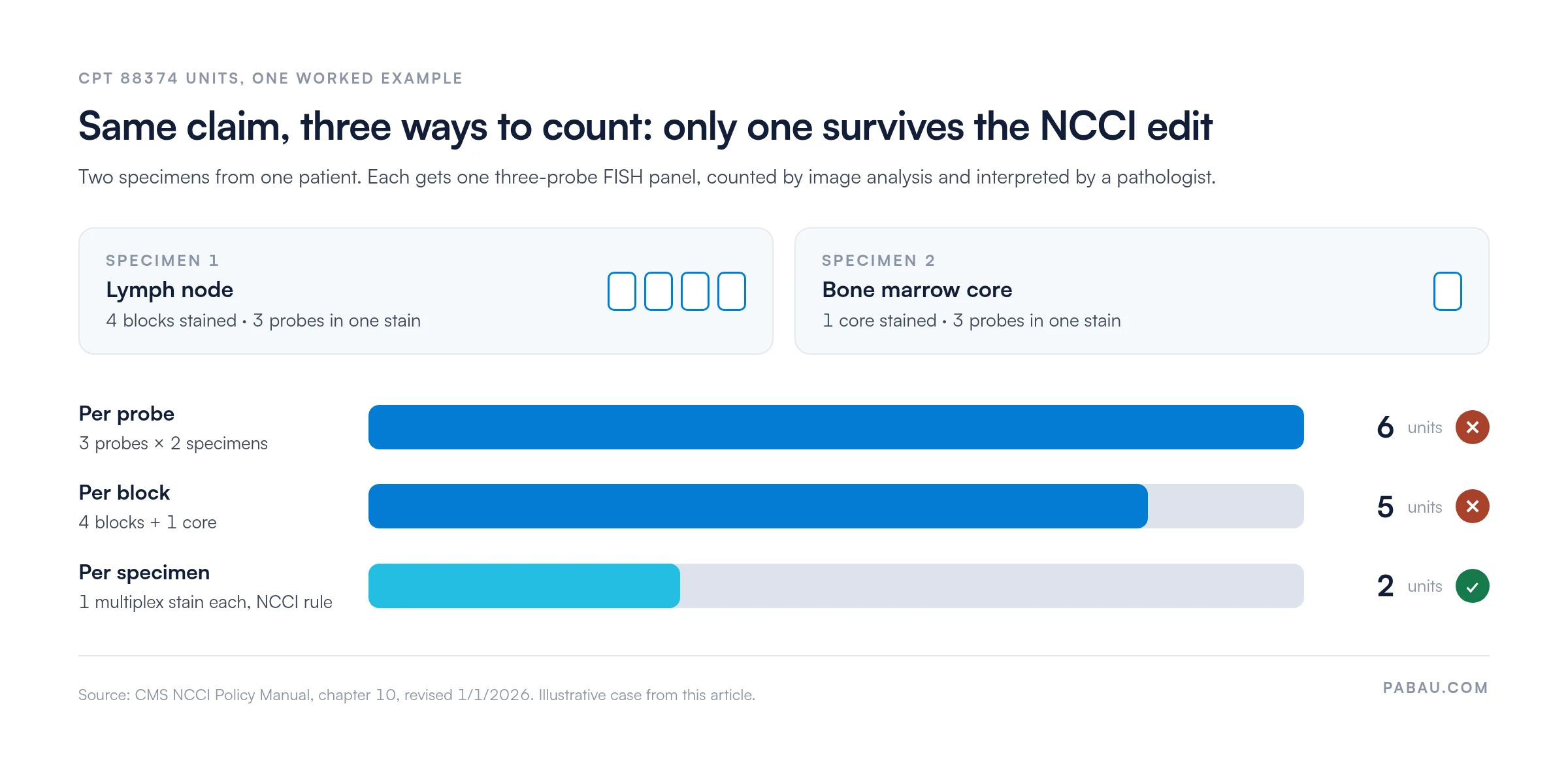
The claim carries two units of 88374, one per specimen. It does not carry six, because the three probes ran as one procedure on each specimen. Had the pathologist counted the bone marrow slide by hand, that specimen would go to 88377 instead.
Now change one detail. Say the lab cut four blocks from the lymph node and stained each one. That’s still one unit for the lymph node, because NCCI counts specimens, not blocks. The chart below runs this version of the case through all three ways of counting.
NCCI ties 88374 to physician work. An M.D. or D.O. has to read, quantitate and interpret the stained tissue or cells. If a laboratory scientist or technologist does that work instead, the lab reports the service with the cytogenetics codes 88271 to 88275.
When a pathologist does the professional work, the provider can bill the global code or split it. The pathologist bills modifier 26, and the lab bills modifier TC. If a non-physician did the reading, the lab can’t bill the TC portion of 88374 either.
Medicare pays 88374 under the Physician Fee Schedule, so the amount depends on the component billed and your locality. Look up current figures in the CMS Physician Fee Schedule lookup tool rather than quoting a number from memory.
These errors tend to surface as unit or bundling edits on the remittance. Sorting the denial codes by CPT code shows whether the problem sits in the report, the coding or one payer.
In many practices, the signed report lives in one system and the claim in another. The biller re-keys units and diagnoses, and a mismatch shows up weeks later as a denial.
Pabau, a practice management and billing platform, lets the practice attach the signed report to the patient record, next to the invoice and claim. Its claims management software checks eligibility first, then sends 837P claims through the Claim.MD clearinghouse.
When the payer responds, the electronic remittance comes back against the same record. A short-paid or denied 88374 line is visible next to the report that supports it, so the fix starts from the source.
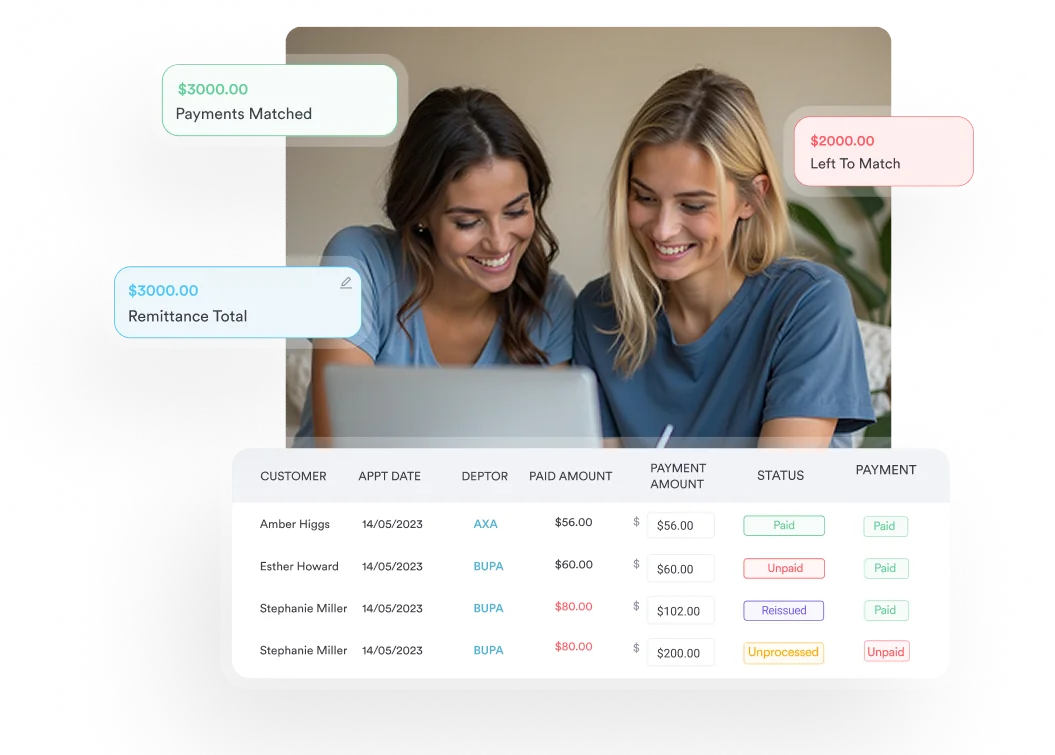

Pabau sends claims through Claim.MD, checks eligibility first and posts remittances back to the patient record. Your team works each 88374 denial from the signed report.

CPT code 88374 rewards labs whose reports say exactly what happened at the bench. Name the probes, show they ran as one stain, state that image analysis made the count and have a pathologist sign it. Then bill one unit per specimen.
If any of those facts is missing, another code in the ISH family probably fits better. Fixing that before submission costs minutes, while fixing it on appeal costs weeks.
Book a demo to see how Pabau puts the signed report, the 88374 claim and its remittance side by side on the patient record.

Counting signals by hand instead? CPT code 88377 covers manual morphometric analysis of a multiplex ISH stain.
Scoring tumor IHC with image analysis? CPT code 88361 explains computer-assisted morphometry for immunohistochemistry stains.
Running a qualitative IHC stain? CPT code 88342 sets out the per-specimen rules for the initial antibody stain.
Want to see how claims reach the payer? Medical claims clearinghouse guide walks through validation, routing and claim status.
Need a cleaner first-pass rate? What a clean claim looks like lists the fields payers check before they pay.
No. FISH uses fluorescent probes, while chromogenic (CISH) and silver (SISH) methods produce a stain you read under a bright-field microscope. The ISH codes apply to all of them, so the method doesn’t change the code.
88374 arrived in the 2015 CPT code set, when the AMA restructured the ISH codes. Before then, morphometric ISH was reported per probe, which is why older claims and some payer policies still count probes.
Usually not. CMS doesn’t pay separately for testing the same analyte by more than one method. If a lab runs FISH and a molecular assay for the same gene, expect only one to be paid.
The code that explains why the test was ordered, taken from the order and the findings. For a breast cancer workup, that might be C50.911, malignant neoplasm of unspecified site of right female breast.
Yes. Medicare pays for laboratory testing only when the performing lab holds a CLIA certificate that covers the test. Check the certificate before the first claim.