CCSD Code J5520: Total pancreatectomy billing guide
CCSD Code J5520: Definition and procedure scope CCSD Code J5520 describes a tota...

Last Updated: Oct 20, 2026
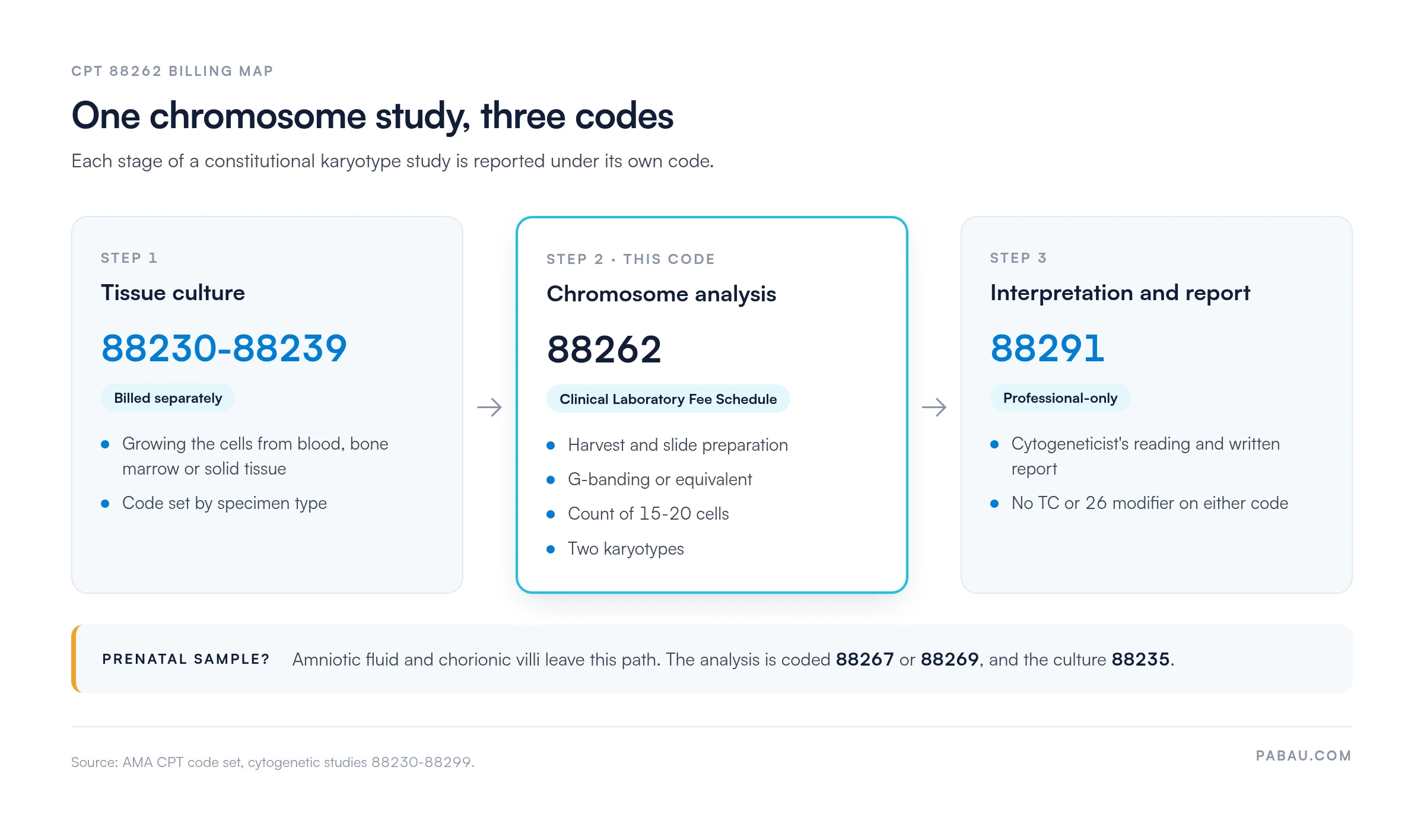
88262 is the CPT code for chromosome analysis; count 15-20 cells, 2 karyotypes, with banding. It covers the lab's harvest, banding, cell count and two karyotypes. Tissue culture (88230-88239) and the physician's interpretation and report (88291) are billed separately.
The neighboring codes 88261, 88263, and 88264 differ in cell count and in the number of karyotypes, so the cytogenetics report must document both. Prenatal amniotic fluid and chorionic villus studies use 88267 or 88269 instead. Most commercial payers also require prior authorization, and a missing preauth triggers a denial regardless of the rest of the claim.
Let Pabau's smart automation suggest the right codes, reduce claim denials, and keep your practice compliant—effortlessly.
Automate repetitive tasks and focus on what matters most—your patients.
Reduce coding errors and ensure compliance with the latest regulations.
Clean claims, fewer denials, and faster reimbursements.
Powerful insights and reporting to help your practice thrive.
HIPAA compliant SOC 2 certified GDPR-compliant Trusted by 4,000+ clinics worldwide

CPT code 88262 covers chromosome analysis with banding: A count of 15-20 cells and 2 karyotypes. Tissue culture (88230-88239) and interpretation (88291) are billed separately.
Cell count and karyotype count both define the code. 88261 is 5 cells with 1 karyotype, 88263 is 45 cells for mosaicism with 2 karyotypes, and 88264 analyzes 20-25 cells.
Amniotic fluid and chorionic villus samples are coded 88267 or 88269, not 88262, with culture under 88235.
Medicare covers 88262 when the test meets the applicable MAC LCD criteria. Most commercial payers require prior authorization.
Pabau’s claims management software supports clean-claim submission and denial tracking for cytogenetics laboratory billing.
CPT code 88262 is defined by the American Medical Association (AMA) as: “Chromosome analysis; count 15-20 cells, 2 karyotypes, with banding.” The code sits within the 88230-88299 Cytogenetic studies subsection of the Pathology and Laboratory chapter.
The service covers harvest and slide preparation, G-banding (or an equivalent banding technique), a chromosome count of 15 to 20 cells, and two karyotypes. Tissue culture is billed separately under 88230-88239. Physician interpretation and the written report are billed under CPT 88291.
The code applies to peripheral blood, bone marrow aspirate, and solid tissue specimens. What matters is that 15 to 20 metaphase cells are counted and two karyotypes prepared. Prenatal specimens are coded differently. Amniotic fluid and chorionic villus studies use 88267 or 88269, and their culture is reported under 88235.
Understanding the boundaries of 88262 prevents both under-billing and bundling errors. The table below summarizes what is included in the service and what must be coded separately.
Because culture and interpretation sit outside 88262, one karyotype study often reaches the payer as three codes. The map below shows which code covers each stage.
The chromosome analysis family (88261-88264) splits on two variables: How many cells are counted or analyzed, and how many karyotypes are produced. Coding on cell count alone is how 88262 claims get miscoded, so check both numbers in the cytogenetics report.
Verify the cell count and the karyotype count in the cytogenetics laboratory report before you select a code. A report of 14 cells does not support 88262, and neither does a report with one karyotype. If the report documents 22 cells, 88264 is the code to check. The report is the audit trail.
Medical necessity is the gatekeeper for every CPT 88262 claim. The ordering physician’s documentation must establish a clinical indication that justifies chromosome analysis at the 15-to-20-cell level. Labs billing 88262 for fertility workups should confirm that the ordering clinician’s note links the test to a specific diagnosis or diagnostic question.
Diagnosis code selection determines whether the claim clears the payer’s medical-necessity edits. The table below lists high-use ICD-10-CM codes accepted with CPT 88262. Some Medicare Administrative Contractors (MACs) publish Local Coverage Determinations (LCDs) with their own covered diagnosis lists. Check the applicable MAC LCD before billing.
Always link the ICD-10 code to the specific clinical question documented in the ordering note. An ICD-10 code that technically qualifies but does not match the ordering physician’s stated indication is a medical-necessity audit risk. Document the indication explicitly.
Chromosome analysis is a laboratory test. CPT 88262 is therefore priced under the Medicare Clinical Laboratory Fee Schedule (CLFS) rather than the Physician Fee Schedule (MPFS).
Check the current-year rate in the CLFS files at cms.gov before you quote a figure.
Medicare generally does not require prior authorization for medically necessary laboratory tests including CPT 88262, provided the applicable MAC LCD’s coverage criteria are met. Commercial payers are a different story. Understanding medical billing fundamentals for genetic testing helps billing staff anticipate which payer classes will gate this test.
A prior authorization request should include the ordering physician’s clinical note and the specific ICD-10 code. Add any prior test results, such as an abnormal ultrasound, an inconclusive microarray, or a semen analysis. Standard requests typically take three to five business days. Urgent requests may qualify for a payer’s expedited review.
A clean chromosome analysis claim depends on documentation that travels from the ordering physician’s office to the laboratory, then to the payer. Following billing compliance requirements specific to cytogenetics reduces audit exposure and speeds payment.
Modifier errors on cytogenetics claims trigger NCCI bundling denials that need corrected claims. A clean claim for 88262 carries modifier 59 or an X{EPSU} modifier only when another chromosome analysis code covers a distinct specimen.
NCCI bundling edits pair 88262 with 88261, 88263, and 88264 as potentially mutually exclusive on the same date for the same specimen. When two of them are legitimately billed, modifier 59 (or an XE/XS/XP/XU modifier) may be required. Documentation must show each is a distinct service on a distinct specimen or indication.
Denial patterns on chromosome analysis claims cluster around three failure points: Documentation, diagnosis linkage, and administrative requirements. Effective denial management workflows address each of these proactively rather than after the denial hits.
See the full list of common denial codes for the remittance codes that accompany these denials.
Run a denial audit on your last 90 days of CPT 88262 claims before implementing new documentation protocols. Find which of these six denial triggers is most common at your lab. Then fix the workflow at its source instead of correcting claims one by one.
Yes, CPT 88262 and 88291 can be billed together on the same date. CPT 88262 is the laboratory analysis, which covers harvest, banding, imaging, the cell count, and the two karyotypes. Tissue culture is reported separately under 88230-88239.
CPT 88291 is the cytogeneticist’s interpretation and written report. It is a professional-only code, so there is no TC/26 split on either line. Before you submit the pair, confirm the signed report is on file to support 88291.
A clean 88262 claim rests on four checks: The cell count, the karyotype count, the preauth status, and 88291 billed alongside the analysis. When billing staff run those checks by hand after the report arrives, a single miss sends the claim back.
Pabau sends electronic claims through its Claim.MD integration to thousands of US payers. Eligibility checks can flag whether a patient’s plan covers cytogenetic testing before the specimen is sent.
Pabau’s claims management software tracks the required documentation fields before submission. Missing items surface on your side, before they trigger a denial or a records request.
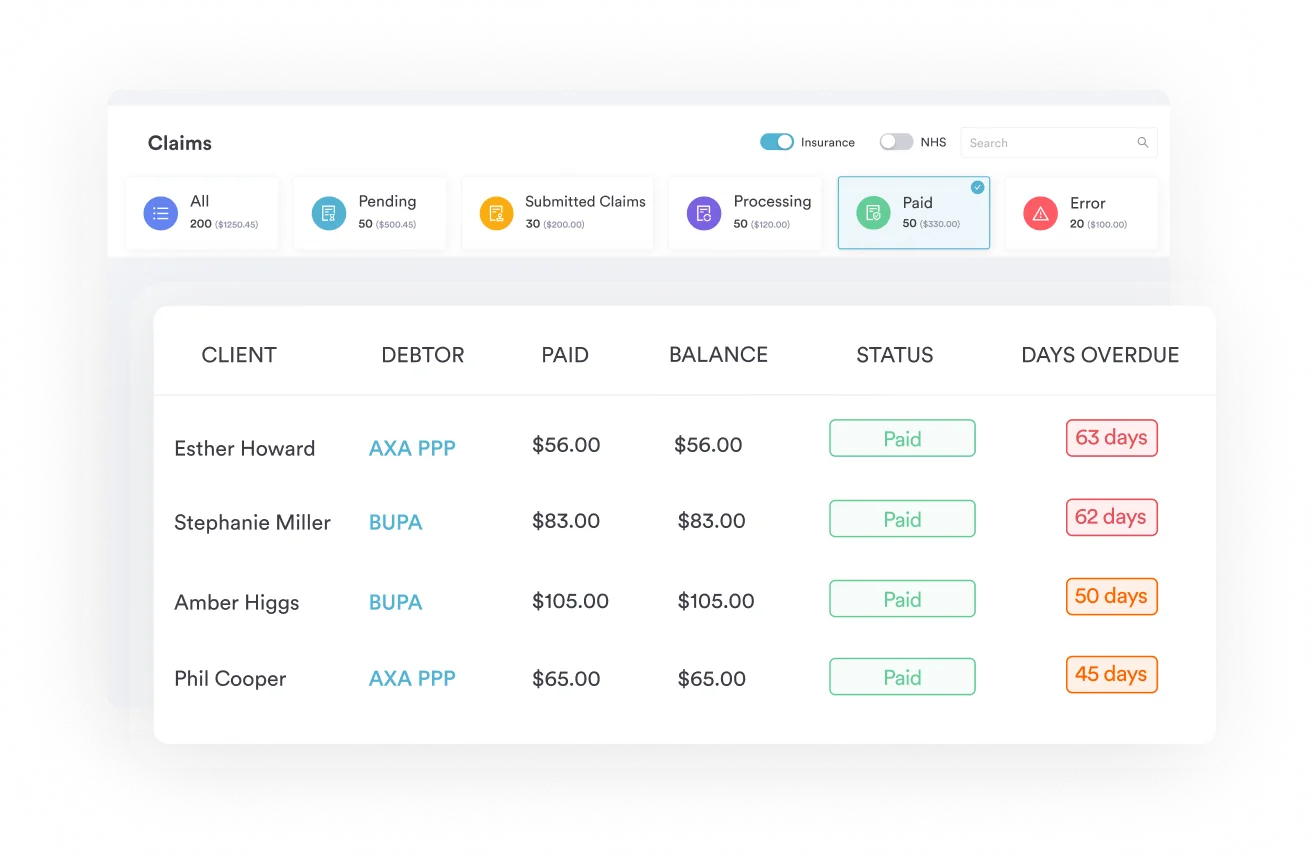

Pabau connects with Claim.MD to submit lab claims to thousands of US payers and check eligibility. It also tracks denials across the cytogenetics code family.

CPT 88262 holds up only when the report proves two numbers: 15 to 20 cells counted and two karyotypes produced. Treat those figures as the coding decision, and the choice between 88261, 88263, and 88264 follows from them.
Settle the payer side before the specimen leaves the practice. That means preauth for commercial plans, a covered ICD-10 code tied to the ordering note, and 88291 reported with the analysis. Checks built into order entry leave far fewer claims to correct after a denial.
Book a demo to see how Pabau handles cytogenetics and laboratory billing from order to payment.

Need to understand how clearinghouse submissions work for lab claims? Medical claims clearinghouse guide explains the 837P transaction flow from lab to payer.
Trying to reduce claim rejections before they become denials? Electronic remittance advice (ERA) guide covers how to read 835 remittances and CARC denial codes.
Looking for the right billing software for your cytogenetics or specialty lab? Best medical billing software for US practices compares platforms supporting lab and specialty billing.
CPT code 88262 is the billing code for chromosome analysis that counts 15 to 20 cells and produces two karyotypes, with banding. It covers the lab’s harvest, G-banding, and karyotyping of a specimen. Tissue culture is billed separately under 88230-88239, and physician interpretation under CPT 88291.
The three codes differ in cell count and in the number of karyotypes. 88261 counts 5 cells with one karyotype. 88262 counts 15 to 20 cells with two karyotypes. 88263 counts 45 cells for mosaicism, also with two karyotypes. The cytogenetics report must state both numbers to support the code billed.
CPT 88262 is paid under the Medicare Clinical Laboratory Fee Schedule (CLFS) when billed by a laboratory. Rates are updated each January, so verify the current-year figure in the CMS CLFS files at cms.gov before you quote one.
Medicare generally does not require prior authorization for medically necessary lab tests including 88262, provided the applicable MAC LCD coverage criteria are satisfied. Most large commercial payers do require prior authorization. Verify with each payer before ordering the test to avoid an automatic denial.
TC and 26 do not apply to the 88262 and 88291 pairing, because 88262 is a lab code and 88291 is professional-only. Modifier 59 or an X-modifier applies only when another 88261-88264 code is billed for a distinct specimen. Documentation must show the separate specimen or indication.
The most common trigger is a missing or non-covered ICD-10 code. Next come reports that omit the exact cell count or the karyotype count. A commercial payer will also deny the claim if its required preauth was not secured before specimen collection.