CPT Code 25210: Excision of a single carpal bone
CPT Code 25210: Official descriptor and quick-reference data CPT Code 25210 is a...

Last Updated: Nov 26, 2026
87400 is the CPT code for influenza A or B antigen detection by immunoassay, reported once for each virus type. The assay may be an EIA, ELISA, FIA or IMCA, and the code covers the analyzer-read rapid flu tests many practices run.
The way the result is read decides the code. A rapid test read by eye is 87804, molecular testing is 87501 to 87503, and influenza antibody serology is 86710.
Let Pabau's smart automation suggest the right codes, reduce claim denials, and keep your practice compliant—effortlessly.
Automate repetitive tasks and focus on what matters most—your patients.
Reduce coding errors and ensure compliance with the latest regulations.
Clean claims, fewer denials, and faster reimbursements.
Powerful insights and reporting to help your practice thrive.
HIPAA compliant SOC 2 certified GDPR-compliant Trusted by 4,000+ clinics worldwide

CPT Code 87400 reports influenza A or B antigen detection by immunoassay, with one unit for each virus type.
The detection method decides the code. An instrument-read antigen test is 87400, while a rapid test read by eye is 87804.
Analyzer-read office tests such as Sofia Influenza A+B FIA and BD Veritor Flu A+B are billed as 87400 with modifier QW.
Influenza antibody serology is 86710, molecular testing is 87501 to 87503, and a combined SARS-CoV-2 and flu antigen test is 87428.
Medicare pays 87400 under the Clinical Laboratory Fee Schedule, at a 2026 national rate of $14.13 per unit.
CPT Code 87400 reports an immunoassay that detects influenza A or influenza B antigen in a patient specimen, billed once for each virus type. A CMS CLIA change request lists the analyzer-read office tests Sofia Influenza A+B FIA and BD Veritor Flu A+B as 87400QW. So the code covers many rapid flu tests run in a practice, not only reference laboratory assays.
The American Medical Association (AMA) maintains the CPT code set, and 87400 sits in the Microbiology subsection of Pathology and Laboratory. Within Microbiology, it belongs to the 87301 to 87467 run of antigen immunoassay codes, where each code names the organism detected.
The official descriptor, as CMS publishes it in the CY2026 Clinical Laboratory Fee Schedule, reads:
Infectious agent antigen detection by immunoassay technique (eg, enzyme immunoassay [EIA], enzyme-linked immunosorbent assay [ELISA], fluorescence immunoassay [FIA], immunochemiluminometric assay [IMCA]), qualitative or semiquantitative; influenza, A or B, each
The word “each” in the descriptor drives the unit count. A test that reports influenza A and influenza B as separate results supports two units of 87400. A test that reports only one type supports one unit. According to the AMA’s CPT code set overview, the descriptor language controls how a code is counted.
An 87400 test looks for viral proteins (antigens) in a respiratory sample. It does not look for the antibodies a patient’s immune system makes. That is why it can diagnose an active infection on the day of the visit.
Qualitative or semiquantitative results both meet the descriptor. A plain positive or negative reading for each type is enough, as long as the device reads it.
CPT 87400 and 87804 both detect influenza antigen by immunoassay. The difference is how the result is read: 87400 is read by an instrument, and 87804 is read by eye. CMS describes 87804 as antigen detection by immunoassay with direct optical (ie, visual) observation.
That makes the test device the deciding fact. A lateral flow cassette that a nurse reads by looking at the lines is 87804. Put a comparable test into a reader that interprets the signal, as with BD Veritor, and the claim moves to 87400.
Medicare’s 2026 national CLFS rates show the split in money terms as well. 87400 pays $14.13 per unit, and 87804 pays $16.55. Billing the wrong one of the pair is a coding error in either direction, even when it lowers the payment.
Read as a decision, the whole influenza family turns on two facts. The first is what the test detects, and the second is how its result is read.
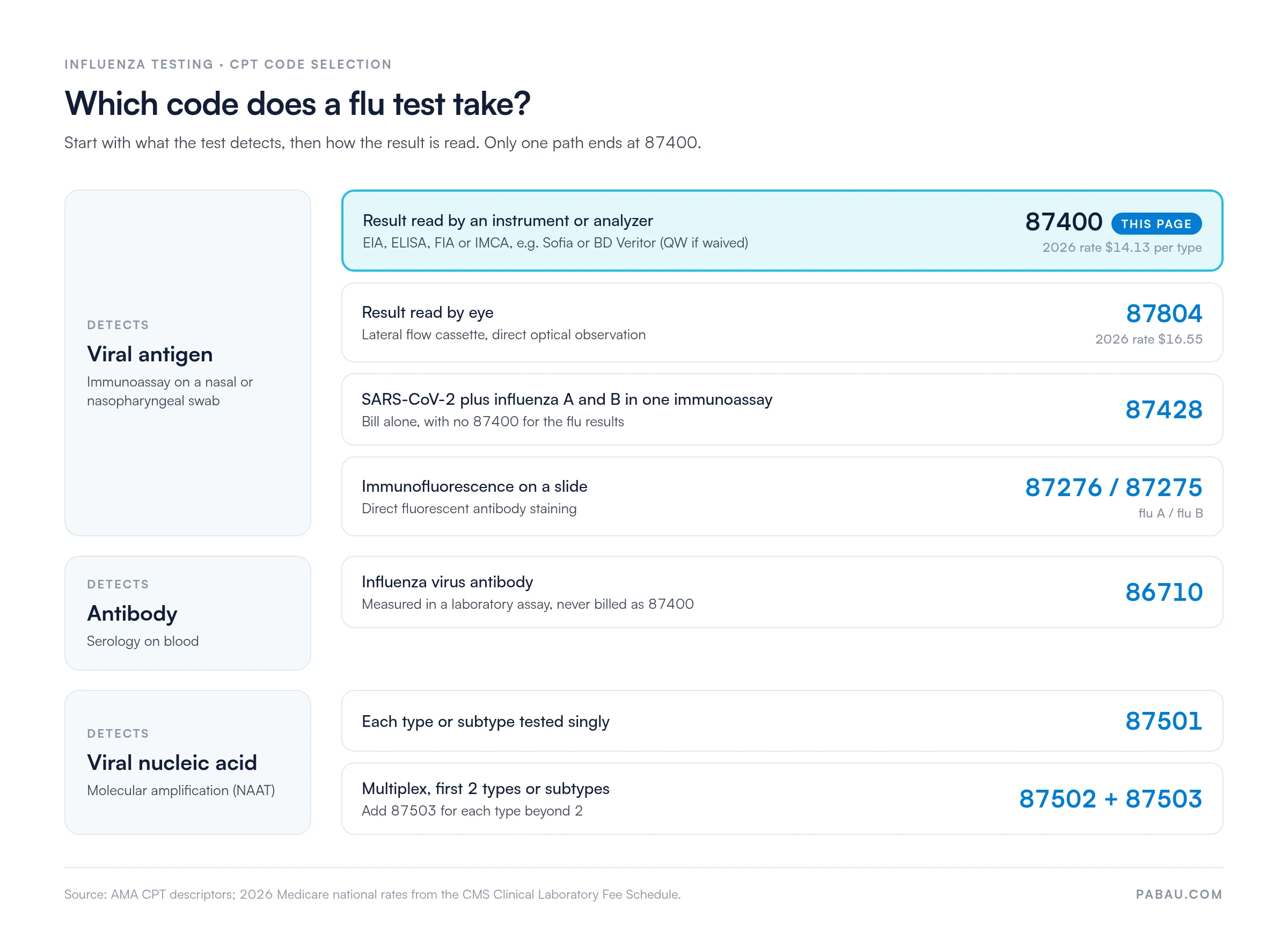
CPT Code 87400 covers one method, so several common influenza tests fall outside it. Billing 87400 for any of the following is a miscoding error that payers flag.
Before flu season, list every influenza test your practice runs next to its CPT code and CLIA status. Note whether each device reads the result itself or relies on the eye. That one sheet settles most 87400 versus 87804 questions at the front desk.
A claim for CPT Code 87400 without a supporting diagnosis code is denied for missing medical necessity. The ICD-10-CM codes below are the most commonly accepted. Your Medicare Administrative Contractor (MAC) may set other requirements, so check its current policy for influenza testing.
Use the most specific diagnosis code available at the time of service. A confirmed influenza code needs the provider’s documented diagnosis behind it, and that includes J11.1 when the strain is not yet identified. When the test is ordered before a diagnosis is made, code the symptoms or exposure, such as R05.9 or Z20.828.
Two modifiers come up most often on 87400 claims. QW marks a CLIA-waived test, and 59 sets a second line apart from another service on the same date.
A note on QW: Not every commercial payer recognizes modifier QW. Some read CLIA status from the billing provider’s enrollment record instead. Confirm each payer’s rule before adding QW to non-Medicare claims. A laboratory running 87400 on a non-waived platform bills it without QW.
Medicare pays CPT Code 87400 under the Clinical Laboratory Fee Schedule (CLFS), not the Physician Fee Schedule. The CY2026 national rate is $14.13 per unit, so a test reporting influenza A and B supports $28.26. Check the current quarter in the CMS Clinical Laboratory Fee Schedule files before you quote it.
A well-documented record is the first line of defense against an 87400 audit. The chart alone must support the claim, without extra explanation. Building medical billing compliance into the documentation workflow prevents the most common audit triggers before they reach a reviewer.
Clean claim submission means each required data element is present, accurate and consistent with the chart. A diagnosis code that does not match the clinical indication in the note is a top trigger for post-payment audits on laboratory codes.
Add an influenza testing checklist to your encounter template. Include the clinical indication, specimen type, test device, whether it reads antigen or antibody, and the CLIA certificate number. A finished checklist at the point of care stops most documentation errors before the claim goes out.
Denials on CPT Code 87400 follow predictable patterns, and most can be corrected and resubmitted. A structured denial management strategy cuts the rework during flu season, when volume makes the patterns easy to spot.
Reviewing remittance denial codes on each 87400 ERA tells the billing team which fix applies. CARC 4 flags a missing or inconsistent modifier, and CARC 97 means the service is included in another payment.
Many practices raise the invoice in one system, then re-key the claim into a clearinghouse portal. Each re-keyed line is another chance to send 87804 instead of 87400, or to drop the QW modifier.
Pabau, a practice management platform with insurance billing built in, turns the invoices you already raise into electronic claims. Its claims management software sends 87400 claims to US payers through the Claim.MD clearinghouse.
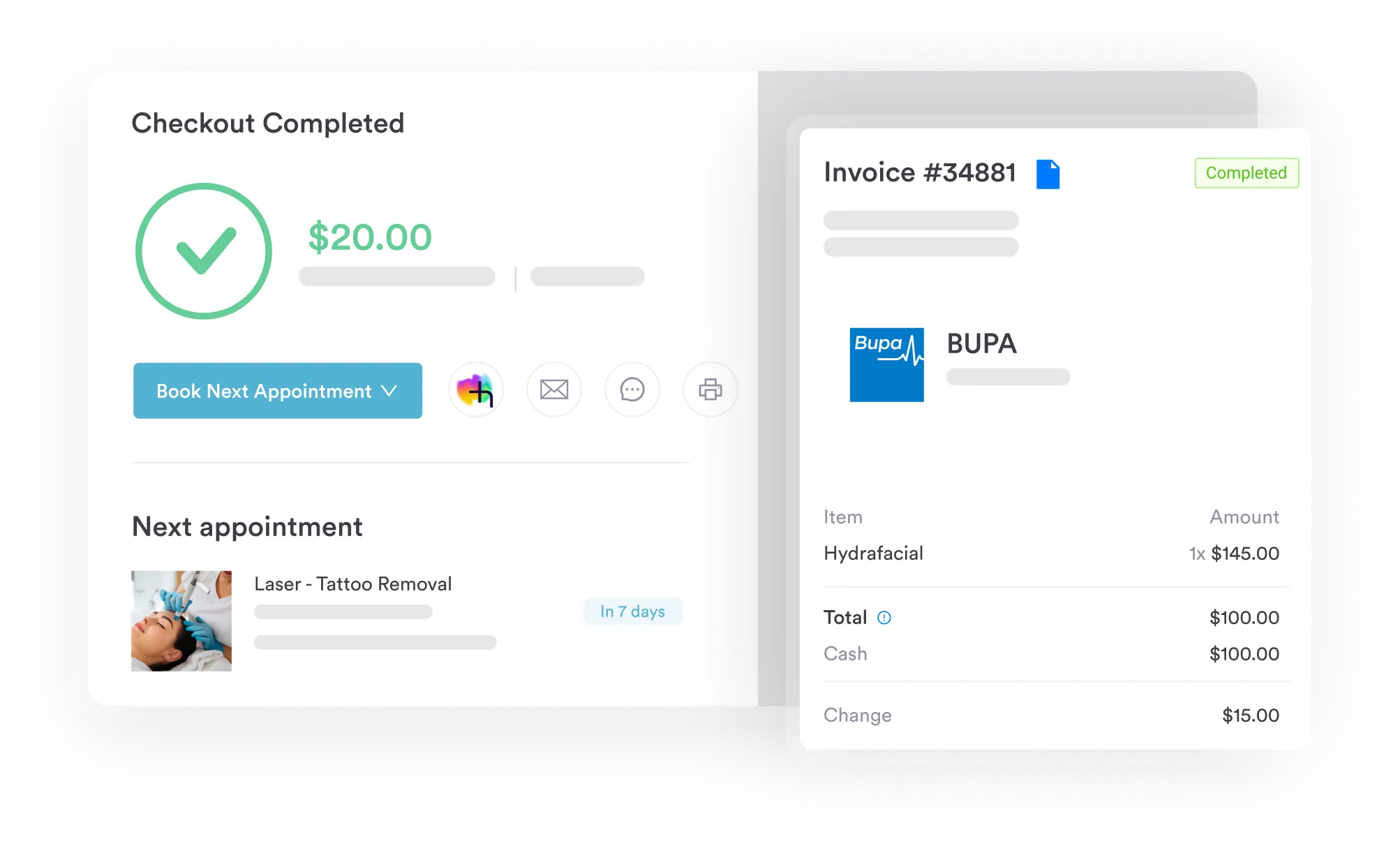
Your front desk can check a patient’s coverage before the swab is taken. Claim statuses and electronic remittance advice then flow back into Pabau. You see which flu test claims are paid, pending or denied without waiting for paper EOBs.

Pabau turns your invoices into electronic claims sent through Claim.MD, with eligibility checks and claim status tracking. See how 87400 claims move from swab to payment.

Code 87400 from the device, not from the order. If an analyzer reads an influenza antigen result, it is 87400, one unit per type. If a person reads the lines, it is 87804, and an antibody test is 86710. RSV follows the same split, with a rapid antigen test read by eye billed as CPT 87807.
Settle that once for each test your practice runs, and most 87400 denials never happen. Book a demo to see how Pabau sends influenza test claims from invoice to payment without re-keying.

Running a respiratory virus panel? CPT code 87631 explains how multiplex molecular panels with 3 to 5 targets are coded.
Need a foundation for understanding claims? What is medical billing explains the full claims lifecycle from encounter to payment posting.
Billing claims electronically? Claim.MD clearinghouse overview covers how electronic claims reach payers and return ERAs.
Getting recurring denials? Denial management in healthcare outlines a systematic approach to tracking and resolving claim rejections.
CPT Code 87400 covers influenza A or B antigen detection by immunoassay, such as EIA, ELISA, FIA or IMCA, read by an instrument. It is billed once for each virus type, so a test reporting influenza A and B separately supports two units.
CPT 87400 is an antigen test. It detects influenza viral proteins in a nasal or nasopharyngeal specimen. Influenza antibody testing on blood is a different code, 86710.
Both codes report influenza antigen detection by immunoassay. CPT 87400 applies when an instrument or analyzer reads the result. CPT 87804 applies when the result is read by eye, as with a visual lateral flow cassette.
The CY2026 Medicare national rate for CPT 87400 is $14.13 per unit under the Clinical Laboratory Fee Schedule. A test reporting influenza A and B supports two units. Check the current quarterly CLFS file, because CMS updates it during the year.
Yes, when the test runs on a CLIA-waived device under a Certificate of Waiver. CMS lists Sofia Influenza A+B FIA and BD Veritor Flu A+B as 87400QW tests. Some commercial payers do not use QW, so check each payer rule.
Not for the same test. CPT 87428 reports a combined SARS-CoV-2 and influenza A and B antigen immunoassay, so it already includes the flu results. Bill 87428 alone for that test.
The most common reasons are a missing QW modifier, an unsupported diagnosis code, or overlap with 87428. A visually read test or an antibody test billed as 87400 also gets denied. Check the CARC and RARC on the remittance to find the cause.