

HCPCS code J2690: Procainamide units and billing guide
What HCPCS code J2690 covers, and what it does not HCPCS code J2690 reports R...

Last Updated: Oct 30, 2026
87205 is the CPT code for smear, primary source with interpretation; Gram or Giemsa stain for bacteria, fungi, or cell types.
The code covers the smear preparation, the stain and the microscopic examination as one service. It applies only to material taken directly from the patient, and the lab report must carry a written interpretation of the findings.
Let Pabau's smart automation suggest the right codes, reduce claim denials, and keep your practice compliant—effortlessly.
Automate repetitive tasks and focus on what matters most—your patients.
Reduce coding errors and ensure compliance with the latest regulations.
Clean claims, fewer denials, and faster reimbursements.
Powerful insights and reporting to help your practice thrive.
HIPAA compliant SOC 2 certified GDPR-compliant Trusted by 4,000+ clinics worldwide

CPT code 87205 covers the smear preparation, the stain and the microscopic interpretation as one service, not just the staining step.
The smear must come from a primary patient specimen, and a smear made from a sub-culture is a top denial trigger.
87205 is a moderate-complexity test under CLIA, so a Certificate of Waiver does not cover performing or billing it.
The written interpretation is the element most often missing from denied 87205 claims.
Claims software such as Pabau scrubs each claim for missing or invalid details before it reaches the clearinghouse.
The official AMA CPT code set descriptor for 87205 is: Smear, primary source with interpretation; Gram or Giemsa stain for bacteria, fungi, or cell types. The phrase “with interpretation” is the operative billing requirement. The code bundles the smear preparation, the staining step and the microscopic examination into one service. That service is complete only when the lab report holds a written interpretation of the findings.
Three components are included in one unit of 87205:
A lab report that records the stain result but does not include a written interpretive statement does not support a complete claim for 87205. The interpretation must name what was found, or state that no organisms were identified. It must also identify the clinician who performed or supervised the examination.
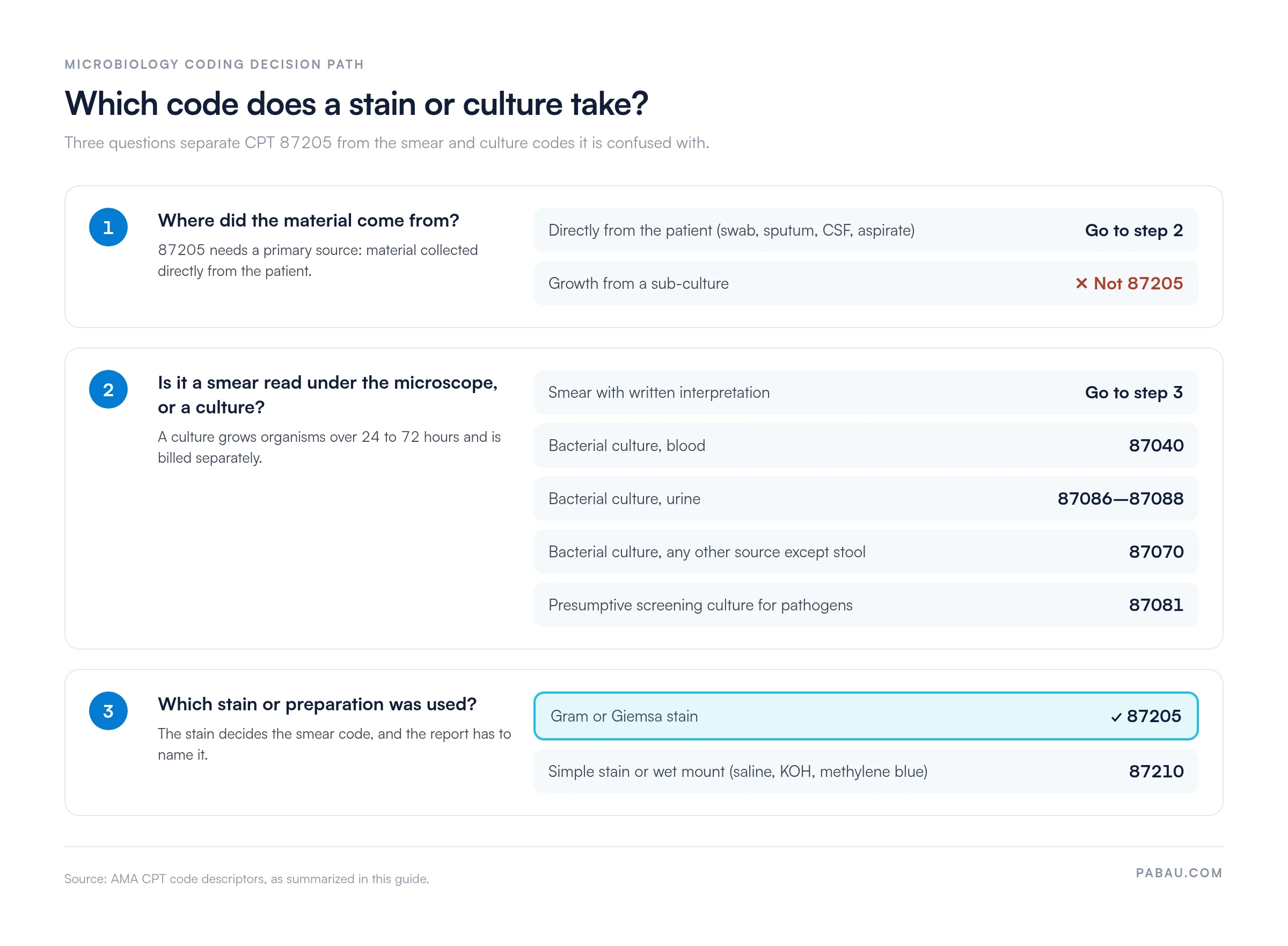
The code requires a primary specimen source, meaning material collected directly from the patient. A smear prepared from sub-culture growth does not qualify and will be denied. Valid primary sources include:
CPT 87210 covers a simple smear or wet mount with interpretation. It uses saline, KOH or other simple preparations rather than a Gram or Giemsa stain. Both tests are often ordered for the same body site at the same visit, which is where billing confusion starts.
Billing 87205 and 87210 on the same date for the same specimen source can trigger NCCI bundling edits. Check the current quarterly NCCI edit table before submitting both codes. Billing both for different specimens, such as a wound Gram stain and a vaginal wet mount from one encounter, is permitted. The documentation has to support each test on its own.
Check the current NCCI Policy Manual chapter on microbiology codes before billing 87205 and 87210 on the same date. NCCI edits update quarterly, so a pairing that was unbundled last year may have an edit in force now. The AAPC Codify lookup tool shows current NCCI edit status for any code pair.
Gram staining and culture are different procedures. CPT 87205 is a direct smear examination. CPT 87070 covers an aerobic bacterial culture from any source other than urine, blood or stool. Blood cultures bill under 87040, and urine cultures under 87086 to 87088.
The smear and the culture are separately billable, and NCCI does not bundle them. Both may be ordered on the same specimen and billed on the same date of service when clinically indicated.
The clinical difference is speed. A Gram stain gives results within 30 to 60 minutes and guides initial empiric treatment. A culture takes 24 to 72 hours and confirms the final organism identification. Ordering both is standard for serious infections, and both are billable as separate services. The decision path below sorts a test into the right code in three questions.
Submitting a clean claim for CPT code 87205 requires each of these elements to be present in the medical record before submission:
The ICD-10-CM code on the claim must reflect the clinical reason the smear was ordered. That means a specific suspected infection or a confirmed diagnosis, not a general encounter code. The most frequently used pairings are:
CPT code 87205 is reimbursed under the CMS Clinical Laboratory Fee Schedule (CLFS), not the Physician Fee Schedule. That distinction has three billing consequences.
For the current year’s CLFS figures, use the AAPC Codify CPT lookup or download the annual rate file from the CMS CLFS page. The rate for 87205 has historically been under $10. For a code that pays this little, accurate charge capture and clean claims matter more than the rate itself.
Gram staining with microscopic interpretation is classified as a moderate-complexity test under the Clinical Laboratory Improvement Amendments (CLIA). This classification is set by CMS and determines what type of CLIA certificate the performing laboratory must hold.
The performing lab’s CLIA number must appear on every claim for CPT 87205. A missing or invalid CLIA number is a standalone denial trigger separate from all other documentation requirements. CMS maintains CLIA certificate records, and your MAC can confirm the number it holds on file.
Most CPT code 87205 denials fall into seven categories. Knowing which denial code you received, and why, is the first step in any appeal. Our guide to denial management in healthcare covers the workflow from CARC code to corrective action.
Appealing a denied claim for CPT code 87205 follows a standard process, but the supporting documents differ by denial reason. Reference the list of denial codes in medical billing to match the CARC code on your EOB to the correct corrective action before filing.
When appealing a missing-interpretation denial, attach the original lab report with the interpretive section highlighted. Add a brief cover letter that quotes the AMA descriptor language, ‘with interpretation’, and gives the date the interpretation was documented. Clear documentation gives the redetermination its best chance of resolving in one round.
Most 87205 denials trace back to a field that was missing or wrong when the claim left the practice. Checking every lab claim by hand takes time that a code paying under $10 can’t justify.
Pabau, the practice management platform we build, moves that check into the billing workflow. Its claims management software validates each claim before it leaves Pabau. A claim that still comes back rejected is flagged Needs action, with a link straight to the field to fix.
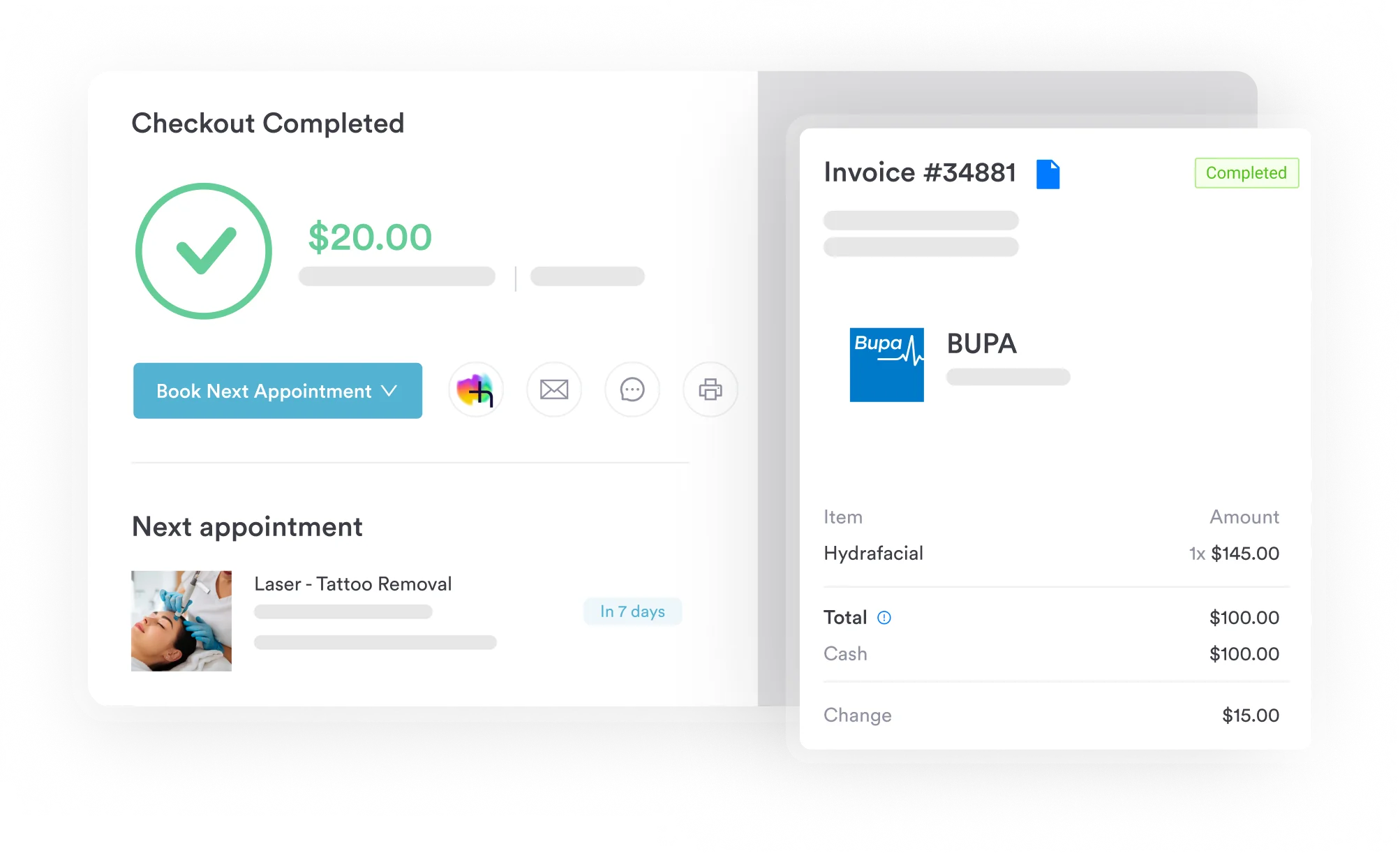
For practices with higher volumes of microbiology claims, electronic remittance advice closes the loop. Payments settle straight from the ERA files that come back through the clearinghouse, so the billing team isn’t reconciling paper EOBs by hand.

Pabau’s claim validation checks every lab claim for missing or invalid details before it reaches your clearinghouse. That way 87205 claims go out complete and come back paid.

If you change one habit for CPT code 87205, make it the written interpretation. It is the element most often missing from denied claims, and adding it costs the lab one sentence per report.
The certificate and the specimen source are settled once, at setup. The interpretation has to be right on every report, which is why a review step before submission pays off on a code this cheap.
One reworked claim can cost more staff time than 87205 pays, so clean submission beats chasing the fee. Book a demo to see how Pabau’s claim validation catches missing details on lab claims before they reach the payer.

Need a reference for medical claims clearinghouse workflows? Medical claims clearinghouse guide explains how electronic claim routing works from practice to payer.
Want to understand how ERAs reach your claim accounts? Electronic remittance advice (ERA) explained covers how remittance files settle payments against claims.
Looking for denial code definitions to support your appeal? Denial codes in medical billing provides a full reference for CARC and RARC codes.
Ordering a culture alongside the Gram stain? CPT code 87070 explains the bacterial culture code that most often pairs with 87205.
Is the specimen urine? CPT code 87086 covers the quantitative urine culture that takes urine specimens out of 87070.
CPT code 87205 covers a direct smear from a primary patient specimen, stained with a Gram or Giemsa stain and read under the microscope. The written interpretation is part of the same billable unit. Smears from sub-cultures and stain results without an interpretive statement do not qualify.
CPT 87205 uses a Gram or Giemsa stain to identify bacteria, fungi or cell types. CPT 87210 covers simple smears and wet mounts, such as saline, KOH or methylene blue preparations. These are used mainly to find Trichomonas, yeast and clue cells. Both require a written interpretation. Billing both for the same specimen on the same date may trigger NCCI bundling, but different specimen sources can be billed together.
Medicare pays CPT 87205 under the Clinical Laboratory Fee Schedule, which sets one national rate and updates it every January. The rate has historically been under $10. Download the current rate file from the CMS CLFS page. The code has no component split, so modifiers -26 and -TC do not apply.
The top reasons are a diagnosis code that does not support medical necessity and a lab report with no written interpretation. Other common triggers are a sub-culture smear billed as primary source and an NCCI conflict when 87210 is billed for the same specimen. A missing or invalid CLIA number on the claim also causes denials.
Yes. CPT 87205 is a moderate-complexity test under CLIA. The performing lab must hold a Certificate of Compliance or Accreditation, not a Certificate of Waiver. Physician office labs that run Gram stains without the right certificate face denials and OIG compliance exposure. The CLIA number must appear on every 87205 claim.
Yes. NCCI does not bundle CPT 87205, the Gram stain smear, with CPT 87070, an aerobic bacterial culture from sources other than urine, blood or stool. They describe distinct procedures, so both may be billed on the same date when the record supports ordering both. The pairing is standard for wound and respiratory specimens. The smear guides empiric treatment while the culture confirms the organism.


