CPT code 95808: Attended polysomnography billing guide
CPT code 95808 covers attended PSG with 1 to 3 extra channels CPT code 95808 is ...

Last Updated: Nov 11, 2026
86923 is the CPT code for compatibility test, each unit; electronic. It reports an electronic crossmatch, where blood bank software confirms ABO compatibility between a donor unit and the patient without a serologic test.
The code is billed once per donor unit. It is valid only when two concordant ABO determinations are on record, one from a current sample, and no clinically significant antibodies are detected. It is never billed with 86920-86922 for the same unit.
Let Pabau's smart automation suggest the right codes, reduce claim denials, and keep your practice compliant—effortlessly.
Automate repetitive tasks and focus on what matters most—your patients.
Reduce coding errors and ensure compliance with the latest regulations.
Clean claims, fewer denials, and faster reimbursements.
Powerful insights and reporting to help your practice thrive.
HIPAA compliant SOC 2 certified GDPR-compliant Trusted by 4,000+ clinics worldwide

CPT Code 86923 reports an electronic (computer) crossmatch and is billed once per donor unit tested, not per patient or per day.
The electronic method is valid only with two concordant ABO determinations on record, one from a current sample, and no clinically significant antibodies.
Never report 86923 with 86920-86922 for the same unit, because an NCCI edit denies the electronic code.
Medicare pays 86923 only on hospital outpatient claims, through OPPS APC 5672 at $174.06 in October 2026. The code is not on the CLFS.
Pabau’s claims management software builds each claim from the patient record and checks eligibility before submission through Claim.MD.
CPT Code 86923 is the code for an electronic crossmatch. It is billed once for each donor unit the blood bank’s software clears as ABO-compatible with the patient.
It sits in the Transfusion Medicine Procedures range (86850-86999) of the American Medical Association CPT code set. The official descriptor reads: Compatibility test, each unit; electronic.
An electronic crossmatch (also called a computer crossmatch) replaces the serologic tube or gel reaction with a software check in the laboratory information system (LIS). The system compares the donor unit’s ABO/Rh type with the patient’s confirmed blood type, so no donor cells are mixed with patient plasma.
The medical billing fundamentals for laboratory codes apply here. The blood bank that performs the crossmatch reports the code, not the physician who ordered the transfusion. Hospitals bill it on the UB-04 (CMS-1450) institutional claim.
The LIS retrieves the patient’s stored blood-type data and compares it with the incoming donor unit’s data. No test tube reaction takes place. AABB Standards set the conditions that must be met before the electronic method is valid, and payers audit the same records.
If any condition is not met, the unit needs a serologic crossmatch, and a claim for 86923 will not hold up on audit. Record the antibody screen date explicitly.
AABB requires a sample drawn within 3 days of transfusion when the patient was transfused or pregnant in the previous 3 months. The chart below turns those conditions into the coding choice for each unit.
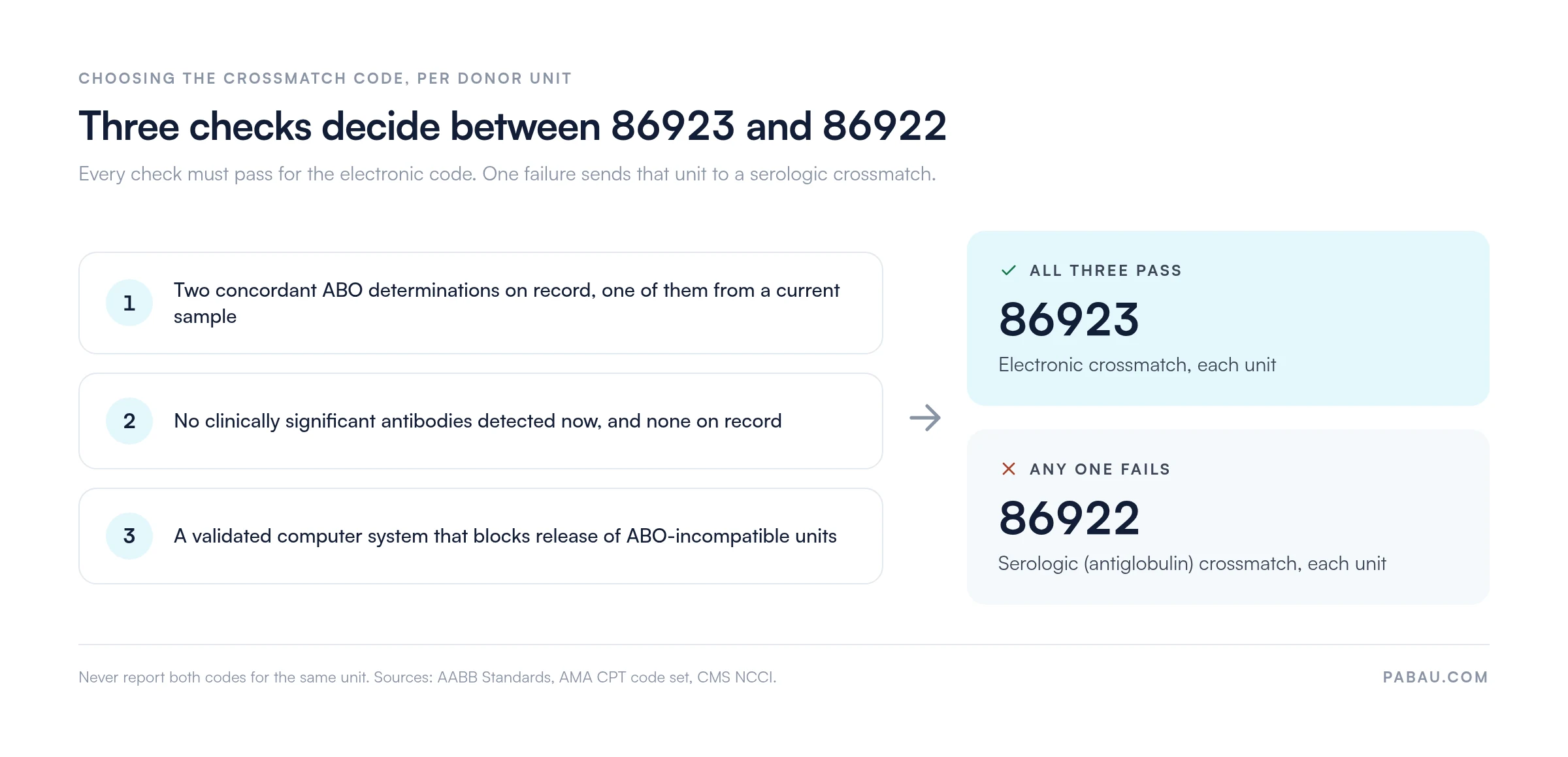
Run a weekly audit of crossmatch records against billed units. A mismatch between the LIS crossmatch log and the claim’s unit count is a common post-payment audit finding on blood bank codes. Keep the LIS record and the charge entry in sync before month-end close.
Use 86923 when the electronic crossmatch conditions are met, and 86922 when the unit needs a serologic (antiglobulin) crossmatch instead. The CPT manual says not to report 86923 with 86920-86922 for the same unit.
The National Correct Coding Initiative (NCCI) enforces this with a code-pair edit, so billing both for one donor unit gets 86923 denied.
When an antibody turns up during the workup, the blood bank must switch from the electronic method to the serologic method. Bill 86922, not CPT Code 86923, for any unit that needed the wet-lab step. Never change the code afterward to reflect a procedure that was not performed.
Several codes in the 86850-86999 range are commonly ordered alongside CPT Code 86923 in a standard pre-transfusion workup. Knowing which are separately reportable prevents both underbilling and NCCI denials.
When ABO typing (86900), Rh typing (86901) and an antibody screen (86850) are performed on the crossmatch date, each may be reported separately. The record must support each test on its own. There is no add-on code for extra units, so each additional unit is another line of the compatibility code used.
The phrase “each unit” in the CPT Code 86923 descriptor is the controlling billing rule. Report the code once per donor unit tested, not once per encounter or per day. A patient who receives four units of red blood cells can generate four lines of 86923. Each unit still needs its own LIS crossmatch record.
List 86923 on successive claim lines with the same date of service, one unit per line. Some payers require a quantity field instead of repeat lines, so follow each payer’s submission format. The AAPC Codify CPT lookup carries billing notes for each code, including unit reporting conventions.
Medicare pays CPT Code 86923 only on hospital outpatient claims, through the Outpatient Prospective Payment System (OPPS). The October 2026 OPPS Addendum B places it in APC 5672, at a national unadjusted rate of $174.06.
That is the same rate as 86920-86922. When a status S, T or V procedure is billed on the same date, the crossmatch is packaged into that payment.
The Clinical Laboratory Fee Schedule (CLFS) does not list 86923, but it prices the screening tests that come before it. The CMS Clinical Laboratory Fee Schedule sets 2026 rates of $9.77 for 86850 and $2.99 each for 86900 and 86901.
Since PAMA took effect in 2018, these are single national rates, with no MAC jurisdiction or geographic adjustment.
Payers need a diagnosis code that shows why the transfusion and crossmatch were medically necessary. The codes below are commonly accepted with CPT Code 86923, but coverage policies differ. Confirm against the applicable Local Coverage Determination (LCD) before submitting.
Code the documented indication first, such as the anemia that prompted the transfusion. Z51.3 is reserved for encounters where no diagnosis is reported. Payer audits on CPT Code 86923 often flag claims whose diagnosis code does not support a transfusion at all.
Denials on CPT Code 86923 cluster around a small number of avoidable errors. Denial management workflows that catch these patterns before submission cut the rework cycle. The most frequent scenarios and their fixes are below.
Each denial arrives with a claim adjustment reason code (CARC). Our guide to medical billing denial codes matches each CARC on a denied 86923 line to its fix.
Before appealing an NCCI denial on 86923, look up the code pair in the current quarter’s NCCI table and check its modifier indicator. An indicator of 1 allows a distinct-unit modifier such as XU when the units genuinely differed. An indicator of 0 means no modifier bypasses the edit.
Run this checklist before a CPT Code 86923 claim moves to the billing queue. Blood bank coders and technologists can use it as one shared sign-off.
Most 86923 denials start when the unit count, the indication or the diagnosis code drifts between the clinical record and the claim. When a billing team rekeys those details from the blood bank log by hand, every mismatch gets a chance to slip through.
Pabau, the practice management platform we build, keeps the order, the clinical note and the diagnosis code in one patient record. Its claims management software builds each claim from that record, and superbill documentation covers payers that ask for one.
US claims go out through the Claim.MD clearinghouse, with an eligibility check before submission. Electronic remittance advice posts payments and denials back against the same patient, so a denied line surfaces the day it returns.
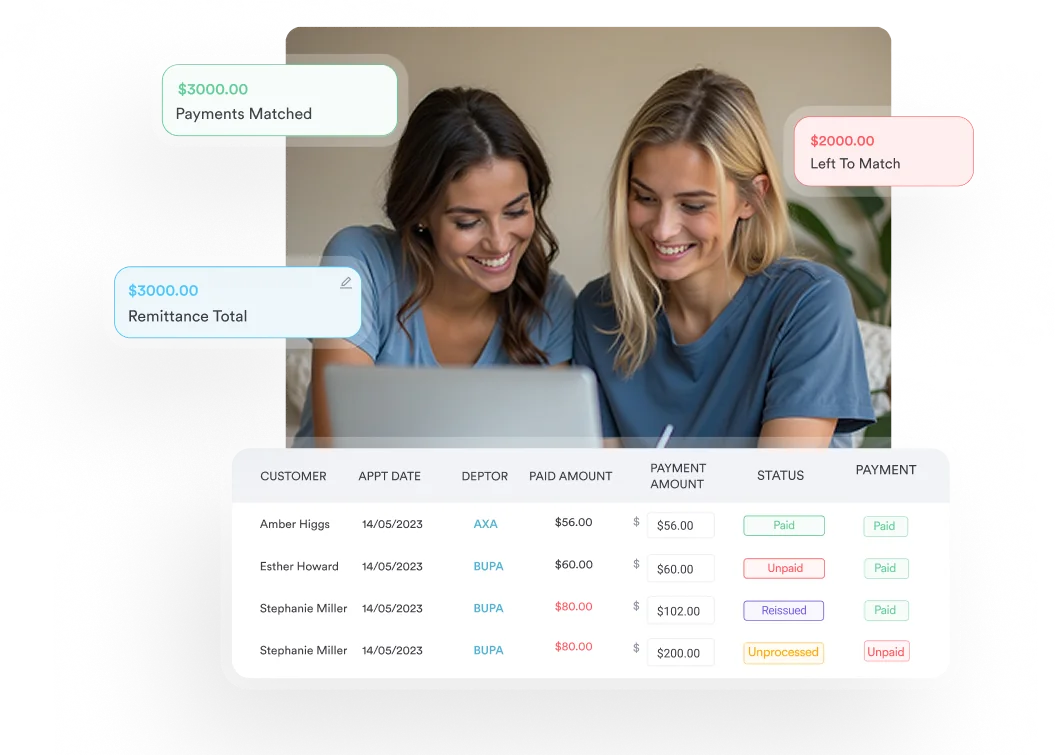

Pabau’s claims management software builds claims from the patient record, checks eligibility and posts remittances through the Claim.MD clearinghouse. Billing errors surface in your workflow, not in a denial letter.

CPT Code 86923 is quick to perform and easy to lose on a claim. The electronic method only stands when the record proves two concordant ABO determinations and a clean antibody history. Without both, the unit belongs under 86922.
The payment side is narrow. Medicare pays 86923 only on hospital claims, so a lab or office billing it to Medicare is chasing money that will not come. Reconcile the LIS log against the charge lines before each claim run, and an audit has little to find. Book a demo to see how Pabau keeps clinical records and claim submission in one workflow.

Need to understand how claims move from submission to payment? Submitting a clean claim walks through the technical requirements that keep blood bank and lab claims out of the denial queue.
Looking for broader billing compliance guidance? Medical billing compliance covers the documentation and audit standards that apply across laboratory and transfusion billing.
CPT Code 86923 covers a compatibility test, each unit; electronic. It is the electronic (computer) crossmatch, in which the LIS confirms ABO compatibility between a donor unit and the patient without a serologic reaction. It is billed once per donor unit tested.
CPT 86923 is the electronic (computer) crossmatch, while CPT 86922 is the serologic (antiglobulin) crossmatch that needs a wet-lab reaction. They cannot be reported for the same donor unit on the same date. Billing both triggers an NCCI edit, and 86923 is denied.
There is no per-encounter cap. Bill 86923 once per donor unit that was electronically crossmatched, provided each unit has a corresponding LIS crossmatch record. If four units were tested, report four units on the same date of service, one per line or in the payer’s quantity format.
Yes, but only on hospital claims. Under OPPS, 86923 sits in APC 5672 with status indicator Q1, at a national unadjusted rate of $174.06 in October 2026. It is packaged when billed with a status S, T or V procedure. The code is not on the CLFS, and the Physician Fee Schedule lists it as a statutory exclusion.
Five triggers account for most denials. The record lacks two concordant ABO determinations or a current negative antibody screen. 86923 and 86922 are billed for the same unit, which trips an NCCI edit. The diagnosis code does not support a transfusion. Or the claim’s unit count does not match the LIS crossmatch records.
Yes, but only when each code covers a different donor unit. If one unit was crossmatched electronically and another needed a serologic crossmatch after a new antibody appeared, both codes can go on the claim. Report one line each, with different unit identifiers. Some payers also want a distinct-unit modifier such as XU to clear the NCCI edit.