



CCSD code G5100: Bypass of duodenum billing guide
CCSD code G5100 bills a bypass that leaves the duodenum in place CCSD code G5100...

Last Updated: Oct 16, 2026
CPT code 86900 is the billing code for blood typing, serologic; ABO. It reports a laboratory test that identifies a patient’s ABO blood group by serologic method. The code sits in the Transfusion Medicine subsection (86850-86999) of the AMA’s Pathology and Laboratory section.
Medicare prices 86900 on the Clinical Laboratory Fee Schedule, so one national amount applies wherever the test runs. Rh typing carries its own code, 86901, and the two usually appear on the same claim. Most denials on 86900 trace back to the diagnosis code rather than the test.

CPT code 86900 describes serologic ABO blood typing, which is separate from Rh typing under CPT 86901.
Medicare prices 86900 on the Clinical Laboratory Fee Schedule, a single national amount with no facility split and no geographic adjustment.
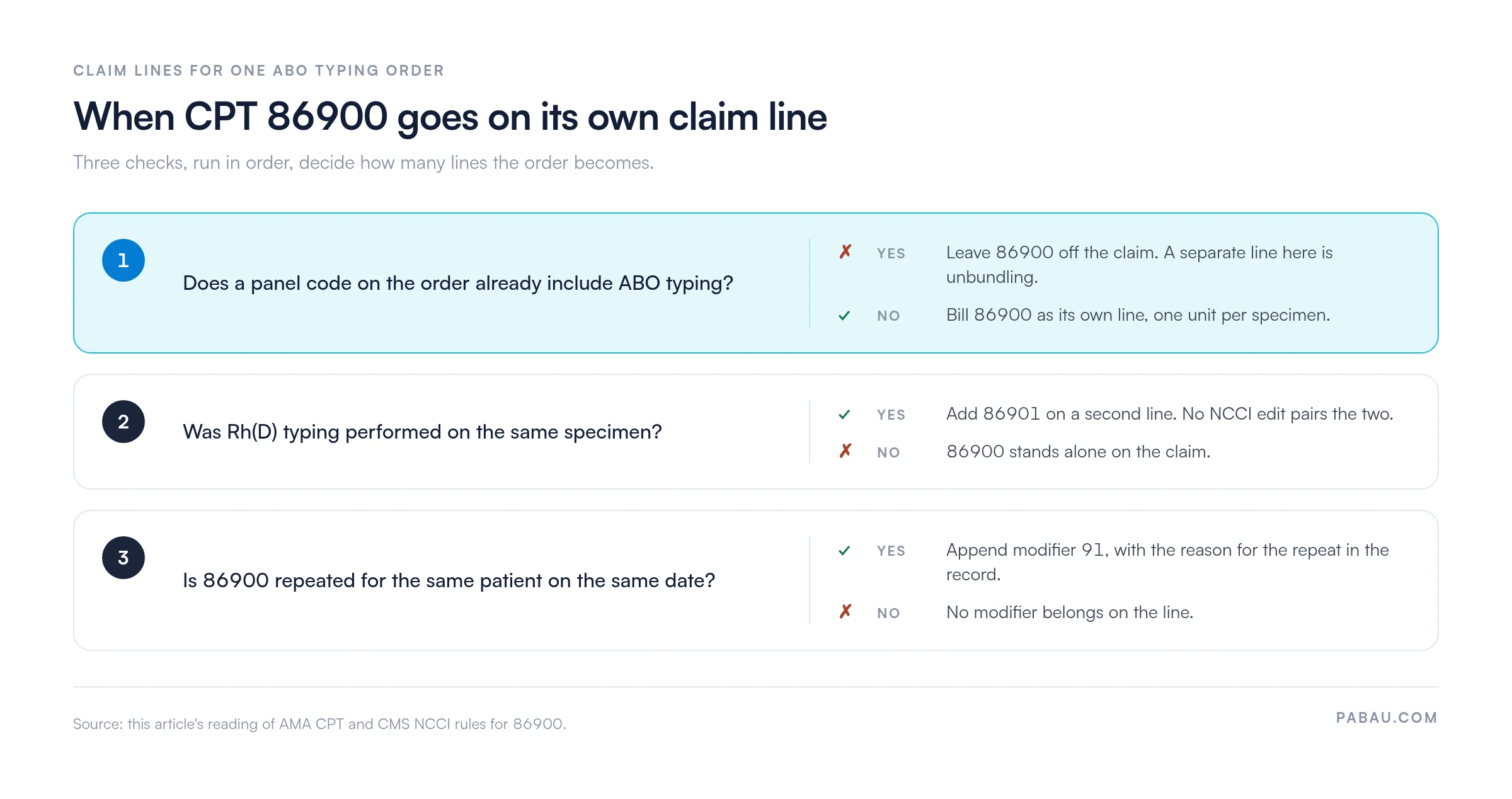
86900 and 86901 are usually billed together but are not bundled under NCCI edits, so each needs its own claim line.
Pabau’s claims management software runs background validation checks and real-time eligibility before a claim leaves the practice.
CPT code 86900 is a laboratory procedure code that reports serologic ABO blood group determination. The AMA’s official long descriptor reads: “Blood typing, serologic; ABO.” According to the AMA’s CPT code set overview, the Transfusion Medicine subsection covers the laboratory testing that supports safe blood administration.
The code is reported per specimen tested, so each patient sample counts as one reportable unit. It does not include Rh(D) typing, which is coded separately under CPT 86901. Most blood bank orders cover both, so both codes appear on the same claim.
Blood group typing is indicated any time a clinician needs a patient’s ABO status before an event that carries transfusion risk. The three dominant scenarios are pre-transfusion workup, pre-surgical preparation, and prenatal screening.
Syphilis screening belongs to that same first prenatal visit. Which code carries it, 86592 or 86780, depends on whether the laboratory runs the traditional or reverse-sequence algorithm.
Medical necessity documentation must reflect one of these established clinical indications. Ordering ABO typing without a documented clinical reason is the most direct path to a claim denial.
Medicare prices CPT code 86900 under the Clinical Laboratory Fee Schedule (CLFS), not the Physician Fee Schedule. That distinction decides how the rate is read. The CLFS carries one national amount per code, and 86900 sits in the lowest reimbursement tier of the laboratory codes.
Plenty of published references quote a Physician Fee Schedule figure for 86900, split into facility and non-facility rates. Neither number applies here. Since the 2018 CLFS overhaul the schedule has carried no site-of-service differential and no GPCI locality adjustment, so the amount does not move by region.
Read the current figure from CMS’s published CLFS files rather than the MPFS lookup tool. The Clinical Laboratory Fee Schedule page carries the annual rate file and the quarterly updates.
Commercial payers set their own laboratory rates and are not bound by the CLFS. Reading the remittance advice after each payment cycle is the fastest way to catch a rate that has drifted from the contract.
Medicare covers CPT 86900 when the test is performed for an established clinical reason tied to an active diagnosis. Coverage runs through contractor-level Local Coverage Determinations rather than a single National Coverage Determination. The policy that applies depends on the MAC jurisdiction where the claim is filed.
Commercial payer rates vary widely. Some payers fold ABO typing into a broader panel fee. Others reimburse it as a standalone line item, so verify the patient’s plan contract before billing.
Run a pre-claim eligibility check before submitting 86900 for outpatient laboratory encounters. Some commercial payers require prior authorization for non-emergency blood typing ordered outside hospital settings, particularly in pre-op workups for elective procedures. Catching this before claim submission avoids retroactive denials.
CPT code 86901 (blood typing, serologic; Rh(D)) is the companion code billed alongside 86900 in nearly every transfusion medicine and prenatal workup. 86900 captures the ABO determination and 86901 captures the Rh factor result. They are distinct codes for distinct analytes, billed on separate lines on the same date of service. Where the workup ends in a transfusion, the administration itself is billed under 36430.
A full type and screen therefore bills as three lines. 86900 reports the ABO determination, 86901 the Rh(D) result, and 86850 the antibody screen.
CPT codes 86900 and 86901 are not subject to a mutual exclusion NCCI edit when billed on the same date. Each describes a distinct serologic test, so both belong on the claim when both tests were run. Billing only 86900 when both were performed costs the practice the 86901 payment.
Bundling problems arise instead with panel codes that already include ABO typing. Three checks, run in order, settle how many lines one ABO typing order becomes.
Pairing CPT code 86900 with the correct ICD-10-CM diagnosis code is what supports medical necessity on the claim. The Z67 series records blood type status as an encounter reason. Pregnancy and pre-op codes apply when typing is ordered in those contexts.
Check each code against the FY2026 tabular list before it goes on a claim, or against our ICD-10-CM code reference. The AAPC CPT-to-ICD-10 crosswalk is a quick way to confirm that a pairing is still valid.
Select the most specific code available. Reporting Z67.90 when the chart already records the patient’s blood type is a documentation defect that invites scrutiny during a payer audit.
Meeting the documentation threshold for CPT 86900 is straightforward, but it has to be applied consistently. Missing elements are the most common trigger for medical necessity denials on laboratory claims. The medical record must include all of the following:
Capturing these fields at the point of order entry, on a structured superbill, cuts the volume of records requests that arrive after submission.
CPT code 86900 billing guidelines cover place of service selection, modifier use, and per-specimen reporting. Getting any one of them wrong is enough to trigger a denial or a payment reduction.
The place of service (POS) code tells the payer where the test was performed. POS 11 identifies a physician office, POS 22 an outpatient hospital, and POS 21 an inpatient hospital. Billing POS 11 for a test run in a hospital-based laboratory is a mismatch that payers catch during claim review.
Modifiers are rarely required on a standalone 86900 claim. Modifier 91 applies when 86900 is billed more than once on the same date for the same patient and the repeat is clinically justified. Do not reach for modifier 59 to override a bundling edit without confirming the edit and its bypass criteria with your MAC.
The claim defects below come from recurring patterns in transfusion medicine billing audits. Each one has a resolution that takes minutes when it is caught before the claim goes out.
After any payer contract renewal, run a 90-day audit of your 86900 and 86901 remittance data. Check that the new rates reached your payments. Payers sometimes delay contract updates in their adjudication systems, and the shortfall on high-volume laboratory codes adds up quickly.
A single ABO typing order leaves four records behind, and the claim has to agree with all of them:
In most setups each of those is keyed by hand into a separate system. One mismatch between the order and the claim is enough to trigger a medical necessity denial weeks later.
Pabau is an all-in-one practice management system. Its claims software for practices keeps the order, the result and the claim in one patient record. Background validation checks run over a claim before it leaves the practice, so obvious defects surface while the biller still has the file open.
Claims route to payers through the Claim.MD clearinghouse, which returns real-time eligibility for thousands of payers. Confirming coverage before submission removes the inactive-coverage denials that a manual workflow only discovers on the remittance.
The 837P file Pabau generates carries the fields a laboratory claim needs, including the rendering provider NPI, the place of service, and the specimen date. Getting those right on the first pass is what shortens the payment cycle on high-volume laboratory codes.

Pabau keeps the order, the diagnosis code and the claim in one patient record. Background validation checks and real-time eligibility run before submission, so your 86900 and 86901 lines go out complete.

Billing CPT code 86900 accurately comes down to three habits. Pair the code with a diagnosis that matches the documented reason for the order. Add 86901 whenever Rh typing was performed, and keep the finalized result in the chart where an auditor can find it.
The code itself is simple. The money goes missing in the workflow around it. An order, a result and a claim get keyed into three systems that never compare notes.
Catching a defect before submission is worth more than appealing it afterwards, because a laboratory line rarely pays back the labor an appeal costs. Book a demo to see how Pabau handles laboratory claims inside the patient record.

Need to understand the full claims submission process? What is medical billing covers the end-to-end workflow from patient encounter to payment posting.
Concerned about claim denial patterns across your lab codes? Denial codes in medical billing provides a reference for reading and responding to payer rejection reasons.
Want to understand how clearinghouses validate your claims? Medical claims clearinghouse guide explains how payers, clearinghouses, and providers exchange claim data.
Wondering how the specimen collection itself is billed? CPT code 36415 covers routine venipuncture, the draw that produces the specimen 86900 is run on.
CPT code 86900 is the billing code for serologic ABO blood typing, a laboratory test that determines a patient’s ABO blood group. It is used in pre-transfusion workups, pre-surgical preparation, prenatal screening, emergency medicine, and blood donor screening. Each test performed on a distinct patient specimen is reported as one unit of 86900.
CPT code 86900 is billed per specimen on a CMS-1500 or 837P electronic claim. The line carries the ordering provider’s NPI, the date of specimen collection, the place of service, and a supporting ICD-10-CM diagnosis code. It is almost always accompanied by CPT 86901 (Rh typing) on the same date-of-service line.
Medicare prices CPT code 86900 on the Clinical Laboratory Fee Schedule, which carries a single national amount per code. There is no facility or non-facility split and no geographic adjustment. Read the current figure from CMS’s published CLFS rate file, which is updated each January.
No. CPT 86900 (ABO typing) and CPT 86901 (Rh typing) are not subject to a mutual exclusion NCCI edit. Bill them on separate lines when both tests are performed on the same date. They represent two distinct serologic tests on different analytes, so billing both is correct and not an unbundling violation.
The most common ICD-10-CM codes paired with CPT 86900 are the Z67.10-Z67.91 blood type status codes and Z34.xx for prenatal supervision. Z01.812 covers a pre-procedural laboratory examination, and Z01.83 covers an encounter for blood typing. Select the most specific code that matches the documented clinical reason for the order.
Yes. CPT 86900 is appropriate for prenatal ABO blood typing at the first obstetric visit, paired with a Z34.xx trimester-specific diagnosis code. If Rh typing is also performed at the same visit (which it typically is), CPT 86901 is reported alongside it on the same claim.
The medical record must include the ordering provider’s identity and NPI, a documented medical necessity statement, and the date and type of specimen collected. It must also carry the finalized test result and an ICD-10-CM diagnosis code that matches the clinical reason for the test. Claims submitted without a documented result or with a mismatched diagnosis code are the most common denial triggers.



