

HCPCS code E0198: Water pressure pad billing guide
HCPCS code E0198 is a water pad for a standard mattress HCPCS code E0198 is the ...

Last Updated: Oct 13, 2026
86850 is the CPT code for antibody screen, RBC, each serum technique.
The descriptor's "each serum technique" wording is where most units disputes start. A single type and screen order generates three separate CPT codes, not one. Conflating them is the most common reason these claims come back denied under CARC CO-97. The comparison table, the ICD-10 pairing guide, and the denial checklist below are built to prevent that.
Let Pabau's smart automation suggest the right codes, reduce claim denials, and keep your practice compliant—effortlessly.
Automate repetitive tasks and focus on what matters most—your patients.
Reduce coding errors and ensure compliance with the latest regulations.
Clean claims, fewer denials, and faster reimbursements.
Powerful insights and reporting to help your practice thrive.
HIPAA compliant SOC 2 certified GDPR-compliant Trusted by 4,000+ clinics worldwide

CPT code 86850 covers one antibody screen by one serum technique, so bill one unit per technique, not per order.
A type and screen maps to three separate codes, 86900 for ABO, 86901 for Rh (D), and 86850 for the screen.
A diagnosis code that fails to support medical necessity is the top denial driver on 86850 claims.
Add 86870 only when the screen comes back positive, because billing both on a negative result reads as unbundling.
Practice management software like Pabau tracks lab code submissions and flags bundling errors before the claim reaches the payer.
CPT code 86850 is the billable code for a red blood cell antibody screen, priced per serum technique. Its official descriptor is Antibody screen, RBC, each serum technique. The American Medical Association keeps it in the transfusion medicine range, 86850 to 86999.
The lab incubates the patient’s serum or plasma with reagent red cells and watches for unexpected alloantibodies. Those antibodies can trigger a transfusion reaction, so the screen runs before elective surgery, during pregnancy, and after a reported reaction.
The screen does not name the antibody. It only confirms that one is present, which is why a positive result sends the sample on to antibody identification under CPT 86870.
The code covers the indirect antiglobulin test itself, run by gel, tube, or solid-phase method on patient serum or plasma. Each distinct serum technique counts as one billable unit. No other step in the transfusion workup rides along with it.
What 86850 includes:
What 86850 excludes, so never bundle these into it:
Billing 86850 and 86870 together on a negative screen is the unbundling error payers flag most often here. A negative result supports 86850 alone. A positive result supports both. The sequence below shows which code fires at each step, and where that bundling line sits.
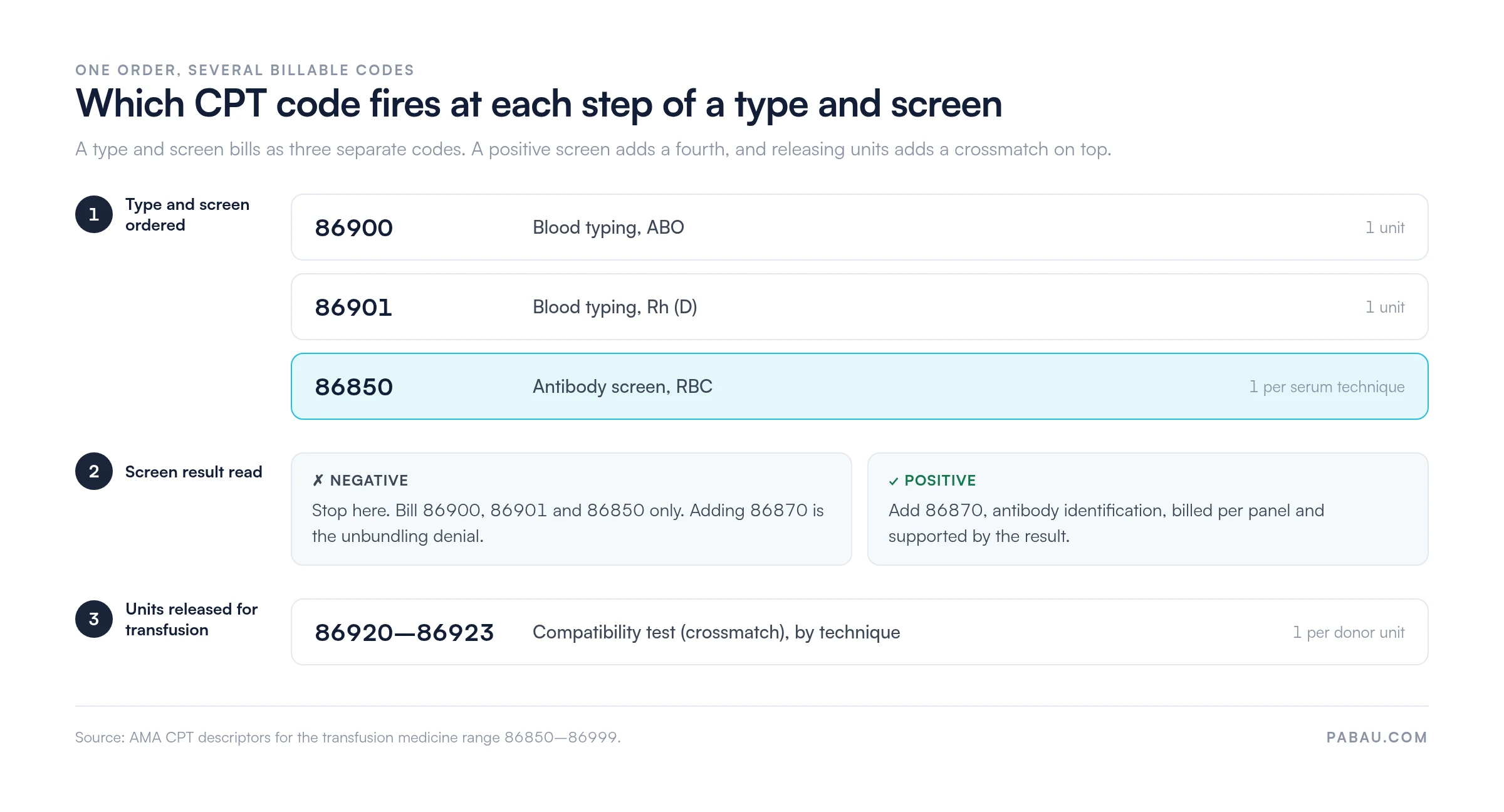
The screen follows the same five steps whatever technique the lab picks. Knowing the sequence lets you tie each documentation requirement to the moment it happens.
Documentation carries the claim from there. The lab report has to name the ordering provider, the clinical indication, the technique used, the result, and the date of service.
The performing laboratory’s CLIA number belongs on the claim itself, not only in the lab’s own files. On a CMS-1500 it sits in Box 23.
On an 837P it sits in loop 2300 as REF*X4, or in loop 2400 as REF*F4 when a reference lab ran the test. Under 42 CFR Part 493 the screen needs at least a moderate-complexity CLIA certificate, because it is not waived.
Flag the technique in the lab report before you submit. ‘Antibody screen performed’ is not enough. The report should say gel method, tube method, or solid-phase method. Payers audit technique specificity when they review units billed, and a vague report supports one unit however many techniques ran.
Six codes in the transfusion medicine range sit close enough to 86850 to get swapped for it. Each one answers a different clinical question, and mixing them up produces a CO-97 denial or an NCCI edit.
The four crossmatch codes split by method. 86920 is the immediate spin technique, 86921 the incubation technique, 86922 the antiglobulin technique, and 86923 the electronic crossmatch.
No. A type and screen is a clinical order, not a single code. It bills as three separate lines, 86900 for ABO typing, 86901 for Rh (D) typing, and 86850 for the antibody screen.
Billing 86850 alone for a full type and screen under-codes the encounter, and the lab never sees the other two payments. Quest Diagnostics lists the same three-code structure for its type and screen, test code 795. Individual lab contracts still vary, so confirm the mapping against your own payer policy.
A diagnosis that fails to support medical necessity denies more 86850 claims than any other error. The code you submit has to state why the screen was ordered. The table pairs the codes payers accept most often with the scenario behind each one.
Watch the fetus digit on the obstetric codes. O36.0110 is the “not applicable or unspecified” option, and O36.0111 is the code for fetus 1. Picking the wrong one on a multiple pregnancy is an easy correction that payers still deny.
Check every code against your Medicare Administrative Contractor’s Local Coverage Determination before you submit. Coverage moves by region and by payer.
Some commercial plans also want a diagnosis naming the planned procedure rather than a general screening code. Our ICD-10-CM code lookup carries the full descriptors if you need to confirm one.
Medicare pays 86850 from the Clinical Laboratory Fee Schedule, not the Physician Fee Schedule. The split follows the work, because a lab procedure is not a physician service. Commercial rates are usually negotiated off that same CLFS figure.
It helps to follow one claim end to end. The lab drops 86850 onto an 837P professional claim with the ordering provider’s NPI, the supporting diagnosis, and one unit.
The CLIA number rides in loop 2300 as REF*X4. When a reference lab performed the test, it moves to loop 2400 as REF*F4 instead. Clearinghouses reject a missing CLIA segment before adjudication ever begins, so the claim never reaches a payer to be denied.
The payer then adjudicates and returns an electronic remittance advice, carrying either the allowed amount or a denial code. Reconcile that remittance against your contracted fee schedule every month. CLFS rates reset each January, and a stale fee schedule quietly under-collects all year.
One unit equals one technique applied to one specimen. Two methods run on the same specimen on the same date can support two units, but only with a report that names both.
In practice, most Medicare Administrative Contractors and commercial payers cap 86850 at one unit per date of service, whatever the technique count. Read your MAC’s Local Coverage Determination before you bill a second unit. The medically unlikely edit value is the number that settles it.
86850 denials fall into six familiar patterns, and most are preventable before the batch transmits. The table maps each pattern to its denial code and the fix action.
Work the denial code before you touch the claim. A CO-50 needs a different diagnosis, so resubmitting the same line only burns another filing day.
A complete lab report does not guarantee a payable claim. Eight items decide whether an 86850 line pays on the first pass, so walk them before the batch goes out.
Lab superbills differ from office visit superbills in three places, the CLIA number, the ordering provider’s NPI, and the technique notation. Billing teams new to lab work miss those three more than any others. The superbill requirements guide sets out what belongs on each one.
Audit your 86850 claims against your MAC’s current LCD once a quarter. LCDs update, and the covered ICD-10 list for antibody screens moves with them. A diagnosis covered last year may now need an ABN, or may have dropped off entirely. Build the review into January, after CMS publishes the annual fee schedule updates.
Most labs find their coding errors after the payer does. The remittance arrives, somebody reads the denial code, and the claim gets reworked weeks after the specimen was drawn. On a code paying six dollars, that rework costs more than the claim.
Practice management software like Pabau checks the claim while it is still editable. It holds the CPT and ICD-10 pairing together, and flags a unit count above the payer’s limit. It also stops the 86850 and 86870 combination when no positive screen is on file.
Claims then submit electronically, and the remittance posts back against the original line. Your billers spend their time on the handful of claims that genuinely need a decision. That is where faster claims management earns its place on a low-value lab code.

Pabau checks CPT and ICD-10 pairings, flags unit counts above the payer limit, and submits claims electronically. Book a demo to see how it handles transfusion medicine coding.

86850 pays a few dollars and generates enough rework to cost more than it earns. The win is submitting it once, cleanly, with the documentation already behind it.
Three habits close most of the leak. Code a type and screen as three lines. Hold 86870 until the screen comes back positive. Match the diagnosis to your MAC’s LCD before the claim leaves the building.
Audit one month of 86850 claims against those three rules and the pattern behind your denials will show up fast. Book a demo to see how Pabau validates lab codes and posts remittances back to the right line.

Need to know how clearinghouse submissions work for lab codes? Pabau’s Claim.MD clearinghouse guide covers how 837P files route to payers and how ERA responses map back to your claims.
Working a denial and need the full code list? Denial codes in medical billing maps every CO, MA, and OA code to the denial type and the recommended appeal action.
Want to see where lab revenue leaks across the cycle? What is revenue cycle management walks the process from order entry through payment posting, including lab claim workflows.
Modifier 90 applies when the billing lab sends the specimen to an outside reference laboratory. The referring lab appends 90 to 86850 and bills the payer, while the reference laboratory bills nobody. Medicare restricts this arrangement, so check your MAC’s policy before you use it.
Three days, when the patient has been transfused or pregnant in the previous three months. AABB standards require a fresh draw after that window closes. A new specimen means a new antibody screen, which is separately billable.
Only when the diagnosis falls outside your MAC’s Local Coverage Determination. Issue the ABN before the draw, have the patient sign it, and append modifier GA to the claim line. Skip it and the practice absorbs the denial.
No. The organ and disease oriented panels in the 80047 to 80081 range do not include transfusion medicine codes. 86850 is reported on its own line, whatever else the lab ran that day.
A treating physician or another qualified provider, and the order has to state a clinical reason. Lab staff cannot add 86850 to a requisition on their own. Payers ask for the signed order when they audit the claim.



