CPT code 95808: Attended polysomnography billing guide
CPT code 95808 covers attended PSG with 1 to 3 extra channels CPT code 95808 is ...

Last Updated: Nov 11, 2026
99423 is the CPT code for an online digital evaluation and management service for an established patient, totaling 21 or more minutes over 7 days.
The patient starts the exchange with a message through a secure portal, and the physician or other qualified health professional replies asynchronously. The 7 days begin when the clinician first reviews the message. Use 99421 for 5-10 minutes and 99422 for 11-20 minutes.
Let Pabau's smart automation suggest the right codes, reduce claim denials, and keep your practice compliant—effortlessly.
Automate repetitive tasks and focus on what matters most—your patients.
Reduce coding errors and ensure compliance with the latest regulations.
Clean claims, fewer denials, and faster reimbursements.
Powerful insights and reporting to help your practice thrive.
HIPAA compliant SOC 2 certified GDPR-compliant Trusted by 4,000+ clinics worldwide

CPT code 99423 bills 21 or more minutes of online digital E/M work over 7 days, started by an established patient’s portal message.
The total counts every minute the billing clinician spends reviewing records, researching and replying, across every session in the 7-day period.
Don’t bill 99423 when a related E/M visit happened in the 7 days before the message, or takes place during the 7-day period.
Pabau, the practice management platform we build, sends US claims through Claim.MD with eligibility checks, while your notes carry the time log and conflict check.
CPT code 99423 is the online digital evaluation and management (E/M) code for established-patient inquiries totaling 21 or more minutes over 7 days.
The American Medical Association (AMA) publishes it as the top tier of the 99421-99423 family. All three codes share one framework. The patient starts the contact, the exchange is asynchronous and non-face-to-face, and only established patients qualify.
Asynchronous means the clinician doesn’t answer in real time. The patient sends a message through a HIPAA-compliant patient portal, and the clinician reviews it and replies on their own schedule.
The 7 days begin when the clinician first personally reviews the message. Time spent on prior records, research and writing the response all counts toward the total.
The 99421-99423 family uses cumulative time as its only tier rule. Add every minute the billing clinician spends on the inquiry, across as many sessions as it takes, then pick the code that total reaches.
Shorter inquiries go to 99421 or 99422, and the ladder below shows where each band starts and what it pays.
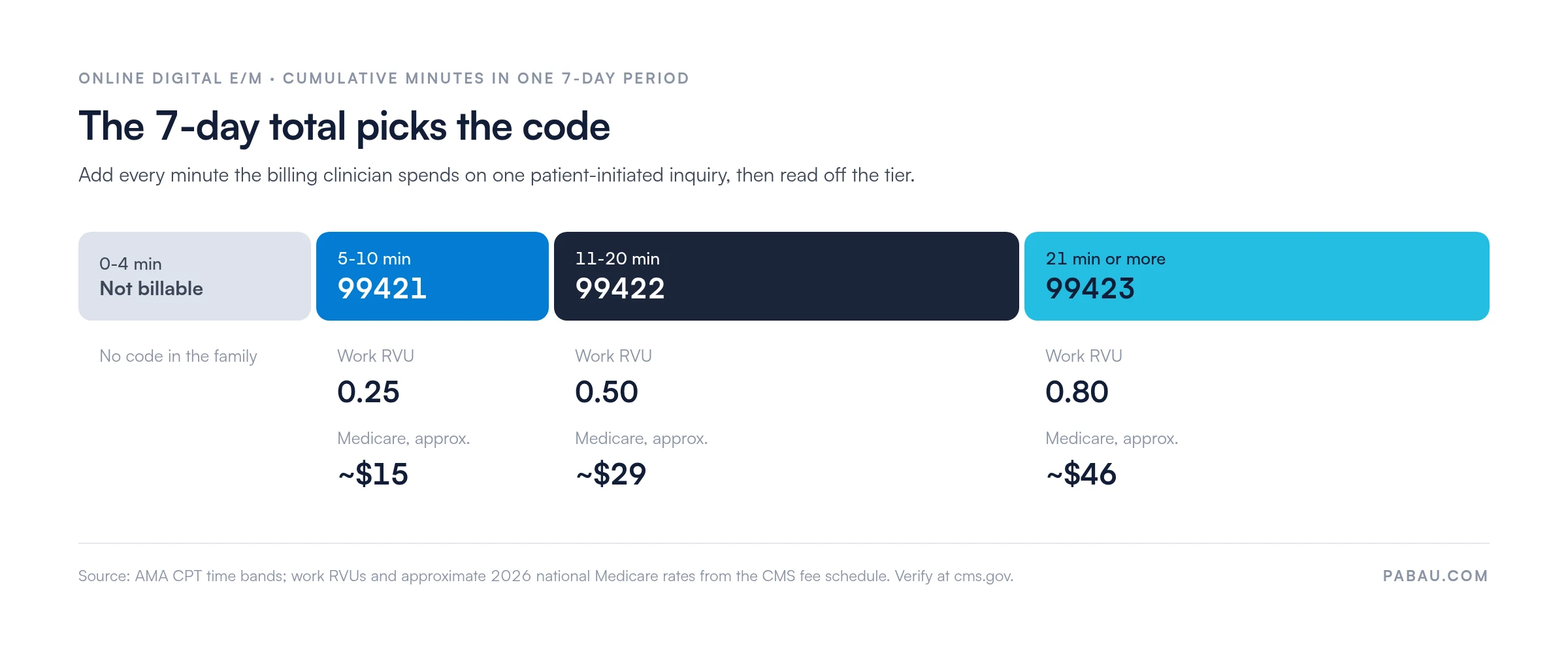
Under 5 minutes doesn’t meet any code in the family, so don’t bill it. Count whole minutes and never round up to reach the next tier. Record start and stop times, or each session’s total, so an auditor can rebuild the number you billed.
Watch for one timing trap. If you billed a lower tier before the 7 days closed and the work kept going, payers expect one code for the whole period. That usually means a corrected claim replacing the 99421 or 99422 with the higher tier.
CPT code 99423 is billed by a physician or other qualified health care professional (QHP) who can report E/M services independently. The claim goes under the performing clinician’s own NPI, and incident-to billing doesn’t apply.
The established-patient rule has no exceptions. A first-time contact through the portal can’t be billed under 99421-99423, however long it takes. Billing for a new patient is a compliance risk and a common denial reason.
Here’s one inquiry followed through the medical billing process, using an illustrative patient. On Monday, an established patient with type 2 diabetes messages the portal about rising morning glucose readings and a new medication’s side effect.
The physician spends 9 minutes on the glucose log and chart that afternoon. On Tuesday, checking the medication question takes another 8 minutes. On Wednesday, writing the plan and replying takes 6 more. That’s 23 minutes inside 7 days, so the claim is 99423.
Every element of the code definition has to show in the record. One missing element can turn into a denial, or an overpayment finding on audit. Build these into a standardized note template, so the clinician completes them before replying.
Medicare sets the 99423 rate each year through the Medicare Physician Fee Schedule (MPFS). The table shows approximate national non-facility and facility rates. Rates change every calendar year.
Check current amounts in the CMS Physician Fee Schedule lookup tool or with your Medicare Administrative Contractor (MAC) before you submit.
The FastRVU lookup tool breaks 99423 into work, practice expense and malpractice RVUs, plus the geographic adjustments that move your local payment. Commercial payers negotiate their own rates, which can land above or below Medicare.
Compare 99423 payments every quarter. Pull your ERA data, work out the average payment per claim for each payer, and flag any payer that sits below the Medicare rate. Those numbers give you a concrete case for the next contract negotiation.
Yes, Medicare Part B pays for 99423 as an online digital E/M service under the Medicare Physician Fee Schedule. The usual Part B cost sharing applies, which can surprise patients who assume a portal message is free.
Medicare’s virtual-care policies have changed often in recent years. Confirm the current rules with your MAC rather than relying on guidance from an earlier coverage period.
Most 99423 denials are preventable, and the same few errors show up from practice to practice. A denial management workflow catches them before submission rather than after. When one slips through, the claim denial codes on the remittance tell you which fix applies.
Focusing on submitting a clean claim the first time cuts out the costliest part of the denial cycle. That’s the time spent working remittances, writing appeals and resubmitting.
Audit your 99423 claims each quarter. Match every billed claim to a timestamped, patient-initiated portal message in the same 7-day period. A claim without that trail is a potential overpayment finding.
Several non-face-to-face services look like 99423 but bill under other codes. Mixing them up is a common unbundling or upcoding risk.
99423 revenue usually slips away before a claim exists. A clinician answers a portal message between appointments, doesn’t note the minutes, and the encounter never reaches billing.
In Pabau, patients send messages through the patient portal, which the practice switches on. The clinician records each session’s minutes and the 7-day conflict check in the patient’s notes, where an auditor will look for them. When the note is done, the claim pre-fills from the patient record, and streamlined claims management checks the required fields before it can be sent.
US claims go to Claim.MD as 837P files, with an eligibility check before submission. Remittances post back from the ERA, so you can see which 99423 claims paid and which need work.

Pabau pre-fills claims from the patient record, checks required fields and sends US claims through Claim.MD after an eligibility check. Your team stops rekeying portal encounters.

CPT code 99423 pays for work your clinicians already do in the portal. In return, it asks for three habits. Confirm the patient started the contact, log every minute, and check for a related visit before you code.
Start with the log. A practice that records minutes as they happen can bill the right tier and defend it on audit. One that rebuilds the time from memory at the end of the week will underbill, overbill, or both.
Book a demo to see how Pabau turns a finished portal note into a clean claim sent through Claim.MD.

Need a broader overview of the medical billing process? What is medical billing explains the full revenue cycle from patient encounter to payment posting.
Troubleshooting denied claims across your whole claims portfolio? Denial codes in medical billing covers CARC and RARC codes, appeal workflows and prevention strategies.
Want to see where the clearinghouse fits in a 99423 submission? Medical claims clearinghouse explains how 837P files are validated and routed to payers.
Consulting a specialist about the patient instead? CPT code 99451 covers the consulting physician’s side of an interprofessional exchange.
Reviewing device data between visits? CPT code 99457 bills remote physiologic monitoring treatment management time.
Once per 7-day period, however many messages the patient sends. All of the billing clinician’s time on the inquiry in that period goes into a single code.
Usually, yes. Under Medicare, the Part B deductible and 20% coinsurance apply, and commercial plans may charge a copay. Tell patients before you bill, so a statement for a portal message doesn’t come as a surprise.
Clinicians who can’t report E/M services, such as physical therapists, clinical psychologists and clinical social workers, use 98970-98972. Those codes follow the same 5-10, 11-20 and 21-plus minute bands over 7 days.
Only if it arrives through a secure, HIPAA-compliant platform such as a patient portal. Standard SMS and personal email don’t meet the requirement, so move the conversation into the portal.
If the inquiry leads to a related E/M visit within the 7 days, don’t bill 99423. The portal work is folded into that visit and isn’t billed separately.