CPT code 21011: Excision of soft tissue tumor of the face
CPT code 21011: Official descriptor and procedure overview CPT code 21011, as pu...

Last Updated: Oct 8, 2026
CPT code 85652 is the billing code for the automated erythrocyte sedimentation rate (ESR) test. It reports an ESR run on an automated analyzer, rather than by the manual Westergren method, which is CPT 85651.
The test records how far red blood cells settle in a tube over one hour, and a raised result points to systemic inflammation.
Medicare prices 85652 under the Clinical Laboratory Fee Schedule at roughly $4.50 to $5.50, as a single national rate. The claim also needs a supporting ICD-10 code and a moderate-complexity CLIA certificate.
Below you will find the code description, clinical indications, ICD-10 pairings, 2026 rates, modifiers, and the documentation an auditor expects.

CPT code 85652 reports the automated ESR test, and CPT 85651 reports the manual, non-automated method.
Medicare prices 85652 on the Clinical Laboratory Fee Schedule, one national rate of roughly $4.50 to $5.50.
Pair 85652 with a supporting ICD-10 code such as R70.0 or M06.9 to establish medical necessity.
Modifier QW never applies, because the automated method is moderate complexity rather than CLIA-waived.
Practice management software like Pabau attaches CPT codes to treatment records, cutting manual billing entry before submission.
CPT code 85652 sits in the hematology and coagulation section of the CPT code set. It describes an erythrocyte sedimentation rate measured on an automated analyzer.
The result records how far red blood cells settle in a tube of anticoagulated whole blood over one hour. The official AMA CPT code set carries the following descriptions for this code:
The ESR test is a non-specific inflammatory marker. A raised result does not name a condition on its own. It shows that inflammation, infection, or another systemic process is present and warrants further investigation. That non-specificity is why the ICD-10 pairing carries so much weight on the claim.
Clinicians order the sedimentation rate CPT code across a wide range of specialties. The test is most common in rheumatology and general internal medicine, where it supports workups for inflammatory and autoimmune conditions. These are the scenarios where it most often appears on a lab requisition:
Because ESR is non-specific, the clinical note has to justify why the test was ordered. Linking the order to a qualifying diagnosis code is what separates a paid claim from a denial. Where a payer requires prior authorization for lab panels, that check belongs before the requisition goes out, not after the result lands.
The only distinction between CPT 85651 and CPT 85652 is the method that produced the result. CPT 85651 covers the non-automated Westergren method. CPT 85652 covers the automated equivalent. Billing the wrong one is among the most common ESR claim errors, especially in hospital outreach labs that run both methods.
The method is fixed by the lab’s equipment, not by clinician preference. If your lab runs an automated ESR analyzer, you bill CPT 85652. If a technician reads the Westergren tube by hand, you bill CPT 85651. Check your CLIA certification level before choosing, because a moderate-complexity certificate is required to perform and bill CPT 85652.
That choice carries through to the diagnosis code and the modifier, which is where automated ESR claims usually fail. The decision path below sets out all four checks in the order a biller works through them.
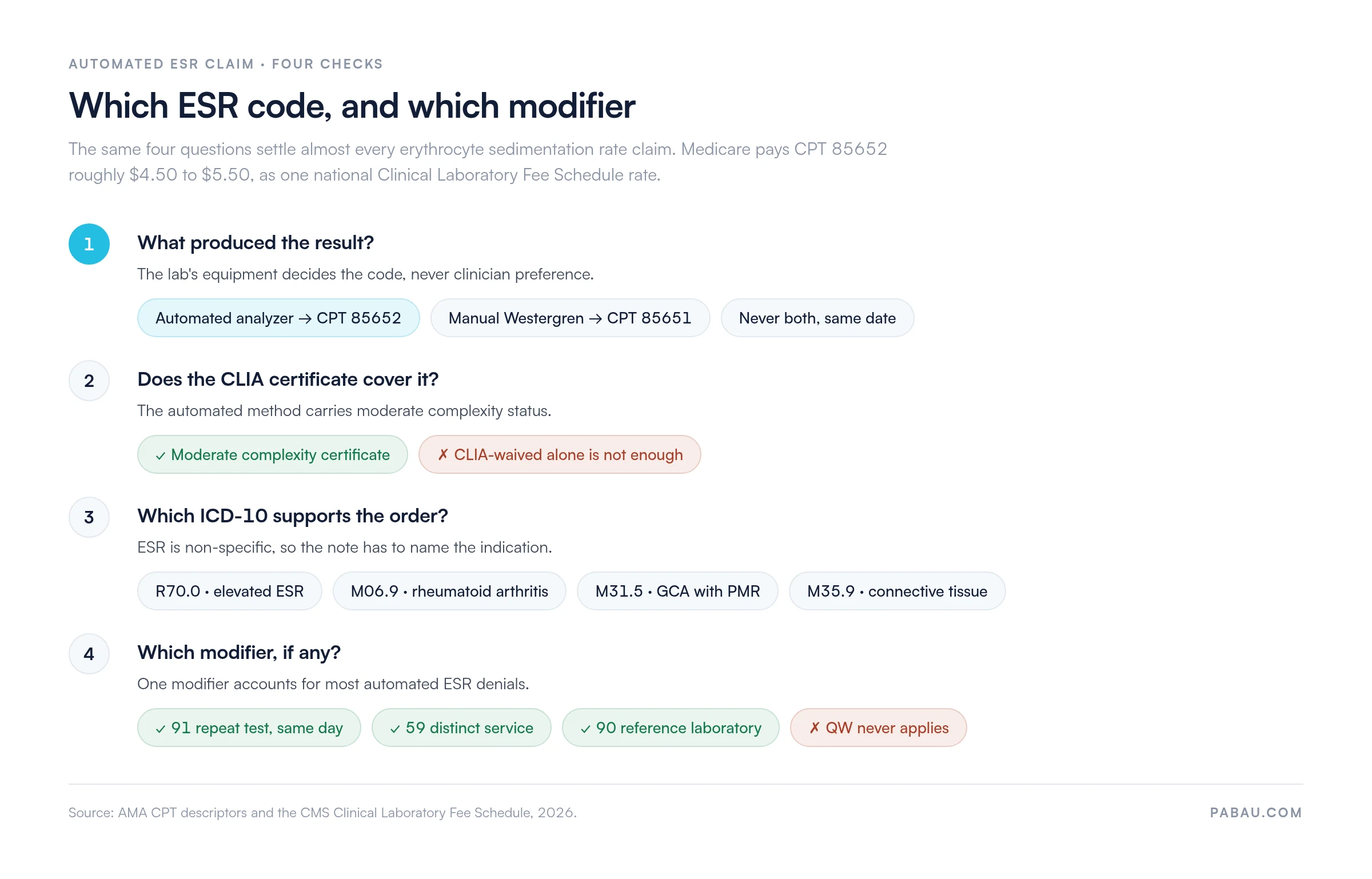
A valid ICD-10-CM diagnosis code is required on every claim for the sedimentation rate CPT code. The code has to reflect medical necessity for the test, and vague or non-specific codes raise denial risk. These are the pairings that appear most often, based on CDC/NCHS ICD-10-CM guidance and standard payer pairing data:
These pairings are widely accepted, but acceptance still depends on the clinical scenario and the payer’s own policy. No ICD-10 code guarantees coverage.
Reserve M31.6, other giant cell arteritis, for GCA documented without polymyalgia rheumatica. Where the record supports a more specific rheumatoid arthritis code, use it rather than defaulting to M06.9.
Medicare prices CPT code 85652 on the Clinical Laboratory Fee Schedule (CLFS), not the Physician Fee Schedule. The 2026 national rate is approximately $4.50 to $5.50, which makes it one of the lower-value hematology codes.
The CLFS pays one national amount per test, so no GPCI geographic adjustment applies and no locality lookup is needed. Confirm the current amount in the CMS Clinical Laboratory Fee Schedule files before you set your own fee schedule.
ESR is a low-value test and is usually billed inside a broader hematology panel. Practices that submit ESR claims as standalone services regularly draw payer scrutiny when the medical necessity documentation is thin. Volume, not unit price, is what makes ESR matter to a rheumatology practice’s revenue.
Check your 2026 ESR rate against the CMS Clinical Laboratory Fee Schedule files before you set your own fee schedule. The CLFS publishes one national amount per test, so there is no locality lookup to run and no GPCI adjustment to apply.
Medicare coverage for CPT 85652 is governed by CMS billing article A57657 and the applicable MAC Local Coverage Determinations (LCDs).
Coverage policy varies by MAC jurisdiction, so verify the current LCD with your local MAC before you assume the test is covered. Eligibility for the patient’s specific Medicare plan, Medicare Advantage included, should be confirmed before the lab order goes out.
Medicare generally covers CPT 85652 when the test is medically necessary for any of the following conditions:
Medicare does not cover ESR ordered as a routine wellness screen without a supporting clinical indication. Z-code screening diagnoses such as Z13.88 may not be accepted by every MAC for this code. Confirm with your MAC’s LCD before you submit a screening ICD-10.
Accurate billing for the sedimentation rate CPT code starts with knowing who may bill it. The place of service and the documentation behind the claim decide the rest. Getting all three right keeps the claim clean and saves an appeal later.
The performing lab must hold a valid CLIA certificate for moderate-complexity testing to bill CPT 85652. A CLIA-waived certificate alone is not enough, because the automated ESR method carries moderate complexity status. Verify the current CMS CLIA database before you rely on that classification.
Modifier QW is the most common incorrect addition to an automated ESR claim. Because CPT 85652 is a moderate-complexity test, the QW modifier does not apply to it at all. Appending it triggers an automatic denial from most payers. Check modifier usage against the payer’s policy and the denial codes your MAC publishes.
Documentation is where most ESR billing problems start. The claim form shows the ICD-10 code, but the patient record has to tell the clinical story behind it. Strong documentation for a CPT 85652 claim includes these elements:
For audit readiness, the documentation should stand on its own. An auditor should be able to identify the clinical question, the test ordered, the result, and the next clinical step without leaving the record. A superbill that pre-populates the ESR code and its common ICD-10 pairings saves time in a high-volume rheumatology practice.
Rheumatology and general medicine billers frequently order ESR as part of a broader panel. Knowing which codes travel with CPT 85652 helps you check for bundling problems and capture the full panel on the claim. These codes appear on the same requisition most often:
Submitting ESR alongside CRP (CPT 86140) on the same claim is generally accepted when both are clinically ordered. Payers occasionally query claims where the two appear together without a clear rationale, so the note should explain why both markers were needed. Each code needs its own support from the ICD-10 diagnosis and the physician order.
Reference sites like AAPC and FindACode give you the code description and stop there. They do not reach into your patient records, your billing queue, or your claim submission. Errors enter at the handoff, when a biller retypes 85652 and its diagnosis code from a browser tab into a separate system.
Pabau’s claims management software attaches CPT codes directly to the treatment record, inside the same platform used for scheduling, clinical notes, and patient management.
When a clinician orders an ESR test, the 85652 code and its paired ICD-10 can be assigned at the point of care. Claims then go out electronically through Claim.MD, our US clearinghouse integration, which routes to over 4,000 payers and supports real-time eligibility checks.
For a lab or practice with high ESR volume, results stay filed against the patient record as they come back. If a denial arrives, the ERA/835 remittance sits beside the original claim, so the appeal is built from one record instead of three systems.

Pabau connects CPT code assignment, patient records, and claim submission in one platform. Attach codes to treatment records, submit via Claim.MD, and catch billing issues before they reach the payer.

CPT code 85652 is a straightforward hematology code, and the claim errors around it are just as predictable. The wrong method code, a missing ICD-10 pairing, modifier QW, and a note that cannot carry medical necessity account for most ESR denials. Each one is preventable at the moment the order is written.
Decide the code from the equipment rather than from habit, and confirm the CLIA certificate covers moderate-complexity testing. Then treat the ICD-10 pairing as a documentation step rather than a billing step.
The note should already say why the test was ordered before the claim is built. Book a demo to see how Pabau keeps ESR coding, documentation, and claim submission on one record.

Need to understand how clearinghouse billing works? Medical claims clearinghouse explained covers how claims flow from practice to payer and where errors typically enter.
Billing compliance keeping you up at night? What is medical billing walks through the full revenue cycle from patient encounter to payment posting.
Getting too many denials on lab claims? Denial management in healthcare explains the most common denial reasons and how to build an effective appeal process.
CPT code 85652 describes the automated erythrocyte sedimentation rate (ESR) test. The test measures how far red blood cells settle in a tube of blood over one hour, which indicates systemic inflammation. The AMA long description is “Sedimentation rate, erythrocyte; automated.” It is classified under the Hematology and Coagulation section of the CPT code set.
CPT 85651 covers the non-automated (manual) Westergren ESR method, while CPT 85652 covers the automated method performed by an analyzer. The method used is determined by the lab equipment, not by clinical preference. Billing both codes on the same date for the same patient is a bundling violation and will trigger a denial.
Medicare prices CPT 85652 on the Clinical Laboratory Fee Schedule (CLFS), not the Physician Fee Schedule. The 2026 national rate is approximately $4.50 to $5.50, which makes it a low-value hematology code. The CLFS publishes one national amount per test, so no GPCI geographic adjustment applies. Verify the current amount in the CMS Clinical Laboratory Fee Schedule files at cms.gov.
CPT 85652 is the code for the automated sed rate (erythrocyte sedimentation rate), and CPT 85651 is the code for the manual, non-automated sed rate. Which code you bill depends on whether your lab runs the test on an automated analyzer or by the manual Westergren technique. Using the wrong one is among the most common billing errors for this test.
CPT 85652 is most often paired with R70.0 (elevated erythrocyte sedimentation rate) and M06.9 (rheumatoid arthritis, unspecified). Other common pairings are M31.5 (giant cell arteritis with polymyalgia rheumatica) and M35.9 (systemic involvement of connective tissue, unspecified). Payer acceptance depends on clinical context, so documentation in the patient record must support the code you submit.
No. Modifier QW is reserved for CLIA-waived tests, and CPT 85652 (automated ESR) carries moderate complexity status rather than waived status. Applying QW to a CPT 85652 claim triggers an automatic denial from most payers. Verify that your CLIA certificate level matches the complexity classification before you submit ESR claims.