

CCSD code G5100: Bypass of duodenum billing guide
CCSD code G5100 bills a bypass that leaves the duodenum in place CCSD code G5100...

Last Updated: Oct 16, 2026
84100 is the CPT code for phosphorus inorganic (phosphate). It reports a quantitative measurement of inorganic phosphorus, usually in serum or plasma. Urine phosphorus is reported with 84105 instead.
When phosphorus is ordered alongside a CMP (80053), it is billed separately under 84100 because the CMP does not include it. The claim also needs a documented clinical indication and a linked ICD-10-CM code that supports medical necessity.
Let Pabau's smart automation suggest the right codes, reduce claim denials, and keep your practice compliant—effortlessly.
Automate repetitive tasks and focus on what matters most—your patients.
Reduce coding errors and ensure compliance with the latest regulations.
Clean claims, fewer denials, and faster reimbursements.
Powerful insights and reporting to help your practice thrive.
HIPAA compliant SOC 2 certified GDPR-compliant Trusted by 4,000+ clinics worldwide

CPT code 84100 covers inorganic phosphorus (phosphate) measurement and is not a component of CPT 80053 (CMP) or CPT 80048 (BMP).
Medicare pays 84100 at a national Clinical Laboratory Fee Schedule (CLFS) rate that CMS publishes and updates every year.
Denials most often stem from missing medical necessity documentation, so every 84100 order needs a linked, supporting ICD-10-CM code.
Pabau’s claims management pulls the diagnosis and procedure codes already on the patient record into a pre-filled claim and submits it via Claim.MD.
CPT code 84100 is classified under Chemistry Procedures (range 82000-84999) with the official descriptor Phosphorus inorganic (phosphate). It covers quantitative measurement of inorganic phosphorus, most commonly in serum or plasma. Also, labs run it with standard photometric or enzymatic methods, and it is billed separately from the metabolic panels, which do not include phosphorus.
Quick-reference code facts, verified against current AMA CPT and AAPC Codify listings:
Inorganic phosphorus is a serum electrolyte that reflects phosphate balance across bone, kidney, and intestinal systems. As a result, clinicians order the test to check or monitor conditions where phosphate homeostasis is disrupted. In fact, that ordering indication is the cornerstone of any medical necessity argument.
First, billing lab chemistry correctly starts with knowing which clinical conditions justify a standalone phosphorus draw. Common ordering scenarios include:
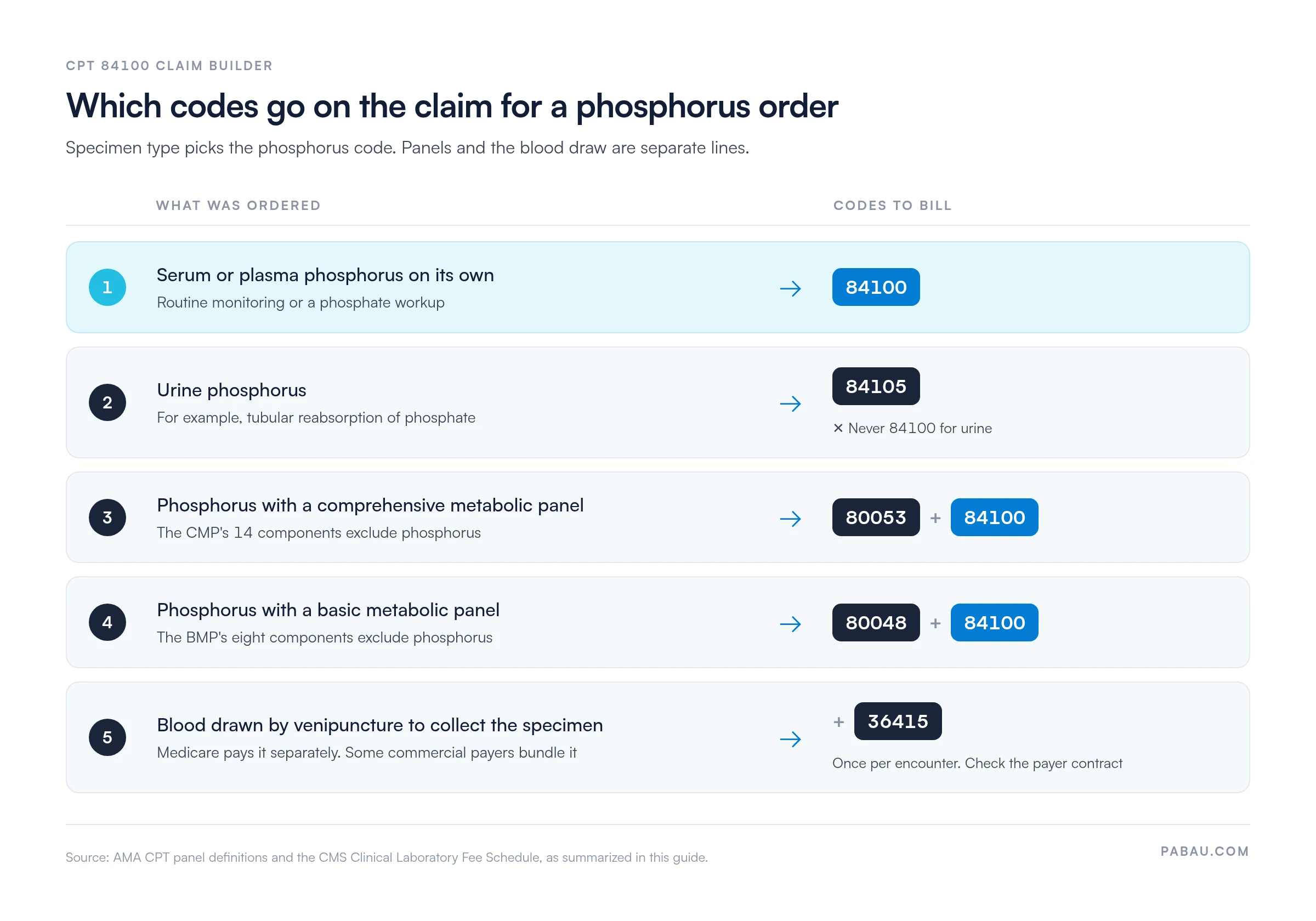
First, the specimen is almost always serum or plasma. However, when a urine phosphorus measurement is needed (for example, to calculate tubular reabsorption of phosphate), the correct code is CPT 84105, not 84100. In fact, using 84100 for a urine specimen is a common coding error that triggers a technical denial.
The Medicare Clinical Laboratory Fee Schedule (CLFS) sets the payment rate for CPT 84100. CMS publishes national CLFS rates in its annual CLFS files, and the rates change each January. So update your fee schedule when the new file posts. In addition, the 2026 national Medicare rate for 84100 sits in the low-single-dollar range typical for routine chemistry codes.
Private payers generally benchmark against the CLFS, but the rate each one pays depends on its contract. For example, some capitated plans bundle lab chemistry reimbursement into a global facility fee and do not reimburse 84100 separately. Therefore, check your payer contracts before assuming the CLFS rate applies.
Claims for 84100 go to Medicare online. In Pabau, the practice management and billing platform we build, they route through Claim.MD, our clearinghouse partner for US payers. That also adds real-time eligibility checks and electronic remittance processing across the thousands of payers Claim.MD reaches.
Every CPT 84100 claim must link to a diagnosis code that justifies the test. The codes below are common supporting diagnoses, with descriptors as listed in the CDC/NCHS ICD-10-CM tool. Payer policies vary by MAC, so confirm them against the active Local Coverage Determinations (LCDs) for your jurisdiction.
In fact, specificity matters. For example, coding E83.30 (unspecified) when the chart clearly documents hypophosphatemia (E83.39 or a more specific code) creates an audit flag. Thus, the ICD-10-CM code must reflect the documented clinical picture, not a generic fallback.
CPT 84100 is not part of the comprehensive metabolic panel. The CMP, CPT 80053, has 14 components. They are albumin, total bilirubin, calcium, carbon dioxide, chloride, creatinine, glucose, alkaline phosphatase, ALT, AST, potassium, sodium, total protein, and BUN. In short, phosphorus is absent from that list.
The basic metabolic panel, CPT 80048, also excludes phosphorus. Its components are calcium, carbon dioxide, chloride, creatinine, glucose, potassium, sodium, and BUN. As a result, a coder who bills 80048 and drops 84100 on the assumption that it is bundled gives up the payment for the phosphorus test.
Medicare pays the specimen collection fee, CPT 36415, separately on the CLFS when the draw is done to collect the specimen. It is paid once per encounter, however many tests the sample covers. In contrast, some commercial payers bundle venipuncture into the lab fee instead, so verify each payer’s policy before billing 36415 alongside 84100.
Three related codes cause the most confusion alongside CPT 84100. Therefore, knowing when each applies prevents incorrect-code denials.
CPT 84100 and CPT 84105 are never interchangeable, because the specimen type alone determines which code applies. However, if a provider orders both serum and urine phosphorus on the same date, you may bill both codes. In addition, each test needs its own documented specimen and clinical indication. The chart below maps each common order to the codes that belong on the claim.
A clean claim for CPT 84100 requires five documentation elements. However, if any one is missing, a payer reviewing the claim has grounds to deny it for medical necessity. Support medical billing compliance by confirming each element is present before you submit.
Incomplete lab documentation usually starts at the requisition. As a result, the ordering clinician captures the indication when the order form requires a diagnosis before it can be completed. Linking diagnosis to procedure at order entry, rather than at billing, is what submitting a clean claim depends on.
Denial rates for routine chemistry codes are low when documentation is tight, but CPT 84100 has a few common failure points. Therefore, effective denial management workflows address each one before submission rather than at appeal. The table below lists the top denial categories and a prevention action for each.
Frequency denials are harder to prevent at order entry, because the limit sits in the payer’s policy rather than in the chart. So when a patient needs more checks than the policy allows, document the clinical change behind each extra test. In addition, knowing how common denial codes map to specific root causes helps billers decide which workflows to fix first.
Run a monthly audit on CPT 84100 claims flagged as denied. Filter by denial reason code and map each to a root cause: missing ICD-10 linkage, wrong specimen code, frequency limit, or missing documentation. Fix the highest-volume root cause first, then check the next month’s claims to confirm it worked.
Many 84100 denials trace back to problems that exist before the claim is built, such as a missing indication or the wrong specimen code. In fact, the claim can only be as accurate as the codes documented on the patient record. Therefore, the fix is making sure those documented codes reach the payer intact.
Pabau pulls the diagnosis and procedure data already on the patient record into pre-filled insurance claims. Then it handles the steps that usually happen in a separate clearinghouse portal:
As a result, your billing team works from the codes the clinician documented and spends less time rebuilding claims by hand.

Pabau pulls the codes on the patient record into a pre-filled claim, submits it via Claim.MD, and tracks status and remittances. See how it handles lab codes like 84100.

CPT code 84100 is a straightforward chemistry code with one recurring misconception: that phosphorus is already inside the CMP. When phosphorus is ordered alongside a CMP (80053), it is billed separately under 84100 because the CMP does not include it.
Check the specimen type first, since it decides between 84100 and 84105 before any other rule applies. Frequency limits are the one denial the chart alone cannot prevent, so read your MAC’s LCD before scheduling repeat draws.
Pabau carries the codes on the patient record into a pre-filled claim and submits it via Claim.MD. It also runs real-time eligibility checks and tracks status and ERA remittances. Book a demo to see how Pabau keeps lab claims like 84100 moving from order to payment.

Need to understand how claims move through the clearinghouse? Medical claims clearinghouse guide explains how payer routing, eligibility verification, and ERA processing work end to end.
Getting denials without knowing why? Electronic remittance advice explained covers how to read ERA files and map CARC denial codes to billing root causes.
Want to confirm coverage before the draw? Insurance eligibility verification walks through the checks that stop a lapsed policy from becoming a denial.
Enrolling a new provider with payers? Credentialing with insurance companies walks through the enrollment process and how it connects to claim acceptance.
CPT code 84100 covers quantitative measurement of inorganic phosphorus (phosphate) in serum or plasma. Urine phosphorus is billed with CPT 84105 instead. The test is not a component of the comprehensive metabolic panel (80053) or the basic metabolic panel (80048). Any separately ordered phosphorus test on a serum or plasma specimen should be billed under 84100.
The Medicare allowable for 84100 is set annually by the Clinical Laboratory Fee Schedule (CLFS) and published at CMS.gov. Rates are national CLFS amounts, updated annually. Check the current CLFS file at CMS.gov for the exact 2026 figure. A static rate published here would go stale once CMS updates the schedule.
It depends on the payer. Medicare pays 36415 separately as a specimen-collection fee. Some commercial payers bundle it, so verify the payer contract before adding 36415.
The most common reason is missing or unsupported medical necessity, meaning no ICD-10 code or one that does not match the documented indication. Other causes are billing 84100 for a urine specimen, which requires 84105, and exceeding payer frequency limits for routine monitoring. Unbundling denials, where 84100 is wrongly treated as a duplicate of a panel component, are less common but also occur.



