HCPCS code V2786: Occupational multifocal lens billing guide
HCPCS code V2786 is a per-lens add-on for occupational multifocals HCPCS code V2...

Last Updated: Nov 6, 2026
Billable Code
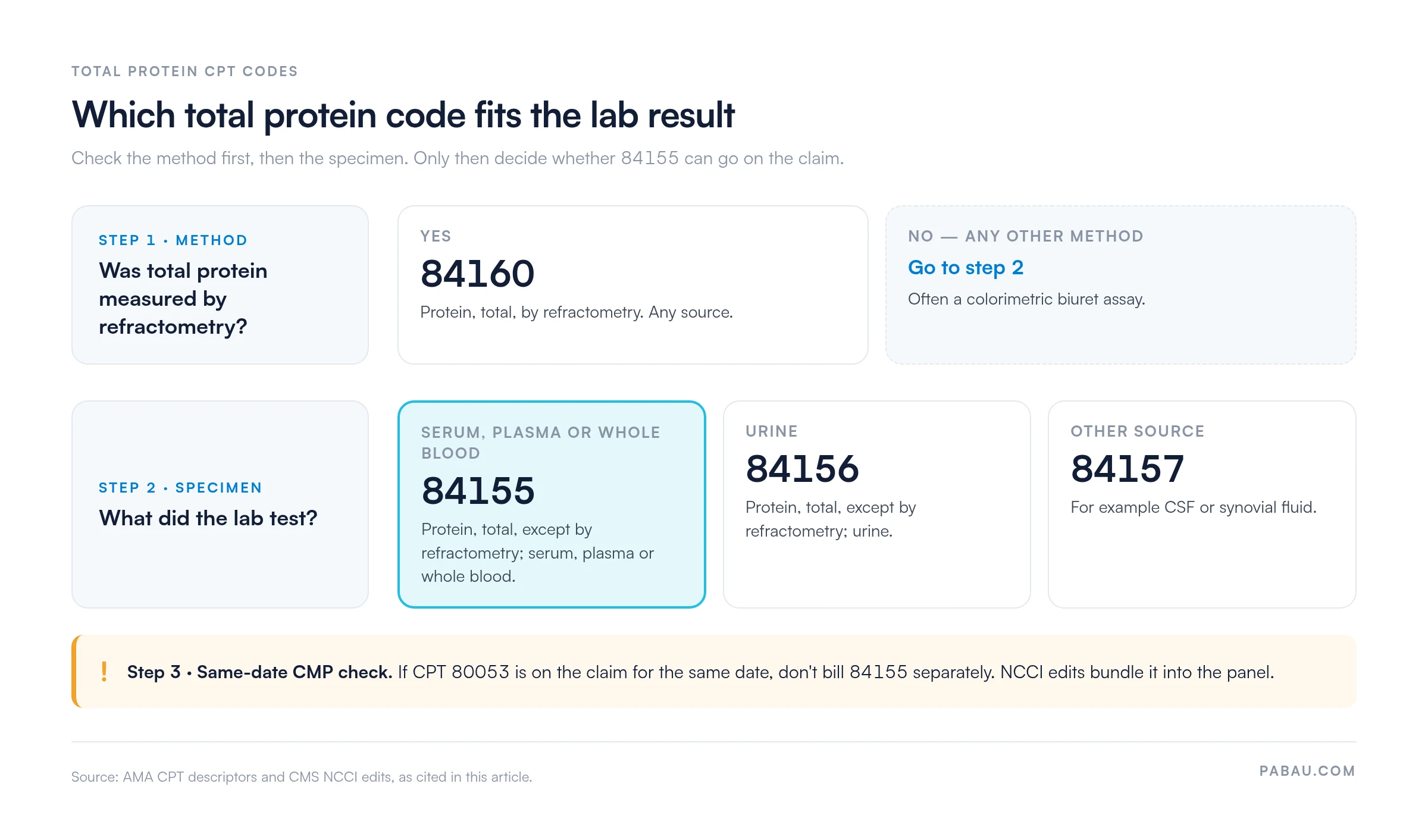
84155 is the CPT code for total protein measured in serum, plasma or whole blood by any method other than refractometry. It is a component of the Comprehensive Metabolic Panel (CPT 80053). Billing both on the same date triggers a National Correct Coding Initiative (NCCI) denial.
Coders most often confuse it with 84160 (refractometry, any source), 84156 (urine) or 84157 (other sources such as CSF or synovial fluid). That mix-up is a frequent source of incorrect claims in the chemistry section.
Let Pabau's smart automation suggest the right codes, reduce claim denials, and keep your practice compliant—effortlessly.
Automate repetitive tasks and focus on what matters most—your patients.
Reduce coding errors and ensure compliance with the latest regulations.
Clean claims, fewer denials, and faster reimbursements.
Powerful insights and reporting to help your practice thrive.
HIPAA compliant SOC 2 certified GDPR-compliant Trusted by 4,000+ clinics worldwide

CPT code 84155 covers total protein in serum, plasma or whole blood measured by any method other than refractometry. Urine is 84156, other sources are 84157, and refractometry is 84160.
84155 is a component of the CMP (CPT 80053), so NCCI edits block billing it separately on the same date without a distinct clinical justification.
The most common denial trigger is bundling with 80053: Document why standalone testing is medically necessary before submitting the claim.
Pabau, the practice management platform we build, turns invoices into electronic CMS-1500 claims through Claim.MD, with eligibility checks, claim-status tracking and ERA remittances.
CPT code 84155 is defined by the American Medical Association with the official descriptor: Protein, total, except by refractometry; serum, plasma or whole blood. The code sits in the Pathology and Laboratory section (80047-89398), within the Chemistry subsection (82009-84999). It is not tied to one method. Any method other than refractometry qualifies, and most labs use a colorimetric biuret assay. In that assay, peptide bonds react with copper sulfate under alkaline conditions to produce a color proportional to total protein concentration.
Three specimen types are valid under 84155: Serum (most common), plasma, and whole blood. Urine total protein is CPT 84156, and other sources such as CSF or synovial fluid fall under CPT 84157. Refractometry-based measurement is CPT 84160, whatever the specimen. Ordering the wrong code for the specimen or method is the most direct route to a claim edit.
CPT 84155 measures the combined concentration of albumin and globulins in serum or plasma, expressed as grams per deciliter. Providers order it when they need a rapid screen for protein deficiency, protein excess, or an albumin-to-globulin (A:G) ratio before ordering more specific fractionation tests.
The most common clinical indications include:
CPT code 84155 carries a low Medicare reimbursement rate. The Centers for Medicare and Medicaid Services (CMS) publishes the Clinical Laboratory Fee Schedule (CLFS) annually. At the national rate, 84155 typically reimburses under $5.00. The exact figure changes by calendar year, so verify the current national limit in the CMS Clinical Laboratory Fee Schedule files before estimating revenue impact. Do not hard-code a dollar amount into your billing policies without citing the publication year.
Place-of-service (POS) assignment affects billing ownership, not the CLFS rate for this code. Say a physician office (POS 11) orders the test and sends the specimen to an independent lab (POS 81). The lab then bills 84155 directly to Medicare. The ordering physician does not bill the lab work separately. Billing both the office visit and 84155 under the physician’s NPI when the test runs at a reference lab is a compliance error.
Commercial payer rates for 84155 vary widely and often track a percentage of the Medicare CLFS rate. Some payers reimburse at 80-120% of Medicare; others use proprietary fee schedules. Check each payer contract. Medicaid rates differ by state and may be lower than Medicare.
Medical necessity for CPT code 84155 requires a supporting ICD-10-CM diagnosis. Payers apply Local Coverage Determinations (LCDs) issued by Medicare Administrative Contractors (MACs); the specific codes covered vary by MAC jurisdiction. The diagnoses below are commonly accepted, but always verify against the applicable MAC LCD before submitting.
Use the most specific code available. Unspecified codes such as E46 are widely accepted, but a more specific diagnosis is safer when the encounter note supports one. Payers may deny 84155 when a vague symptom code is submitted without supporting documentation that explains why the protein level is relevant to that condition. Check the CDC/NCHS ICD-10-CM tool to confirm the current-year validity of any code before submission.
Accurate billing for CPT code 84155 starts with the ordering provider’s documentation. The record must show: The clinical indication, the test ordered, and the treating provider’s NPI. A verbal order alone is insufficient for most MAC audits.
Key documentation elements for superbill documentation and claim preparation:
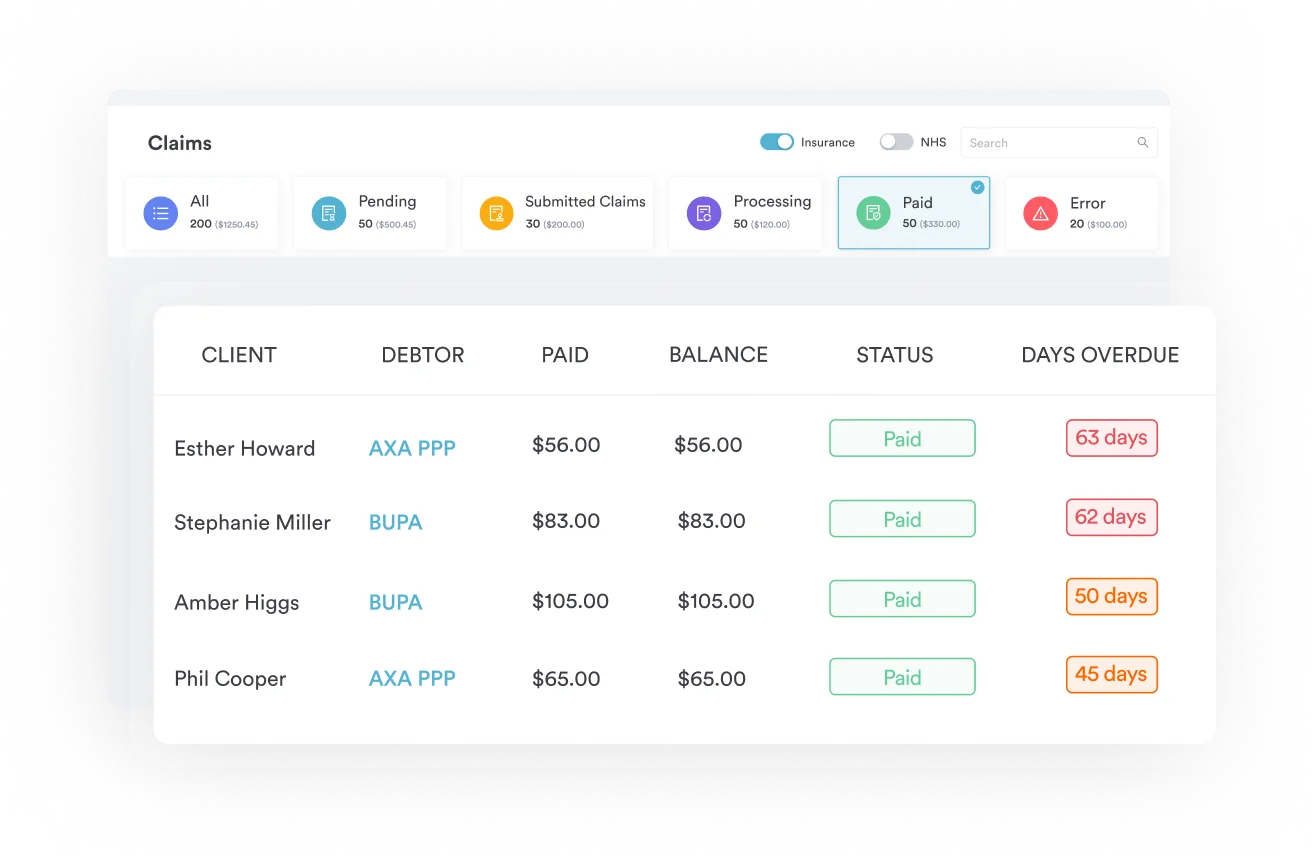
Claims management software with eligibility checks and claim-status tracking shows a rejected lab claim as soon as the payer responds. A missing NPI or a mismatched diagnosis then gets corrected quickly. Submitting a clean claim on the first pass avoids the 3-5 day resubmission cycle that erodes practice revenue on low-value chemistry codes.
Run a monthly audit of 84155 claims billed with a generic symptom ICD-10 code such as R63.4 or R60.0. Check whether each encounter note documents a clear clinical reason for the standalone protein order. Payers increasingly use pre-payment claim editing to reject symptom-only codes on chemistry tests when no prior panel result is on file.
CPT code 84155 is a component of the Comprehensive Metabolic Panel (CPT 80053). NCCI edits prohibit billing 84155 separately on the same date that 80053 is billed for the same patient. The CMS logic is straightforward: If the physician ordered and received the full CMP, the total protein result is already captured under 80053. Billing 84155 on top of it is unbundling.
There are two scenarios where standalone 84155 billing is appropriate alongside a CMP order:
Albumin (CPT 82040) is frequently ordered alongside 84155 for differential interpretation. NCCI edits do not bundle 82040 with 84155 by default because they measure different analytes. Both can be billed on the same date when each has a supporting diagnosis and the orders are documented separately. Reviewing your MAC’s billing policies before filing two chemistry codes on one date reduces audit exposure.
CPT code 84155 measures total protein in serum, plasma or whole blood by any method other than refractometry. CPT 84156 and 84157 cover urine and other sources, and CPT 84160 covers refractometry on any specimen. Selecting the wrong code is upcoding or downcoding, both of which carry compliance risk.
The practical decision rule: Check the lab report, method first and specimen second. If the method was refractometry, use 84160 for any specimen. Otherwise, serum, plasma or whole blood takes 84155, urine takes 84156, and other sources such as CSF take 84157. Never select the code before confirming the specimen type and method from the lab result. The AAPC Codify CPT lookup displays the full descriptor for each code to confirm you have the right one before billing.
CPT 84155 triggers a reflex to serum protein electrophoresis (SPEP, CPT 84165) when total protein falls outside the expected range. The clinical picture must also raise concern for monoclonal gammopathy, myeloma, or significant hypergammaglobulinemia. Reflex claims are a frequent audit trigger, because the added test needs its own authorization and its own diagnosis. If SPEP then shows a monoclonal band, the serum immunofixation that types it is billed separately as CPT 86334.
Reflex testing means the lab automatically adds SPEP when 84155 meets a predefined threshold, without a new physician order for each case. Billing reflex testing correctly requires attention to three elements:
Labs that autoreflect without documenting the standing order protocol are routinely flagged in MAC audits. Build the reflex threshold and authorization into the lab’s standard operating procedure and maintain a copy in the ordering provider’s chart.
CPT code 84155 pays little, so working a single denial can cost more than the claim is worth. Effective denial management workflows start with knowing the triggers before submission.
Two modifiers apply to 84155 claims in specific circumstances. Using the wrong one, or omitting one when required, causes a claim edit or denial that may not be immediately obvious from the remittance advice.
Tracking which claims carry modifier 91 over time helps identify patterns of repeat testing that may draw payer scrutiny. Reviewing common denial codes from your remittance advice regularly surfaces modifier-related edits before they accumulate.
When lab claims are keyed in by hand, one missing field is enough for a CARC 16 rejection. On a code that pays under $5.00, working that rejection can cost more than the claim is worth.
In Pabau’s billing software, invoices become electronic CMS-1500 claims sent through our Claim.MD integration. Eligibility checks confirm the patient’s coverage before you submit, so a coverage problem surfaces early.
Claim-status tracking shows where each claim sits, and ERA remittances bring the payer’s reason codes back to your team. A bundling or NPI denial is visible as soon as it lands, rather than at month end.

Pabau turns invoices into electronic CMS-1500 claims through Claim.MD, with eligibility checks, claim-status tracking and ERA remittances in one place. Rejected 84155 lines surface quickly, so your team can correct and resubmit them.

The specimen and the method decide the code, and a same-day CMP decides whether you can bill it at all. Confirm both on the lab report before 84155 goes on the claim.
With a payment this low, a denied 84155 rarely justifies the rework. Prevention is the cheaper path. Put the ordering NPI in Box 17 on every lab claim, and pair a diagnosis that matches the documented reason for the test.
To see how Pabau tracks each lab claim from submission to remittance, book a demo with the team.

Need to understand how clearinghouse submission works for lab codes? Claim.MD clearinghouse guide explains how electronic claims reach payers and what happens during validation.
Want a reference on reading remittance advice for denial codes? Electronic remittance advice (ERA) explained covers CARC and RARC codes you will see on 84155 denials.
Billing multiple chemistry codes on the same claim? Revenue cycle management overview covers how claim edits affect chemistry panel billing from order to payment posting.
Filing two chemistry codes on one date? Medical billing compliance covers the policies and audits that shape how practices file lab claims.
Billing albumin alongside total protein? CPT code 82040 covers the albumin descriptor, its ICD-10 pairings and its billing rules.
CPT code 84155 covers total protein measurement in serum, plasma, or whole blood by any method other than refractometry, often a colorimetric biuret assay. It does not cover urine protein (84156), other sources such as CSF (84157), or refractometry (84160). The code is a component of the Comprehensive Metabolic Panel (CPT 80053).
The Medicare Clinical Laboratory Fee Schedule (CLFS) rate for CPT 84155 is typically under $5.00 nationally. The exact figure changes with each annual CLFS update. Verify the current figure in the CMS Clinical Laboratory Fee Schedule files and note the publication year in your billing policies.
No, not on the same date for the same patient. NCCI edits bundle 84155 as a component of 80053; billing both triggers an automatic denial under reason code 97. Standalone 84155 billing is appropriate only when no CMP is ordered on that date. The one other case is a CMP documented as non-covered, with a separate ABN and clinical justification.
CPT 84155 covers total protein in serum, plasma, or whole blood by any method other than refractometry, often a colorimetric biuret assay. CPT 84160 covers total protein measured by refractometry, from any source. The method difference is critical: Select the code that matches the method reported on the lab result, not the specimen type alone.
Commonly accepted ICD-10 codes include E46 (unspecified protein-calorie malnutrition), R63.4 (abnormal weight loss) and K74.60 (unspecified cirrhosis of liver). N04.9 (nephrotic syndrome with unspecified morphologic changes), C90.00 (multiple myeloma) and R60.0 (localized edema) are also commonly accepted. Coverage criteria vary by MAC LCD jurisdiction, so always verify against the applicable local coverage determination before submitting.
Labs add SPEP when total protein rises above a predefined threshold, often 8.5-9.0 g/dL, or when the albumin-to-globulin ratio is reversed. Either finding raises concern for monoclonal gammopathy. Both 84155 and 84165 can be billed on the same date when a standing reflex order is documented. The SPEP claim must carry a diagnosis code that reflects the reflex indication, such as C90.00 or D47.2.