

CCSD code G5100: Bypass of duodenum billing guide
CCSD code G5100 bills a bypass that leaves the duodenum in place CCSD code G5100...

Last Updated: Oct 16, 2026
82803 is the CPT code for gases, blood, any combination of pH, pCO2, pO2, CO2, HCO3 (including calculated O2 saturation). One unit covers a single reported analyte or all six from the same specimen, whether the blood is arterial, venous or capillary.
Denials on 82803 usually trace back to two mistakes. Coders assume the sample must be arterial, when many payer LCDs accept venous or capillary blood. Billers also stack individual analyte codes on top of 82803 without checking NCCI edits first.
Let Pabau's smart automation suggest the right codes, reduce claim denials, and keep your practice compliant—effortlessly.
Automate repetitive tasks and focus on what matters most—your patients.
Reduce coding errors and ensure compliance with the latest regulations.
Clean claims, fewer denials, and faster reimbursements.
Powerful insights and reporting to help your practice thrive.
HIPAA compliant SOC 2 certified GDPR-compliant Trusted by 4,000+ clinics worldwide

CPT Code 82803 bills as one unit for any combination of pH, pCO2, pO2, CO2, HCO3 and calculated O2 saturation.
82803 applies to arterial, venous and capillary specimens. Some payers restrict coverage to arterial samples, so check the relevant MAC LCD before submitting.
NCCI edits bundle 82374 (CO2/bicarbonate) and 82800 (pH) into 82803. Billing either alongside it denies unless modifier 59 is backed by documentation.
Pabau’s claims management software checks each 82803 claim before it’s sent, and its Claim.MD integration verifies eligibility before the specimen is drawn.
CPT Code 82803 is defined by the American Medical Association as “Gases, blood, any combination of pH, pCO2, pO2, CO2, HCO3 (including calculated O2 saturation).” The phrase “any combination” is deliberate: one unit of 82803 covers a single reported analyte or all six measured from the same specimen draw.
The six analytes in scope are listed below. All six may appear on the same lab report without extra units or separate codes.
Because the code bundles all analyte combinations into a single reimbursable unit, coders must not unbundle by separately reporting CPT 82800 (pH only) alongside 82803. That triggers an NCCI edit and an automatic denial.
Blood gas testing is ordered when a clinician needs real-time assessment of a patient’s acid-base balance, oxygenation, or ventilatory status. Medical necessity documentation must link the test to a clinical indication that a payer’s Local Coverage Determination (LCD) recognizes.
Common clinical scenarios and their associated ICD-10-CM codes are shown below.
MAC LCDs define the covered indications for blood gas testing in each jurisdiction. Verify the applicable LCD before submitting claims in a new payer market, as covered indications vary by contractor. For a COPD exacerbation, report J44.1 on the claim and point the 82803 line to it, so the payer sees the covered indication.
CPT Code 82803 applies regardless of whether the specimen is arterial, venous, or capillary blood. The code describes the analytes measured, and the collection site plays no part in code selection.
That said, payer policy can narrow this. Several MAC LCDs restrict reimbursement to arterial specimens for specific indications. When venous blood gas (VBG) or capillary samples are collected instead, document the clinical reason in the order and the medical record. Common acceptable rationales include:
Payers that limit 82803 to arterial specimens deny a VBG claim as “not medically necessary for the indication billed.” They don’t treat it as a coding error. Appeal it with the documented clinical reason for venous collection, because no modifier overturns that denial.
When your practice draws a capillary sample itself, the finger, heel or ear stick has its own code, 36416. Medicare bundles it into the related service, so it supports the record without paying separately.
Before ordering a venous or capillary blood gas, check the relevant MAC LCD for your jurisdiction. Pull the LCD’s covered indication list and confirm the specimen-source language. A quick check at the point of ordering prevents a denial that takes far longer to appeal.
Four CPT codes cover blood gas analysis. Picking the wrong one invites audits and take-backs.
The key distinction between 82803 and 82805 is measured versus calculated O2 saturation. CPT Code 82803 includes calculated O2 saturation derived mathematically from pH and pO2. CPT 82805 requires an analyzer that measures O2 saturation directly, usually a CO-oximeter. If the instrument only derives saturation, bill 82803.
The decision tree below runs the same check as two questions about what the analyzer reported.
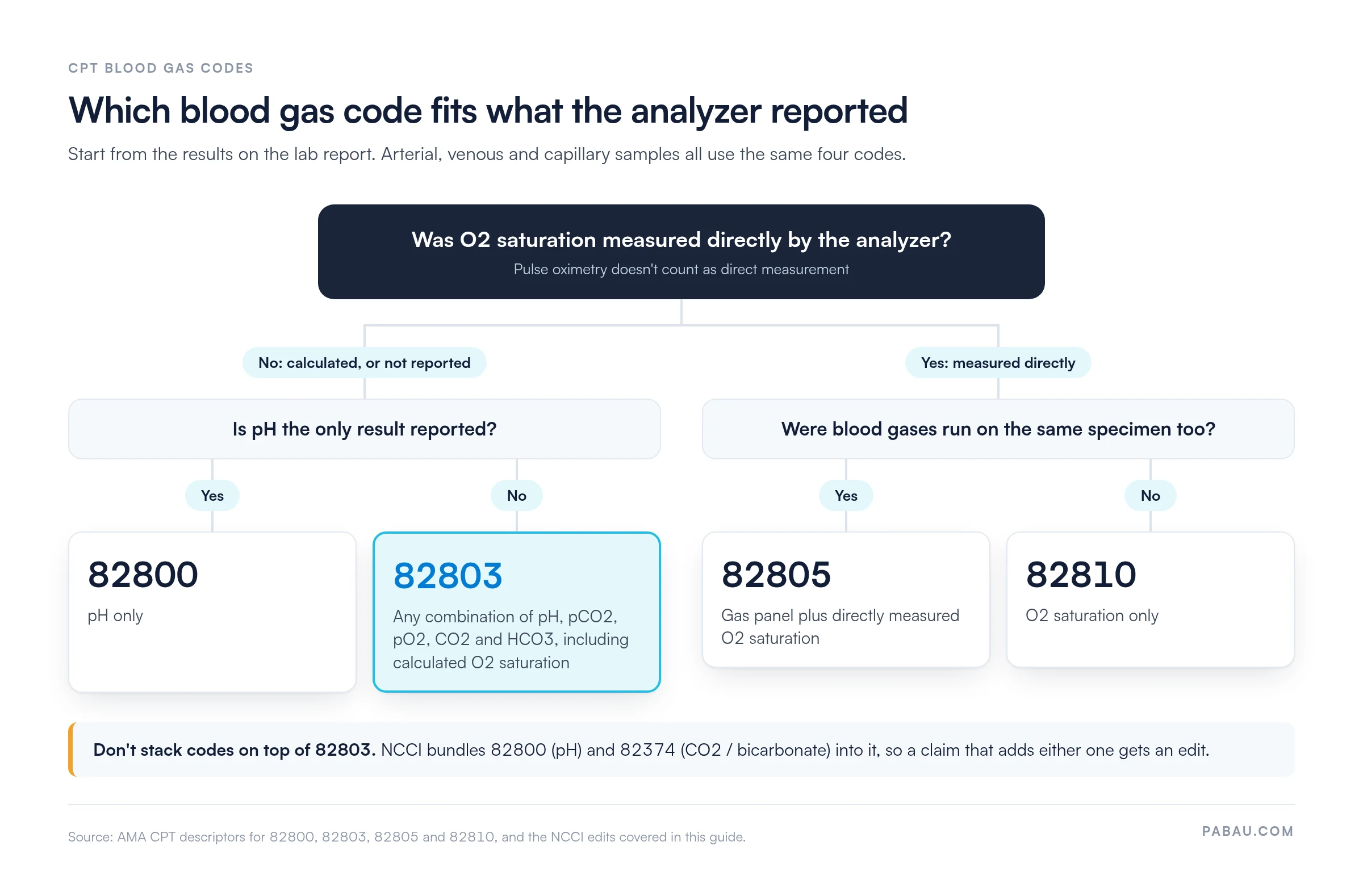
The National Correct Coding Initiative (NCCI) bundles individual analyte codes that overlap with the 82803 descriptor into CPT Code 82803. Billing them together triggers an automatic edit, and the payer denies the component code.
The two codes this edit catches most often are:
Modifier 59 (distinct procedural service) may override some NCCI edits when testing was genuinely separate in time or clinical context. It only holds up when the medical record documents a distinct clinical reason for the separately billed code.
Modifier 91 (repeat clinical diagnostic laboratory test) applies when the same blood gas panel is ordered multiple times on the same day for monitoring purposes. Serial blood gases during mechanical ventilation are the most common scenario. Each additional panel on the same date requires modifier 91 appended to 82803.
NCCI edit tables are updated every quarter. Check the current version before you reuse last year’s modifier strategy.
Payers expect the medical record to hold all six of the elements below before they pay a CPT Code 82803 claim.
Point-of-care (POC) blood gas analyzers add a layer of complexity. POC testing at the bedside still requires CLIA certification or a CLIA waiver under 42 CFR Part 493. The documentation requirements match reference laboratory testing, but the billing entity differs. Record the POC collection event in the clinical note as well as on the instrument printout.
The goal of complete documentation is submitting a clean claim on the first pass. A missing specimen source field or an absent ordering physician NPI will trigger an edit and hold up payment.
Medicare reimburses CPT Code 82803 through the Clinical Laboratory Fee Schedule (CLFS), not the Physician Fee Schedule. CMS sets a national limitation amount (NLA) annually, and individual Medicare Administrative Contractors (MACs) may pay at or below the NLA depending on their jurisdiction.
For the current figure, use the CMS Physician Fee Schedule and CLFS lookup tool. The FastRVU 2026 reimbursement lookup also works, with your MAC’s geographic practice cost index applied.
The CPT code itself does not change based on where the test is performed. CPT Code 82803 applies in both a CLIA-waived POC setting and a reference laboratory. What changes is the billing entity and the applicable fee schedule component.
A common error on lab claims is a physician office billing 82803 under a reference lab’s CLIA number. The performing entity must match the CLIA certificate used on the claim.
Blood gas claims deny for predictable reasons, and each pattern below has a set fix. Every denial arrives with a reason code on the remittance, and our guide to reading denial codes explains what each one means.
If the same denial keeps coming back, set up denial management workflows that sort denials by reason code. Feed each fix into your pre-submission checks. Running eligibility verification before testing stops another share of denials before they reach the payer.
Build a four-field pre-submission checklist for 82803 claims. Confirm the ICD-10-CM code is on the MAC LCD covered list, and that the documented specimen source matches payer policy. Then check modifier 91 is on every same-day repeat panel, and that the CLIA number matches the performing entity. A four-point check at submission heads off four of the six denial patterns in the table above.
Blood gas denials usually trace back to a field nobody checked before submission. A missing NPI, a lapsed policy or a repeat panel without modifier 91 each cost a resubmission and weeks of waiting.
Pabau’s claims software that catches errors runs validation checks every time you send a claim. The Send button stays disabled until required details are filled in, so a missing NPI or diagnosis code gets fixed before a payer sees it.
Claims go out through Claim.MD, Pabau’s US clearinghouse partner, which reaches thousands of US payers. Run a real-time eligibility check before the specimen is drawn, so you don’t collect a blood gas from a patient whose coverage has lapsed. Claim statuses and remittances flow back into billing, so your team works denials from one screen.


Pabau checks each claim before it’s sent and verifies patient eligibility in real time through Claim.MD. Claim statuses and remittances come back into billing, so no denied 82803 goes unnoticed.

The code itself is simple. The denials come from what surrounds it: extra analyte codes, missing modifiers and specimen-source rules. Bill one unit per specimen, keep 82800 and 82374 off the claim, and add modifier 91 only to same-day repeats.
The trade-off sits with specimen source. Venous and capillary samples spare the patient an arterial puncture, but they need a documented reason wherever the LCD expects arterial blood. Build that check into ordering, and the specimen-source denial never reaches the appeal stage.
Pabau brings electronic remittance advice back through Claim.MD, so a denied 82803 shows up in billing with its reason code attached. Book a demo to see how Pabau checks and tracks lab claims from submission to payment.

Want to understand how claims move from submission to payment? Medical claims clearinghouse explains how electronic claims are validated, scrubbed, and routed before reaching payers.
CPT Code 82803 covers blood gases in any combination of pH, pCO2, pO2, CO2, HCO3, and calculated O2 saturation measured from a single specimen. One unit of 82803 is billed whether one analyte or all six are reported.
CPT 82800 covers pH measurement only, as a standalone single-analyte test. CPT Code 82803 covers any combination of blood gas analytes. If the lab also measured pCO2 or pO2 alongside pH, 82803 is the correct code. Billing 82800 and 82803 together triggers an NCCI bundling edit.
Yes, CPT Code 82803 is not specimen-source-specific by AMA definition and applies to arterial, venous, and capillary blood. However, some MAC LCDs restrict reimbursement to arterial specimens for specific indications. Always verify the applicable LCD before ordering and document the clinical rationale when venous or capillary collection is used.
Modifier 91 applies when the same blood gas panel is repeated on the same date for monitoring, such as serial gases during mechanical ventilation. Modifier 59 may override certain NCCI bundling edits when a separately billed analyte code is a genuinely distinct service. The medical record must document that clinical distinction.
The most common reason is an ICD-10-CM code that isn’t on the MAC LCD’s covered indication list. NCCI bundling edits follow when 82374 or 82800 is billed alongside 82803. Same-day repeat panels without modifier 91, a missing ABN and a CLIA number mismatch cause the rest. Each denial type has its own corrective action.
CPT 82803 reports a blood gas panel, with O2 saturation calculated from pH and pO2. CPT 82810 reports O2 saturation alone, measured directly by the analyzer rather than by pulse oximetry. If the gas panel was run and saturation was also measured directly, the correct code is 82805.



