

HCPCS Code L0472: Hyperextension TLSO billing guide
HCPCS code L0472: Official descriptor and device definition HCPCS code L0472 des...

Last Updated: Nov 5, 2026
83020 is the CPT code for hemoglobin fractionation and quantitation; electrophoresis (eg, A2, S, C, and/or F). Labs use it when they separate and measure fractions such as HbA2, HbS, HbC and HbF by electrophoresis. The results help diagnose or monitor sickle cell disease, thalassemia and other hemoglobinopathies.
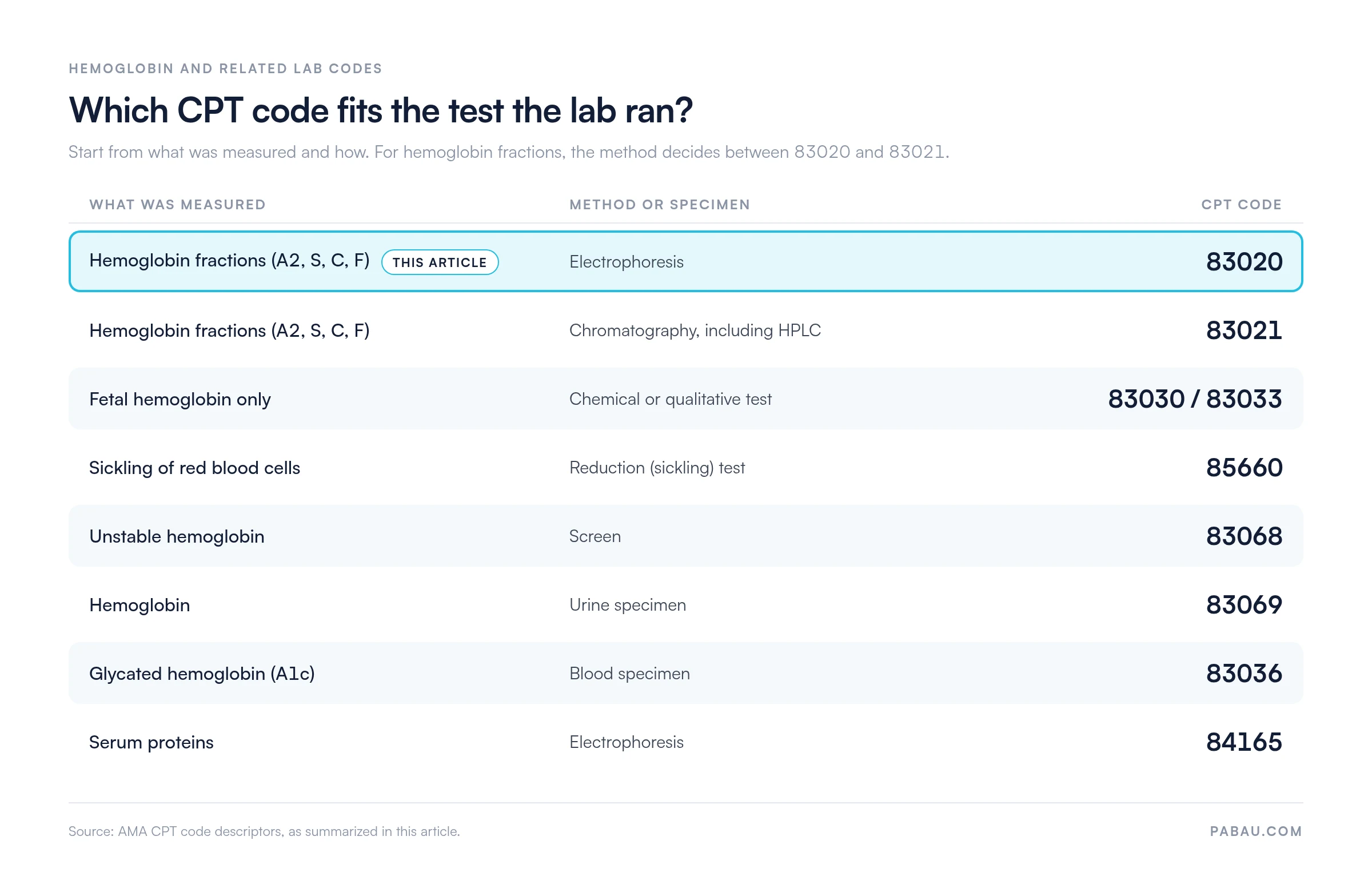
The method decides the code. Electrophoresis is billed as 83020, while chromatography, including HPLC, is billed as 83021. Medicare pays the test under the Clinical Laboratory Fee Schedule, and the claim needs a specific diagnosis such as D57, D56 or D58.
Let Pabau's smart automation suggest the right codes, reduce claim denials, and keep your practice compliant—effortlessly.
Automate repetitive tasks and focus on what matters most—your patients.
Reduce coding errors and ensure compliance with the latest regulations.
Clean claims, fewer denials, and faster reimbursements.
Powerful insights and reporting to help your practice thrive.
HIPAA compliant SOC 2 certified GDPR-compliant Trusted by 4,000+ clinics worldwide

CPT code 83020 reports hemoglobin fractionation and quantitation by electrophoresis, identifying fractions such as HbA, HbA2, HbF, HbS, and HbC.
Chromatography, including HPLC, is billed as CPT 83021, so the method on the lab report decides the code.
Accepted ICD-10 diagnosis codes include D57.x (sickle cell disorders), D56.x (thalassemia), and D58.x (other hereditary hemolytic anemias).
Billing 83020 and 83021 on the same date of service without clinical justification triggers bundling edits and denial.
Pabau, the practice management platform we build, sends electronic CMS-1500 claims through Claim.MD and checks patient eligibility in real time.
CPT code 83020 is the five-digit procedure code for hemoglobin fractionation and quantitation by electrophoresis.
The American Medical Association places it in the Chemistry subsection (82009-84999) of the Pathology and Laboratory section (codes 80047-89398).
The test uses an electric field to separate hemoglobin molecules by charge and size. The resulting pattern identifies and quantitates the major fractions in a patient’s blood sample.
Many labs now run hemoglobin fractionation on high-performance liquid chromatography (HPLC) rather than gel electrophoresis. HPLC is a chromatography method, so labs running HPLC or any other chromatography report CPT 83021. CPT 83020 is for electrophoresis, whether on cellulose acetate, citrate agar, or a capillary system.
The code covers identification and quantitation of the principal hemoglobin fractions in a single test run. What it does not cover is equally important for avoiding over-billing.
Coders sometimes bill 84165 (protein electrophoresis) when they meant 83020, because both tests use electrophoresis. 83020 separates hemoglobin specifically, while 84165 evaluates total serum proteins. Using 84165 for a hemoglobin fractionation study is an incorrect code assignment. It will likely be denied or, in an audit, produce an overpayment finding. Serum immunofixation is a third electrophoresis test with its own code, CPT 86334, so it cannot stand in for 83020 either.
Glycated hemoglobin is the other frequent mix-up. HbA1c has its own code, 83036, and never belongs on a fractionation claim. The chart below maps each hemoglobin-related test to its code by what was measured and how.
Medical necessity for CPT code 83020 must be established before the claim reaches the payer. The ordering provider’s documentation should explicitly connect the test to a qualifying clinical scenario.
Ordering the test for a routine wellness visit without a documented clinical indication is the most reliable path to a CO-50 (not medically necessary) denial. The chart note must state the clinical question the test is meant to answer, not simply list the test ordered.
Document the specific hemoglobinopathy suspicion in the order note, not just the symptom. ‘Microcytic anemia, rule out thalassemia trait’ supports medical necessity far more effectively than ‘anemia workup.’ Payers audit the linkage between diagnosis and test, not just the test code.
The ICD-10-CM codes below are the most commonly accepted diagnoses for establishing medical necessity. Verify current codes against the CDC’s ICD-10-CM tool each fiscal year, as codes update annually on October 1.
D64.9 (anemia, unspecified) is a persistent problem. Coders reach for it when the chart is vague. Payers that see it as the sole supporting diagnosis deny the claim as not medically necessary. If the note documents a suspected hemoglobinopathy, the coder should work with the ordering provider to get a more specific code documented before billing.
CPT 83020 and CPT 83021 describe the same service, hemoglobin fractionation and quantitation, performed by different methods. CPT 83020 is for electrophoresis. CPT 83021 is for chromatography, which includes HPLC. The method named on the lab report decides the code, so the claim has to match the analyzer the lab used.
Billing 83020 and 83021 on the same date without a documented clinical reason for running both methods is a common bundling error in lab billing. When both are genuinely needed, append modifier 59, or the more specific XU for an unusual non-overlapping service. The chart must also explain why both methods were ordered.
Several adjacent codes appear frequently on the same lab requisition as CPT code 83020. Getting the boundaries right prevents both upcoding and missed billing opportunities.
CPT code 83020 is priced under the Medicare Clinical Laboratory Fee Schedule (CLFS), not the Physician Fee Schedule. The CLFS sets one national payment rate per code, based on private-payer data reported under PAMA, with no locality adjustment.
Medicare pays the lower of the submitted charge or that CLFS rate. Check the current rate in the CMS CLFS files, which CMS updates on its published schedule.
The lab performing the test must hold an active CLIA certificate at the high-complexity level. An expired certificate, or a lab without the right certification category, gets the claim denied however good the documentation is. Submitting superbill data with the correct CLIA number on the claim form is a basic check that prevents this denial.
Payers beyond Medicare each handle coverage differently. Supporting your revenue cycle management team with current LCD and NCD summaries is the most reliable way to avoid payer-specific surprises.
When medical necessity for a Medicare beneficiary is uncertain, an Advance Beneficiary Notice (ABN) must be issued before the test is performed. Without a valid ABN, the lab absorbs the cost if the claim is denied on medical necessity grounds.
A clean 83020 claim requires specific documentation elements. Missing any one of them gives payers a straightforward reason to deny without reviewing the clinical record.
Modifier 91 applies when the same test is performed more than once on the same day for a clinical reason (such as monitoring during treatment). It does not apply to resubmitting a denied claim or correcting a billing error.
Using modifier 91 incorrectly is a common audit trigger. For structured guidance on managing these patterns, see denial management workflows and the reference on denial codes in medical billing.
Reviewing your 83020 denials by ICD-10 code each quarter shows which diagnosis pairings fail most often. Read them alongside your clean claim rate to see whether the problem starts at documentation or at coding.
Run a quarterly audit of 83020 claims denied for CO-50. Group them by the ICD-10 code billed. If D64.9 or D58.2 appears more than twice, the problem starts upstream. Ordering providers need guidance on documenting a specific hemoglobinopathy suspicion, not just the resulting anemia.
Without a claims system, a lab biller checks coverage by phone, keys each CMS-1500 by hand and hears about a rejection weeks later. Every manual step is another chance for a missing CLIA number or a lapsed policy to reach the payer.
In Pabau’s claims management software, the invoice becomes an electronic CMS-1500 claim, sent through Claim.MD to thousands of US payers. Real-time 270/271 eligibility checks confirm coverage before the visit. Claim validation scrubs each claim for missing or invalid details before it leaves Pabau.
Your team then follows each claim through submission, acceptance, payment or denial. A rejected claim is flagged for action, with a link to the field that needs fixing. Electronic remittance advice comes back into Pabau and settles against the claims it pays.
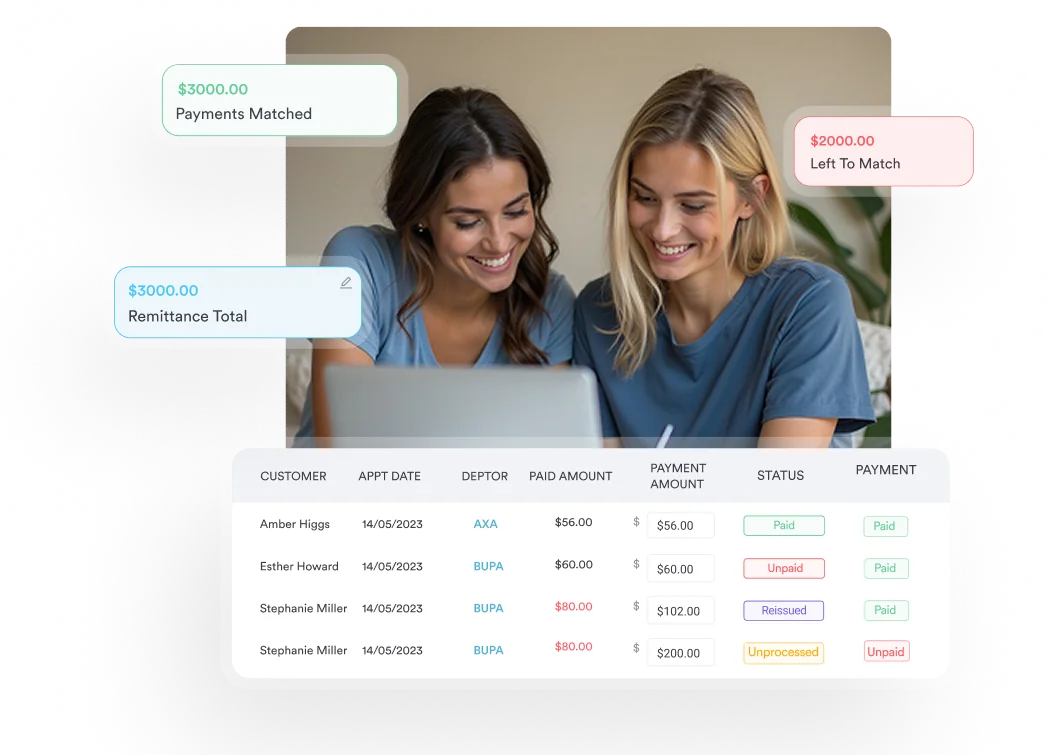
The result is fewer claims bouncing back for missing details, and a clear view of which hemoglobin test claims still need work.

Pabau sends electronic CMS-1500 claims through Claim.MD to thousands of US payers, checks eligibility in real time and tracks every claim to payment.

Let the method on the lab report choose the code first. Electrophoresis goes on 83020, chromatography on 83021, and a claim carrying both needs a documented reason for each.
After that, put your effort into the order note. A specific hemoglobinopathy suspicion, coded to D57, D56 or D58, protects the claim far better than an appeal written after a CO-50 denial.
Pabau sends your lab claims electronically, checks eligibility before the visit and flags rejected claims for a quick fix. Book a demo to see how Pabau keeps hemoglobin test claims moving from order to payment.

Need a clearinghouse for lab claims? What is a medical claims clearinghouse explains how clearinghouses validate and route lab claims to the right payer.
Seeing recurring CO-50 denials across lab codes? Revenue cycle management fundamentals covers the full workflow from order to payment posting.
Want to understand the ICD-10-CM codes behind these claims? Medical billing overview explains how diagnosis codes connect to procedure codes throughout the billing cycle.
CPT code 83020 is the billing code for hemoglobin fractionation and quantitation by electrophoresis. Labs use it to identify and measure hemoglobin fractions such as HbA, HbA2, HbF, HbS, and HbC in a blood sample.
CPT 83020 reports hemoglobin fractionation and quantitation by electrophoresis, while CPT 83021 reports the same analysis by chromatography, including HPLC. Billing both on the same date without documented clinical justification triggers NCCI bundling edits and CO-97 denials.
The strongest-supporting codes are D57.x (sickle cell disease and trait), D56.x (thalassemia), and D58.2 (other hemoglobinopathies). D64.9 (anemia, unspecified) alone is high-risk for a CO-50 denial because it lacks specificity for a hemoglobinopathy workup.
Yes, when 83020 and 83021 are both billed on the same date and the chart supports both tests. Append modifier 59, or XU for a service that does not overlap in clinical purpose. Without the modifier and supporting documentation, the second code is denied as bundled.
Confirmatory hemoglobin electrophoresis after an abnormal newborn screen is a recognized clinical indication supported by ACMG guidelines. Coverage depends on the state Medicaid program’s newborn screening policies and the commercial plan in effect. A screening ICD-10 code alone may not be enough without a documented abnormal screen result triggering the confirmatory test.
CPT 83020 is paid at one national rate under the Medicare Clinical Laboratory Fee Schedule, with no locality adjustment. CMS updates CLFS rates on its published schedule, so check the current CLFS file on cms.gov before quoting a figure.



